Imagine walking into your home and being greeted by a fresh, beautiful fragrance—without constantly spraying air freshener or buying expensive scented products.
A simple homemade fragrance trick is attracting attention on social media, and the idea is surprisingly easy: combine a scented liquid with a few decorative sticks in a small glass bottle to create your own reed diffuser.
The viral images show a blue liquid being poured into a clear container, followed by several wooden reeds arranged like a miniature bouquet. The finished result looks elegant enough to display on a coffee table, bathroom shelf, or entryway console.
But does this homemade fragrance trick really work? What are the two ingredients? And can you safely use laundry products to make your home smell wonderful?
Let’s explore how reed diffusers work, the safest ways to make one, and the mistakes to avoid.
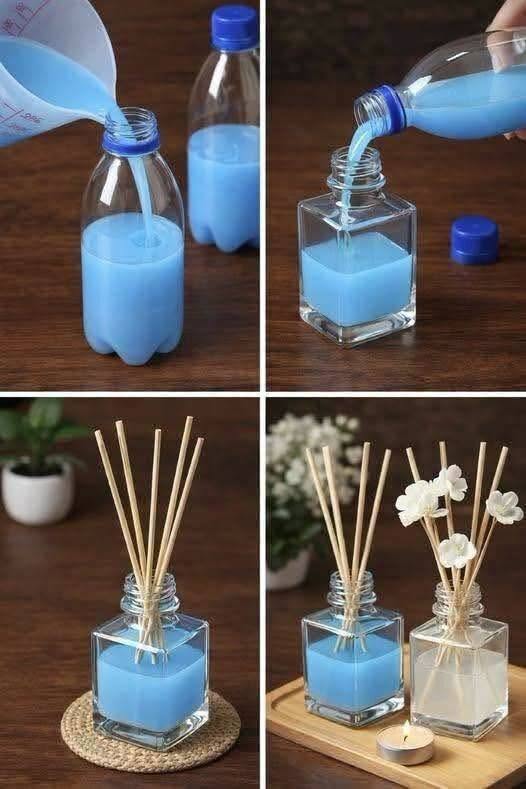
Why This Homemade Air Freshener Trick Is Going Viral
There is something appealing about a home that always smells clean and welcoming.
Whether you’re expecting visitors, relaxing after work, or simply enjoying a quiet afternoon, a pleasant scent can make your living space feel more comfortable.
Unfortunately, commercial home fragrances can be expensive, especially if you use them regularly.
That’s why DIY fragrance ideas have become so popular.
The viral method promises several benefits:
- Only a few ingredients are needed.
- The finished diffuser looks decorative.
- No electricity is required.
- You don’t need to spray fragrance repeatedly.
- The scent may be released gradually over time.
- You can customize the fragrance to your preferences.
However, not every homemade mixture is suitable for a reed diffuser.
The type of liquid you use makes a significant difference.
What Is a Reed Diffuser?
A reed diffuser is a passive home-fragrance product that uses narrow sticks to carry scented liquid from a container into the surrounding air.
Unlike an electric diffuser, it does not require a power outlet.
Unlike a candle, it does not use a flame.
And unlike a spray, it does not need to be activated every time you want fragrance.
The basic components are simple:
A fragrance liquid: A solution specifically formulated to release scent gradually.
Diffuser reeds: Porous sticks that absorb the liquid and help it evaporate.
The reeds draw liquid upward through tiny channels.
As the fragrance evaporates from the exposed surfaces, scent enters the surrounding air.
This process is commonly called capillary action.
The 2-Ingredient DIY Reed Diffuser Recipe
For a straightforward homemade version, you need just two main ingredients: a suitable reed diffuser base and a fragrance oil intended for diffuser use.
Ingredients
- 80 ml of ready-to-use, unscented reed diffuser base, following its manufacturer’s instructions
- 20 ml of fragrance oil approved for use in reed diffusers, or the amount specified by the base manufacturer
The quantities above are an example of a 20% fragrance mixture. Use them only if both product manufacturers permit that concentration. Some bases require a different ratio.
Additional Supplies
- 1 small glass bottle with a narrow opening
- 5–8 reeds designed for diffusers
- A small funnel
- A clean mixing container
- Optional decorative flowers or ribbon
Preparation Time
Approximately 5–10 minutes.
Step-by-Step Instructions
Step 1: Choose Your Glass Bottle
Select a clean, dry glass container with a relatively narrow opening.
A narrow neck helps reduce unnecessary evaporation.
Step 2: Prepare the Fragrance Mixture
Follow the instructions supplied with your diffuser base.
If the base requires added fragrance, measure the approved amount of fragrance oil and mix gently.
Step 3: Pour the Liquid Into the Bottle
Use a funnel to transfer the mixture into the glass container.
Avoid overfilling it.
Step 4: Add the Reeds
Place the diffuser reeds into the bottle, allowing their lower ends to reach the fragrance mixture.
Step 5: Allow the Fragrance to Develop
Give the reeds time to absorb the liquid.
Depending on the materials and formulation, the scent may become more noticeable over several hours.
Step 6: Position Your Diffuser Carefully
Place it on a stable surface away from children, pets, direct sunlight, heat sources, and open flames.
Use a protective tray to prevent damage from accidental spills.
Your homemade reed diffuser is now ready.
Can You Use Fabric Softener Instead?
This is one of the biggest questions surrounding the viral image.
The bright blue liquid resembles certain laundry products, leading viewers to wonder whether fabric softener is the secret ingredient.
Some online tutorials suggest combining fabric softener with water and inserting wooden sticks.
However, fabric softener is not designed to function as a reed diffuser liquid.
There are several reasons this matters.
Fabric Softener May Not Travel Through Reeds Properly
Fabric softeners contain ingredients formulated to coat fabrics during the laundry process.
Their consistency and composition can interfere with absorption and evaporation.
As a result, the sticks may not distribute fragrance effectively.
Water-Based Mixtures Can Develop Problems
Diluting fabric softener with water may create a mixture that is unsuitable for long-term storage in an open container.
Depending on the formulation and storage conditions, microbial contamination or changes in the mixture may occur.
Fragrance Ingredients May Irritate Sensitive People
A product that smells pleasant on clothing is not necessarily suitable for continuous evaporation in a living space.
Some fragrances can cause discomfort or irritation in sensitive individuals.
The Product Was Not Intended for This Use
Laundry products should be used according to their labels.
For a more predictable result, choose a liquid specifically manufactured for reed diffusers.
Can You Make a Reed Diffuser With Water and Essential Oils?
Another popular recipe involves adding essential oils to water.
Although this may seem simple, essential oils do not normally mix evenly with plain water.
They may float on the surface rather than forming a stable fragrance solution.
Ordinary wooden sticks may also fail to absorb the mixture effectively.
For these reasons, water and essential oil alone are generally not a reliable substitute for a formulated reed diffuser base.
If you prefer natural-inspired fragrances, look for diffuser-compatible oils and follow the manufacturer’s guidance.
How Long Does a Homemade Reed Diffuser Last?
The lifespan of a reed diffuser depends on several factors:
- The volume of liquid
- The type of fragrance base
- The number and quality of reeds
- Room temperature
- Air circulation
- The size of the bottle opening
A properly formulated diffuser may release fragrance for several weeks, but there is no guarantee that a homemade version will last a particular number of days.
The viral promise that your home will “never stop smelling” is an exaggeration.
Eventually, the fragrance liquid evaporates or the reeds become less effective.
7 Fragrance Ideas for a Beautiful-Smelling Home
One of the most enjoyable parts of creating a homemade diffuser is choosing a fragrance that suits your space.
1. Fresh Linen
A clean, soft fragrance that works beautifully in bedrooms and entryways.
2. Lavender
A floral aroma often associated with a relaxing atmosphere.
3. Vanilla
A warm, sweet scent that can make a living room feel cozy.
4. Lemon and Citrus
Bright, refreshing fragrances that many people enjoy in kitchens and common areas.
5. Rose
A classic floral scent that can give a room an elegant feeling.
6. Sandalwood
A woody fragrance that creates a warm, sophisticated atmosphere.
7. Jasmine
A rich floral scent that can be particularly noticeable in smaller spaces.
Choose products intended for home-fragrance use, and consider household members who may be sensitive to scents.
If you have pets, check fragrance safety with your veterinarian before use.
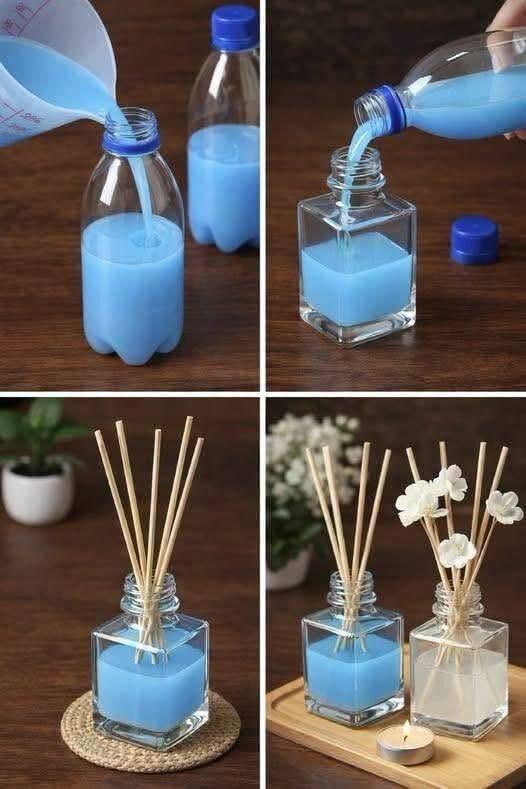
Where Should You Place Your Reed Diffuser?
Location can influence both fragrance performance and safety.
Living Room
A shelf or side table may be suitable, provided it is stable and inaccessible to children and pets.
Entryway
A diffuser near the entrance can create a welcoming first impression.
Bathroom
A small diffuser may provide a subtle scent, although ventilation and regular cleaning remain essential.
Bedroom
If you enjoy fragrances while resting, choose a mild scent and avoid placing the diffuser close to your face.
People with asthma, allergies, or fragrance sensitivity may prefer a fragrance-free bedroom.
Places to Avoid
Do not place reed diffusers near:
- Candles or open flames
- Hot stoves
- Radiators or other heat sources
- Children’s play areas
- Pet feeding stations
- Unprotected wooden or painted furniture
- Unstable shelves or crowded countertops
Some diffuser liquids are flammable, and spills may damage furniture finishes.
6 Common Mistakes That Can Ruin Your Homemade Diffuser
Mistake 1: Using Ordinary Wooden Skewers
Not every wooden stick is suitable for diffusing fragrance.
Specialized diffuser reeds are designed to absorb and release liquid more effectively.
Mistake 2: Adding Too Much Fragrance Oil
More fragrance does not always mean better performance.
Excessive fragrance concentration may affect how the liquid travels through the reeds and may increase irritation risks.
Mistake 3: Using the Wrong Base
Water, fabric softener, cooking oil, and random household cleaning products are not interchangeable with a diffuser base.
Mistake 4: Placing the Bottle in Direct Sunlight
Heat and sunlight can accelerate evaporation and may affect fragrance quality.
Mistake 5: Using Too Many Reeds
Adding more reeds can increase the rate at which liquid evaporates.
Follow the product’s recommendations and adjust only when appropriate.
Mistake 6: Ignoring Safety Instructions
Reed diffusers may look decorative, but their liquids should never be treated as harmless.
Keep them securely out of reach of children and pets.
Is a Homemade Reed Diffuser Safe Around Children and Pets?
This is an especially important consideration.
Many fragrance liquids contain concentrated ingredients that can be harmful if swallowed.
Some may also irritate the skin, eyes, or respiratory system.
Essential oils are not automatically safe simply because they come from plants.
Certain oils can be particularly hazardous to cats and dogs.
For households with curious children or pets, an open bottle of fragrance liquid may not be the best option.
If a child or pet swallows diffuser liquid, seek immediate advice from a poison control service or appropriate medical or veterinary professional. Do not induce vomiting.
If the liquid splashes into the eyes or onto the skin, rinse promptly with running water and seek advice as appropriate.
Never leave an open diffuser where it can be knocked over or accessed by a child or animal.
Can a Reed Diffuser Eliminate Bad Odors?
A reed diffuser adds fragrance to the air.
It does not necessarily remove the underlying cause of an unpleasant smell.
For example, if your kitchen smells bad because of spoiled food, a scented diffuser will not solve the problem.
Similarly, fragrance cannot replace proper cleaning when there is mold, dampness, or a plumbing issue.
To maintain a genuinely fresh-smelling home:
- Remove household rubbish regularly.
- Clean food preparation surfaces.
- Wash dirty dishes promptly.
- Keep fabrics and bedding clean.
- Address dampness and water leaks.
- Ventilate rooms when outdoor air conditions permit.
- Identify and remove the source of persistent odors.
A pleasant fragrance works best as a finishing touch to a clean, well-maintained space.
Frequently Asked Questions
What are the two ingredients in a homemade reed diffuser?
A diffuser-compatible base and a fragrance oil approved for reed diffuser use are two common ingredients. The correct mixing ratio depends on the products.
Can I use fabric softener and water?
This viral shortcut is not recommended. Fabric softener is designed for laundry, not for continuous evaporation through reeds.
Why isn’t my homemade diffuser producing a strong smell?
Possible reasons include unsuitable reeds, an incompatible liquid, a low fragrance concentration, or the size and ventilation of the room.
Can I use perfume in a reed diffuser?
Ordinary perfume is not necessarily suitable for this purpose. Use a product specifically intended for reed diffusers.
How often should I replace the reeds?
Replace them when they become clogged, damaged, or no longer release fragrance effectively. Follow the diffuser manufacturer’s instructions.
Should I turn the reeds upside down?
Some products recommend occasionally turning the reeds, but this can increase spill and skin-contact risks. Follow the manufacturer’s directions and handle them carefully.
Will a diffuser make my entire house smell good?
Usually not. A small reed diffuser is more likely to scent a limited area. Results depend on room size, airflow, and fragrance formulation.
Are homemade reed diffusers cheaper?
They can be, particularly if you reuse a suitable bottle. However, proper fragrance bases and diffuser reeds may cost more than viral posts suggest.
Can I place a diffuser next to a candle?
No. Keep fragrance liquids and reeds away from flames and other heat sources.
Is a strong fragrance always better?
No. A fragrance that is too intense can be unpleasant or irritating, especially for sensitive individuals.
Final Thoughts: A Simple Home-Fragrance Idea With One Important Secret
The viral two-ingredient diffuser trick is popular for a reason.
It transforms a small glass bottle and a handful of reeds into a decorative home accessory that can gradually release fragrance without electricity.
And with the right materials, making a DIY reed diffuser can be a fun and satisfying project.
But the secret isn’t simply pouring any pleasant-smelling household liquid into a bottle.
The real key is choosing ingredients specifically formulated for reed diffusers and following their safety instructions.
Fabric softener, random cleaning products, and improvised water mixtures may not perform as expected and can introduce unnecessary risks.
With a suitable diffuser base, compatible fragrance oil, and proper reeds, you can create a customized fragrance for your home.
Just remember that a diffuser adds scent—it doesn’t replace cleaning, ventilation, or fixing the source of bad odors.
A fresh-smelling home starts with a clean, comfortable environment. A carefully chosen fragrance can make it feel even more inviting.