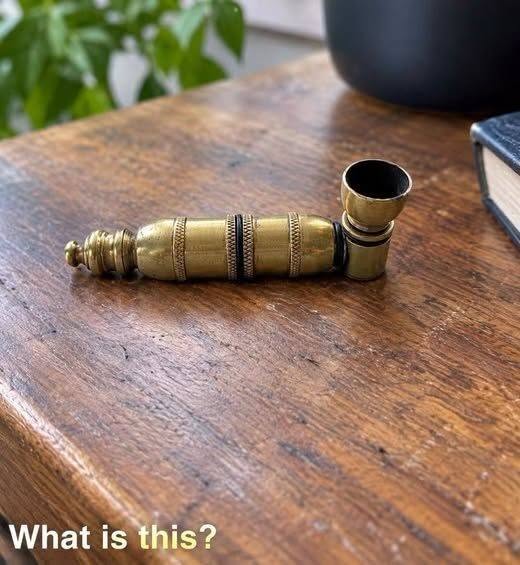
Imagine opening an old wooden drawer in your grandfather’s house and discovering a small, mysterious brass object.
It’s heavy for its size, beautifully decorated, and looks like something from another century.
At first glance, you might mistake it for an antique tool, a miniature musical instrument, or even a piece of forgotten machinery.
But look more closely.
One end has a small, upright bowl-shaped opening, while the main body features intricate metal detailing.
If you recognize this unusual design, you may already know its purpose.
The object appears to be a small metal smoking pipe, sometimes called a brass tobacco pipe or pocket pipe.
And while its purpose may seem simple today, objects like this can reveal fascinating details about everyday life, craftsmanship, and collecting traditions.
What Is This Mysterious Brass Object?
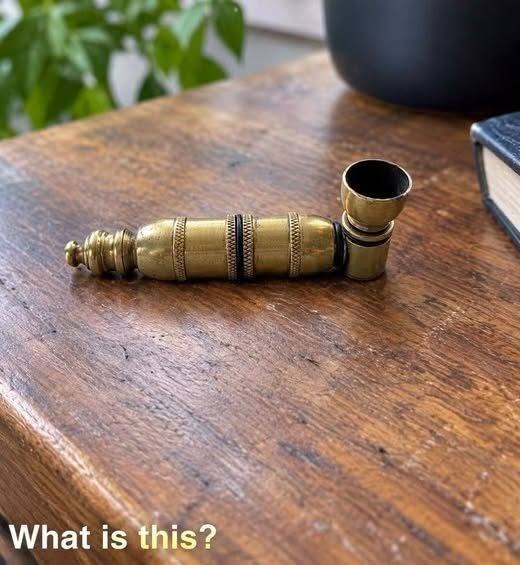
The object shown in the photograph resembles a compact smoking pipe made from brass or a similar gold-colored metal.
Its most recognizable features include:
- A small upright bowl
- A short horizontal stem
- A decorative cylindrical body
- A narrow mouthpiece at one end
- A metallic finish with engraved details
The upright bowl is where smoking material would traditionally be placed.
The horizontal stem provides a passage between the bowl and mouthpiece.
The object is small enough to fit inside a pocket or drawer, which explains why similar items are sometimes described as pocket pipes.
However, a photograph alone cannot confirm its exact manufacturer, age, material, or original intended substance.
Why Does It Look So Unusual?
Most people today recognize traditional wooden smoking pipes with curved stems and rounded bowls.
But pipes have been made in many different shapes and materials throughout history.
Some are large and decorative.
Others are compact and portable.
Metal pipes can feature straight stems, detachable sections, engraved surfaces, and unusually shaped bowls.
The object in the photograph appears to belong to the compact metal-pipe category.
Its decorative design gives it an antique appearance, although similar designs are still manufactured today.
A Closer Look at Its Design
Several details help explain why the object resembles a smoking pipe.
1. The Upright Bowl
The most distinctive feature is the small cup-shaped opening at one end.
On a typical pipe, this is the chamber that holds the smoking material.
The bowl is positioned above the stem.
2. The Horizontal Body
The cylindrical body forms the main structure of the pipe.
Depending on the design, the body may contain an internal passage connecting the bowl to the mouthpiece.
3. The Mouthpiece
At the opposite end, there appears to be a narrower section that could function as a mouthpiece.
4. Decorative Metalwork
The body has patterned sections and dark bands.
These may be decorative grooves, contrasting materials, or features of the pipe’s construction.
Such details can make an otherwise ordinary object look like a valuable antique.
Is It Really an Antique?
Not necessarily.
This is one of the most important things to understand when identifying mysterious objects online.
Something can look old without actually being old.
Brass develops a darker surface appearance over time, especially when exposed to air, moisture, and handling.
But manufacturers can also produce new objects with an intentionally aged finish.
Decorative patterns are another unreliable indicator of age.
A modern item may imitate traditional craftsmanship.
Therefore, the object’s appearance alone cannot establish whether it is 10, 50, or 150 years old.
How Can You Tell Whether It’s Old?
Collectors and antique specialists often examine several details.
Manufacturing Marks
Some objects carry stamped symbols, initials, numbers, or maker’s marks.
These can sometimes help identify a manufacturer or production period.
Construction
The way an object is assembled can provide clues about its manufacturing method.
Material
Brass, bronze, copper, and brass-plated alloys may look similar in photographs.
Determining the exact metal can require closer inspection.
Wear Patterns
Natural wear may appear around areas that were frequently handled.
However, artificial aging can imitate some of these effects.
Provenance
Knowing where an object came from can be especially useful.
An item accompanied by old photographs, receipts, packaging, or family records is easier to research than one found without any background.
Why Were Small Metal Pipes Popular?
Compact smoking pipes have existed in many forms because portability can be convenient.
Compared with large decorative pipes, smaller models are easier to carry and store.
Metal also allows manufacturers to create relatively thin components with detailed surface patterns.
Some metal pipes can be disassembled for cleaning, although the construction varies widely.
Others are primarily decorative or collectible.
Not every pipe-shaped object was necessarily used regularly.
Why Did People Use Brass?
Brass is an alloy primarily made from copper and zinc.
It has several properties that make it useful for decorative metal objects.
These include:
- An attractive golden appearance
- Good workability
- The ability to hold engraved details
- Resistance to certain forms of corrosion
- Suitability for casting and machining
Brass has been used for household objects, musical instruments, hardware, decorative accessories, and many other products.
Its warm color also makes it appealing to collectors.
However, brass can become hot, and the suitability of any metal object for smoking depends on its actual construction and materials.
An unidentified vintage object should not be assumed safe to use.
What About the Dark Bands Around the Stem?
The dark bands visible in the photograph add contrast to the brass-colored body.
They might be decorative rings, textured sections, or separate components.
Without handling the object, it’s difficult to identify their precise function.
Some small metal pipes have multiple threaded sections, while others are made from fewer pieces.
A visual inspection can suggest possibilities, but it cannot confirm the internal construction.
Could It Be Something Other Than a Tobacco Pipe?
Yes.
Although it resembles a compact smoking pipe, similar shapes may be used for other smoking-related accessories or decorative objects.
The image doesn’t provide enough information to determine its original use with certainty.
This is why a careful identification should describe it as a pipe-like smoking accessory, rather than claiming a specific historical origin or purpose without evidence.
Why Do People Find Objects Like This in Old Drawers?
Family homes often contain small items that were once common but are unfamiliar to younger generations.
Grandparents may have kept:
- Old tools
- Pocket watches
- Smoking accessories
- Mechanical parts
- Sewing equipment
- Coins
- Decorative objects
- Small souvenirs
- Collectibles
Over time, these objects become separated from their original packaging or explanation.
When rediscovered years later, they can seem mysterious.
That’s part of what makes vintage-object identification so interesting.
Can an Old Brass Pipe Be Valuable?
Possibly, but not automatically.
The value of a collectible pipe depends on several factors.
Age
A genuinely old example may attract more interest than a modern reproduction.
Manufacturer
Items made by recognizable or historically significant manufacturers can be more desirable.
Condition
Cracks, missing parts, heavy corrosion, or damage can affect value.
Rarity
An unusual design may attract specialist collectors.
Provenance
A documented history can increase collector interest.
Demand
Even rare objects may have modest resale values if few people collect them.
A small brass-colored pipe should not automatically be described as expensive simply because it looks antique.
How to Identify a Similar Object at Home
If you discover something resembling the object in the picture, start with a careful visual inspection.
Step 1: Examine Its Shape
Look for a bowl, stem, and possible mouthpiece.
Step 2: Look for Markings
Check whether there are any manufacturer names, stamped letters, or symbols.
Step 3: Photograph Every Side
Take clear pictures of the top, bottom, sides, and any markings.
Step 4: Measure It
Record its length, width, and approximate weight.
Step 5: Research Comparable Examples
Compare the shape and construction with documented vintage smoking accessories.
Step 6: Ask an Appropriate Specialist
An antique dealer or knowledgeable collector may help identify unusual examples.
Avoid forcing apart components if you don’t know how they are assembled.
Should You Clean an Old Brass Object?
That depends on whether you want to preserve it as a collectible.
Aggressive cleaning can remove patina, damage delicate details, or reduce historical value.
For a potentially valuable antique, it’s often better to avoid polishing until you’ve established what it is.
If the object is dusty, gentle dry dusting with a soft cloth may be enough initially.
Avoid soaking it in chemicals or using abrasive cleaning products.
Why Patina Matters
Patina is the surface change that develops on certain materials over time.
On brass, it may appear as darkening, tarnish, or changes in color.
Some collectors appreciate natural patina because it contributes to an object’s character.
Removing it completely may make an old item look newer, but it doesn’t necessarily make it more valuable.
In some cases, excessive polishing can actually reduce collector appeal.
Is It Safe to Use an Old Pipe?
An unidentified vintage smoking accessory should not automatically be used.
Older or unknown metal objects may contain materials or coatings that are unsuitable for heating or inhalation.
They may also have corrosion, residue, or internal damage.
And smoking itself carries significant health risks.
For these reasons, a mysterious pipe found in an old drawer is better treated as a collectible or historical curiosity rather than something to try using.
Why Do Vintage Objects Attract So Much Attention Online?
There’s something irresistible about discovering an unfamiliar object.
A tiny brass item can spark hundreds of guesses.
Some people see a mechanical tool.
Others imagine a musical instrument.
Someone else recognizes a familiar household accessory from decades ago.
These posts are popular because they connect curiosity with memory.
Older readers may remember similar objects from childhood, while younger readers encounter them for the first time.
The mystery becomes a conversation between generations.
Other Small Vintage Objects People Often Misidentify
This brass pipe isn’t the only old-fashioned object that causes confusion.
Antique Sewing Tools
Small metal thimbles, needle cases, and thread holders can resemble mechanical components.
Pocket Watch Keys
Tiny decorative keys were once used to wind certain watches.
Vintage Perfume Containers
Some miniature metal containers were designed to hold fragrances.
Old Tobacco Accessories
Pipe cleaners, tampers, and other smoking-related objects can look unfamiliar today.
Mechanical Pencil Holders
Some antique writing instruments have unusual shapes and intricate metal designs.
Decorative Miniatures
Not every object that resembles a functional tool was intended for practical use.
Some were made as ornaments or souvenirs.
The Difference Between an Antique and a Vintage Object
These terms are often used interchangeably, but collectors sometimes distinguish them.
An antique is commonly understood to be an object at least 100 years old.
Vintage generally refers to an older item associated with a particular period, though definitions vary.
An object that looks old isn’t automatically antique.
Its age needs to be established through evidence.
Why You Shouldn’t Trust Every Viral Identification
Social-media posts sometimes attach dramatic stories to ordinary objects.
A common pipe may be described as a rare historical invention.
A modern reproduction may be presented as a centuries-old artifact.
And an everyday household accessory may be given an invented secret function.
The best approach is to look at the object’s physical characteristics and compare them with reliable examples.
A fascinating story is not proof of an object’s identity.
Frequently Asked Questions
What is the small brass object in the photograph?
It appears to be a compact metal smoking pipe, possibly a brass pocket pipe.
Is it definitely an antique?
No. Its age cannot be determined from the photograph alone.
What is the small cup-shaped section for?
On a conventional smoking pipe, the upright bowl holds the smoking material.
Why is the body decorated?
The patterns may be ornamental, although some features could also relate to the object’s construction.
Is it made of solid brass?
It has a brass-colored appearance, but the exact material cannot be confirmed from the image.
Could it be valuable?
Possibly, depending on its age, maker, condition, rarity, and collector demand.
Should I polish it?
Avoid aggressive polishing until you know whether it has collectible value.
Can I use it?
Using an unidentified old smoking accessory isn’t recommended because its materials, condition, and previous use are unknown.
Final Thoughts: A Tiny Object With an Interesting Story
The small golden object found in a grandfather’s drawer may look mysterious, but its shape offers an important clue.
With its upright bowl, short stem, and decorative cylindrical body, it closely resembles a compact brass-colored smoking pipe.
Whether it’s genuinely antique, a vintage collectible, or a modern reproduction remains uncertain without further examination.
But that uncertainty is part of the fascination.
Sometimes the most interesting discoveries aren’t expensive treasures or forgotten inventions.
They’re ordinary objects that reveal how everyday habits, designs, and traditions have changed over time.
The next time you find a strange little object in an old drawer, don’t throw it away immediately. Take a closer look—you might discover a small piece of history. 🔎✨