Most people imagine spiders sitting quietly in the middle of a web, waiting for an insect to become trapped.
But many spiders don’t hunt that way at all.
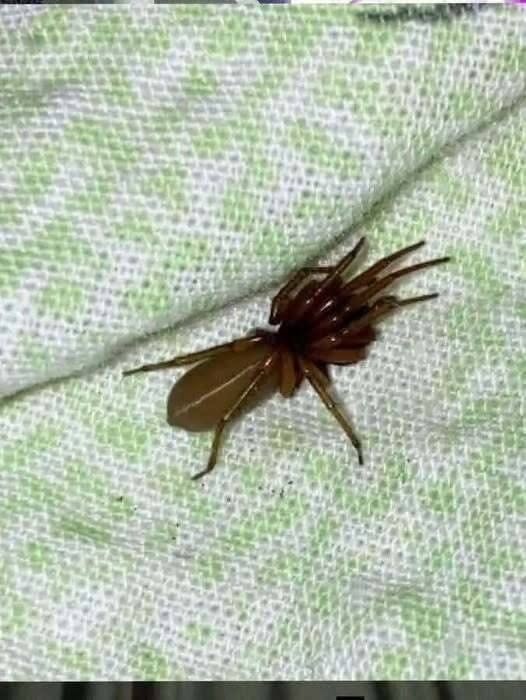
A viral photo circulating online describes a dark reddish spider as the “red-fanged wandering spider.” The dramatic name makes it sound like an exotic and potentially dangerous creature, but there is an important detail to understand first:
“Red-fanged wandering spider” is not a precise identification you should make from a viral photograph alone.
Spiders can be difficult to identify from a single image, and several species can have reddish legs, mouthparts, or bodies.
The spider commonly associated with posts like this may resemble certain wandering or sac spiders, including the broad-faced sac spider (Trachelas tranquillus) found in parts of North America.
So rather than assuming an exact species from the picture, let’s look at what makes spiders like these so interesting—and what you should do if you find a similar one in your home.
Not Every Spider Builds a Web 🕸️
One of the biggest misconceptions about spiders is that they all build large webs to catch their food.
They don’t.
Some spiders are active hunters.
Instead of waiting for prey to arrive, these spiders leave their hiding places and actively search for:
- Flies
- Small insects
- Other spiders
- Tiny arthropods
They rely on movement, vibration, touch, speed, and stealth rather than a large sticky web.
That’s why you might suddenly find one walking across a wall or floor.
A Hunter That Becomes Active at Night 🌙
Many wandering hunting spiders are primarily nocturnal.
During daylight hours, they may hide in protected locations such as:
Under bark
Beneath stones
Inside leaf litter
Behind furniture
Inside cracks
Under boards
Around stored objects
When darkness arrives, they become more active and begin searching for prey.
This nighttime behavior is one reason homeowners sometimes discover spiders unexpectedly after turning on a light.
Why Does It Have Such a Reddish Appearance?
Some hunting spiders have noticeably reddish or chestnut-colored front sections and legs.
Depending on the species, the abdomen may be lighter and more grayish, tan, or brown.
Their mouthparts can also appear prominent.
But photographs can dramatically change how colors look.
Lighting, camera flash, magnification, shadows, and image processing can make reddish mouthparts look much brighter than they really are.
That’s another reason you shouldn’t identify a spider solely because a social-media post calls it “red-fanged.”
Is It a Brazilian Wandering Spider?
This is an important distinction.
The phrase “wandering spider” can create unnecessary panic because many people immediately think of Brazilian wandering spiders in the genus Phoneutria.
Those are completely different spiders.
A small reddish house spider shouldn’t automatically be assumed to be a Brazilian wandering spider simply because someone online describes it as “wandering.”
In ordinary language, a spider can be described as wandering simply because it actively moves around searching for prey rather than relying on a capture web.
The word alone doesn’t establish its species or medical importance.
Could It Be a Broad-Faced Sac Spider?
Some viral photographs of reddish wandering spiders resemble the broad-faced sac spider, scientifically known as Trachelas tranquillus.
This species occurs in parts of North America.
It has a distinctive appearance that may include:
Reddish-brown legs
A dark reddish front body
A lighter abdomen
Prominent mouthparts
It is an active hunter rather than a spider that depends on a large prey-catching web.
However, exact spider identification often requires details that aren’t visible in an ordinary photograph.
So a picture should be treated as a clue rather than definitive proof.
Why Are They Called Sac Spiders?
The name can be confusing.
A sac spider doesn’t carry a bag around.
Instead, many spiders described this way create small silk retreats where they can rest or hide.
The silk is therefore used differently from the classic circular web we normally associate with spiders.
Rather than sitting in a large web waiting for dinner, the spider may leave its retreat and actively hunt.
Why Do These Spiders Enter Houses? 🏠
A spider found indoors isn’t necessarily trying to establish an infestation.
It may simply have wandered inside accidentally.
Possible entry points include:
Open doors
Window gaps
Cracks around the building
Spaces beneath doors
Boxes
Firewood
Plants or other objects brought indoors
Some outdoor spiders are occasionally found inside homes, particularly when environmental conditions change.
Does Finding One Mean Your House Is Infested?
Not necessarily.
Finding a single wandering spider doesn’t mean hundreds are hiding behind your walls.
It may simply have entered accidentally.
Repeated sightings, however, can justify investigating the environment.
Check:
Window frames
Door gaps
Baseboards
Storage areas
Basements
Garages
Firewood
and areas where insects are abundant.
A large supply of insect prey can make a building more attractive to spiders.
Are These Spiders Aggressive?
Most spiders aren’t wandering around looking for humans to attack.
Humans aren’t prey.
A spider is much more likely to bite when it becomes:
Trapped against the skin
Squeezed
Handled
or
Threatened.
For example, a spider hiding inside clothing or bedding could potentially become pressed against the skin.
That’s why handling an unknown spider with bare hands isn’t recommended.
Can a Broad-Faced Sac Spider Bite?
Yes.
Like many spiders, it is physically capable of biting.
Documented bites attributed to Trachelas tranquillus have produced localized symptoms such as pain, redness, and some swelling.
One documented case described the sensation as similar to a wasp sting, with redness that resolved afterward.
But this doesn’t mean everyone who sees one should panic.
Bites appear to be uncommon and typically occur when the spider is trapped or disturbed.
Does Its Bite Destroy Skin?
Claims about spider bites causing dramatic wounds are frequently exaggerated online.
Skin infections, allergic reactions, inflammatory conditions, and other medical problems are sometimes incorrectly blamed on spiders.
A skin lesion alone generally cannot prove that a spider caused it.
Confirmed spider bites are much more convincing when the spider is actually observed biting and can be accurately identified.
So if an unexplained wound develops, don’t automatically assume:
“It must have been a spider.”
Other causes may require completely different treatment.
What Should You Do If You Find One Indoors?
The safest approach is simple:
Don’t pick it up with your bare hands.
If you want to remove the spider without killing it, you can use the classic container method.
Place a glass or plastic container over the spider.
Carefully slide a stiff piece of paper or cardboard underneath.
Keep the container against the cardboard.
Then move the spider outside to an appropriate location.
Don’t attempt this if you believe you’re dealing with a medically important species or if you aren’t comfortable approaching it.
Don’t Crush Unknown Spiders With Your Fingers
Even a spider that isn’t considered medically dangerous may bite defensively when squeezed.
Use a container, vacuum, or appropriate pest-control method rather than bare hands.
What If You Find One in Your Bed? 🛏️
First, don’t panic.
Remove the spider safely.
Then shake out:
Sheets
Blankets
Pillows
and nearby clothing.
Inspect the area around the bed.
Look behind:
Headboards
Nightstands
Furniture
and nearby objects.
One spider doesn’t necessarily mean the bed itself is infested.
Check Shoes and Clothing 👟
In areas where wandering spiders are common, shaking out clothing or shoes that have been left on the floor or stored in garages, sheds, or other sheltered areas is a simple precaution.
This is particularly useful when items have been stored for a long period.
How to Make Your Home Less Attractive to Spiders
Spiders often enter homes because the building provides shelter—and sometimes food.
One of the most effective long-term strategies is reducing both entry points and insect prey.
Seal Gaps
Inspect areas around:
Doors
Windows
Pipes
Cables
Foundation cracks
Seal appropriate openings.
Weather stripping underneath doors can also reduce entry.
Repair Window Screens
Small tears can provide easy access for insects and spiders.
Repair damaged screens and make sure windows close correctly.
Reduce Clutter
Cardboard boxes, piles of clothing, stored materials, and rarely disturbed corners can provide hiding places.
Keeping storage areas organized makes them easier to inspect and clean.
Control Other Insects
Remember that spiders are predators.
If your home contains many insects, spiders have a food source.
Reducing flies, cockroaches, moths, and other household pests can indirectly make your home less attractive to hunting spiders.
Be Careful With Firewood 🪵
Firewood can provide shelter for many small animals.
Store it appropriately away from living areas when possible.
Inspect pieces before carrying them indoors.
Avoid leaving large piles of firewood immediately beside frequently used entrances.
Don’t Spray Random Chemicals Everywhere
Seeing one spider doesn’t automatically require spraying your entire house with insecticide.
Unnecessary pesticide use can expose people and pets to chemicals without addressing why spiders are entering.
Start with:
Removing the spider
Sealing entry points
Reducing clutter
and
Controlling insect prey.
If you repeatedly find large numbers of spiders, professional pest-control advice may be useful.
What Should You Do After a Suspected Spider Bite?
If you believe a spider has bitten you, wash the area gently with soap and water.
A cool compress may help with mild pain and swelling.
Avoid scratching the area.
And don’t:
Cut the bite
Burn it
Try to suck out venom
or
Apply harsh household chemicals.
These methods can cause additional injury.
When Should You Seek Medical Attention? ⚠️
Most minor local reactions don’t become emergencies.
However, seek medical advice if symptoms are significant or worsening.
Watch for:
Increasing pain
Rapidly spreading redness
Significant swelling
Pus or drainage
Fever
Muscle cramps or unusual systemic symptoms
A wound that continues worsening
Emergency medical help is appropriate for serious symptoms such as difficulty breathing, fainting, severe widespread reactions, or other rapidly developing symptoms.
If Possible, Take a Photograph 📸
If a spider bite is genuinely suspected and the spider is still nearby, a clear photograph may help with later identification.
Don’t risk another bite trying to capture it.
A good photograph can sometimes provide useful information without requiring direct handling.
Spiders Are Also Useful Predators
Although many people dislike finding spiders indoors, they perform an important ecological role.
Spiders consume enormous numbers of insects and other small arthropods.
Outdoors, this natural pest control can be beneficial.
That’s why a harmless spider found inside can often simply be relocated rather than killed.
The Scary Name Doesn’t Always Match the Risk
“Red-fanged wandering spider” sounds terrifying.
It combines three words that naturally get attention:
Red.
Fangs.
Wandering.
But a dramatic common name doesn’t tell you how dangerous an animal actually is.
Almost all spiders possess structures designed to capture prey, and many use venom against small arthropods.
That doesn’t mean every spider represents a serious threat to humans.
Don’t Confuse Appearance With Danger
Bright colors, large fangs, or fast movements can make an animal appear threatening.
But appearance isn’t a reliable measure of medical importance.
Some frightening-looking spiders pose relatively little danger to people.
Conversely, some medically important spiders aren’t particularly dramatic-looking.
Correct identification matters.
Why Spider Identification From Photos Is Difficult
A proper identification may require examining:
Body proportions
Eye arrangement
Leg structure
Hair patterns
Body markings
Geographic distribution
and sometimes microscopic anatomical features.
Two spiders that look nearly identical in a blurry Facebook photograph can belong to completely different groups.
That’s why viral posts should avoid confidently identifying a species based on appearance alone.
A Fascinating Nighttime Predator 🌙🕷️
What makes these spiders interesting isn’t how frightening they look.
It’s how they survive.
Rather than constructing an elaborate web and waiting patiently, an active hunting spider explores its environment in search of prey.
It detects movement and vibrations.
It approaches small arthropods.
It uses speed to capture them.
Then, during periods of inactivity, it may retreat into a protected hiding place.
It’s a completely different hunting strategy from the familiar spider sitting in the center of a web.
The Bottom Line
The spider shown in viral posts as a “red-fanged wandering spider” may resemble a reddish hunting or sac spider, and some examples circulating online are associated with spiders such as the broad-faced sac spider.
But a photograph alone isn’t enough to guarantee an exact species identification.
What we can say is that many spiders with this general lifestyle are active nighttime hunters rather than traditional web-based hunters.
If you find a similar spider indoors:
Don’t handle it with bare hands.
Remove it carefully if possible.
Seal gaps around windows and doors.
Reduce indoor insect populations and clutter.
And if a suspected bite produces significant or worsening symptoms, seek appropriate medical care.
The creature may look intimidating, but its most fascinating feature isn’t its supposed “red fangs.”