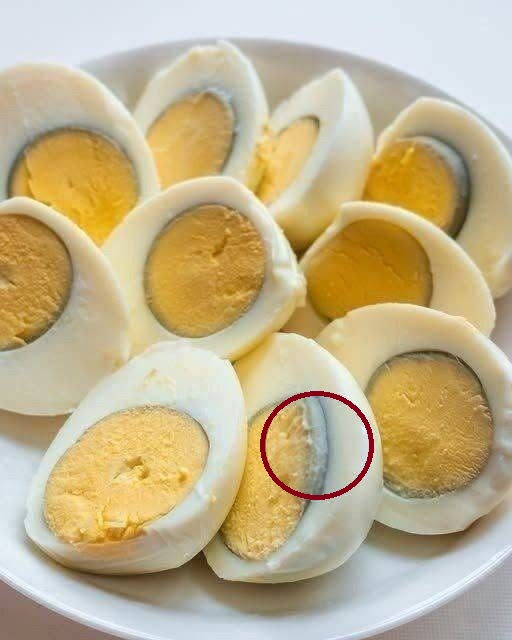
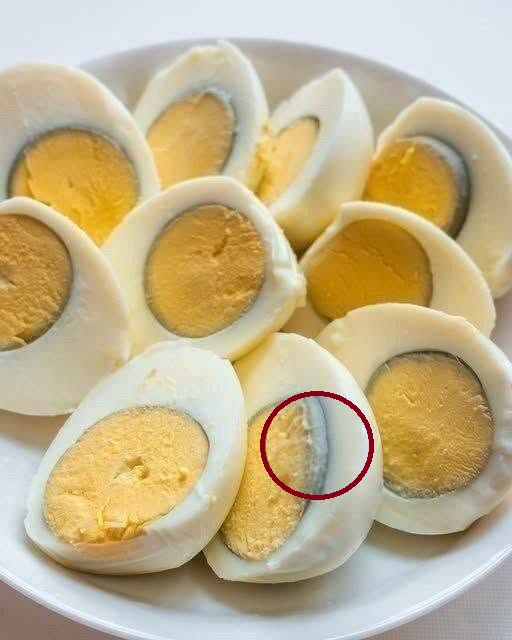
You peel a hard-boiled egg, cut it in half, and notice something strange: instead of a perfectly yellow yolk, there’s a gray-green or dark green ring around the outside of it.
It doesn’t look particularly appetizing, and many people immediately wonder:
Is the egg spoiled?
Is it dangerous to eat?
Was there something wrong with the chicken?
Fortunately, the explanation is usually much simpler.
That green ring is generally a harmless result of the cooking process, especially when an egg has been cooked too long or exposed to excessive heat.
What Causes the Green Ring?
The discoloration is the result of a chemical reaction inside the egg.
Egg whites naturally contain sulfur compounds, while the yolk contains iron.
During prolonged or excessively hot cooking, sulfur compounds from the white can react with iron at the surface of the yolk.
The result is the formation of iron sulfide, which can create that characteristic gray-green layer around the yolk.
So the color isn’t mold, food coloring, or evidence that the egg suddenly became toxic.
It’s chemistry.
Is a Green-Ringed Hard-Boiled Egg Safe to Eat?
In general, yes.
When the green-gray ring is simply the result of overcooking, the discoloration itself doesn’t make the egg unsafe.
You can eat it.
The main difference is usually quality rather than safety.
An overcooked egg may have:
- A dry yolk
- A chalky texture
- A rubberier white
- A stronger cooked-egg smell
- The characteristic green-gray ring
It may not taste as good as a properly cooked egg, but the green ring itself isn’t a reason to throw it away.
Why Do Some Eggs Turn Green While Others Don’t?
Several factors can influence whether the ring develops.
The biggest ones are:
Cooking for too long
The longer an egg remains exposed to high heat, the more opportunity there is for the sulfur-and-iron reaction to occur.
Excessive temperature
Keeping eggs at a vigorous boil for an unnecessarily long period can encourage discoloration.
Slow cooling
Even after you remove eggs from hot water, the heat trapped inside continues cooking them.
That’s why cooling is such an important part of making good hard-boiled eggs.
The Mistake Many People Make
A common method is:
Put eggs in water.
Bring the water to a vigorous boil.
Then leave them boiling for 15, 20, or even 25 minutes “just to make sure they’re cooked.”
The result?
Very firm whites, dry yolks—and often that unattractive green ring.
Hard-boiled eggs don’t need to be aggressively boiled for a very long time.
How to Prevent the Green Ring 🥚✨
The secret is controlled cooking followed by rapid cooling.
One reliable approach is to place eggs in a saucepan in a single layer and cover them with cold water.
Bring the water just to a boil.
Then reduce or remove the heat and allow the eggs to finish cooking gently in the hot water.
Cooking time varies depending on egg size and method, but the important principle is simple:
Don’t continue violently boiling the eggs for an unnecessarily long time.
Once they’re cooked, cool them promptly.
Why an Ice Bath Helps ❄️
As soon as the eggs finish cooking, transfer them into very cold water or an ice bath.
This rapidly reduces their temperature.
Cooling helps stop the residual cooking process that would otherwise continue inside the egg.
That means you’re less likely to end up with:
Rubbery whites
Dry yolks
and
Green-gray discoloration.
Let the eggs cool thoroughly before peeling.
A Simple Hard-Boiled Egg Method
Here’s an easy approach:
Step 1: Place the eggs in a saucepan
Arrange them in a single layer.
Step 2: Add cold water
Cover the eggs with enough water so they’re fully submerged, with roughly an inch of water above them.
Step 3: Bring the water to a boil
Heat until the water reaches boiling.
Step 4: Remove from strong heat
Once boiling, turn off the heat or reduce it dramatically, depending on your preferred method.
Cover the saucepan.
Step 5: Let the eggs cook gently
For large eggs, around 15 minutes of standing in the hot water is one commonly recommended method.
Exact timing can vary depending on egg size and cooking technique.
Step 6: Cool immediately
Transfer the eggs to cold or ice water.
This is the step many people forget.
Why Does the Outside of the Yolk Turn Green First?
Notice that the green color usually forms as a ring around the outer edge of the yolk, rather than throughout its center.
That’s because the reaction occurs where the yolk meets the egg white.
Sulfur compounds originating from the white interact with iron from the yolk at that boundary.
That’s why the discoloration creates such a distinctive circle.
Does a Green Ring Mean the Egg Is Old?
Not necessarily.
People sometimes assume:
Green yolk = old egg.
That’s not a reliable conclusion.
Even a perfectly usable egg can develop a green-gray ring if it’s cooked too long.
Cooking conditions are generally the more important explanation.
Does It Mean the Egg Is Rotten?
Again, no.
A green ring around the yolk of a hard-boiled egg is very different from signs that an egg has actually spoiled.
Spoiled eggs often produce a very unpleasant odor.
If an egg smells clearly abnormal or rotten when you open it, discard it.
Don’t use the green ring around a cooked yolk as your main test for spoilage.
Green Yolk vs. Unusual Egg White Color
This distinction is important.
A gray-green ring immediately surrounding the yolk of an otherwise normal hard-boiled egg is a familiar result of overcooking.
But unusual discoloration elsewhere can have a different explanation.
For example, abnormal pink or iridescent discoloration of egg white can be associated with spoilage.
So don’t assume that every unusual egg color is simply caused by overcooking.
What About the Smell?
Overcooked eggs sometimes develop a stronger sulfur-like smell.
That’s another reason people associate hard-boiled eggs with an unpleasant odor.
Gentler cooking and prompt cooling can help produce a better texture and aroma.
Why Are Some Hard-Boiled Yolks Bright Yellow?
When an egg is cooked appropriately and cooled promptly, the yolk can remain a much more attractive yellow color.
The center should be cooked to the desired level without developing that thick gray-green border.
The difference can be dramatic.
Put two eggs side by side—one severely overcooked and one properly cooked—and they may look as though they came from completely different batches.
Yet the main difference may simply be time and temperature.
Can Iron in Water Contribute?
Interestingly, cooking water containing a relatively high amount of iron may also contribute to green discoloration.
However, in ordinary home cooking, excessive cooking is one of the most common explanations for the familiar green-gray ring.
Can Scrambled Eggs Turn Green Too?
Surprisingly, yes.
Eggs don’t need to be inside their shells for similar discoloration to occur.
Scrambled eggs exposed to excessive heat or held hot for a prolonged period can sometimes develop a greenish appearance.
This is particularly noticeable when large quantities of scrambled eggs are kept warm for extended periods.
Again, the discoloration can result from reactions involving sulfur and iron.
What About Cooking Eggs in Cast Iron?
Iron from cookware can sometimes contribute to greenish discoloration in scrambled eggs.
That doesn’t automatically mean the food has spoiled.
It can simply be another chemical interaction between the iron and sulfur compounds in the eggs.
Are Green Yolks Less Nutritious?
The green ring isn’t an indication that the egg has suddenly lost all its nutritional value.
Eggs remain a source of nutrients including:
Protein
Choline
Vitamin B12
Selenium
and other vitamins and minerals.
The main reason to avoid overcooking is usually quality—better color, texture, and flavor—rather than fear of the green ring itself.
How Long Can Hard-Boiled Eggs Stay in the Refrigerator?
Food safety matters much more than the green ring.
Hard-boiled eggs should be refrigerated promptly rather than being left sitting at room temperature for hours.
A commonly recommended guideline is to use refrigerated hard-boiled eggs within about one week.
If cooked eggs have been left unrefrigerated for an extended period, don’t assume they’re safe simply because they look normal.
Appearance alone can’t reveal every food-safety problem.
Don’t Leave Cooked Eggs at Room Temperature All Day
Hard-boiled eggs are often prepared for:
Breakfast
Lunch boxes
Picnics
Parties
Buffets
Meal preparation
Remember that cooked eggs are perishable.
Keep them properly refrigerated and avoid leaving them at room temperature for prolonged periods.
A good general food-safety rule is not to leave cooked eggs unrefrigerated for more than about two hours, and even less time in very hot conditions.
What If the Egg Smells Bad?
Trust the warning sign.
A properly cooked egg naturally has an egg-like or somewhat sulfurous aroma, particularly when overcooked.
But an obviously rotten or highly abnormal odor is different.
If you’re uncertain about the safety of an egg because of a strong off-odor or other suspicious signs, it’s safer to discard it.
Why Are Some Hard-Boiled Eggs Difficult to Peel?
This is another common frustration.
You cook beautiful eggs, but when you try to peel them, half the white comes off with the shell.
Very fresh eggs can sometimes be more difficult to peel.
Cooling cooked eggs can also make peeling easier.
Try gently tapping the cooled egg all over, rolling it carefully to loosen the shell, and peeling from the wider end.
Should You Pierce the Shell Before Boiling?
Some old kitchen tricks recommend piercing the shell with a needle before cooking.
That’s unnecessary and isn’t generally recommended from a food-safety perspective because a nonsterile tool or a small crack can potentially introduce contamination.
You can make excellent hard-boiled eggs without piercing them.
Can You Microwave an Egg in Its Shell? ⚠️
Don’t microwave an intact egg in its shell.
Steam can build up inside rapidly and cause the egg to explode.
Use an appropriate cooking method instead.
The Perfect Egg Is About Temperature Control
The lesson behind the green ring is surprisingly useful.
Cooking eggs harder doesn’t necessarily make them better.
Once the egg has reached the appropriate level of doneness, additional heat can simply degrade its texture and appearance.
The goal isn’t:
“Boil it as long as possible.”
It’s:
“Cook it sufficiently, then stop the cooking.”
That’s where cold water or an ice bath becomes so useful.
The Next Time You See a Green Ring…
Don’t panic.
You haven’t necessarily discovered a spoiled egg.
That gray-green circle around the yolk is usually telling you something much simpler:
The egg probably got a little too much heat.
The discoloration occurs when sulfur compounds associated with the egg white react with iron in the yolk during cooking.
The result may look strange, but the green ring itself is generally harmless.
The Bottom Line 🥚🟢
A green or gray ring around the yolk of a hard-boiled egg is usually caused by overcooking, not spoilage.
It results from a natural chemical reaction between sulfur and iron compounds in the egg.
And yes—an otherwise properly handled hard-boiled egg with this green ring is generally safe to eat.
If you want beautifully yellow yolks instead, remember three things:
Avoid excessive cooking.
Don’t keep eggs at unnecessarily high heat.
Cool them promptly in cold or ice water once they’re done.
Sometimes the difference between a beautiful golden yolk and a gray-green one isn’t the egg at all.
It’s simply how you cooked it.