While cleaning my son’s room, imagine finding a small white plastic stick tucked among his things.
At first glance, it looks strangely mysterious.
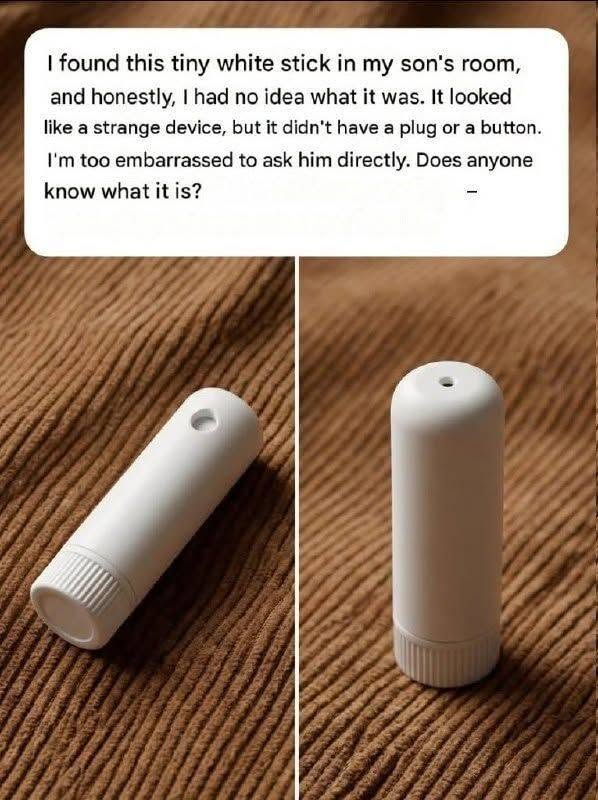
There’s no obvious screen, no charging port, no buttons, and no cable. It’s simply a small cylindrical object with a textured section at one end and a tiny opening at the other.
If you found something like this in your teenager’s bedroom, you might immediately start wondering:
Is it an electronic device? A vape? A cosmetic product? Medicine? Or something completely different?
That’s exactly why images like this have attracted so much attention online.
But the explanation may be much more ordinary than people imagine.
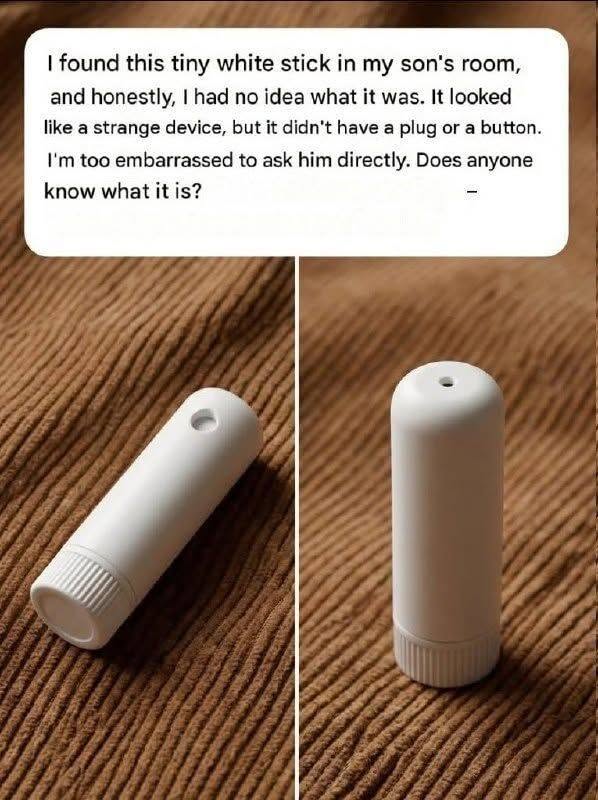
So, What Is This Tiny White Stick?
The object shown in viral versions of this story has been described online as a small nasal inhaler, similar in concept to portable menthol inhalers used when someone feels congested.
These inhalers are typically small enough to carry in a pocket, purse, backpack, or bedside drawer.
However, an important detail needs to be mentioned:
A picture alone cannot confirm the exact product.
Many small plastic containers can look extremely similar.
So while the viral story identifies it as a nasal inhaler, you shouldn’t assume every white cylindrical object with this appearance is automatically the same thing.
What Is a Nasal Inhaler?
A nasal inhaler is a small handheld product designed to release aromatic vapors through openings near one end.
Depending on the product, it may contain aromatic ingredients such as menthol.
Instead of swallowing something or applying a cream, the user holds the inhaler close to a nostril and gently inhales the aroma.
The cooling sensation produced by menthol can make the nose feel more open.
Why Does It Have a Tiny Hole?
That little opening is one of the details that makes the object look unusual.
On an inhaler, openings allow aromatic vapors from the material inside to escape when the person inhales.
Inside some designs is an absorbent wick containing aromatic ingredients.
The outer plastic shell protects the material and makes the inhaler portable.
Suddenly, the strange design makes a lot more sense.
Why Doesn’t It Have a Button?
Because a simple nasal inhaler doesn’t necessarily require electricity.
There may be:
No battery
No charging port
No screen
No electronic switch
The user simply opens the product and inhales near the appropriate end according to its instructions.
That simplicity is partly why someone unfamiliar with these products may struggle to identify one.
Why People Might Mistake It for a Vape
Today, parents are understandably more aware of vaping devices.
Some modern vapes can be very small and have minimalist designs, so an unfamiliar object in a teenager’s bedroom may immediately create concern.
But a traditional aromatic nasal inhaler works very differently.
A vape is an electronic device that heats a substance to create an aerosol.
A simple nasal inhaler doesn’t work that way.
It doesn’t need to heat anything.
This is why it’s important not to identify an unknown object based only on its size or shape.
It Could Also Resemble a Lip Balm Container
Another reason for the confusion is that small cosmetic containers can look remarkably similar.
Lip balms, solid perfumes, sunscreen sticks, sample containers, and other personal-care products can all use small cylindrical plastic packaging.
Some even have twist mechanisms at the bottom.
So seeing a white cylinder isn’t enough to determine exactly what’s inside.
The Viral Story Has an Important Lesson
The interesting part of this story isn’t really the object.
It’s how quickly our imagination fills in missing information.
Someone finds an unfamiliar item.
They become worried.
They feel embarrassed to ask.
Then they imagine increasingly alarming explanations.
But sometimes the mysterious object is something completely ordinary.
That’s why identification should come before conclusions.
What Should a Parent Do After Finding an Unknown Object?
The simplest approach is usually the best:
Ask.
It doesn’t need to become an interrogation.
A calm question such as:
“Hey, I found this while cleaning. What is it?”
may resolve the mystery immediately.
Teenagers own countless small gadgets, cosmetics, school supplies, accessories, and personal-care products that their parents may never have encountered.
Not recognizing something doesn’t automatically make it dangerous.
Look for a Brand or Label
Before guessing, examine the object carefully.
Look for:
- A brand name
- Product markings
- Instructions
- Ingredients
- Warning symbols
- A model number
- Packaging nearby
Even tiny printed letters can completely solve the mystery.
If there’s a recognizable product name, identifying it becomes much easier.
Don’t Open an Unknown Object Aggressively
If you genuinely don’t know what something contains, don’t immediately break it apart.
An unknown container could contain:
- Cosmetics
- Medication
- Fragrance
- Adhesive
- Cleaning substances
- Concentrated aromatic oils
- Something else entirely
Identify the item first.
Don’t Smell Unknown Substances Directly
Another common reaction is to put an unknown object directly under the nose and inhale deeply.
That’s not a good identification method.
If you don’t know what’s inside a container, avoid deliberately inhaling its contents.
A product designed as a nasal inhaler should be identifiable through its packaging or labeling and used according to its instructions.
Does Menthol Actually Unblock Your Nose?
This is an interesting detail.
Menthol produces a cooling sensation that can make breathing feel easier.
That sensation doesn’t necessarily mean the nasal airway has physically opened dramatically.
In other words, the feeling of easier breathing and an actual measurable reduction in congestion aren’t always exactly the same thing.
This is why aromatic inhalers can feel refreshing even though they aren’t necessarily treating the underlying cause of congestion.
What Causes a Blocked Nose?
Nasal congestion can occur for many reasons, including:
Common colds
Allergies
Sinus irritation
Dry air
Environmental irritants
An inhaler may provide a temporary cooling sensation, but persistent or severe congestion may require addressing the actual cause.
Can You Use a Nasal Inhaler Constantly?
Products should always be used according to their instructions.
This is particularly important because the term “nasal inhaler” can describe different products.
An aromatic menthol inhaler isn’t necessarily the same as a medicated nasal product.
Some medicated nasal decongestants have specific limits on how frequently or how long they should be used.
So don’t assume all nasal products are interchangeable.
Should People Share Nasal Inhalers?
It’s better not to share personal products that come close to the nose.
Even when an inhaler doesn’t enter deeply into the nostril, keeping personal-use products personal is a sensible hygiene habit.
The same general idea applies to lip balm and similar items.
Keep Them Away From Small Children
Small cylindrical objects can also create safety concerns around young children.
Depending on their size and construction, caps or detachable components may present choking hazards.
Some products may also contain ingredients that shouldn’t be swallowed.
Store personal-care and medicinal products appropriately.
What If You Find One Without Packaging?
That’s where identification becomes harder.
If there is:
- No label
- No brand
- No packaging
- No ingredient information
don’t automatically use it just because it resembles something familiar.
Two products can have almost identical containers while containing completely different substances.
Appearance isn’t enough.
Could It Be Something Completely Different?
Absolutely.
That’s why viral posts should be approached carefully.
Small white plastic cylinders can be used for many things.
Depending on their design, they might contain:
Lip balm
Solid perfume
Cosmetic products
Aromatic material
Medication
Craft supplies
Personal-care products
or something else.
A single photograph doesn’t provide enough information to identify every object with certainty.
Why This Image Gets So Much Attention
The story uses a very effective curiosity trigger:
“I found this in my son’s room and was too embarrassed to ask him.”
Immediately, readers begin imagining what the object could be.
The unusual shape adds to the mystery.
But that’s also why it’s important to separate an entertaining viral story from confirmed information.
The exact object should be identified through its markings, packaging, contents, or manufacturer—not through assumptions.
A Better Way to Handle the Situation
If you find an unfamiliar item in your child’s room:
1. Don’t panic.
An unfamiliar object isn’t automatically dangerous.
2. Inspect it without using it.
Look for identifying information.
3. Don’t taste or inhale unknown contents.
Identify the product first.
4. Ask your child calmly.
A simple conversation may provide the answer immediately.
5. Check the packaging.
Instructions and ingredients can tell you exactly what the product is designed for.
6. Take safety concerns seriously when necessary.
If the object genuinely appears dangerous or contains an unknown substance, keep it away from younger children and avoid unnecessary handling until you know what it is.
Why Communication Matters More Than Guessing
Finding something unfamiliar can easily make a parent imagine the worst.
But immediately accusing a teenager of doing something dangerous can damage trust—especially if the mysterious object turns out to be an ordinary personal-care product.
Curiosity is reasonable.
Concern is reasonable.
But calm communication usually works better than jumping to conclusions.
Sometimes the question that feels embarrassing is actually very simple:
“What is this?”
The Bottom Line
That mysterious tiny white stick circulating in this viral story has been described as a portable nasal inhaler rather than a secret electronic gadget.
Its small openings can allow aromatic vapors to be inhaled, while its compact shape makes it easy to carry around.
But there is an important lesson:
You cannot reliably identify every unknown object from appearance alone.
Many cosmetic, medical, and personal-care containers use similar cylindrical designs.
So if you ever find something unfamiliar in your child’s room, don’t panic and don’t immediately assume the worst.
Look for labels, identify the product properly, and—perhaps most importantly—simply ask.
Sometimes the mysterious object that sends your imagination racing has a surprisingly ordinary explanation.