Imagine this: you visit a friend for dinner, walk into the kitchen, and suddenly stop.
The sink is overflowing with dishes. Plates are stacked across the counter. Glasses, utensils, pans, bottles, and leftover food seem to cover every available surface.
Your friend smiles and says:
“Dinner will be ready soon!”
What would you do? 😅
Would you offer to help? Would you quietly ignore the mess? Or would you suddenly remember that you “already ate”?
A messy kitchen can make for a funny social-media debate, but there’s also an important distinction: a cluttered kitchen and an unsafe kitchen aren’t necessarily the same thing.
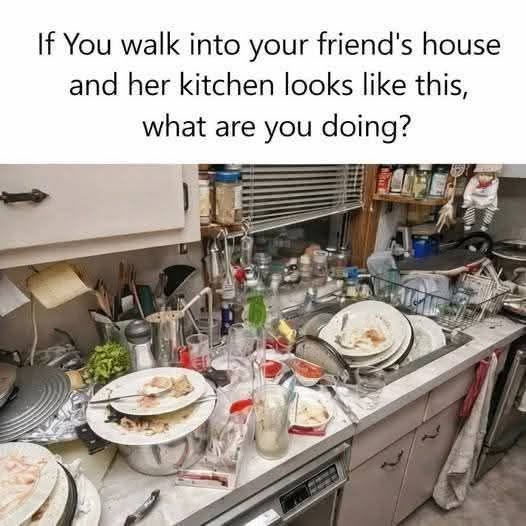
Messy Doesn’t Automatically Mean Dirty
Some kitchens become chaotic while someone is preparing a large family meal.
There may be mixing bowls everywhere, pans on the stove, vegetable scraps waiting to be thrown away, and a mountain of dishes in the sink.
That doesn’t necessarily mean the food is unsafe.
What matters much more is how food, hands, utensils and preparation surfaces are being handled.
According to USDA food-safety guidance, four basic principles help prevent foodborne illness:
Clean. Separate. Cook. Chill.
So before judging your friend’s mountain of dishes, there are more important things to notice.
1. Are the Food-Preparation Surfaces Clean?
A cluttered counter can still contain a clean area where food is being prepared.
But if cooked or ready-to-eat food is being placed directly onto a surface covered with old food residue, that’s different.
CDC guidance recommends regularly cleaning kitchen countertops and other surfaces with soap or detergent. Cleaning removes dirt, impurities and many germs from surfaces.
So the important question isn’t:
“Are there dishes in the sink?”
It’s:
“Is the surface touching my food clean?”
2. Raw Meat Changes Everything 🍗
This is one of the biggest food-safety concerns in any kitchen.
Raw chicken, meat, seafood and eggs can carry microorganisms capable of causing illness.
If raw chicken juice gets onto a cutting board and someone immediately uses that same board to chop lettuce for a salad, germs can transfer to food that won’t be cooked afterward.
That’s called cross-contamination.
USDA recommends keeping raw meat, poultry and seafood—and their juices—away from cooked and ready-to-eat foods.
So if the kitchen is messy but raw ingredients are handled carefully, that’s one situation.
If raw chicken is leaking over the counter beside tonight’s salad?
That’s a legitimate reason to be concerned.
3. Look at the Cutting Boards
Cutting boards can become a major source of cross-contamination.
Ideally, raw animal products should be kept separate from foods that won’t subsequently be cooked.
After preparing raw meat, the board, utensils and nearby surfaces should be properly cleaned before they’re used for something else.
USDA specifically recommends washing cutting boards, dishes, countertops and utensils with hot, soapy water when handling food.
That matters much more than whether yesterday’s coffee mug is still sitting beside the sink.
4. What About the Sponge? 🧽
That innocent-looking kitchen sponge can become pretty unpleasant.
Sponges remain damp and repeatedly encounter food residue.
Instead of using a visibly dirty sponge to spread residue across counters, keep cleaning tools themselves clean and replace them when necessary.
And remember that different jobs may deserve different cleaning materials.
You probably don’t want the same filthy cloth wiping the floor and then your food-preparation surface.
5. Are Hands Being Washed?
This might be the easiest safety habit to overlook.
Someone can have a spotless Instagram-worthy kitchen and still prepare food unsafely if they handle raw chicken and then immediately touch bread, vegetables or utensils without washing their hands.
CDC recommends washing hands before, during and after preparing food, particularly after handling raw meat, poultry, seafood, flour or eggs.
USDA guidance recommends washing hands with soap and water for about 20 seconds.
Clean hands matter more than a perfectly organized countertop.
6. Has Food Been Sitting Out for Hours?
Now we’re getting into another important issue.
Imagine walking into the messy kitchen and seeing cooked chicken, meat, rice or other perishable foods that have apparently been sitting on the counter since lunchtime.
That’s more concerning than dirty dishes.
USDA advises refrigerating perishable food within two hours, or within one hour when temperatures are above 90°F/32°C.
A kitchen can look beautifully organized while food has been stored unsafely.
And it can look chaotic while the food itself has been handled correctly.
Appearances aren’t everything.
7. Is the Refrigerator Cold Enough?
The refrigerator is another area guests can’t judge simply by looking at the kitchen.
USDA recommends keeping refrigerators at 40°F (4.4°C) or below.
Proper refrigeration slows bacterial growth and helps keep perishable food safer.
So if your friend has 30 dirty dishes in the sink but safely refrigerated the chicken?
That’s far better than a sparkling kitchen where raw meat has been sitting at room temperature for hours.
Should Every Kitchen Be Disinfected Constantly?
Not necessarily.
This is another common misconception.
According to the CDC, ordinary cleaning with soap or detergent is sufficient to remove most germs from many household surfaces. Routine disinfection generally isn’t necessary unless someone is sick or there are circumstances requiring additional precautions.
Food-contact surfaces contaminated by raw meat or poultry deserve particular attention.
CDC recommends cleaning contaminated countertops and food-preparation surfaces and then sanitizing surfaces that have contacted raw meat, poultry or their juices.
Never Mix Cleaning Chemicals ⚠️
If your reaction to a messy kitchen is:
“Bring me every cleaning product you have!”
Don’t.
More chemicals don’t automatically mean more cleanliness.
The CDC specifically warns against mixing bleach or disinfectants with other cleaners because dangerous vapors can be produced.
Always follow the instructions on the product label.
So…Would You Still Eat There? 😂
Now we return to the question everyone actually wants to answer.
You walk into your friend’s kitchen.
It looks like a tornado passed through five minutes earlier.
What do you do?
Option A: Start washing dishes 🧽
You’re the friend everyone secretly hopes will visit.
Roll up your sleeves and say:
“Where’s the dish soap?”
Ten minutes later, the kitchen is under control.
Option B: Ignore it and enjoy dinner 🍽️
If the kitchen is simply cluttered from cooking and the food has been handled safely, a pile of dishes isn’t necessarily a reason to panic.
Enjoy your evening.
The dishes can wait.
Option C: Offer to help without embarrassing your friend ❤️
Instead of saying:
“HOW DO YOU LIVE LIKE THIS?!”
Try:
“Want me to clear some of this while you finish cooking?”
Your friend may have had an exhausting day.
Maybe she cooked for several people.
Maybe she has children.
Maybe the dishwasher broke.
Maybe you’re seeing the kitchen during its worst five minutes of the week.
A photograph doesn’t tell you the whole story.
Option D: Pay attention to actual hygiene problems 👀
If you see spoiled food, insects, raw meat contaminating other foods, dirty utensils being used for ready-to-eat food or other obvious hazards, that’s different.
You don’t have to eat something you genuinely believe has been handled unsafely.
Clean Kitchen vs. Perfect Kitchen
Social media has changed what many people think a kitchen should look like.
We’re constantly shown:
✨ Empty countertops
✨ Perfectly labeled containers
✨ Spotless sinks
✨ Matching jars
✨ Immaculate refrigerators
Real kitchens don’t always look like that.
People cook.
Children eat.
Dishes accumulate.
Flour gets on counters.
Pasta sauce splashes.
Someone leaves a coffee mug beside the sink.
A kitchen doesn’t have to look like a showroom to be hygienic.
The goal should be safe food preparation and reasonable cleanliness, not perfection.
A Simple Kitchen Reset
If your own kitchen sometimes reaches the stage shown in the picture, don’t panic.
Start with the trash.
Put leftover food away.
Load or wash the dishes.
Clear the sink.
Clean the food-preparation surfaces.
Wash cutting boards and utensils.
Put away ingredients.
Sweep the floor.
Then you’re finished.
You don’t necessarily need a three-hour deep-clean every evening.
The Most Important Kitchen Rule
If you remember only one thing, remember the USDA’s four basic food-safety steps:
CLEAN — Wash hands, utensils and surfaces.
SEPARATE — Keep raw animal foods away from ready-to-eat foods.
COOK — Cook foods to safe internal temperatures.
CHILL — Refrigerate perishable foods promptly.
Those four habits matter far more for food safety than whether every plate has already been washed.
Final Question: What Would YOU Do? 😅
So imagine again:
You arrive at your friend’s house.
She tells you she’s preparing your favorite meal.
Then you walk into the kitchen and see that mountain of dirty dishes.
Are you:
A) 🧽 Helping her clean immediately
B) 😂 Pretending you didn’t see anything
C) 🍽️ Eating anyway because you trust your friend
D) 🚪 Suddenly remembering you have somewhere else to be
There’s no need to shame someone simply because their kitchen is temporarily messy.
But when it comes to food, genuine hygiene and safe handling still matter.
And now the question goes to you: