If you live with a cat, you’ve probably experienced this dozens—maybe hundreds—of times.
You walk through the door, head toward the kitchen, or simply stand still for a moment, and suddenly your cat appears.
They walk toward you.
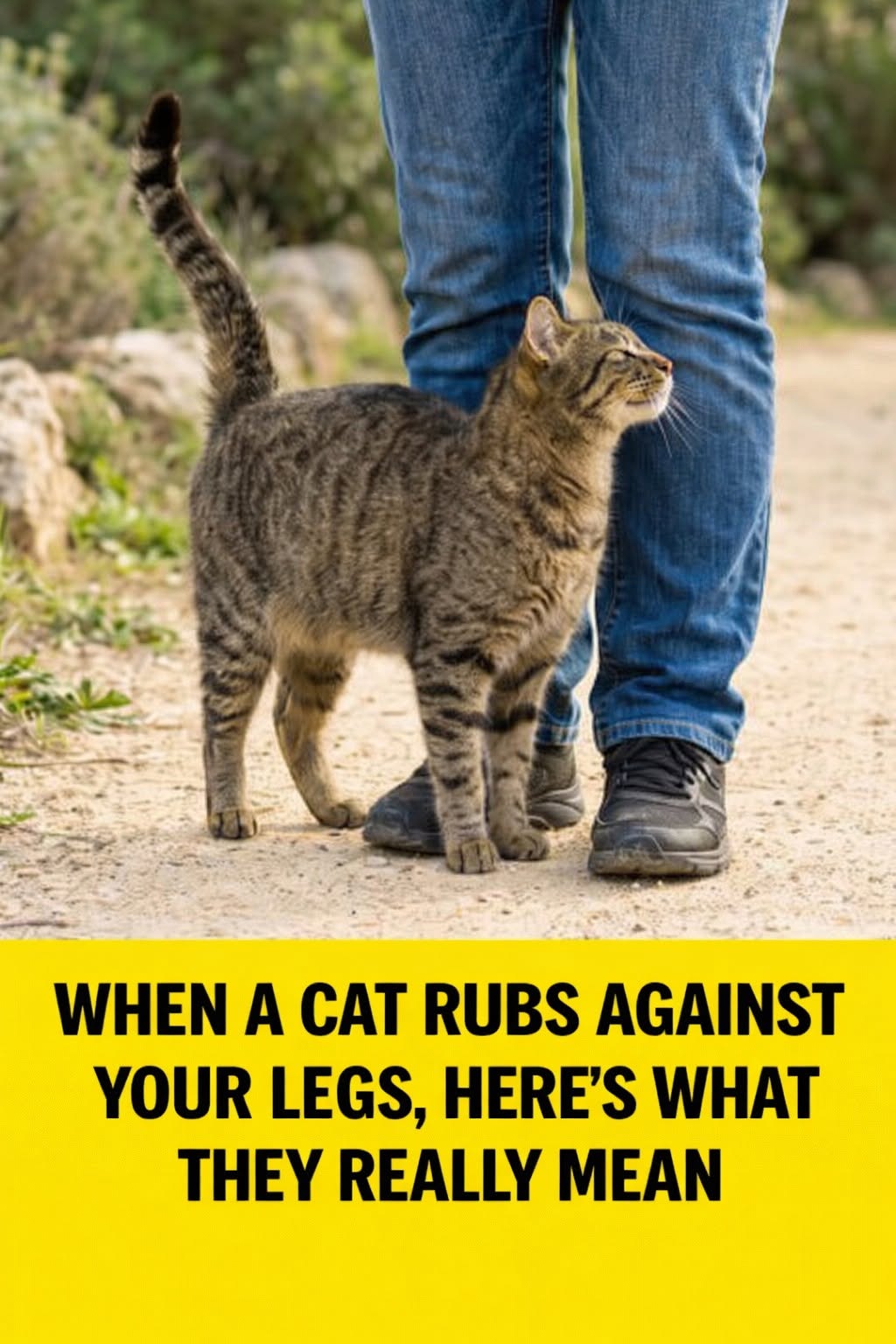
Their tail rises.
Then they press their head or body against your legs, sometimes weaving back and forth until you’re practically trying not to trip over them.
Most people immediately think:
“They’re hungry.”
And sometimes they are.
But rubbing against your legs can mean much more than asking for dinner.
Cats use scent, touch, posture, and movement to communicate, and rubbing is an important part of that language. Veterinary behavior sources describe it as a behavior associated with greeting, scent marking, familiarity, bonding, and sometimes requesting something from you.
So what exactly is your cat trying to say?
1. Your Cat May Simply Be Saying “Hello”
One of the simplest explanations is also one of the sweetest.
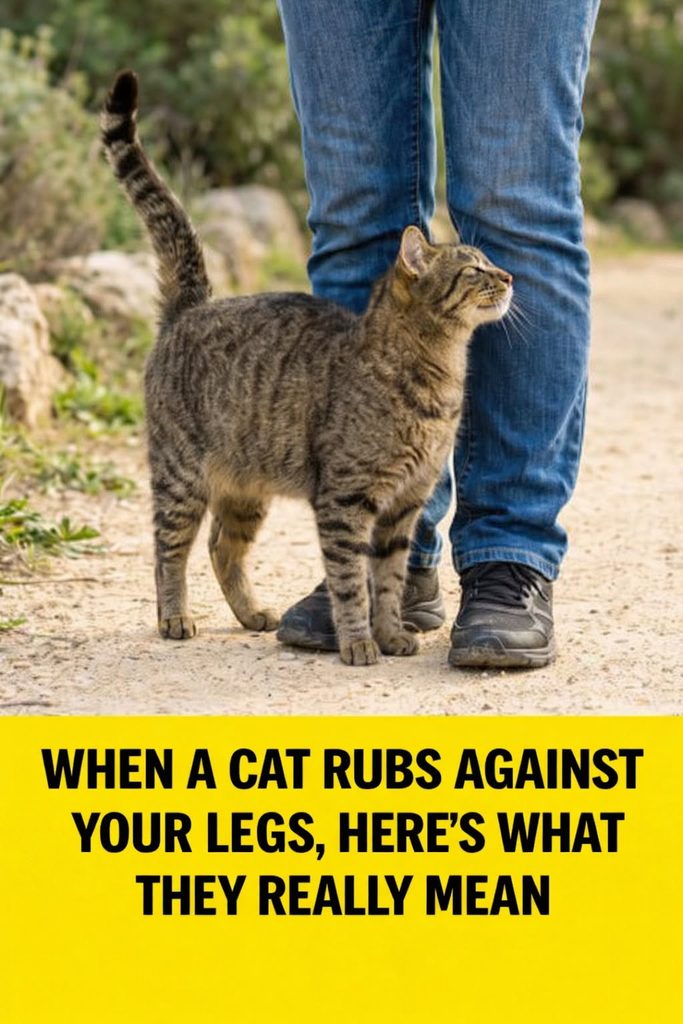
Your cat may be greeting you.
You might notice the behavior especially when you:
- Come home from work
- Wake up in the morning
- Enter a room after being away
- Return after several hours outside
Cats Protection notes that rubbing the head or body against a person is often a friendly greeting and can mean the cat is happy to see them.
Think of it as the feline version of:
“Hey! You’re back!”
Some cats may combine the rubbing with purring, meowing, or an upright tail.
2. They’re Leaving Their Scent on You
Here’s where things get fascinating.
Cats experience the world through smell much more intensely than humans do.
They have scent glands in several areas of their bodies, including around the:
- Cheeks
- Chin
- Forehead/head
- Base of the tail
When your cat rubs these areas against you, they can deposit chemical scent signals known as pheromones.
You probably won’t smell anything.
But another cat can detect these chemical messages.
So when your cat rubs against your legs, they’re doing something humans can’t easily perceive:
They’re leaving their scent behind.
3. In Cat Language, You Smell Familiar and Safe
This doesn’t necessarily mean your cat is aggressively declaring:
“THIS HUMAN BELONGS TO ME!”
It’s subtler than that.
Cats also rub against familiar objects and individuals to create an environment filled with reassuring scents.
Cats Protection explains that familiar pheromones can help signal that a person or place is safe and trusted.
Your sofa may smell familiar.
Their bed smells familiar.
Their favorite scratching post smells familiar.
And after rubbing against you?
You smell familiar too.
That familiarity can be comforting.
4. It Can Be a Sign of Trust ❤️
When your cat voluntarily approaches you and rubs their face or body against you while appearing relaxed, that’s generally a positive social interaction.
VCA describes head bunting—the familiar head-and-face rubbing behavior—as a sign of trust.
That’s important because cats don’t interact with every person in exactly the same way.
If your cat repeatedly chooses to approach you, rub against you, relax near you, and seek interaction, you’re probably an important part of their social environment.
So yes, that little head bump can mean quite a lot.
5. You May Be Part of Their “Group”
Cats living together peacefully sometimes rub against each other.
Why?
One reason is scent sharing.
Cats can exchange scents through rubbing, helping create a familiar group scent.
Your cat may perform similar behavior with you.
In other words, when your cat walks around your ankles and rubs their cheeks against your legs, they may be treating you somewhat like a familiar member of their social group.
That’s a pretty special compliment coming from a cat.
6. Yes… Sometimes They’re Just Hungry 😹
We shouldn’t make everything overly romantic.
Sometimes your cat really does want food.
You know the routine.
You walk toward the kitchen.
Your cat suddenly appears.
They rub against you.
They meow.
They look at the food cupboard.
Then they look at you.
Then back at the cupboard.
Message received.
Cats can learn that certain behaviors get our attention, and rubbing can be one way of asking for something—food, attention, play, or another need.
The context tells you a lot.
If rubbing always happens five minutes before dinner, there’s probably a fairly obvious explanation.
7. They Might Want Attention
Food isn’t the only thing your cat may be requesting.
Sometimes the message is simply:
“Pay attention to me.”
Your cat may want:
- Petting
- Playtime
- Interaction
- Access to another room
- A clean litter box
- Something else you’ve learned to associate with their behavior
Cats quickly learn routines.
If rubbing your legs causes you to bend down and pet them every time, they may learn that rubbing is a very effective way to get your attention.
And frankly, they’re right.
It usually works. 😹
8. Why Does My Cat Rub Their Face Against Me?
Face rubbing is particularly interesting because cats have scent glands around the face.
When your cat pushes their forehead or cheek against you, the behavior is sometimes called bunting.
During this interaction, your cat can transfer facial pheromones onto you.
VCA explains that cats also bunt objects in their environment, helping make familiar spaces smell reassuringly like their territory.
So that adorable little head bump isn’t random.
It’s communication.
9. Why Does My Cat Walk Between My Legs?
This behavior can be adorable.
It can also be mildly dangerous when you’re carrying hot coffee. 😅
Some cats don’t merely rub against one leg.
They weave between both legs in a figure-eight pattern.
This allows them to repeatedly make physical contact while rubbing different parts of their body against you.
Often, the cat is excited to see you, seeking attention, anticipating something pleasant, or scent-marking.
Whatever the motivation, watch your step.
Your cat may understand feline communication perfectly.
They may not understand that humans are terrible at balancing.
10. Watch the Tail
The tail can give you useful context.
A cat approaching you with a relaxed body and tail held upright is often showing friendly intentions.
Cats Protection notes that a friendly greeting may involve rubbing against your legs along with purring, meowing, and an upward-pointing tail.
Look at the entire cat rather than one behavior.
A relaxed cat might show:
- Tail upright
- Relaxed ears
- Soft eyes
- Purring
- Gentle rubbing
- Comfortable posture
Those signals together make the meaning much easier to understand.
11. What If a Cat You Don’t Know Rubs Against You?
Here’s an interesting exception.
If an unfamiliar cat rubs against you, don’t automatically assume:
“It wants me to pet it!”
Cats may sometimes rub against unfamiliar people or animals while gathering scent information.
Give the cat control over the interaction.
Instead of immediately reaching over its head, allow it to approach and observe its body language.
A cat that remains relaxed and continues seeking contact may welcome interaction.
A cat that backs away is telling you something too.
Respect it.
12. Why Does My Cat Rub Against Furniture Too?
You’ve probably noticed that your legs aren’t the only target.
Cats rub against:
- Sofas
- Chairs
- Door frames
- Tables
- Walls
- Their beds
- Boxes
Again, scent communication plays an important role.
VCA notes that facial rubbing allows cats to deposit pheromones on familiar objects within their environment.
From the cat’s perspective, scent is part of how a familiar home feels like home.
Humans decorate with photographs and furniture.
Cats apparently add invisible scent labels.
13. Why Do They Rub Against You After You’ve Been Outside?
This makes even more sense once you understand scent.
When you leave home, you encounter countless smells.
Your clothes may pick up scents from:
- Other people
- Animals
- Cars
- Restaurants
- Shops
- Outdoors
When you return, your cat may investigate you carefully.
Then comes the rubbing.
One interpretation is that they’re refreshing their familiar scent on you. PetMD notes that cats may rub and remark people because scent markings fade and need to be reapplied.
Basically:
“Welcome home. You smell weird. Let me fix that.” 😹
14. Does Rubbing Mean “I Love You”?
It’s tempting to translate every feline behavior directly into human language.
We can’t know that a cat rubbing against your leg literally means the human sentence:
“I love you.”
But rubbing can occur in friendly social contexts and can communicate familiarity, trust, greeting, and bonding.
So if your relaxed cat regularly approaches and rubs against you, it’s fair to interpret the behavior as positive.
Maybe “I love you” is too literal.
But:
“You’re familiar, safe, and important to me”
is pretty wonderful too.
15. What If My Cat Suddenly Starts Rubbing Constantly?
Ordinary rubbing is usually normal.
But a sudden dramatic change deserves attention.
If your cat starts rubbing much more frequently or aggressively than usual, particularly alongside other unusual symptoms, consider talking to your veterinarian.
Excessive rubbing can sometimes accompany problems such as allergies, fleas, ear infections, hypersensitivity, or neurological conditions.
Watch for additional changes such as:
- Excessive scratching
- Hair loss
- Head tilting
- Unusual vocalization
- Confusion
- Changes in appetite
- Changes in normal behavior
The key isn’t simply that your cat rubs.
It’s whether their normal behavior has suddenly changed.
Rubbing Is NOT the Same as Head Pressing
There’s another distinction every cat owner should know.
Friendly head bunting involves a cat deliberately bumping or rubbing their head against you or another object and then continuing normally.
Head pressing is different.
A cat that persistently pushes its head against a wall or other surface and appears abnormal may have a serious medical problem. PetMD notes that head pressing can be associated with neurological disease and should receive veterinary attention.
Don’t confuse the two.
A happy little forehead bump against your hand?
Usually normal.
Persistently pressing the head into a wall while behaving strangely?
Call your veterinarian.
How Should You Respond When Your Cat Rubs Against You?
You don’t need to do anything complicated.
If your cat appears relaxed and enjoys being touched, you can gently offer affection.
Many cats enjoy being stroked around areas such as the cheeks and head.
But let your cat guide the interaction.
Some cats want a long petting session.
Others want exactly three seconds of attention before walking away as though you no longer exist.
That’s cats for you. 😹
The Next Time Your Cat Rubs Against Your Legs…
Don’t automatically head toward the food bowl.
Look at what’s happening.
Is your cat greeting you after you’ve been away?
Are they purring?
Is their tail upright?
Are they rubbing their cheeks against you?
Are they standing beside the food cupboard screaming dramatically?
Context changes everything.
Your cat may be saying:
“Hello.”
“You are familiar.”
“I trust you.”
“Pay attention to me.”
Or, of course:
“Dinner. Immediately.”
The Bottom Line 🐱❤️
When a cat rubs against your legs, it’s usually a normal and positive behavior.
Cats have scent glands around their face, head, and tail area, and rubbing helps transfer pheromones onto people and objects. This can be part of greeting, scent marking, bonding, and creating a familiar environment.
Sometimes they’re also asking for food or attention.
So the next time your cat circles your ankles and presses their little face against your leg, remember:
They’re doing much more than simply brushing against you.
They’re communicating in one of the most distinctly feline ways possible.
And if they’re relaxed, purring, and looking up at you?
You can probably take it as a very good sign. 🐾❤️