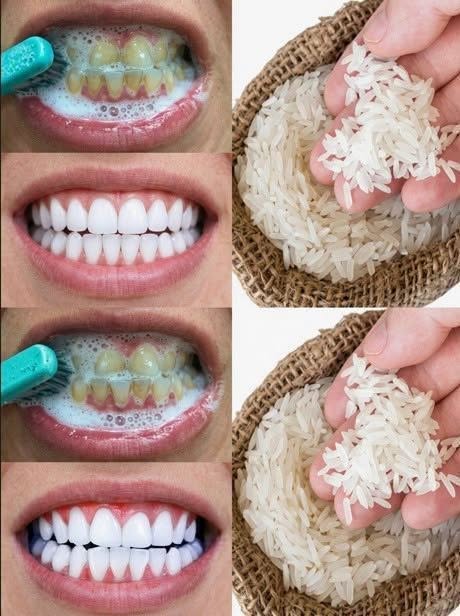
If you’ve spent time on Facebook, TikTok, or Pinterest, you’ve probably seen dramatic before-and-after photos promising perfectly white teeth in only 60 seconds.
One version is especially surprising because the supposed secret ingredient isn’t an expensive dental product.
It’s something almost everyone has in the kitchen:
Rice. 🍚
The viral posts often suggest grinding rice into a powder, combining it with other household ingredients, and brushing the mixture onto your teeth.
The promise?
Yellow teeth become noticeably whiter almost instantly.
It sounds incredible—but before rubbing ground rice or other DIY mixtures over your enamel, there’s something important to understand.
There is no proven “rice whitening” treatment that can safely transform the natural color of your teeth in 60 seconds. The American Dental Association (ADA) warns that many DIY whitening methods promoted online have limited evidence and may be ineffective or potentially damaging.
So what actually makes teeth look yellow, what can rice powder really do, and which whitening methods have evidence behind them?
Here’s what you should know.
Why Do Teeth Become Yellow in the First Place?
Not everyone’s natural tooth color is bright white.
Teeth can naturally appear slightly yellow because underneath the enamel is a layer called dentin, which has a more yellowish appearance.
As enamel becomes thinner or more translucent with age, more of that dentin may become visible.
But that’s only one reason.
Teeth can also develop external stains from things we consume every day.
Common causes include:
- Coffee
- Tea
- Red wine
- Cola
- Dark-colored foods
- Tobacco
Poor oral hygiene can also contribute to visible discoloration.
And this distinction matters because surface stains and the natural internal color of your teeth aren’t the same thing.
So Where Does the Rice Trick Come From?
The idea behind the viral method is usually simple.
Dry rice is ground into a fine powder.
Some versions then combine it with ingredients such as toothpaste or baking soda.
The mixture is brushed onto the teeth with claims that it “polishes away” yellow stains.
At first glance, the explanation seems believable.
Rice powder has particles.
Particles can create friction.
Friction can remove some material from a surface.
But your teeth aren’t kitchen countertops.
Enamel needs to be protected.
A substance doesn’t become a safe whitening treatment simply because it can scrub a surface.
Can Ground Rice Remove Surface Stains?
There isn’t good clinical evidence showing that brushing with ground rice is an effective tooth-whitening treatment.
It’s possible that abrasive materials can temporarily remove some superficial buildup.
But abrasion is not the same thing as bleaching.
Whitening toothpastes themselves primarily work by using carefully formulated abrasives to help remove extrinsic surface stains.
They generally don’t dramatically change the intrinsic color of the tooth.
Commercial toothpaste abrasivity is also evaluated and controlled.
A homemade powder from your kitchen isn’t formulated or tested in the same way.
That’s why repeatedly scrubbing your teeth with random abrasive ingredients isn’t a good whitening strategy.
Can You Really Whiten Teeth in 60 Seconds?
This is the biggest red flag in the viral claim.
True tooth bleaching generally doesn’t transform yellow teeth into brilliant white teeth after one minute of brushing.
Effective whitening products usually rely on ingredients such as:
Hydrogen peroxide
or
Carbamide peroxide.
These compounds penetrate dental tissues and chemically break down colored molecules responsible for discoloration.
Even then, whitening usually requires repeated applications or professional treatment.
Over-the-counter products may take days or weeks to produce noticeable changes.
So a dramatic transformation after 60 seconds should immediately make you skeptical.
Why Do Viral Before-and-After Photos Look So Convincing?
Because photographs are incredibly easy to manipulate.
Lighting can make teeth appear dramatically different.
So can:
- Camera exposure
- White balance
- Filters
- Contrast
- Editing
- Different angles
Even wet versus dry teeth can look different in photographs.
That’s why a split-screen image isn’t scientific evidence that a remedy works.
The only reliable way to evaluate a whitening method is through controlled testing.
What About Baking Soda?
Baking soda deserves a little more nuance because it actually is used in some commercial toothpastes.
But there’s a major difference between:
A professionally formulated toothpaste containing baking soda
and
Scrubbing your teeth aggressively with homemade abrasive mixtures.
The formulation, particle size, concentration, brushing technique, and frequency all matter.
Adding more abrasive ingredients doesn’t automatically create a better whitening product.
What About Lemon Juice? 🍋
Avoid using lemon juice as a DIY tooth-whitening treatment.
Lemon juice is acidic.
Repeated acid exposure can contribute to enamel erosion.
Once enamel is lost, your body doesn’t simply grow it back.
And ironically, thinning enamel can eventually make teeth appear more yellow, because the underlying dentin becomes more visible.
So “natural” doesn’t necessarily mean “safe for teeth.”
The ADA specifically cautions that some DIY whitening approaches promoted online may do more harm than good.
What About Vinegar?
The same caution applies.
Vinegar is acidic.
Using it repeatedly on teeth isn’t a sensible whitening strategy.
Your goal shouldn’t be to chemically or mechanically strip away the surface of your teeth until they appear different.
Healthy enamel is more important than achieving an unnaturally white shade.
What About Activated Charcoal?
Another enormously popular social-media whitening hack is activated charcoal.
The black powder makes for dramatic videos because there’s a huge visual contrast when it’s rinsed away.
But according to the ADA, there isn’t sufficient evidence demonstrating that charcoal-based dental products provide safe and effective whitening benefits.
Some abrasive DIY mixtures may potentially wear tooth surfaces rather than safely bleach them.
Again:
Scrubbing isn’t the same thing as whitening.
What Actually Works for Whiter Teeth?
Fortunately, you don’t need viral kitchen hacks.
There are established options.
1. Whitening Toothpaste
Whitening toothpastes can help remove certain surface stains.
They’re especially useful for stains caused by foods and beverages.
But don’t expect them to completely change the natural internal color of your teeth.
Look for products from reputable manufacturers and follow their instructions.
2. Whitening Strips
Many whitening strips contain peroxide.
Unlike simple abrasive polishing, peroxide can chemically lighten tooth color.
Clinical evidence supports the effectiveness of whitening strips, although results depend on the product and how consistently it’s used.
Products carrying the ADA Seal have provided evidence supporting safety and effectiveness when used as directed.
3. Dentist-Supervised Whitening
A dentist may provide custom trays containing whitening gel for use at home.
Because the trays are fitted to your teeth, they can help minimize unnecessary contact between whitening gel and your gums.
Treatment duration varies depending on the whitening agent and concentration.
4. Professional In-Office Whitening
For faster results, dentists can use higher concentrations of whitening agents under controlled conditions.
Professional treatments may produce visible changes much faster than ordinary over-the-counter products.
However, stronger treatment doesn’t mean zero side effects.
Sensitivity can still occur.
Why Do Teeth Sometimes Hurt After Whitening?
One of the most common side effects of bleaching is temporary tooth sensitivity.
You may notice discomfort when drinking:
❄️ Cold water
☕ Hot coffee
🍦 Ice cream
🍋 Acidic beverages
Gum irritation can also occur if whitening gel contacts soft tissues.
The ADA identifies tooth sensitivity and gingival irritation among the most common side effects of whitening treatments.
This is another reason not to assume that stronger or more frequent bleaching is automatically better.
Can Everyone Whiten Their Teeth?
Not necessarily.
Before whitening, it’s useful to understand why your teeth are discolored.
For example, whitening won’t repair:
- Cavities
- Cracked teeth
- Gum disease
- Worn enamel
There’s another important limitation:
Crowns, veneers, fillings, and implants don’t whiten like natural teeth.
If you have visible restorations, bleaching your surrounding natural teeth may actually create a color mismatch.
A dentist can help determine what’s causing the discoloration and whether whitening is appropriate.
Sometimes You Don’t Need Whitening at All
Here’s something viral posts rarely mention.
If the discoloration is primarily caused by plaque or surface staining, a professional dental cleaning may already make your teeth look brighter.
Dental professionals can remove deposits and certain stains that ordinary brushing may not completely eliminate.
The ADA notes that having a dental cleaning and addressing oral-health issues before whitening may help patients determine whether additional bleaching is even necessary.
How to Keep Teeth Looking Brighter Naturally
Instead of constantly trying aggressive DIY whitening methods, focus on preventing new stains.
Brush Twice Daily
Use fluoride toothpaste and brush gently and thoroughly.
Clean Between Your Teeth
Floss or use another appropriate interdental cleaner.
Limit Tobacco
Smoking and tobacco use are major contributors to external staining.
Watch Staining Drinks
Coffee, tea, cola, and red wine can contribute to surface discoloration.
You don’t necessarily need to eliminate everything you enjoy, but regular oral hygiene matters.
Visit Your Dentist Regularly
Professional examinations and cleanings can identify problems that no viral whitening trick will solve.
Don’t Chase “Paper White” Teeth
Social media has created unrealistic expectations about what healthy teeth should look like.
Healthy natural teeth aren’t necessarily pure white.
A slightly ivory or yellowish shade can be completely normal.
Your goal should be:
Healthy teeth and gums first.
Cosmetic whitening comes second.
The Biggest Problem With DIY Whitening Hacks
The danger isn’t necessarily trying something once.
The bigger problem comes when someone sees a viral post and thinks:
“If one minute makes them whiter, I’ll do it every morning.”
Repeated exposure to abrasive or acidic substances may damage enamel or irritate gums.
And unlike hair or fingernails, damaged enamel isn’t something you want to sacrifice for a temporary cosmetic effect.
Rice vs. Real Teeth Whitening
Let’s make the difference clear.
Ground Rice
There isn’t strong evidence that rice powder safely bleaches teeth.
Any apparent effect would be more likely related to mechanical surface cleaning—not genuine bleaching.
Whitening Toothpaste
Can help remove certain surface stains.
Peroxide-Based Whitening Products
Can actually lighten natural tooth color when appropriately formulated and used correctly.
Professional Whitening
Can provide faster and more controlled results, especially when significant whitening is desired.
So, What’s the “Secret Dentists Don’t Tell You”?
There really isn’t one.
Dentists aren’t hiding a 60-second rice trick.
Effective tooth whitening is already well understood.
Some products remove external stains.
Others use peroxide to bleach pigments within natural teeth.
Professional treatments can use stronger concentrations under supervision.
The boring truth isn’t as clickable as:
“Rub THIS kitchen ingredient on your teeth for 60 seconds!”
But when you’re dealing with enamel that needs to last your entire life, boring and evidence-based is usually the better choice.
The Bottom Line 🦷
The viral rice whitening trick may look impressive in before-and-after photos, but there isn’t good evidence that ground rice can safely transform yellow teeth into bright white teeth in 60 seconds.
And adding acidic or highly abrasive household ingredients can potentially do more harm than good.
If you want brighter teeth, safer evidence-based options include whitening toothpaste for surface stains, appropriately formulated peroxide-based products, whitening strips, and dentist-supervised treatment.
Most importantly:
Don’t sacrifice healthy enamel chasing an edited-looking smile.
Your teeth don’t need to be perfectly white to be healthy or beautiful.
And when an internet post promises a dramatic dental transformation in 60 seconds using something from your kitchen, that’s usually a good reason to look at the evidence before reaching for your toothbrush.