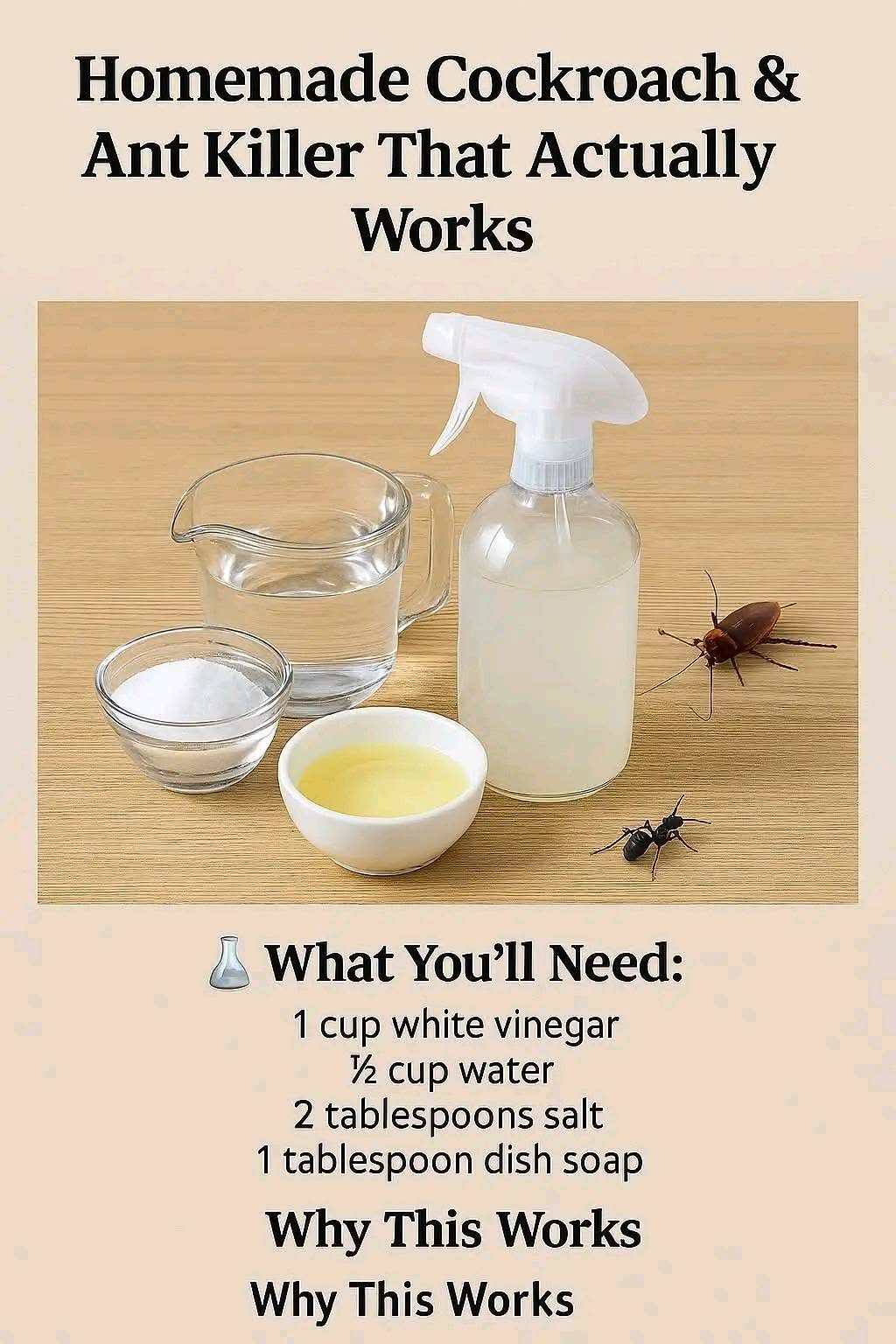
Cockroaches and ants are among the most frustrating unwanted visitors you can find in your home.
You clean the kitchen, wipe the counters, and go to bed thinking everything is spotless. Then you turn on the light at night and suddenly see a cockroach running across the floor—or a trail of ants heading straight toward the pantry. 😩
That’s why a simple homemade recipe circulating online has attracted so much attention.
The viral mixture combines white vinegar, water, dish soap, and sometimes baking soda, with claims that spraying it around your home will make ants and cockroaches disappear.
But does it really work?
The answer is: parts of the idea can be useful, especially for ants, but this mixture shouldn’t be treated as a guaranteed exterminator—particularly for a cockroach infestation.
Here’s how the ingredients work, how to use a simple version safely, and what to do if the bugs keep coming back.
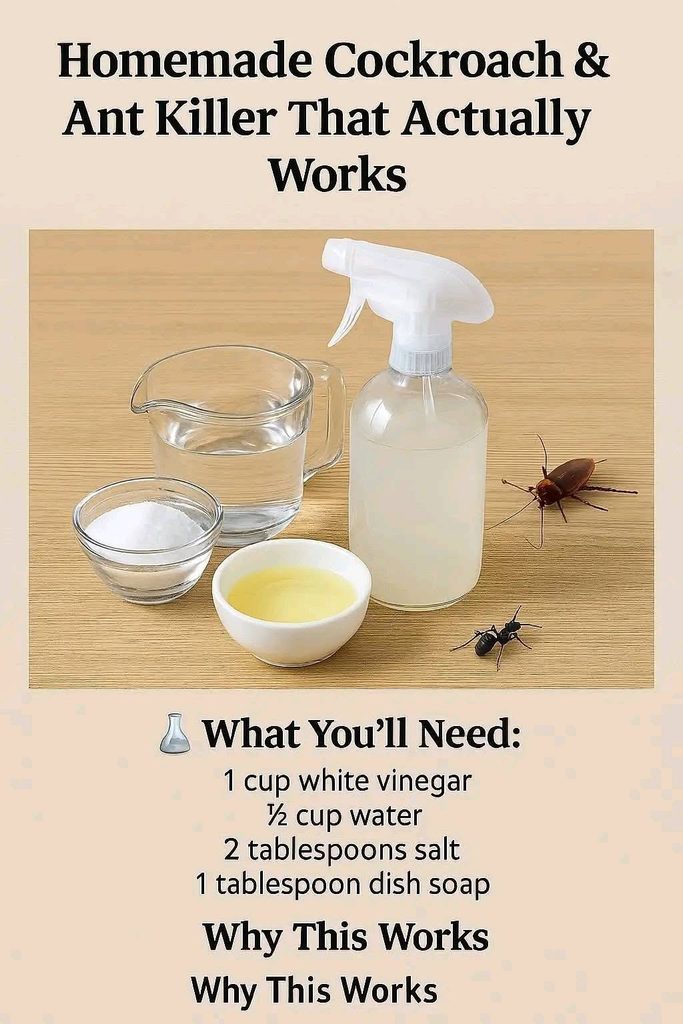
The Viral Homemade Spray
One popular version uses:
- 1 cup white vinegar
- ½ cup water
- About 2 tablespoons mild dish soap
Pour the ingredients into a spray bottle and mix gently.
There’s no need to shake aggressively because the dish soap can create a large amount of foam.
Important Note About Baking Soda
Some versions add baking soda to vinegar.
That’s unnecessary for this spray.
When vinegar and baking soda are mixed together, they react and foam, which can also build pressure if they’re combined in a closed container.
For a simple household spray, stick with vinegar, water, and a small amount of dish soap.
Where Can You Spray It?
Rather than spraying your entire home, focus on places where you’ve actually noticed insect activity.
For example:
- Along ant trails
- Around door thresholds
- Near window frames
- Around garbage areas
- Along compatible hard surfaces near entry points
Always test the mixture on a hidden area first because vinegar can damage certain materials.
Avoid using vinegar on natural stone such as marble or granite, and be cautious with wood finishes and other acid-sensitive surfaces.
Why Vinegar May Help With Ants
Ants often travel using chemical scent trails.
When worker ants find food, they can leave behind signals that help other ants follow the same route.
Cleaning those trails can disrupt their activity temporarily.
The University of Minnesota Extension specifically notes that a mild vinegar-and-water solution can be used to wipe ant trails and temporarily disrupt ant activity.
But notice the key word:
Temporarily.
Wiping out the visible trail doesn’t necessarily eliminate the colony.
The queen and most of the colony may still be hidden somewhere else.
What Does Dish Soap Do?
Dish soap is useful primarily because it’s an excellent cleaner.
It removes grease and food residue that can attract pests.
A soapy solution may also kill some insects when it directly contacts them, but that doesn’t mean spraying soap around the kitchen will eliminate an entire hidden infestation.
The EPA has even documented dish-soap-and-water solutions as a suggestion for deterring ants, while cautioning that concentrated soap can harm plants and leave residue.
So think of the spray as a cleaning and short-term control tool, not a miracle pesticide.
Does It Really Kill Cockroaches?
This is where viral posts often exaggerate.
If you spray an insect directly with enough soapy solution, you may affect or kill it.
But killing the cockroach you can see doesn’t necessarily solve the real problem.
Cockroaches often hide:
- Behind refrigerators
- Under sinks
- Behind stoves
- Inside cracks
- Around plumbing
- Behind cabinets
- Near drains
- Inside wall gaps
If you’re seeing several cockroaches, there may be many more hidden from view.
That’s why established pest-control guidance focuses on eliminating their food, water, shelter, and entry routes, rather than relying solely on a homemade spray.
The Biggest Mistake People Make
Imagine seeing a cockroach.
You spray it.
It disappears.
Problem solved?
Unfortunately, maybe not.
If your kitchen still provides food, moisture, and hiding places, the conditions that attracted cockroaches remain unchanged.
The EPA recommends a simple principle:
Starve them out. Dry them out. Keep them out.
That means removing food sources, eliminating unnecessary water, and sealing possible entry points.
This is far more important for long-term control than spraying random surfaces every evening.
Step 1: Remove Their Food
Cockroaches and ants don’t need much food.
Tiny crumbs are enough.
Before going to bed:
- Wipe countertops
- Clean grease around the stove
- Sweep or vacuum crumbs
- Wash dirty dishes
- Store food in closed containers
- Keep garbage covered
- Don’t leave pet food out overnight
Pay particular attention to the spaces underneath appliances.
You may be surprised by how many crumbs accumulate under a refrigerator or stove.
Step 2: Remove Water
Cockroaches need moisture.
Check your home for:
- Dripping faucets
- Leaking pipes
- Water beneath sinks
- Wet sponges
- Water around refrigerators
- Pet water left overnight
- Excess water beneath houseplants
The EPA specifically recommends fixing leaks and removing accessible sources of water as part of household pest prevention.
A clean kitchen with a leaking pipe can still provide cockroaches with exactly what they need.
Step 3: Seal Their Entry Points
Look carefully around:
- Pipes
- Baseboards
- Doors
- Windows
- Cabinets
- Wall cracks
Small gaps can provide both entry routes and hiding places.
Seal appropriate cracks and openings whenever possible.
This is especially important in apartments, where cockroaches can sometimes move between neighboring units.
What About Ants?
Ants require a slightly different approach.
If you find a trail, don’t just focus on killing the ants you can see.
First, figure out what they’re trying to reach.
Maybe it’s:
🍯 Sugar
🍞 Crumbs
🐕 Pet food
🍉 Fruit
🗑️ Garbage
Remove the food source and clean the trail.
Then watch where the ants are entering.
The University of Minnesota Extension explains that killing only foraging worker ants often has limited effect because only a small portion of the colony is outside the nest at a given time. Targeting the colony, including with an appropriate bait when needed, can be more effective.
A Better Strategy for Persistent Ants
If cleaning doesn’t solve the problem, ant bait can be useful.
The idea is different from spraying.
Workers collect bait and carry it toward the colony.
But you need the appropriate product for the species and situation.
Always follow the label carefully, especially around children and pets.
And avoid spraying insecticide directly around bait because you may discourage ants from approaching it.
What About Cockroach Baits?
Cockroach bait stations or gels can also be more useful for established infestations than repeatedly spraying visible insects.
Place appropriate products according to their labels near areas of activity, such as around cracks and hiding places.
Don’t put pesticides somewhere simply because you saw someone do it in a viral video.
Follow the manufacturer’s directions.
Try This Nighttime Test
Cockroaches are often more active when the house becomes quiet and dark.
If you suspect an infestation, wait until late evening.
Enter the kitchen quietly with a flashlight and inspect:
- Under the sink
- Around the refrigerator
- Behind the stove
- Near garbage
- Inside lower cabinets
- Around plumbing
Sticky monitoring traps can also help reveal where activity is concentrated.
If you’re consistently finding several cockroaches, you’re probably dealing with more than one lost insect.
Why Cleaning Is So Powerful
People often think pest control begins with poison.
It actually begins with prevention.
Pests need the same basic resources other living creatures need:
Food. Water. Shelter.
Take those away and your home becomes much less attractive.
The EPA calls the broader approach Integrated Pest Management (IPM)—combining monitoring, prevention, sanitation, exclusion, and targeted treatments instead of relying on one chemical solution.
Don’t Mix Random Household Chemicals
This is extremely important.
Social media is filled with homemade pest recipes combining multiple cleaning products.
Don’t assume:
“If one cleaner works, mixing three together must work even better.”
Never randomly combine bleach, ammonia, drain cleaners, disinfectants, or other household chemicals.
Dangerous reactions and fumes can result from incompatible products.
Use cleaning products according to their labels.
Be Careful Around Children and Pets
Even homemade mixtures shouldn’t automatically be considered harmless.
Keep spray bottles out of children’s reach.
Don’t spray directly onto pets.
Don’t leave unknown mixtures in cups or bowls where children or animals could drink them.
And clearly label any homemade cleaning bottle so nobody mistakes it for something else.
When the Homemade Method Isn’t Enough
A little ant activity near a window may be manageable with cleaning and prevention.
A serious cockroach infestation is different.
Consider professional pest-control help if:
- You regularly see cockroaches during daylight
- You see numerous cockroaches every night
- You find egg cases
- Several rooms are affected
- The infestation repeatedly returns
- Baits and sanitation aren’t improving the situation
- You live in a multi-unit building with widespread activity
Professional treatment can target hiding places and breeding populations that you may not be able to reach yourself.
So, Does the Viral Recipe “Actually Work”?
The answer depends on what you mean by “work.”
For cleaning ant trails?
A mild vinegar solution can help temporarily disrupt them.
For directly spraying individual insects?
Soapy water may affect insects it directly contacts.
For eliminating an entire ant colony?
Not reliably.
For eliminating a cockroach infestation?
Don’t count on vinegar and dish soap alone.
For long-term control, sanitation, moisture control, sealing entry points, monitoring, and appropriate targeted treatments are much more important.
The Bottom Line
The viral homemade mixture isn’t completely useless—but “Homemade Cockroach & Ant Killer That Actually Works” makes it sound far more powerful than it really is.
If you want to try a simple household spray, use:
1 cup white vinegar + ½ cup water + a small amount of dish soap.
Use it primarily for cleaning compatible surfaces and disrupting ant trails rather than treating it as a guaranteed exterminator.
And remember the real secret to keeping pests away:
Remove food.
Eliminate water.
Seal cracks and entry points.
Keep the kitchen clean.
Use properly labeled baits or other targeted treatments when necessary.
Because the best pest-control trick isn’t the bottle sitting under your sink.
It’s making your home a place where pests have nothing to eat, nowhere to hide, and fewer ways to get inside. 🐜🪳🏠