Imagine walking toward your doorway and spotting a large, brown, spider-like creature with a long, curved appendage stretching behind it. You look closer, expecting an ordinary house spider, but something about its appearance doesn’t seem right. Is it a dangerous spider, a bizarre insect, or something else entirely?
A mysterious photograph circulating on social media has caught people’s attention for exactly this reason.
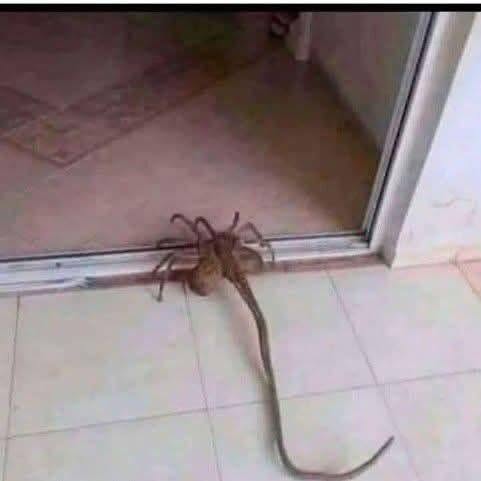
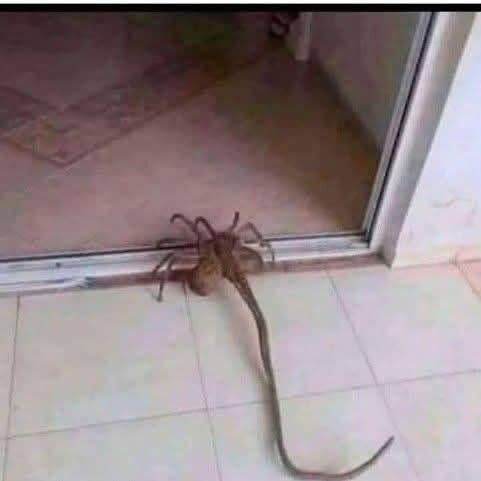
The image shows what appears to be a brown spider positioned near a sliding doorway. Several long legs extend around its body, while an unusually long, narrow structure curves across the tiled floor.
The person who shared the picture reportedly wrote:
“Normally I’m pretty good about our local spiders, but this one has me stumped. This is the third one I’ve found in my house this summer.”
It’s easy to understand the confusion.
At first glance, the creature resembles an oversized spider with a tail.
But the photograph raises an important question: What exactly are we looking at?
The answer isn’t necessarily as frightening as the picture suggests.
Let’s explore the possible explanations, why spiders sometimes look so unusual, whether a creature like this could be dangerous, and what to do if you discover something similar in your home.
The Strange Discovery That Sparked Curiosity
Finding a spider indoors is a fairly common experience.
Most people have encountered one hiding behind furniture, crawling along a wall, or sitting quietly in a corner.
But occasionally, an animal appears so unusual that even someone familiar with local wildlife has difficulty recognizing it.
That’s what makes this particular image intriguing.
The creature appears to have a rounded brown body and multiple long, jointed legs.
Behind it is a thin, extended structure that looks almost like a tail.
Unlike the short appendages usually associated with spiders, this structure appears remarkably long.
It curves across the floor and seems to end in a slight upward hook.
The result is a silhouette that looks more like a creature from a science-fiction movie than a familiar household spider.
However, photographs can be misleading.
Lighting, perspective, overlapping objects, and low image resolution can make an ordinary animal appear extraordinary.
Before identifying the creature, it’s important to understand what spiders actually look like.
Do Spiders Have Tails?
Most living spiders do not have long, flexible tails like those seen on lizards or scorpions.
A typical spider has two main body regions:
- The cephalothorax, which contains the eyes, mouthparts, and leg attachments.
- The abdomen, which contains many of the spider’s internal organs.
Spiders also have eight legs, although some may be hidden from view or difficult to distinguish in photographs.
At the rear of the abdomen are structures called spinnerets.
These help produce and manipulate silk.
In most familiar spider species, the spinnerets are relatively short and do not resemble a long tail.
However, some spiders have more noticeable spinnerets, and a few unusual groups have elongated rear structures.
This is one reason an unfamiliar spider can look surprisingly different from the species people commonly encounter.
Still, the very long appendage in the viral photograph cannot be confidently explained from the image alone.
Could It Be a Spider With Unusually Long Spinnerets?
One possibility worth considering is a spider belonging to a group with prominent spinnerets.
Spinnerets are the silk-producing structures located near the rear of a spider’s abdomen.
Most people never notice them.
But in certain spiders, they are more visible.
For example, some members of the family Hersiliidae are commonly known as two-tailed spiders because they have elongated posterior spinnerets.
These spiders are particularly interesting because of their hunting behavior.
Rather than relying exclusively on a conventional web to trap prey, some can move rapidly around insects while wrapping them in silk.
Their long spinnerets help them manipulate the silk during this process.
However, these spiders generally have two conspicuous elongated spinnerets, not one extremely long, curved tail.
The animal in the photograph does not show enough detail to confirm that it belongs to this family.
An unusual appendage alone is not enough to identify a spider species.
Could It Be a Whip Spider?
Another possibility that often comes up when people encounter a strange arachnid is a whip spider.
Whip spiders, also known as amblypygids or tailless whip scorpions, are arachnids with flattened bodies and exceptionally long, thin front legs.
These specialized legs function as sensory organs.
Because they resemble whips, they can give the animal a startling appearance.
Whip spiders are not true spiders, even though they belong to the same broader class of animals: Arachnida.
They are generally nocturnal and often inhabit warm environments.
Despite their intimidating appearance, whip spiders lack the venom-injecting fangs of true spiders.
They can still defend themselves physically if handled, but they are not generally considered dangerous to humans.
Could the creature in the photograph be a whip spider?
It’s difficult to say.
The apparent body shape and the long trailing structure do not provide enough information for a reliable identification.
The photograph also lacks a clear view of the creature’s front appendages.
Therefore, identifying it as a whip spider would be speculative.
What About a Vinegaroon or Whip Scorpion?
Vinegaroons are another fascinating group of arachnids.
They are sometimes called whip scorpions because of the long, whip-like appendage extending from the rear of their bodies.
Unlike true scorpions, vinegaroons do not possess a venomous stinger.
Instead, they can release a defensive spray containing acetic acid and other compounds.
This spray has a vinegar-like smell, which explains their common name.
Vinegaroons have robust bodies, large front appendages, and a thin tail-like flagellum.
Their unusual anatomy makes them one of the first animals people think of when they see an arachnid with a tail.
But there is an important complication.
A typical vinegaroon has a recognizable body shape, including prominent pedipalps that resemble pincers.
Those features are not clearly visible in the social media image.
Without a sharper photograph, it would be inappropriate to conclude that the animal is a vinegaroon.
Nevertheless, vinegaroons demonstrate an important fact:
Not every eight-legged creature with a long tail-like structure is a true spider.
Could the Image Show a Spider Carrying Something?
There is another explanation that deserves consideration.
The long structure might not be part of the animal’s body at all.
Spiders occasionally carry prey, debris, or other material.
A spider may be photographed while dragging an insect, moving through vegetation, or resting beside an object that appears connected to its abdomen.
A thin cable, plant stem, strand of material, or even another animal could create the illusion of a tail.
This effect is especially convincing when the photograph is blurry or taken from a distance.
In the viral image, the point where the long structure meets the apparent spider is not sufficiently clear.
That makes it difficult to determine whether the structure is anatomically attached.
It may be part of the animal.
It may be something the animal is holding or dragging.
Or it may be an unrelated object positioned behind it.
The photograph simply does not establish which explanation is correct.
Could It Be a Digitally Altered Image?
With modern editing software and artificial intelligence, unusual animal photographs should be evaluated carefully.
Some images are genuine photographs of rare animals.
Others are ordinary photographs modified to make a creature look more frightening or mysterious.
And some are entirely computer-generated.
A strangely proportioned animal, unclear body connections, or inconsistent details may raise questions about authenticity.
However, these characteristics are not proof of manipulation.
Poor lighting, compression, motion blur, and unusual camera angles can produce similar effects.
In this case, the image is too limited to establish whether it has been edited.
A reliable assessment would require the original photograph, preferably at higher resolution, along with additional images or video of the animal.
Until then, any definitive identification would be premature.
Are Strange-Looking Spiders Dangerous?
The appearance of an arachnid is not a reliable measure of its danger.
Some large, intimidating spiders have venom that poses relatively little medical risk to humans.
Meanwhile, certain smaller species can cause medically significant bites.
Most spiders are not aggressive toward people.
They typically bite only when trapped, pressed against the skin, or otherwise threatened.
Even when a spider is venomous, that does not automatically mean it is dangerous to humans.
Venom potency, the amount delivered, and the person’s response all matter.
Because the creature in the photograph cannot be reliably identified, its medical significance cannot be determined from the image.
If you find an unfamiliar arachnid in your home, the safest approach is to avoid direct contact.
Why Are Spiders Entering Homes?
The social media caption suggests that the person had encountered several similar creatures during the same summer.
That detail raises another question.
Why might unusual spiders or other arachnids repeatedly appear inside a house?
There are several possible explanations.
1. Searching for Food
Many spiders enter buildings because insects are present.
Flies, moths, mosquitoes, and other small arthropods can attract predators.
Outdoor lights may also attract insects, indirectly drawing spiders toward doorways and windows.
2. Seasonal Activity
Some species become more noticeable during particular seasons.
Adult males may wander while searching for mates.
Others become more active when temperatures or humidity change.
3. Access Through Small Openings
Spiders can enter through gaps around doors, windows, vents, and utility openings.
Sliding doors may have small spaces near their tracks or seals.
4. Shelter From Weather
Some arachnids seek protected environments during periods of extreme heat, cold, or heavy rain.
Garages, basements, sheds, and storage rooms can provide suitable hiding places.
5. Suitable Indoor Habitat
Cluttered storage areas, undisturbed corners, and spaces containing insects can support spider activity.
Finding several spiders indoors does not necessarily mean there is a dangerous infestation.
However, repeated sightings may indicate that entry points or insect populations deserve attention.
What Should You Do if You Find an Unknown Spider in Your Home?
Discovering an unfamiliar arachnid can be unsettling.
But panicking or attempting to handle it with bare hands is rarely helpful.
A calm, cautious response is usually best.
Step 1: Keep Your Distance
Avoid touching the animal.
Don’t try to pick it up to examine its body.
Even a normally harmless species may bite or defend itself if handled.
Step 2: Keep Children and Pets Away
If the animal is in a busy part of the home, prevent children and pets from approaching it.
This reduces the risk of accidental contact.
Step 3: Take a Clear Photograph
If you can do so safely, take photographs from a distance.
Try to capture:
- The top of the animal.
- The body and legs.
- Any unusual appendages.
- A nearby object for scale.
- The surrounding environment.
A clear photograph can help a local expert make an identification.
Step 4: Avoid Using Your Hands
If the animal is not suspected to be medically significant and can be safely contained, a transparent container and a stiff piece of cardboard may help move it without direct contact.
If you are uncertain about the species or uncomfortable approaching it, leave it alone and seek assistance.
Step 5: Contact a Local Expert
A university entomology department, local wildlife specialist, or qualified pest management professional may be able to help identify the animal.
Local knowledge is particularly important because arachnid species vary greatly by region.
Step 6: Check Possible Entry Points
Inspect door seals, window screens, and visible gaps.
Repairing openings can help reduce future encounters.
What if a Spider Bites You?
Most suspected spider bites do not result in serious medical problems.
However, some can require medical evaluation.
If you believe you have been bitten:
- Move away from the animal.
- Wash the affected area gently with soap and water.
- Apply a cool compress wrapped in cloth.
- Avoid scratching or squeezing the area.
- Monitor for worsening symptoms.
Do not cut the wound, attempt to suck out venom, or apply dangerous home remedies.
Seek urgent medical care if you experience difficulty breathing, severe or spreading pain, significant swelling, muscle spasms, fainting, or other serious symptoms.
Also seek medical advice if the bite area becomes increasingly red, hot, painful, or develops signs of infection.
If possible, photograph the animal without attempting to capture it by hand.
A photograph may help with identification, although treatment often depends more on symptoms than on the suspected species.
The Fascinating World of Unusual Arachnids
One reason the viral photograph has attracted attention is that arachnids are much more diverse than many people realize.
The group includes far more than ordinary house spiders.
Some arachnids have body structures that look almost unbelievable.
Here are several examples.
Tailless Whip Scorpions
These arachnids have long sensory legs and flattened bodies.
They are often mistaken for dangerous spiders because of their dramatic appearance.
Vinegaroons
Vinegaroons have a whip-like tail and can release a defensive spray.
They are not true scorpions.
Pseudoscorpions
These tiny arachnids resemble miniature scorpions but lack a long tail.
They can sometimes be found indoors, where they prey on small arthropods.
Harvestmen
Often called daddy longlegs, harvestmen are frequently confused with spiders.
Unlike typical spiders, their two main body regions appear broadly joined.
They also do not produce silk in the same way spiders do.
Camel Spiders
Camel spiders belong to the order Solifugae.
They have large mouthparts and can run quickly, which contributes to their frightening reputation.
Despite their common name, they are not true spiders.
Two-Tailed Spiders
Certain spiders possess unusually long spinnerets.
Their distinctive anatomy can make them look very different from familiar house spiders.
These examples show why identifying an unfamiliar arachnid requires more than counting legs or looking for a tail.
Why Animal Photos Can Be So Misleading
A photograph captures only one moment from one angle.
That can make identification surprisingly difficult.
Consider how different an ordinary spider might look if photographed:
- From directly above.
- From underneath.
- While moving quickly.
- With several legs overlapping.
- Beside a curved plant stem.
- In poor lighting.
- Through a glass door.
- With a low-resolution camera.
Even experienced naturalists sometimes need multiple images to identify an animal.
The problem becomes greater when a photograph circulates online without a location, date, or original source.
For example, knowing whether the animal was found in North America, Australia, Africa, or Southeast Asia could significantly narrow the possibilities.
Habitat information can also help.
Was it found near a garden?
Inside a bathroom?
In a tropical forest?
In a dry, desert-like region?
All of these details matter.
Without them, the most responsible answer may simply be that the animal cannot yet be identified with confidence.
How to Make Your Home Less Attractive to Spiders
If you’re uncomfortable finding spiders indoors, there are several practical ways to reduce encounters.
The goal is to make entry more difficult and remove conditions that attract insects.
Seal Gaps Around Doors and Windows
Check weatherstripping and door sweeps.
Repair visible gaps where small animals may enter.
Repair Damaged Screens
Window and vent screens help keep insects and other arthropods outside.
Reduce Clutter
Boxes, piles of clothing, and unused items provide hiding places.
Keeping storage areas organized makes inspection and cleaning easier.
Vacuum Regularly
Vacuuming corners, baseboards, and undisturbed areas can remove webs, egg sacs, and some spiders.
Dispose of vacuum contents appropriately.
Control Indoor Insects
Because many spiders feed on insects, reducing indoor insect activity may also reduce spider activity.
Adjust Outdoor Lighting
Bright exterior lights can attract flying insects.
Using lighting only when needed or choosing less insect-attracting options may help.
Avoid Unnecessary Chemical Treatments
Not every spider sighting requires pesticide use.
If repeated sightings are a concern, a qualified pest management professional can recommend appropriate measures.
Should You Kill a Spider Found Indoors?
Many people instinctively want to kill any spider they encounter.
But most spiders are beneficial predators.
They help control populations of flies, mosquitoes, and other insects.
When an animal is clearly identified as harmless, relocation may be an option.
However, if its identity is uncertain, don’t put yourself at risk attempting to handle it.
Keeping a safe distance and seeking expert advice is a sensible approach.
The decision should be based on safety and the local species involved—not simply on how frightening the animal looks.
Frequently Asked Questions
Can a Real Spider Have a Tail?
Most modern spiders do not have a long tail. Some species possess elongated spinnerets that can resemble short tails, while other arachnids have genuine tail-like structures.
What Is a Spider With a Long Whip-Like Tail Called?
A vinegaroon, also known as a whip scorpion, has a long, thin tail-like flagellum. However, not every photograph of a spider-like animal with a tail shows a vinegaroon.
Are Whip Spiders Dangerous?
Tailless whip scorpions do not have venom-injecting fangs like true spiders and are generally not considered dangerous to humans. They should still be left undisturbed.
Are Vinegaroons Venomous?
Vinegaroons do not possess a venomous stinger. They can release an irritating defensive spray, so handling them is not recommended.
Why Would the Same Unusual Spider Appear Several Times in One Summer?
Seasonal activity, suitable habitat, insect availability, and access through gaps can contribute to repeated sightings.
Can Spiders Enter Through Sliding Doors?
Yes. Small openings around sliding door tracks and seals may allow spiders and other arthropods to enter.
Can You Identify a Spider From One Photograph?
Sometimes, but not always. Clear images, location information, and views of identifying features are often needed.
Is the Creature in the Viral Photo Definitely a Spider?
No. The image does not provide enough detail to establish whether the animal is a true spider, another arachnid, or an animal photographed alongside an unrelated object.
Is the Long Structure Definitely a Tail?
No. The apparent connection between the structure and the animal’s body is unclear.
Should You Be Worried if You Find One?
Not necessarily. Appearance alone does not establish danger. Avoid touching an unidentified animal and consult a local expert if needed.
Final Thoughts: The Truth Behind the Mysterious Long-Tailed Spider
The viral photograph is certainly unusual.
A brown, spider-like creature stands near a doorway, surrounded by long legs, with a remarkable curved structure trailing behind it.
It’s easy to understand why someone might be startled.
But the image also illustrates an important lesson about nature.
Something that looks terrifying is not automatically dangerous, and something that looks extraordinary is not always what it appears to be.
The creature could represent an unusual arachnid.
The long structure could be a specialized appendage.
It might also be an unrelated object or a misleading photographic detail.
Without a clearer image and reliable information about where the animal was found, its identity remains uncertain.
What we can say is that the animal kingdom contains many extraordinary arachnids, including whip spiders, vinegaroons, and spiders with elongated spinnerets.
Their unfamiliar appearances often inspire fear, even when they pose little threat to people.
If you ever encounter a strange spider-like creature at home, remember three things:
Don’t touch it. Photograph it safely. And seek a reliable identification before jumping to conclusions.
Sometimes, the most fascinating discoveries begin with something as simple as looking down at the floor and asking:
“What on earth is that?”
What Do You Think?
Take another look at the strange creature in the photograph.
Does it resemble a spider carrying something?
A whip-tailed arachnid?
Or an optical illusion created by an unusual camera angle?
Would you stay calm if you found this creature near your doorway, or would you immediately leave the room?
Share your reaction in the comments!