If you spend enough time driving around areas where pickup trucks are common, you may eventually notice something unusual: one or more tall metal posts sticking vertically out of the truck bed directly behind the cab.
They can look like antennas, exhaust pipes, flag holders, or even some mysterious piece of equipment.
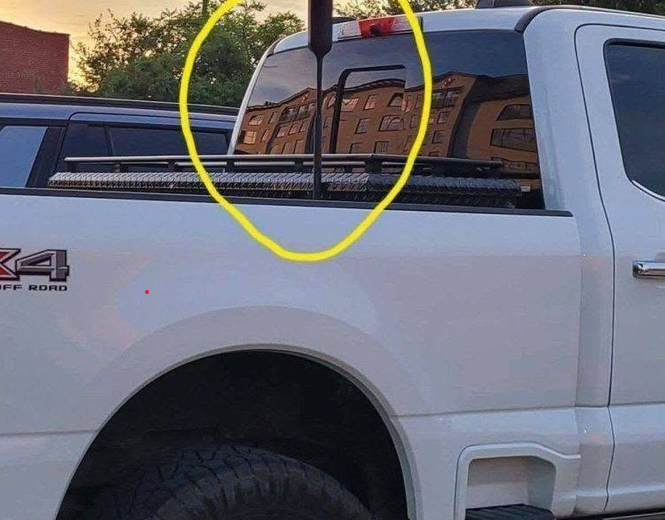
A viral photo showing a white pickup with tall black uprights has left plenty of people asking the same question:
“I see these on trucks everywhere. What are they?”
The answer is less mysterious than it looks. In many cases, these uprights are part of a truck rack, headache rack, cargo-support system, or removable rack setup designed to protect the cab and help carry or secure loads.
But the exact function depends on the particular setup.
The Most Common Explanation: A Headache Rack or Cargo Rack
A headache rack, sometimes called a cab guard or cab protector, is a metal structure installed at the front of a pickup bed, immediately behind the cab.
Traditional versions are easy to recognize because they usually have two vertical supports connected by horizontal bars, mesh, or louvers.
Their main job is to create a protective barrier between cargo and the truck’s rear window.
Manufacturers describe headache racks as protection against shifting materials such as ladders, lumber, and pipes, particularly when the vehicle brakes suddenly.
The truck in the viral image doesn’t show a conventional full-width mesh guard, however. The narrow vertical uprights may instead be components of a more minimal or removable cargo-rack arrangement.
Why Would a Truck Need Tall Upright Posts?
Pickup beds are excellent for carrying cargo, but they have one obvious limitation:
The bed walls aren’t very tall.
Imagine loading several long boards, pipes, ladders, or pieces of construction material.
You need something sturdy to help position and secure those items.
That’s where racks and uprights become useful.
Depending on the design, vertical posts can provide support points for:
- Lumber
- Pipes
- Ladders
- Construction materials
- Long tools
- Landscaping equipment
- Kayaks or canoes
- Oversized cargo
More elaborate bed racks use uprights at both the front and rear of the bed with crossbars connecting them. This creates an elevated platform that can carry long items above the truck bed.
Why Are They Positioned Behind the Cab?
The front of the pickup bed is a particularly useful location for cargo support.
Long objects naturally extend toward the front of the truck. Without a proper rack, they could potentially contact the rear window or roof.
A rack behind the cab creates a strong support point before the cargo reaches the passenger compartment.
Some headache racks extend above the cab specifically so that longer materials can be supported without resting directly against the truck’s roof.
The Name “Headache Rack” Has an Interesting Meaning
It’s a strange name until you understand its purpose.
Imagine a pickup carrying heavy lumber or steel pipe.
The driver suddenly slams on the brakes.
Because of inertia, poorly secured cargo wants to continue moving forward.
And directly in front of the truck bed is the rear window—and the people sitting inside the cab.
A headache rack creates an additional physical barrier between the cargo and the cab. That’s why these structures are commonly described as protecting the rear window and occupants from forward-shifting loads.
The nickname essentially refers to avoiding one very serious “headache.”
But Are the Posts in the Picture Definitely a Headache Rack?
Not necessarily.
That’s an important distinction.
From a single photograph, we can see vertical posts mounted around the front portion of the pickup bed, but we can’t confirm the manufacturer or exact accessory model.
Pickup owners use many similar-looking systems.
The posts could be components of:
A headache/cab rack — primarily positioned behind the cab.
A ladder rack — designed to carry ladders and long materials above the bed.
A lumber rack — commonly used by contractors.
A modular bed rack — configurable for different cargo.
Removable uprights — inserted only when additional load support is required.
Different regions and trades may also use different names for very similar equipment.
So it’s safer to identify the pictured objects broadly as truck-bed cargo/rack uprights rather than claim that every vertical post seen on a pickup has one specific purpose.
Some Truck Racks Are Removable
This explains another thing that often confuses people.
You may see a pickup one day with two tall posts sticking out of the bed but no obvious horizontal structure connecting them.
That doesn’t necessarily mean something is missing.
Some truck-rack systems are modular.
Parts can be inserted, removed, or repositioned depending on what the owner needs to transport.
There are even patented designs for removable and vertically adjustable headache racks that fit into truck-bed mounting structures.
A contractor may therefore leave certain supports installed while removing other parts of the rack when they’re unnecessary.
They’re Not Usually Exhaust Pipes
This is one of the first guesses people make.
Diesel trucks sometimes have vertical exhaust stacks, especially heavily modified pickups.
But cargo-rack uprights and exhaust stacks serve completely different purposes.
An exhaust stack needs to be connected to the vehicle’s exhaust system and designed to carry exhaust gases safely.
A rack post is simply structural equipment.
If you see multiple square or rectangular metal posts mounted to the bed rails, particularly around cargo-rack hardware, you’re probably looking at a rack system rather than exhaust pipes.
They’re Not Antennas Either
Antennas generally have a different construction.
Radio antennas are usually relatively thin and often flexible. Even larger communications antennas require appropriate cables and mounting equipment.
Cargo uprights are typically:
- Thicker
- Rigid
- Made from steel or aluminum
- Square or rectangular tubing
- Mechanically attached to the bed or rack structure
Their strength is the clue.
They’re designed to support or restrain something rather than transmit a radio signal.
Why Contractors Love Truck Racks
For someone who uses a pickup exclusively for groceries and weekend trips, a rack may seem unnecessary.
For tradespeople, it can completely change how useful the truck is.
Consider a carpenter carrying 12-foot boards.
Putting them flat inside a short pickup bed would leave a significant portion hanging beyond the tailgate.
An elevated rack allows long material to extend over the cab instead.
Headache racks can also provide additional tie-down locations and support for ladders, boards, and other oversized materials.
That’s why these accessories are frequently seen on:
- Construction trucks
- Roofing vehicles
- Plumbing trucks
- Electrical contractor pickups
- Landscaping vehicles
- Farm trucks
- Maintenance vehicles
For those owners, the unusual-looking metal structure is essentially another tool.
They Can Also Protect the Rear Window
A pickup’s rear window is vulnerable when the truck is carrying long or heavy objects.
Imagine sliding a ladder into the bed too aggressively.
Or having a piece of lumber move forward during braking.
Without protection, the object could strike the glass.
A properly designed headache rack creates a barrier between cargo and the rear of the cab.
WEATHER GUARD, for example, describes headache racks as barriers intended to help protect the rear window and cab from shifting materials such as lumber, ladders, and pipe.
That protection can be particularly valuable on trucks used for work every day.
Can You Tie Cargo Directly to the Posts?
That depends entirely on the rack.
Some systems intentionally provide tie-down points.
Others don’t.
Never assume that any vertical object attached to a truck is automatically rated as a cargo anchor.
If you’re using a rack system, follow the manufacturer’s:
- Load limits
- Installation requirements
- Tie-down instructions
- Crossbar limits
- Weight-distribution recommendations
Heavy cargo needs to be properly restrained regardless of whether a headache rack is installed.
A rack should never be treated as a substitute for correctly securing the load.
Headache Rack vs. Ladder Rack: What’s the Difference?
The two are related but aren’t necessarily the same.
Headache Rack
Usually sits directly behind the cab.
Its most recognizable function is protecting the cab and rear window from shifting cargo.
It can also provide tie-down points and support longer materials.
Ladder Rack
Usually includes supports toward both the front and rear of the truck bed.
Crossbars create an elevated platform.
The primary purpose is carrying long objects such as ladders, lumber, pipes, or recreational equipment.
Full Bed Rack
A more extensive framework can span much of the truck bed.
These systems are increasingly popular for work, camping, and overlanding.
They may carry:
- Rooftop tents
- Recovery equipment
- Storage boxes
- Kayaks
- Fuel or water containers
- Camping equipment
The basic engineering principle remains similar: use the space above the pickup bed instead of relying only on the bed floor.
Why Not Just Put Everything in the Truck Bed?
Because some cargo is longer than the bed.
A typical pickup bed simply can’t fully contain a long ladder or long pieces of lumber.
A rack lets the owner use vertical space.
Instead of this:
long object → hanging far behind the tailgate
you can potentially have:
long object → supported above the bed and cab
Of course, oversized loads still need to comply with local road laws regarding securement, overhang, flags, lighting, and maximum dimensions.
Steel vs. Aluminum Truck Racks
Most heavy-duty racks are made from steel or aluminum.
Each has advantages.
Steel
Steel is strong and commonly used for work-truck equipment.
It can handle demanding environments when properly designed and maintained.
The disadvantage is weight and the potential for corrosion if protective coatings become damaged.
Aluminum
Aluminum is lighter and naturally resistant to rust.
That makes it attractive for owners who want useful cargo capacity without adding unnecessary weight.
Commercial headache-rack manufacturers offer both styles, depending on the application.
Some Racks Hold Lights Too
Once you’ve installed a strong metal frame behind the cab, it becomes a convenient location for accessories.
Depending on the design, owners may install:
- Work lights
- Warning lights
- LED light bars
- Antennas
- Tool mounts
- Tie-down hardware
This is another reason you may see unusual posts or brackets behind pickup cabs even when the truck isn’t currently carrying anything.
The equipment may serve several purposes.
Are Headache Racks Required?
Not every pickup needs one.
Someone who rarely carries anything larger than grocery bags probably won’t gain much from a heavy commercial cargo rack.
They become more useful when a truck regularly transports:
- Heavy equipment
- Long lumber
- Pipes
- Ladders
- Tools
- Construction supplies
Even then, owners need to choose a rack designed for their particular truck and intended load.
Does a Headache Rack Make Unsecured Cargo Safe?
Absolutely not.
This is an important misconception.
Installing a protective rack doesn’t give you permission to throw heavy objects into the bed without securing them.
The rack is an additional protective structure.
Proper cargo securement remains essential.
Ratchet straps, appropriate tie-down points, load positioning, and equipment rated for the cargo should be used as required.
Think of the rack as additional protection—not as your entire cargo-securement system.
Why Do Some Trucks Have Just One or Two Strange Posts?
Truck racks come in many configurations.
Some have enormous full-width frames.
Others are minimalist.
Some systems are partially removable.
And some owners customize their trucks for very specific work.
That’s why one pickup might have a massive mesh guard covering the entire rear window while another has only a few narrow uprights.
The exact configuration depends on what the truck is used for.
Frequently Asked Questions
What are the sticks behind pickup truck cabs?
They are often components of a headache rack, ladder rack, lumber rack, or another truck-bed cargo-support system. The exact equipment can vary by truck.
Why are they so tall?
Tall supports can help support cargo above the bed and sometimes above the roofline, allowing long objects such as ladders or lumber to be transported more effectively.
Why is it called a headache rack?
The name refers to the rack’s role in helping prevent cargo from moving forward into the rear window and passenger cab during sudden stops.
Are they exhaust pipes?
Usually not. Cargo-rack posts are structural components. Exhaust stacks are connected to the vehicle’s exhaust system.
Are they roll bars?
Not necessarily. A cargo/headache rack and a rollover-protection structure aren’t automatically the same thing. Don’t assume a cargo rack provides certified rollover protection unless the manufacturer specifically says it does.
Can they carry ladders?
Many truck racks are specifically designed to help carry ladders and other long materials. The exact weight capacity and configuration depend on the particular rack.
Can they protect the truck’s rear window?
A proper headache rack is designed to help protect the cab and rear glass from cargo moving forward.
The Bottom Line
Those mysterious vertical metal “sticks” behind pickup truck cabs aren’t usually antennas or decorative pipes.
They’re commonly part of a cargo rack, headache rack, ladder rack, or removable truck-bed support system.
Their exact purpose varies with the design, but these systems can help support long cargo, provide mounting or tie-down locations, and—in the case of headache racks—create an additional barrier between shifting cargo and the rear of the cab.
So the next time you see a work truck with strange posts sticking several feet above its bed, there’s probably a practical explanation.
They’re there because the truck was equipped to carry something that wouldn’t fit neatly inside the bed.