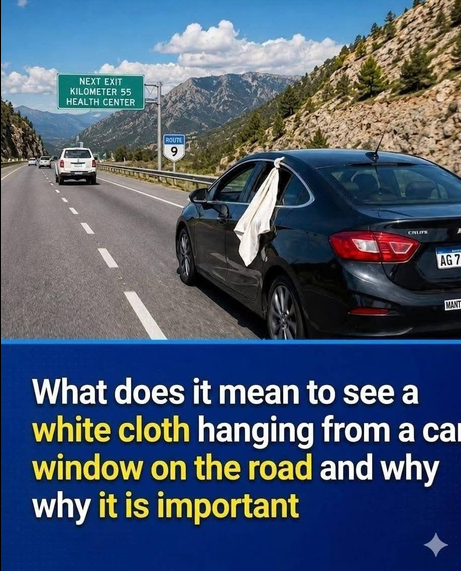
You’re driving along a highway when you notice something unusual on another vehicle: a white cloth, towel, T-shirt, or handkerchief hanging from one of its windows.
At first, it might look like someone simply forgot a piece of clothing there.
But in some places, a visible white cloth has traditionally been used as a distress signal—particularly when a vehicle has broken down and the driver needs assistance.
There’s an important catch, however: this isn’t a universal traffic signal with exactly the same meaning everywhere. Customs and official guidance vary by location, and drivers shouldn’t automatically assume that every white cloth means the same thing.
Here’s what you should know.
The Most Common Meaning: “This Vehicle Is Disabled”
One of the best-documented uses of a white cloth on a vehicle is to indicate that the car has become disabled.
In this situation, the driver may attach or display something white where approaching motorists and roadside assistance can easily see it.
The message is essentially:
“My vehicle has a problem, and I may need assistance.”
This can be particularly useful when the car is stopped on the shoulder and the driver needs to make it clear that the vehicle has broken down rather than simply been parked.
The custom has appeared in U.S. driving guidance, including material associated with North Carolina road practices. However, it should be treated as a location-dependent signal rather than a universal rule recognized everywhere.
Why Use a White Cloth?
Before mobile phones became nearly universal, getting stranded on a highway could be much more complicated.
Drivers couldn’t simply call roadside assistance from their vehicle.
A visible cloth offered a simple way of communicating distress to:
- Passing motorists
- Police officers
- Highway patrol
- Tow-truck operators
- Roadside workers
White was particularly useful because a light-colored cloth could be relatively easy to notice against many vehicles.
Even today, some motorists still know the tradition.
Does It Always Mean “Emergency”?
No.
This is where viral social-media posts often oversimplify the story.
A white cloth hanging from a car window doesn’t have one legally standardized meaning throughout the United States or the world.
Its meaning depends on context and location.
It might be used to indicate a disabled vehicle.
It could be an improvised attempt to attract attention during an emergency.
Or it might have nothing to do with an emergency at all.
Someone could simply have a towel, shirt, decoration, or other object hanging from the window.
So don’t see a white cloth and automatically assume a medical crisis is happening inside the vehicle.
Look at the entire situation.
A White Cloth Is Not a Replacement for Hazard Lights
If your vehicle suddenly develops a mechanical problem, don’t rely exclusively on a piece of fabric.
Modern vehicles have hazard warning lights specifically designed to alert other road users that something unusual is happening.
If you can safely move the vehicle out of active traffic, do so.
Then use the appropriate warning equipment and contact roadside assistance or emergency services as necessary.
A white cloth can provide additional visibility, where its use is recognized, but it shouldn’t replace established emergency procedures.
What Should You Do If Your Car Breaks Down?
A breakdown on a high-speed road can become dangerous very quickly.
The safest response depends on where your vehicle stops and the type of roadway you’re traveling on.
As a general principle, if the vehicle is still controllable, try to move away from active traffic to a safe location.
Turn on your hazard lights.
Make the vehicle as visible as reasonably possible.
Then contact the appropriate roadside assistance service.
If there’s an immediate danger to life, a collision, fire, or medical emergency, contact local emergency services.
Should You Stay Inside or Get Out?
There’s no universal answer because the safest choice depends on your location.
Getting out of a vehicle beside fast-moving traffic can be extremely dangerous.
On the other hand, remaining inside a vehicle stopped in an active traffic lane can also be dangerous.
Follow local highway-authority guidance and emergency-dispatch instructions for the particular situation.
Most importantly, don’t stand directly beside your vehicle in a live traffic lane.
What If You See a White Cloth on a Parked Car?
Imagine you’re driving down the highway and see a vehicle stopped well off the roadway.
Its hazard lights are flashing.
A white towel is hanging from the driver’s window.
There’s nobody standing outside.
In that context, the cloth may very well be intended to signal:
“This vehicle is disabled.”
That doesn’t necessarily mean you should stop.
Stopping on a high-speed road can create an additional hazard.
If the situation appears dangerous or someone seems to need urgent assistance, contact the appropriate emergency or highway service rather than making a risky stop.
What If the Car Is Still Moving?
This changes the situation.
A white cloth hanging from the window of a moving vehicle is much more ambiguous.
It could potentially be an attempt to attract attention during an emergency, but it could also simply be an object hanging from the vehicle.
There’s no universal rule saying:
Moving car + white cloth = medical emergency.
If the vehicle is being driven erratically, occupants are visibly signaling for help, or something else clearly suggests an emergency, keep a safe distance and contact emergency services when appropriate.
Don’t chase the vehicle or attempt a dangerous roadside intervention.
Could It Mean There’s a Medical Emergency?
Potentially—but you shouldn’t assume so based solely on the cloth.
People sometimes improvise signals when they urgently need attention.
A driver transporting someone experiencing a medical crisis might wave a cloth, flash headlights, activate hazard lights, or otherwise attempt to alert other motorists.
But a white cloth isn’t a universally standardized medical-emergency symbol for passenger cars.
If someone is experiencing a serious medical emergency, contacting emergency medical services is generally far safer than relying on other drivers to understand an improvised signal.
Is the White Cloth Signal Actually a Law?
Not generally as a universal rule.
Traffic laws vary significantly between jurisdictions.
There are also some very specific legal uses of white flags that shouldn’t be confused with the general roadside custom.
For example, North Carolina statutes provide for a specific reflective white distress flag with a red “H” for qualifying drivers with disabilities when getting into or out of vehicles or when in distress. That’s a defined statutory flag—not simply any random white towel hanging from a car window.
This illustrates why it’s important not to turn an informal roadside tradition into a supposed nationwide law.
Why Do Some People Put the Cloth on the Driver’s Door?
Visibility.
If the vehicle is parked on the shoulder, a cloth caught securely in a window can be seen by approaching traffic without requiring the driver to stand outside.
Other drivers may place it somewhere else visible on the vehicle.
Historically, the idea isn’t about one exact window.
The goal is to make the distress signal noticeable.
What About a White Cloth Tied to an Antenna?
That’s another variation people may encounter.
Older vehicles commonly had external radio antennas, making them convenient places to tie a visible cloth.
Modern cars often lack those traditional antennas, so a window, door, mirror, or another secure location may be used instead.
Again, local practices differ.
Why Not Just Raise the Hood?
An open hood is another widely recognized visual clue that a vehicle may have mechanical trouble.
If you see a car parked on the shoulder with its hood raised, it’s reasonable to suspect a breakdown.
But opening the hood isn’t always safe or practical.
It may also obscure visibility or expose the driver to traffic while they attempt to open it.
A visible cloth provides another way of attracting attention without requiring someone to remain outside the vehicle.
Does White Mean “I Don’t Need Help”?
This is another reason drivers should be careful with viral explanations.
Informal signals can develop different interpretations in different places.
One person may use a white cloth to mean:
“I’m broken down and need help.”
Someone else might use it simply to indicate:
“This vehicle is disabled.”
Those aren’t quite the same thing.
The second doesn’t necessarily mean the occupants are requesting every passing motorist to stop.
This ambiguity is why official warning systems—hazard lights, emergency calls, roadside-assistance requests, warning devices, and instructions from highway authorities—are more dependable.
Why This Signal Still Matters in the Smartphone Era
You might wonder why anyone needs a cloth when practically everyone carries a phone.
There are still situations where phones aren’t enough.
A driver may:
- Have no mobile signal
- Have a dead battery
- Be in an unfamiliar location
- Be unable to describe the vehicle’s location
- Need to make the disabled vehicle more visible
- Be waiting for assistance that has already been called
A visual signal can therefore still serve a purpose.
But modern roadside safety shouldn’t depend exclusively on motorists recognizing an old custom.
Don’t Confuse the White Cloth With Other Roadside Warning Devices
Many jurisdictions have specific requirements or recommendations regarding warning devices for disabled vehicles, especially commercial vehicles.
Depending on the location and vehicle, these can include:
Hazard lights — alert motorists that the vehicle presents an unusual situation.
Reflective warning triangles — improve visibility around a stopped vehicle.
Road flares — used in certain circumstances, though they involve fire and safety considerations.
Emergency beacons — provide high-visibility warning.
White cloth — an informal or locally recognized visual distress indicator.
These devices aren’t necessarily interchangeable.
Follow the road laws and safety recommendations where you’re driving.
What Should You Do When You See One?
Suppose you’re driving and notice a stopped vehicle displaying a white cloth.
Don’t panic.
Reduce unnecessary distractions and assess what’s happening while maintaining control of your own vehicle.
If the vehicle is safely on the shoulder and nothing indicates immediate danger, the driver may simply be waiting for assistance.
If you see a person lying on the ground, smoke or fire, a collision, someone frantically signaling for help, a vehicle stopped dangerously in traffic, or another obvious emergency, contact emergency services when it is safe to do so.
Don’t make an abrupt stop in a traffic lane simply because you saw a white cloth.
Creating another collision won’t help anyone.
Never Assume Someone Is Abandoning the Vehicle
A white cloth on a parked vehicle doesn’t necessarily mean the owner has abandoned it.
They may have:
- Gone to get fuel
- Walked to find assistance
- Called a tow truck
- Been picked up temporarily
- Experienced a mechanical failure
- Left the vehicle in a safer location while seeking help
Roadside vehicles may still be subject to local towing and abandonment rules, regardless of whether a cloth is displayed.
A Signal Worth Knowing—but Not Overinterpreting
The most useful way to understand this tradition is simple:
A visible white cloth on a vehicle can be a clue that the vehicle is disabled or that someone may be trying to attract attention.
It isn’t a secret code with one guaranteed meaning.
And it isn’t a universal replacement for emergency equipment.
Context matters.
A white towel on a stopped car with flashing hazards means something very different from a white shirt accidentally hanging from the rear window of an otherwise normal moving car.
Frequently Asked Questions
What does a white cloth hanging from a car window mean?
In some places, it is used as a visual distress signal indicating that a vehicle has broken down or that its occupants may need assistance. However, the meaning isn’t universal.
Does a white cloth mean someone is having a medical emergency?
Not necessarily. It can indicate distress or a disabled vehicle, but you shouldn’t diagnose the situation from the cloth alone.
Is hanging a white cloth from a car window an official nationwide signal?
No. Practices and legal requirements vary by jurisdiction. Some places have specific rules or traditions involving white flags, but there is no single worldwide meaning.
Should I stop when I see one?
Not automatically. Stopping unexpectedly on a highway can be dangerous. If there appears to be an emergency, contact the appropriate authorities or roadside services rather than putting yourself and other motorists at risk.
Should I use a white cloth if my own car breaks down?
If local driving guidance recognizes it, a visible white cloth may provide an additional signal. But prioritize moving to safety when possible, using hazard lights, following local roadside-warning requirements, and contacting assistance.
Does a white cloth replace hazard lights?
No. Treat it as an additional or informal signal, not a substitute for the vehicle’s warning systems or official emergency procedures.
The Bottom Line
That white cloth hanging from a car window may be much more than a forgotten towel.
In some areas, displaying a white cloth has traditionally been used to indicate that a vehicle is disabled or that its occupants may need assistance. The practice remains recognizable enough that it continues to appear in roadside discussions and driving guidance.
But the viral claim needs one important qualification:
A white cloth isn’t a universal road signal with exactly the same legal meaning everywhere.
If you encounter one, pay attention to the surrounding circumstances rather than making assumptions.
And if your own vehicle breaks down, don’t rely solely on a piece of cloth. Get the vehicle to a safe location if possible, activate appropriate warning equipment, and contact roadside or emergency assistance.
Sometimes a simple piece of white fabric really is a message.
Knowing what it might mean could help you recognize when another driver is in trouble.