Finding a long black scuff or scratch on your car can be frustrating, especially when the surrounding paint still looks perfect. That’s why viral tricks promising to remove scratches with foam, toothpaste, baking soda, or other household products attract so much attention.
But before rubbing anything onto your car, there’s something important to understand:
Not every black mark is actually a deep scratch.
Some marks are material or paint transferred onto the surface. Others are shallow scratches in the clear coat. And some have penetrated through the paint completely.
The correct repair depends on which type you have.
Professional automotive finishing systems use compounds and polishes specifically designed to remove or reduce fine scratches and surface defects in clear coat. For example, 3M describes automotive rubbing compounds as products that remove fine sanding scratches, oxidation, stains, and other surface blemishes.
So before trying the viral “foam trick,” here’s how to determine what you’re actually dealing with.
First: Understand the Layers of Your Car’s Paint
Modern automotive paint generally consists of several layers over the underlying body panel.
At a simplified level, you have the substrate, primer, colored base coat, and transparent clear coat.
The clear coat is the outer protective layer that gives the finish much of its gloss.
This distinction matters because a scratch that exists only in the clear coat can sometimes be polished until it becomes dramatically less visible.
But if the scratch has gone through the color coat, polishing cannot magically replace missing paint.
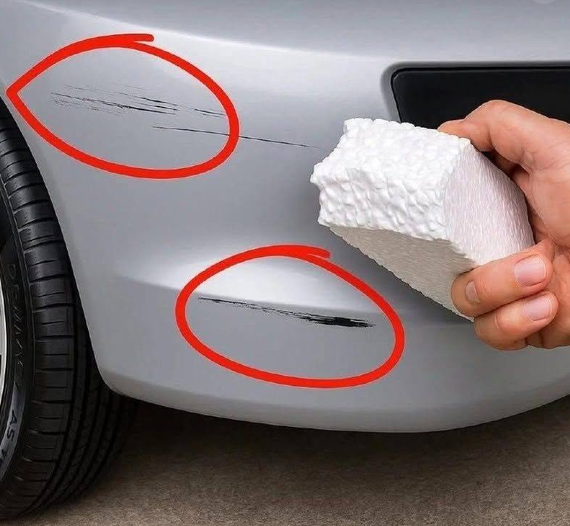
Is It Really a Scratch—or Just Paint Transfer?
This is one of the easiest mistakes to make.
Imagine your silver bumper brushes against a black rubber object, painted pole, garage door, or another vehicle.
You may be left with an ugly black line.
It looks as though the black line has been carved into your silver paint.
But sometimes some of what you’re seeing is actually foreign material sitting on top of the finish.
If that’s the case, careful cleaning may remove a surprising amount of it before any polishing is required.
That’s why you should always start with the least aggressive method.
Step 1: Wash the Damaged Area
Never begin by aggressively rubbing a dirty car.
Dust and grit sitting on the surface can create additional scratches while you’re trying to repair the original one.
Wash the affected panel using:
- Clean water
- Automotive car shampoo
- A clean microfiber wash mitt
- A clean microfiber drying towel
Rinse thoroughly and dry the area.
Then inspect it under good lighting.
You may discover that part of the apparent “scratch” was simply dirt or transferred material.
Step 2: Determine How Deep the Scratch Is
Once the surface is clean, gently run a fingernail across the scratch.
Don’t dig into it.
You’re simply checking whether your nail noticeably catches in the groove.
If your fingernail doesn’t catch
That’s encouraging.
You may be dealing with a very shallow clear-coat scratch or surface scuff.
These are the types most likely to respond to polishing.
If your fingernail catches slightly
The scratch may be deeper in the clear coat.
It might still be improved substantially through careful paint correction, but completely removing it could require more aggressive polishing.
If you can see primer, bare metal, or plastic
Stop trying to “buff it out.”
The damage has gone through the surface layers.
No amount of rubbing can restore paint that is physically missing.
The repair may require touch-up paint, localized refinishing, or professional bodywork.
Can Foam Really Remove Car Scratches?
This is where the viral image can be misleading.
A piece of ordinary foam isn’t a magical scratch-removing material.
If a mark disappears while someone rubs it with foam, several things could be happening.
The mark may have been surface contamination rather than a scratch.
The foam may be applying another cleaning or polishing substance that isn’t obvious in the photograph.
Or the damage may be so superficial that mild abrasion changes its appearance.
But foam alone cannot replace missing clear coat or automotive paint.
Professional scratch correction works through controlled abrasion and polishing—not because foam itself possesses some special ability to heal paint.
The Safer DIY Method for Very Light Scratches
For minor clear-coat defects, use a product specifically designed for automotive paint rather than improvising with household materials.
You’ll typically need:
- Car shampoo
- Clean microfiber towels
- Automotive scratch remover or fine polishing compound
- Foam or microfiber applicator pad
- Automotive wax or paint sealant if appropriate
Always read the product’s instructions first.
Step 3: Apply a Small Amount of Automotive Polish
Place a small amount of the appropriate scratch remover or fine polish onto your applicator.
Work on a small area.
Use gentle, controlled overlapping motions rather than applying enormous pressure.
You’re trying to refine the clear coat—not grind through it.
Automotive compounds work by removing a microscopic amount of the surface to level fine defects. 3M’s professional finishing products, for example, are specifically engineered to remove fine scratches and other surface defects from automotive finishes.
Step 4: Wipe and Inspect
After working the product according to its instructions, wipe away the residue with a clean microfiber towel.
Now inspect the area from several angles.
Don’t immediately apply another aggressive round simply because you can still see a faint line.
Compare the result first.
If the scratch has become significantly less noticeable, you may only need another light pass.
If nothing has changed, the scratch may be too deep for polishing.
Step 5: Protect the Area
Some polishing and compounding processes can remove or reduce previously applied waxes and sealants.
Once you’re satisfied with the correction, apply an appropriate automotive wax, sealant, or other paint protection according to its directions.
This doesn’t repair deep scratches, but it helps protect the corrected finish.
What About Black Scuff Marks on a Bumper?
Black marks on light-colored bumpers can look particularly dramatic.
Fortunately, some are transfer marks rather than deep damage.
Start by washing the area thoroughly.
If material remains on top of the surface, use an automotive product specifically designed to safely remove contaminants or paint transfer.
Don’t immediately reach for the strongest solvent you can find.
Modern painted bumpers may have clear coat just like other painted body panels, and aggressive chemicals or abrasion can turn one small scuff into a much larger dull patch.
Can Toothpaste Remove Car Scratches?
This is probably the most famous DIY scratch-removal trick.
There’s a grain of truth behind it.
Some toothpastes contain mild abrasives, so they can occasionally reduce the appearance of extremely superficial clear-coat marks. The AA notes that toothpaste may have an effect on small, shallow scratches that haven’t penetrated beyond the clear coat.
But that doesn’t make toothpaste the best product for your car.
AAA similarly notes that toothpaste might reduce very minor clear-coat scratches but warns that it shouldn’t replace professional polishing compounds and can do more harm than good on deeper damage.
An automotive polish is specifically formulated for automotive finishes.
Toothpaste is formulated for teeth.
Given the choice, use the product designed for the job.
What About Baking Soda?
Baking soda appears in countless DIY cleaning hacks because it’s mildly abrasive.
That’s precisely why you should be cautious about rubbing it across glossy automotive paint.
Uncontrolled abrasion can leave the surface dull or create additional fine scratches.
There’s little reason to experiment with kitchen powders when purpose-made automotive scratch removers and finishing polishes already exist.
What About WD-40?
Another popular trick involves spraying WD-40 over scratches.
It may temporarily change the appearance of some marks, making them look less obvious.
But temporarily disguising a scratch isn’t the same thing as repairing it.
AAA specifically cautions against treating WD-40 as a scratch-repair solution because using products outside their intended purpose can produce unwanted results.
Use automotive paint-care products instead.
What About Magic Eraser-Type Foam?
This deserves special attention because the viral image appears to suggest that some form of foam can simply wipe scratches away.
Melamine foam—often sold as a “magic eraser”—works through very fine abrasion.
That’s useful for certain household cleaning jobs.
But your car’s glossy clear coat isn’t a kitchen wall.
Aggressive rubbing with an abrasive foam can potentially dull the finish or create a hazy patch.
So don’t assume:
“If it removes marks from walls, it’ll safely remove marks from my car.”
Automotive paint requires a different approach.
Don’t Sand Your Car Unless You Know What You’re Doing
Videos of professional detailers wet-sanding paint can make the process look surprisingly easy.
It isn’t.
Professional paint correction can involve carefully controlled sanding followed by compounding and polishing.
For example, 3M’s professional finishing system uses progressive abrasives, compounds, and polishing stages to remove sanding scratches and restore gloss.
The critical word is controlled.
If you sand too aggressively, you can remove too much clear coat or even expose the color coat.
A scratch that originally required minor correction could then require repainting.
If you’re inexperienced, leave wet sanding to a professional.
How to Tell Whether a Scratch Can Be Polished Out
Here’s a practical rule of thumb.
Very light swirl or haze
Usually a good candidate for polishing.
Light clear-coat scratch
May be removed or significantly reduced using a suitable automotive polish or compound.
Moderate scratch that catches your nail
Professional paint correction may improve it, but completely eliminating it might require removing too much clear coat.
Scratch through the color coat
Polishing won’t restore missing paint.
You’ll likely need touch-up or refinishing.
Bare metal visible
Repair should not be delayed unnecessarily because exposed metal can become vulnerable to corrosion.
Why Deep Scratches Cannot Be “Erased”
This becomes easier to understand if you imagine scratching a painted wall.
If you only leave a light scuff on the surface, you might clean or polish it away.
But if you gouge through the paint and expose the material underneath, rubbing the surrounding paint doesn’t put the missing material back.
The same principle applies to automotive paint.
Polishing works by carefully leveling the surrounding surface.
It doesn’t generate new paint.
That’s why endlessly polishing a deep scratch can make things worse—you may simply remove more clear coat without eliminating the defect.
What If the Scratch Is on a Plastic Bumper?
Many modern bumpers have plastic underneath their painted exterior.
If a scratch has penetrated through the paint and exposed black or gray plastic, ordinary polishing won’t restore the missing paint.
The repair may require:
- Surface preparation
- Appropriate primer
- Color-matched paint
- Clear coat
- Finishing and polishing
Small defects may sometimes be addressed with a touch-up system.
Large or highly visible damage is generally better handled professionally.
Touch-Up Paint for Deeper Scratches
If the scratch has penetrated the color layer but the damage is relatively small, color-matched touch-up paint may be an option.
Your vehicle’s paint code is important.
A silver car isn’t simply “silver.”
Manufacturers use many different shades, metallic flakes, and finishes.
Using the correct paint code gives you a much better chance of achieving a reasonable match.
The AA notes that scratch-repair products can use paint matched to the vehicle and can be combined with other repair materials depending on the damage.
When Should You Go to a Body Shop?
DIY repair makes sense for minor cosmetic defects.
But professional help is worth considering when:
- Bare metal is visible
- The scratch is very deep
- Paint is peeling
- The damaged area is large
- The bumper is cracked or deformed
- There is a dent underneath the scratch
- You have an expensive or specialty paint finish
- You don’t know how much clear coat remains
- Previous DIY polishing has created haze
- The vehicle has recently been repainted
- You want a near-invisible repair
Professional repair costs more, but correcting a failed DIY repair can cost even more.
What If the Scratch Happened During a Collision?
A cosmetic mark can sometimes accompany hidden damage.
This is particularly relevant with modern bumpers, which can conceal impact-absorbing structures and electronic sensors.
If the scratch resulted from a meaningful impact rather than a simple scrape, inspect the bumper for deformation, cracks, loose mounting points, parking-sensor issues, or warning lights.
A scratch-removal trick isn’t a substitute for assessing collision damage.
Common Mistakes That Can Make Scratches Worse
Avoid these tempting shortcuts:
- Rubbing dirt directly into the paint
- Using kitchen scouring pads
- Using abrasive household sponges
- Applying random solvents
- Scrubbing with baking soda
- Using toothpaste aggressively
- Sanding without understanding paint correction
- Using dirty microfiber towels
- Polishing repeatedly until the clear coat becomes dangerously thin
- Assuming every black line is a scratch
- Assuming every scratch can be polished away
The safest principle is simple:
Start with the least aggressive method and only move to stronger correction when necessary.
A Better Step-by-Step Strategy
When you discover an ugly mark on your car, follow this order:
1. Wash the area thoroughly.
Remove dirt before rubbing anything.
2. Inspect the damage in bright light.
Determine whether you’re seeing transferred material, a scratch, or both.
3. Perform the gentle fingernail test.
If your nail doesn’t catch, polishing may work.
4. Remove surface contamination carefully.
Use automotive-safe products.
5. Try a proper fine automotive polish.
Start conservatively.
6. Reinspect after each attempt.
Don’t polish indefinitely.
7. Protect the corrected paint.
Apply suitable protection afterward.
8. Stop if you discover deeper damage.
Touch-up paint or professional repair may be necessary.
Frequently Asked Questions
Can car scratches really disappear in minutes?
Very shallow clear-coat scratches and transferred scuff marks sometimes can be improved surprisingly quickly.
Deep scratches cannot.
Does foam remove scratches?
Ordinary foam doesn’t regenerate damaged automotive paint. A foam applicator can be useful for applying a proper polishing compound, but the polishing product and controlled abrasion do the corrective work.
Can I use a kitchen sponge?
Avoid abrasive kitchen scrubbers. They’re designed for dishes and cookware, not automotive clear coat.
Can toothpaste remove scratches?
It may slightly improve extremely shallow marks because of its mild abrasive properties, but proper automotive polish is a more appropriate choice.
What if my fingernail catches the scratch?
That suggests the damage is deeper. Be cautious about repeatedly polishing it, because removing excessive surrounding clear coat isn’t a good trade-off for chasing one scratch.
What if I see another color inside the scratch?
If you’re seeing primer, bare metal, or exposed plastic, the scratch has penetrated beyond the clear coat. Polishing alone won’t restore it.
Can rubbing compound remove scratches?
Automotive rubbing compounds are specifically designed to remove or reduce certain fine scratches and surface defects. 3M, for example, makes compounds intended for clear-coat finishing and scratch removal.
But compounds remove material from the surface, so they should be used correctly rather than applied endlessly.
The Bottom Line
The viral idea that you can simply rub car scratches with a piece of foam and watch them disappear needs some important context.
Sometimes an ugly black line isn’t a deep scratch at all—it may partly consist of transferred material sitting on the surface.
Very shallow clear-coat scratches can also sometimes be dramatically improved through proper polishing.
But deep scratches cannot be wiped away with foam, toothpaste, baking soda, WD-40, or another household trick.
For the safest DIY approach:
Wash → inspect → determine scratch depth → use an automotive-safe polish for shallow defects → protect the finish afterward.
If the damage has penetrated through the paint, consider touch-up paint or professional refinishing rather than continuing to rub the area.
The goal isn’t simply to make the black line disappear for a photograph.
It’s to improve the scratch without damaging the perfectly good paint surrounding it.