A viral social media post claims that a baby weighing 7 kilograms at birth stunned the world in 1983—and promises an incredible look at him 40 years later. But who was this unusually large baby, what happened to him as he grew older, and what does medical science say about babies born at extraordinary weights?
Imagine being in a hospital delivery room in 1983.
A mother has just given birth, and the medical staff are preparing to weigh her newborn.
But when the baby is placed on the scale, everyone is surprised.
The number is far higher than expected.
Seven kilograms.
That’s approximately 15 pounds and 7 ounces—more than twice the weight of many average-sized newborns.
For a baby to weigh that much at birth would be extraordinarily unusual.
Now, decades later, a viral Facebook image is bringing this remarkable claim back into the spotlight.
The post reads:
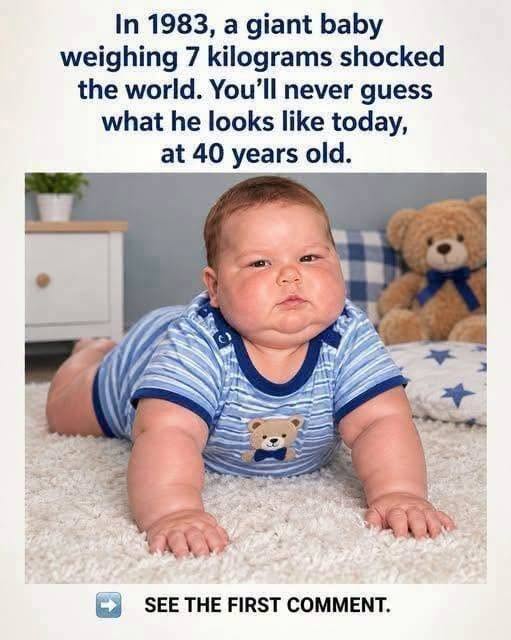
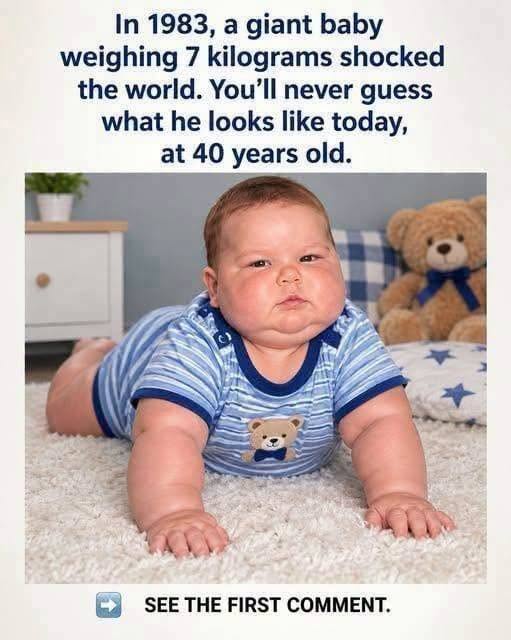
“In 1983, a giant baby weighing 7 kilograms shocked the world. You’ll never guess what he looks like today, at 40 years old.”
The image features a large-looking baby lying on a blanket, with a caption encouraging readers to discover what happened later.
Naturally, people are curious.
Did the baby grow into an exceptionally tall adult?
Did his unusual birth weight affect his health?
And what does he look like today?
The answers require separating a fascinating medical possibility from an unverified internet story.
The Viral Story of the 7kg Baby Born in 1983
The story has the ingredients of a classic viral mystery.
An extraordinary birth.
A shocked hospital.
A baby supposedly twice the size of a typical newborn.
And a dramatic promise to reveal his appearance four decades later.
But there’s an important detail missing from the social media post.
It does not provide a verifiable name, hospital, birthplace, medical record, or original news report establishing the identity of the baby.
Nor does the photograph alone establish that the child pictured was born in 1983 or weighed seven kilograms.
The image could be illustrative, unrelated to the original claim, or reused from another context.
Without reliable documentation, it would be misleading to identify a particular adult as the baby in the photograph or claim to know what happened to him.
Still, the underlying subject is genuinely fascinating.
Babies weighing around seven kilograms have been reported in medical and historical accounts, and unusually high birth weights raise important questions about pregnancy, genetics, growth, and health.
To understand why the viral claim attracts so much attention, we first need to understand just how unusual a seven-kilogram newborn would be.
How Big Is a 7kg Newborn?
A typical full-term newborn weighs approximately 3 to 3.5 kilograms, although healthy birth weights vary.
A baby weighing seven kilograms would be substantially larger.
<escape>Birth weight comparison:</escape>
| Birth weight | Approximate equivalent |
|---|---|
| 2.5 kg | 5 lb 8 oz |
| 3.0 kg | 6 lb 10 oz |
| 3.5 kg | 7 lb 11 oz |
| 4.0 kg | 8 lb 13 oz |
| 4.5 kg | 9 lb 15 oz |
| 5.0 kg | 11 lb |
| 7.0 kg | 15 lb 7 oz |
At seven kilograms, a newborn would weigh about as much as some babies several months old.
That does not necessarily mean the baby would look exactly like an older infant.
Newborn proportions, muscle development, head control, and other characteristics still depend on gestational development.
But the size difference would certainly be striking.
What Is a Giant Baby Called in Medical Terms?
Doctors use the term fetal macrosomia to describe a baby who is unusually large at birth.
Definitions vary.
Some medical guidelines use a birth weight above 4,000 grams, while others use 4,500 grams as an important threshold.
A seven-kilogram baby would be far beyond either threshold.
Macrosomia is not a description of the baby’s future height or adult appearance.
It refers specifically to unusually high birth weight.
A baby can be large at birth without growing into an unusually large adult.
Likewise, someone born at an average weight may eventually become exceptionally tall.
Why Are Some Babies Born So Large?
There is no single explanation for every case.
Several factors can influence fetal growth.
1. Maternal Diabetes
Diabetes during pregnancy is an important risk factor for fetal macrosomia.
When maternal blood glucose levels are elevated, additional glucose can cross the placenta.
The baby’s pancreas may respond by producing more insulin.
Insulin promotes growth and fat storage, potentially contributing to increased birth weight.
This is one reason prenatal diabetes screening and appropriate blood glucose management are important.
However, not every unusually large baby is born to a mother with diabetes.
2. Genetics
Family characteristics can influence birth weight.
Parents who are tall or naturally larger may have babies who are bigger than average.
Genetic influences can affect growth before birth as well as later development.
3. Gestational Age
Babies generally gain weight as pregnancy progresses.
A pregnancy that continues beyond the expected due date may increase the likelihood of a larger baby.
However, gestational age alone does not explain every case of extreme birth weight.
4. Previous Pregnancies
Birth weight may be influenced by the number of previous pregnancies.
Some women give birth to progressively larger babies.
This is not universal, but it is a recognized association.
5. Maternal Weight and Pregnancy Weight Gain
Maternal metabolic health and weight gain during pregnancy can influence fetal growth.
The relationship is complex and should be considered in the context of overall prenatal care.
6. Rare Medical or Genetic Conditions
In uncommon circumstances, certain medical or genetic conditions can contribute to excessive fetal growth.
These require specialist assessment.
An unusually large baby should not automatically be assumed to have a genetic disorder.
Was a 7kg Baby Really Born in 1983?
The viral image makes a specific historical claim, but it does not provide enough information to confirm it.
To verify such a story, reliable evidence would ideally include the child’s identity, date and place of birth, recorded birth weight, and independent contemporary reporting.
Without those details, the precise 1983 claim remains unverified.
There have been documented historical accounts of exceptionally heavy newborns, although reports differ in reliability and circumstances.
The broader phenomenon of extreme birth weight is real.
What remains uncertain is whether the viral photograph and its accompanying story refer to a particular verified individual.
This distinction matters because social media frequently combines authentic medical facts with unrelated images and exaggerated personal stories.
What Is the Heaviest Baby Ever Born?
One of the best-known historical records involves a baby born in the United States in 1879 to Anna Haining Bates, a woman known for her extraordinary height.
The newborn reportedly weighed approximately 9.98 kilograms, or 22 pounds.
Sadly, the baby survived only a short time.
Historical birth records should be understood in context, especially when comparing records from different centuries.
Nevertheless, the case illustrates that extremely high birth weights have been reported long before the modern era.
A seven-kilogram newborn would be extraordinary, but it would not represent the highest birth weight ever reported.
What Would a 7kg Baby Look Like?
A seven-kilogram newborn might have a noticeably larger body than most babies of the same age.
Possible characteristics could include:
- A larger overall body size.
- Fuller cheeks.
- More prominent fat deposits.
- Larger arms and legs.
- Greater shoulder and trunk measurements.
- A higher weight relative to typical newborns.
However, appearance varies greatly.
A photograph alone cannot accurately establish a baby’s weight.
Camera perspective, clothing, posture, and comparison objects can all affect how large an infant appears.
A baby who looks unusually big in a photograph may not necessarily have an extreme birth weight.
Likewise, an exceptionally heavy newborn may not look as dramatically different as people imagine.
The Biggest Question: What Would He Look Like at 40?
This is the central mystery promised by the viral post.
People naturally wonder whether a seven-kilogram newborn would become an enormous adult.
But the science of human growth provides a surprising answer.
Birth weight alone cannot predict a person’s adult height, weight, body shape, or appearance.
A baby born extremely large might grow into an adult of average height.
Another might remain larger than average.
Still another might experience significant changes in growth patterns during childhood.
Adult size is influenced by many factors, including genetics, nutrition, health, hormones, and environmental conditions.
There is no medically sound way to reconstruct a 40-year-old person’s appearance from a photograph and a claimed birth weight.
And because the viral post does not establish the baby’s identity, it cannot support a verified before-and-after comparison.
Does Being a Big Baby Mean You’ll Be a Big Adult?
Not necessarily.
There is some relationship between early growth and later body size at the population level.
But that relationship is not precise enough to predict an individual’s adult appearance.
A child’s growth can change considerably over time.
For example, a baby born large may grow at an average rate during childhood.
Another may remain near the upper end of growth charts.
A third may have a different pattern entirely.
Doctors assess children’s growth using measurements over time rather than relying on birth weight alone.
Height, weight, head circumference during infancy, and developmental milestones all provide useful information.
A single number at birth cannot tell the whole story.
Are Babies Born at 7kg Healthy?
An unusually high birth weight does not automatically mean a baby is unhealthy.
However, extreme macrosomia is associated with increased risks during delivery and shortly after birth.
Medical teams may need to monitor both mother and baby carefully.
Possible Risks During Delivery
One concern is shoulder dystocia.
This occurs when the baby’s shoulders become difficult to deliver after the head has emerged.
It is an obstetric emergency that requires prompt, skilled management.
Large babies may also have an increased risk of certain birth injuries.
Increased Chance of Cesarean Delivery
When fetal size is estimated to be very large, clinicians may discuss delivery options.
The decision depends on multiple factors, including maternal health, diabetes status, obstetric history, and estimated fetal weight.
Ultrasound estimates are not perfectly accurate, particularly at the extremes of fetal size.
Low Blood Sugar After Birth
Some large newborns, particularly those exposed to maternal diabetes, may experience low blood glucose after delivery.
Medical teams may monitor feeding and blood sugar levels.
Other Possible Complications
Certain newborns may require assessment for breathing difficulties, jaundice, or other concerns.
The actual risks vary significantly between individuals.
Being large at birth does not mean that every complication will occur.
Can Doctors Predict a Baby’s Weight Before Birth?
Healthcare professionals can estimate fetal weight during pregnancy.
Ultrasound measurements may include:
- Head circumference.
- Abdominal circumference.
- Femur length.
- Other biometric measurements.
These values are combined using established formulas.
However, estimated fetal weight is not an exact measurement.
The prediction can differ from the baby’s actual birth weight.
This uncertainty becomes especially important when a baby is suspected to be unusually large.
Medical decisions should therefore consider the complete clinical picture rather than one ultrasound estimate.
How Would Doctors Manage an Extremely Large Baby Today?
Modern obstetric care includes several approaches to evaluating suspected macrosomia.
Healthcare professionals may review maternal health, diabetes screening results, fetal growth, and previous delivery history.
If diabetes is present, appropriate glucose management is important.
Clinicians may discuss the potential benefits and risks of different delivery plans.
In certain circumstances, planned cesarean delivery may be considered based on estimated fetal weight and other risk factors.
After birth, the newborn may receive additional monitoring.
This could include blood glucose checks, feeding assessment, and examination for birth-related injuries.
Care is individualized.
An unusually large fetal weight estimate does not automatically require the same intervention for every pregnancy.
How Different Was Childbirth in 1983?
Obstetric medicine in the early 1980s already included hospital deliveries, ultrasound technology, cesarean sections, and newborn monitoring.
However, technology and clinical guidelines have continued to evolve.
Ultrasound imaging has improved.
Screening and management approaches for gestational diabetes have developed.
Neonatal monitoring and intensive care have advanced.
Clinical protocols for obstetric emergencies have also been refined.
A newborn with an extreme birth weight would likely attract significant medical attention in any era.
But the exact treatment would depend on the available resources, medical circumstances, and clinical standards of the time.
Why Do Stories About Giant Babies Go Viral?
Unusual birth stories capture attention because they combine several powerful elements.
First, babies are familiar to nearly everyone.
Most people have some sense of what an average newborn looks like.
Second, an exceptionally high birth weight creates immediate surprise.
Third, a dramatic before-and-after promise encourages curiosity.
The question “What does he look like today?” creates a strong reason to keep reading.
Finally, photographs can make a story seem more convincing—even when they are not independently verified.
This combination makes giant-baby stories especially popular on social media.
How to Tell Whether a Viral Baby Story Is Real
Before believing a dramatic claim, consider a few basic questions.
Does the Post Name the Person?
A real identity can sometimes help establish whether a story has reliable documentation.
Is There a Verifiable Birth Date?
Specific dates make historical claims easier to check.
Is the Hospital Identified?
A named hospital or contemporary medical account may provide supporting evidence.
Is the Photograph Authentic?
A photograph can be reused, edited, or taken out of context.
Is the Adult Photograph Actually Connected to the Baby?
A convincing before-and-after comparison requires evidence that both images depict the same person.
Do Independent Sources Confirm the Story?
Multiple reliable sources are more persuasive than repeated copies of the same social media caption.
These checks are especially important when a post makes extraordinary claims.
Can Extreme Birth Weight Affect Long-Term Health?
Researchers have studied associations between birth weight and later health outcomes.
At the population level, high birth weight has been linked with certain later metabolic risks.
However, these associations are complex.
Birth weight is only one factor among many.
A person’s later health is influenced by genetics, nutrition, physical activity, environment, medical care, and other circumstances.
A large newborn is not destined to develop obesity, diabetes, or cardiovascular disease.
Nor can a person’s health at age 40 be determined from their birth weight.
Individual outcomes vary widely.
Do Giant Babies Grow Faster Than Other Children?
Not necessarily.
Some babies born large experience a period of slower relative weight gain as their growth pattern adjusts.
Others continue along higher growth percentiles.
The pattern depends on the individual.
Pediatricians monitor growth using standardized charts.
Rather than focusing on whether a child is larger or smaller than another child, healthcare professionals examine growth trends and overall development.
A healthy pattern is more important than a single comparison.
What Determines a Person’s Adult Height?
Adult height is influenced strongly by genetics.
However, other factors also matter.
These include:
- Childhood nutrition.
- General health.
- Hormonal development.
- Timing of puberty.
- Certain medical conditions.
- Environmental influences.
Birth weight provides only limited information about these factors.
Even if a child begins life at an unusually high weight, their adult height cannot be predicted accurately from that number alone.
Could the Baby in the Photo Be Older Than a Newborn?
Yes.
The image shows a relatively large infant lying on a blanket with the head raised and arms supporting the upper body.
That posture is more commonly associated with a baby who has developed some head and upper-body control.
However, an image alone cannot establish the infant’s exact age.
This is another reason to be cautious about treating the photograph as documentation of a newborn weighing seven kilograms in 1983.
The photograph may simply be an illustrative image selected to make the story more dramatic.
The Emotional Side of Extraordinary Birth Stories
Behind every unusual birth statistic is a family.
A baby born at an exceptionally high weight may require additional medical attention.
Parents may feel excitement, surprise, anxiety, or uncertainty.
Medical staff may need to respond to unexpected challenges.
For this reason, extraordinary birth stories deserve more than sensational headlines.
The baby’s well-being, the mother’s health, and the family’s privacy matter far more than the number displayed on a scale.
When an individual’s identity has not been established, speculation about their current appearance or medical history can be misleading.
Frequently Asked Questions
Was a 7kg Baby Born in 1983?
The viral post claims that a seven-kilogram baby was born in 1983, but the screenshot does not provide enough reliable identifying information to verify the specific story.
How Much Is 7kg in Pounds?
Seven kilograms is approximately 15 pounds and 7 ounces.
Is a 7kg Newborn Possible?
Yes. Extremely high birth weights are rare but medically possible.
What Is the Medical Term for a Very Large Baby?
The term is fetal macrosomia.
What Causes a Baby to Be Born So Large?
Possible factors include maternal diabetes, genetics, gestational age, maternal metabolic factors, and, rarely, certain medical conditions.
Does a Big Baby Become a Big Adult?
Not necessarily. Birth weight alone cannot reliably predict adult height, weight, or appearance.
What Does the 1983 Baby Look Like Today?
The viral screenshot does not establish the baby’s identity or provide a verified recent photograph. Therefore, his present-day appearance cannot be confirmed from the available information.
Is Giving Birth to a 7kg Baby Dangerous?
Extreme birth weight can increase the risk of delivery complications, including shoulder dystocia and birth injuries. Actual risks depend on the circumstances.
Can Ultrasound Detect a Very Large Baby?
Ultrasound can estimate fetal weight, but the estimate has a margin of error.
What Is the Heaviest Baby Ever Reported?
A famous historical record concerns a baby reportedly weighing approximately 9.98 kilograms at birth in 1879.
Final Thoughts: The Truth Behind the 7kg Baby Mystery
The story of a baby supposedly born weighing seven kilograms in 1983 is certainly fascinating.
A newborn that size would have been extraordinarily unusual.
And it’s understandable why people would want to know what happened to him four decades later.
But the viral post leaves out the most important details.
It does not establish the baby’s identity, provide a verified birth record, or show a confirmed photograph of the person as an adult.
The claim may be inspired by genuine cases of unusually large newborns, but the specific before-and-after story remains unverified.
What medical science can tell us is equally interesting.
A seven-kilogram newborn is possible, although extremely rare.
Several factors can contribute to unusually high birth weight.
And perhaps most surprisingly, being enormous at birth does not guarantee that someone will be exceptionally large as an adult.
A person’s growth and appearance are shaped by many influences over the course of life.
The real lesson is that an extraordinary beginning does not determine the entire story.
A baby’s birth weight may make headlines for a day, but it cannot tell us what that person’s life will look like 40 years later.
What do you think? If a baby weighed 15 pounds at birth, would you expect him to become an unusually tall adult—or do you think he could grow up to be an average-sized man? Share your thoughts in the comments!