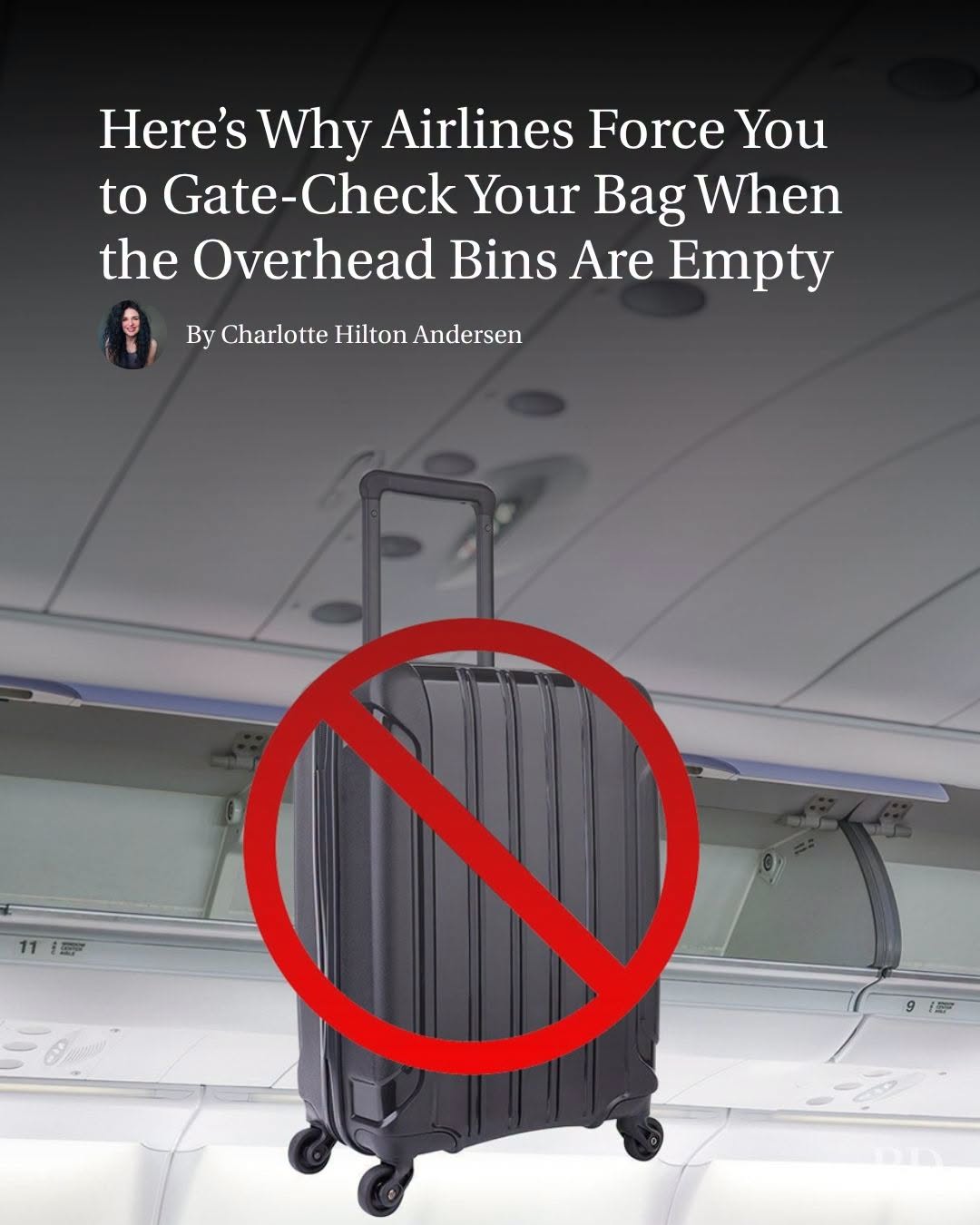
You’ve waited in line, boarded your flight, and carefully packed everything into a carry-on suitcase to avoid checking luggage. But just before stepping onto the plane, a gate agent tells you that your bag must be checked. Then you walk into the cabin and discover something frustrating: the overhead bins are almost completely empty.
Sound familiar?
For many travelers, being forced to gate-check a carry-on bag is one of the most confusing parts of flying.
You followed the baggage rules. Your suitcase fits the airline’s published dimensions. You arrived on time. And you can clearly see space above the seats.
So why won’t the airline let you bring your bag onboard?
The answer is more complicated than you might expect.
Airlines make baggage decisions based on several factors, including aircraft design, boarding procedures, safety requirements, available storage space, and operational efficiency.
And sometimes, the decision to gate-check your bag has already been made before anyone knows exactly how full the overhead bins will be.
Here’s what you need to know about this frustrating travel experience—and how to reduce the chances of it happening on your next flight.
What Does Gate-Checking a Bag Actually Mean?
Gate-checking happens when an airline accepts your carry-on bag at the departure gate or near the aircraft door and transports it in the aircraft’s cargo compartment rather than the passenger cabin.
Depending on the airline and aircraft, you may receive your bag at the baggage carousel after landing or at a designated location near the aircraft.
Some regional flights use a process commonly called valet checking, where passengers leave larger carry-ons before boarding and retrieve them near the aircraft after arrival.
The procedure varies by airline.
Gate-checking is often free when an airline requires it because of limited cabin space.
However, that doesn’t necessarily mean every bag is eligible for complimentary checking.
Airlines may still charge fees for oversized or otherwise noncompliant baggage under their policies.
1. The Airline May Be Predicting That the Overhead Bins Will Fill Up
One of the biggest reasons airlines gate-check bags is that they anticipate running out of overhead storage.
Airline staff don’t always wait until every compartment is full before making a decision.
Instead, they may use information such as:
- The number of passengers on the flight
- The aircraft type
- The number of passengers already boarded
- The expected number of carry-on suitcases
- Previous experience with similar flights
- Cabin crew reports about available space
If the flight is nearly full and many passengers are traveling with rolling suitcases, gate agents may begin checking bags before the cabin reaches capacity.
This can prevent congestion later in the boarding process.
The downside is that the prediction may not be perfectly accurate.
Some passengers may have smaller bags than expected.
Others may not bring carry-ons at all.
As a result, a passenger who was required to check a bag may board and see empty compartments.
That doesn’t necessarily mean the original decision was arbitrary, but it can mean the forecast was conservative.
2. Empty Overhead Bins Don’t Always Mean Available Space
An overhead bin may look empty when you first enter the aircraft.
However, that doesn’t guarantee the space is available for your suitcase.
Some compartments may be reserved for specific purposes.
For example, certain areas may contain or be designated for:
- Emergency equipment
- Crew belongings
- Medical or safety supplies
- Items that must remain accessible during the flight
On some aircraft, compartments may also be restricted because of their design or weight limitations.
Additionally, airlines sometimes manage cabin storage by boarding groups or cabin sections.
A visibly empty bin may be intended for passengers who have not yet boarded.
Although policies vary, the important point is that physical space and available passenger storage are not always identical.
3. Your Boarding Group Can Make a Big Difference
Airlines frequently board passengers in groups.
These groups may be determined by ticket type, loyalty status, seat location, or other factors.
Passengers who board early generally have a better opportunity to find overhead storage.
Those boarding later face a greater chance that the compartments will be full.
This is particularly important on busy flights.
By the time the final boarding groups are called, gate agents may already be asking passengers to check larger carry-ons.
But sometimes the airline begins that process earlier based on anticipated demand.
That’s why you might be told to check your bag even though you haven’t seen the inside of the aircraft.
Travel tip: If bringing your suitcase onboard is especially important, check whether your ticket includes early boarding or whether your airline offers an earlier boarding option.
Paying extra isn’t always necessary, and it doesn’t guarantee space, but boarding order can affect your chances.
4. Some Aircraft Simply Have Smaller Overhead Bins
Not every airplane offers the same amount of cabin storage.
A large aircraft used for long-distance flights may have spacious overhead compartments.
A smaller regional jet may have significantly less room.
Some aircraft cannot accommodate standard-size rolling suitcases in every overhead compartment.
This means a bag that fits comfortably on one flight might need to be checked on another.
Even two aircraft operated by the same airline can have different storage configurations.
For example, a passenger might travel on a larger jet for the first leg of a journey and transfer to a regional aircraft for the second.
The same suitcase could be accepted in the cabin on the first flight but require gate-checking on the second.
Travel tip: Check the aircraft type before departure when that information is available.
Remember that aircraft assignments can change.
5. Airlines Want to Avoid Boarding Delays
Boarding an aircraft involves hundreds of small actions.
Passengers find their seats, store luggage, remove jackets, organize personal belongings, and settle in.
When overhead bins fill up, the process becomes more complicated.
Passengers may walk backward through the aisle searching for space.
Flight attendants may need to rearrange luggage.
Some bags may have to be removed from the cabin and transferred to the cargo hold.
All of this takes time.
A delayed boarding process can affect the aircraft’s scheduled departure.
For airlines, delays may have consequences beyond a single flight.
Aircraft, crews, and airport gates are often scheduled for multiple operations throughout the day.
A late departure can contribute to problems elsewhere in the network.
Gate-checking some bags in advance may help reduce last-minute disruptions.
However, whether it actually saves time depends on how efficiently the airline handles the process.
6. Gate Agents May Follow Instructions Based on Expected Capacity
Passengers sometimes assume that gate agents personally decide who gets to bring a suitcase onboard.
In reality, agents often work within established airline procedures.
They may receive guidance about how many carry-on bags can reasonably be accommodated.
For example, an airline may anticipate that only a certain number of larger bags will fit in the cabin.
Once that threshold is reached, staff may begin checking additional suitcases.
The actual number of available spaces can vary because not every passenger carries the same type of luggage.
This helps explain why some bins remain empty even after gate-checking begins.
The decision may have been based on a general capacity estimate rather than a precise count of every compartment.
7. Some Bins Are Designed for Specific Bag Positions
Overhead compartments are not simply empty boxes.
Their dimensions and design affect how luggage must be stored.
Some newer aircraft feature larger bins that allow suitcases to stand on their sides.
Older aircraft may require bags to lie flat.
A suitcase that fits one way might not fit another.
Passengers who place bags incorrectly can reduce the amount of available storage.
For example, a rolling suitcase placed horizontally in a bin designed for vertical storage may occupy space that could accommodate another bag.
Airlines sometimes use cabin announcements or signs to explain how bags should be positioned.
Travel tip: Follow the airline’s instructions for placing your suitcase in the overhead compartment.
Proper positioning helps maximize space for everyone.
8. Weight and Safety Restrictions Can Matter
Overhead compartments have structural weight limits.
They are designed to hold luggage safely during normal flight conditions and turbulence.
Even if a compartment appears to have enough room, adding another heavy bag may not always be appropriate.
Flight attendants may also need to ensure that bins can close and latch securely.
A bag that prevents a compartment from closing cannot remain there for takeoff.
Similarly, unusually heavy items may present handling or safety concerns.
Some airlines impose cabin-baggage weight limits in addition to size restrictions.
These rules differ substantially among carriers.
Travel tip: Check both the size and weight allowance before traveling.
A suitcase that meets one airline’s rules may not meet another’s.
9. Your Fare Type May Affect Your Carry-On Allowance
Not all airline tickets include the same baggage privileges.
Some basic economy or low-cost fares permit only a small personal item without an additional charge.
Other tickets include a full-size carry-on suitcase.
This is different from operational gate-checking.
If your fare doesn’t include a cabin suitcase, the airline may require you to check it or pay an applicable fee.
An empty overhead compartment doesn’t automatically change the baggage allowance attached to your ticket.
Travel tip: Review your fare conditions before arriving at the airport.
Look specifically for the difference between a personal item and a carry-on bag.
10. The Airline May Be Trying to Keep the Aisles Clear
Airplane aisles are narrow.
When passengers stop to search for luggage space, everyone behind them may have to wait.
A passenger who walks several rows past their seat to find an empty compartment may then need to move against the flow of boarding passengers.
These situations can create congestion.
On busy flights, cabin crew may prefer to minimize the number of large suitcases entering the aircraft once storage becomes limited.
This can make boarding more orderly.
It can also reduce the need to move luggage after passengers are already seated.
11. Flight Attendants and Gate Agents May Have Different Information
The employees working at the gate and the crew onboard do not always have exactly the same view of available storage.
A flight attendant can see which compartments are full.
A gate agent may rely on estimates, passenger counts, or updates from the cabin.
Communication between the two teams is important, but the situation can change quickly during boarding.
If several passengers unexpectedly board without large bags, more space may remain than anticipated.
This can result in the frustrating experience of seeing empty bins after being told that no more carry-ons are allowed.
It is not necessarily evidence that an employee deliberately misled passengers.
12. Last-Minute Aircraft Changes Can Affect Baggage Decisions
Airlines occasionally change aircraft because of maintenance, scheduling, weather, or operational requirements.
A replacement aircraft may have a different cabin layout.
It may also offer less overhead storage than the originally scheduled plane.
Passengers who packed according to the first aircraft’s capacity may discover that their bags must be checked.
Sometimes these changes occur close to departure.
That can leave little time for staff to adjust boarding procedures.
13. Airlines May Prefer a Conservative Approach
From an operational perspective, airlines often try to avoid discovering a luggage problem at the last possible moment.
Imagine that boarding is nearly complete.
The cabin is crowded.
Several passengers still have large suitcases.
The remaining compartments are full.
Now employees must remove bags from the aircraft, attach tags, arrange loading, and complete the process before departure.
That situation can create delays.
Some airlines therefore choose to gate-check bags earlier than strictly necessary.
The approach can help avoid last-minute problems.
But it may also result in unused overhead space.
For passengers, this is one of the most frustrating consequences of conservative capacity planning.
What Should You Do If You’re Told to Gate-Check Your Bag?
Being asked to surrender your carry-on doesn’t have to become a stressful experience.
A few simple steps can help protect your belongings and reduce inconvenience.
1. Ask Whether Gate-Checking Is Mandatory
Sometimes airlines ask for volunteers to check their bags.
Other times, the decision is mandatory.
These are different situations.
If an announcement requests volunteers, you may be able to keep your bag if you don’t volunteer and your ticket permits it.
If the airline requires gate-checking for operational or safety reasons, you generally need to comply with the applicable conditions of carriage.
You can politely ask whether your bag can remain onboard, but don’t assume the agent can make an exception.
2. Remove Essential Items Before Handing Over Your Bag
This is one of the most important travel habits.
Before gate-checking your suitcase, remove anything you may need during the flight or cannot safely place in checked baggage.
Important items include:
- Passport and identification
- Wallet and money
- House and car keys
- Essential medications
- Valuable jewelry
- Important travel documents
- Fragile electronics
- Spare lithium batteries and power banks
Important: Spare lithium batteries and power banks generally must remain in carry-on baggage under aviation safety rules. If your carry-on is being gate-checked, remove these items and keep them with you in the cabin.
Electronic devices with installed batteries may be subject to additional airline-specific requirements.
Always follow the carrier’s dangerous-goods instructions.
3. Keep a Small Personal Bag With You
A backpack, purse, or compact under-seat bag can be extremely useful.
Pack it with items you cannot afford to lose access to.
For example:
- Phone
- Charger
- Medication
- Identification
- Headphones
- Snacks
- Reading glasses
- Baby essentials, if applicable
Make sure your personal item complies with the airline’s size allowance.
If your larger suitcase must be checked, you’ll still have the essentials nearby.
4. Ask Where You’ll Collect Your Bag
This is a detail many travelers forget.
Some gate-checked bags are returned near the aircraft after landing.
Others are sent to the regular baggage carousel.
If you have a connecting flight, the bag may be checked through to your final destination, depending on the airline and circumstances.
Before handing it over, ask:
“Will I collect this bag at the aircraft or at baggage claim?”
The answer can save confusion after landing.
5. Keep Your Baggage Claim Tag
When your bag is checked, you should receive a claim tag or receipt.
Keep it until your luggage has been returned.
The tag contains information that may help the airline locate your bag if it is delayed or misplaced.
You can also take a photograph of the tag for your records.
6. Take a Photo of Your Suitcase
A quick photograph can be useful if you need to describe your luggage later.
Capture its color, size, brand, and any distinctive markings.
This can make a delayed-baggage report easier to complete.
7. Don’t Argue With the Gate Agent
It’s understandable to feel annoyed when you see empty bins after being required to check your suitcase.
But arguing at the gate rarely changes the aircraft’s baggage procedures.
A calm question may be more effective.
For example:
“I understand. Could you tell me whether this is because of the aircraft’s storage limits?”
If you believe the airline applied its policy incorrectly, you can contact customer service afterward.
How to Reduce Your Chances of Having to Gate-Check a Carry-On
Although no method guarantees overhead space, several strategies may improve your chances.
Choose a Smaller Suitcase
A compact carry-on that comfortably fits the airline’s size limits is less likely to create storage problems.
Soft-sided bags may also be easier to accommodate in certain compartments, provided they meet the carrier’s rules.
Check Your Boarding Group
If your airline assigns boarding groups, find out when yours will be called.
Earlier boarding may improve your access to overhead storage.
However, early boarding does not override aircraft restrictions or guarantee space.
Avoid Overpacking
An overstuffed suitcase can exceed the airline’s permitted dimensions.
Remember that external pockets, wheels, and handles may count toward the measurement.
Check the Aircraft Type
If you’re flying on a smaller regional aircraft, prepare for the possibility that your carry-on may need to be checked.
Keep Essentials Separate
Even experienced travelers sometimes forget this step.
Always organize your belongings so you can quickly remove important items if necessary.
Consider a Bag That Fits Under the Seat
For short trips, an appropriately sized personal item may be enough.
Under-seat bags can reduce your dependence on overhead storage.
Make sure the bag fits your airline’s published dimensions and doesn’t obstruct required foot space.
Is Gate-Checking Your Bag Free?
It depends on why the bag is being checked and the airline’s rules.
If the airline requires passengers to check compliant carry-ons because overhead storage is limited, gate-checking is often complimentary.
However, if your ticket doesn’t include a carry-on allowance or your bag exceeds the permitted dimensions, fees may apply.
Policies differ by airline, route, and fare.
Always check the specific conditions of your ticket.
Can You Refuse to Gate-Check Your Carry-On?
You can politely ask whether an alternative is available.
But if the airline requires gate-checking because of safety, aircraft capacity, or its applicable baggage rules, refusing may prevent you from boarding with the bag.
A compliant carry-on allowance does not necessarily guarantee a particular overhead compartment.
Airlines generally retain operational authority over where baggage is stored, subject to applicable laws and their conditions of carriage.
If you believe the decision was inconsistent with your ticket, keep relevant documentation and raise the issue with customer service.
What Happens if the Airline Loses Your Gate-Checked Bag?
Gate-checked luggage can occasionally be delayed, damaged, or misplaced.
If your bag doesn’t arrive where the airline instructed you to collect it, report the problem promptly.
Keep your claim tag and boarding pass.
Provide a description of the suitcase and its contents.
Ask the airline for a baggage report reference.
Depending on the route and applicable law, passengers may have rights concerning delayed, damaged, or lost baggage.
For international flights, the Montreal Convention may govern certain baggage claims, subject to its conditions and limits.
Specific deadlines and procedures can apply.
Frequently Asked Questions
Why Did the Airline Check My Bag When the Overhead Bins Were Empty?
The airline may have anticipated limited storage, followed a boarding procedure, reserved certain compartments, or used a conservative estimate of available space.
Do Airlines Intentionally Leave Overhead Bins Empty?
Some compartments may be reserved or restricted. In other cases, empty space may remain because actual baggage demand was lower than expected.
Does Early Boarding Guarantee Overhead Bin Space?
No. It may improve your chances, but aircraft restrictions and airline procedures still apply.
Can I Keep My Laptop When My Suitcase Is Gate-Checked?
Yes, you should remove valuable and essential electronics when possible. Follow the airline’s rules for devices containing lithium batteries.
Can I Leave a Power Bank in a Gate-Checked Bag?
No. Spare lithium batteries and power banks generally must be removed from gate-checked bags and kept in the cabin.
Will I Get My Bag Back Immediately After Landing?
Not always. Some bags are returned near the aircraft, while others go to baggage claim.
Can Gate-Checking Delay My Luggage?
Yes. Although many gate-checked bags arrive without problems, delays can occur.
Is Gate-Checking Safer Than Carrying a Bag Onboard?
Both methods involve different considerations. Cabin baggage remains accessible to the passenger, while gate-checked baggage is handled through the aircraft’s cargo and baggage systems.
Should I Put Medication in My Checked Suitcase?
Essential medication should generally remain in your accessible personal bag whenever possible, especially if you may need it during travel.
Can I Ask for Compensation if My Bag Is Damaged?
You may have rights under applicable baggage rules and laws. Report damage promptly and keep supporting documentation.
Final Thoughts: The Real Reason Your Carry-On Sometimes Gets Taken Away
Being forced to gate-check a suitcase when overhead bins appear empty can feel unfair.
But the explanation is not always as simple as airlines refusing to let passengers use available space.
Airlines must coordinate boarding, storage capacity, safety procedures, aircraft restrictions, and departure schedules.
Sometimes those decisions are based on estimates rather than exact real-time measurements.
And sometimes those estimates leave more empty space than expected.
The result can be frustrating for travelers who packed carefully and expected to keep their belongings nearby.
Fortunately, a little preparation can make the experience easier.
Keep important items in a small personal bag, know your airline’s baggage rules, and always ask where your gate-checked suitcase will be returned.
The next time an airline asks you to check your carry-on at the gate, you’ll have a better understanding of why it might be happening—even if the overhead bins don’t look full.
Have you ever been forced to gate-check your suitcase, only to board the plane and see empty overhead bins?
Share your experience in the comments. You might be surprised how many travelers have been through the same thing!