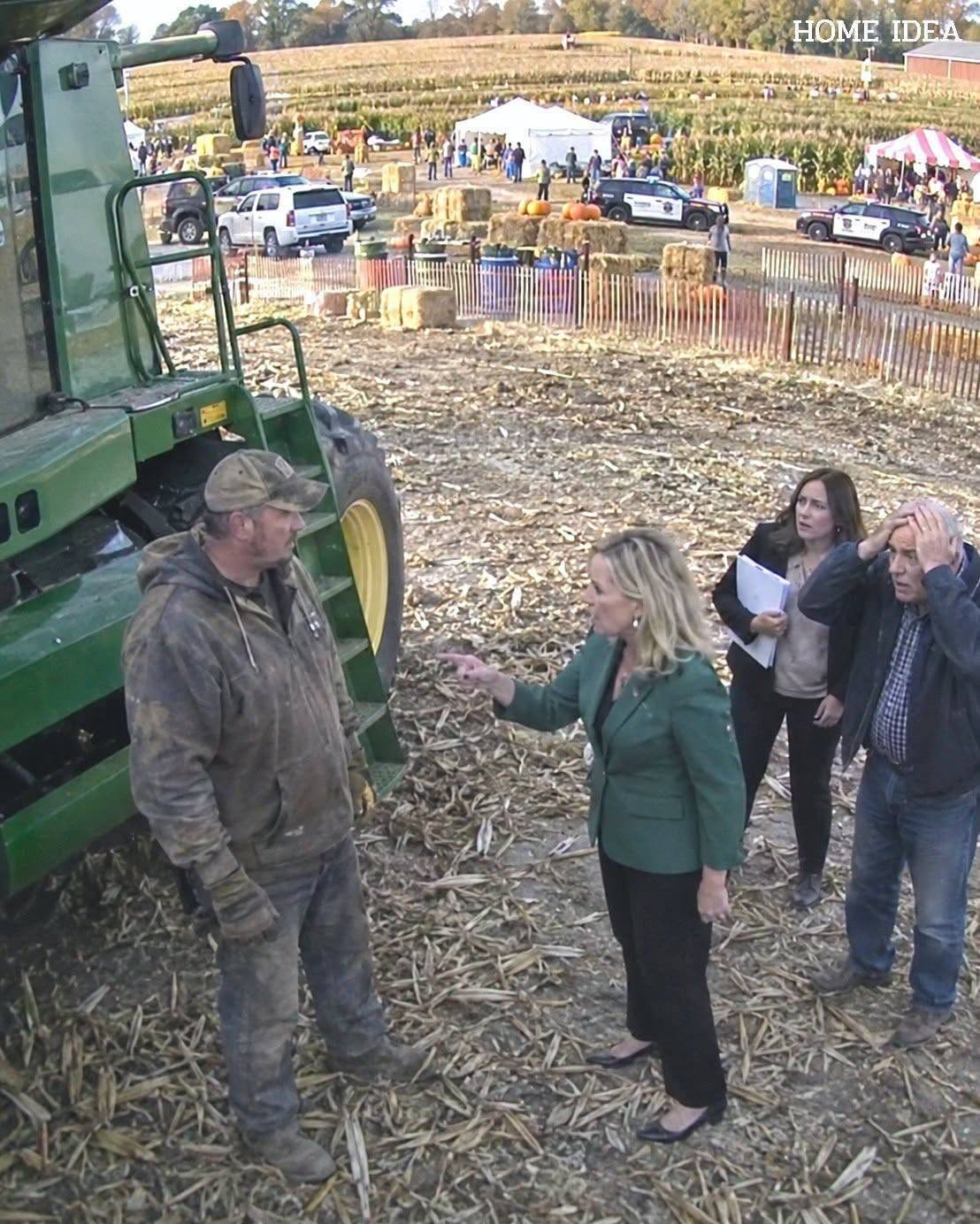
An original fictional story about a farmer, an overreaching homeowners association, and the unexpected consequences of making plans on someone else’s land.
The Morning I Discovered My Farm Had Become a Tourist Attraction
The first time I learned my cornfield had become the biggest fall attraction in Cedar County, a woman I had never met was pounding a wooden sign into my soil.
I was standing beside my tractor, finishing a cup of coffee, when I noticed an orange volunteer vest moving near the southern fence.
At first, I thought someone had gotten lost.
Then I saw the sign.
CEDAR RIDGE HARVEST WEEKEND — PARKING THIS WAY
I drove over and rolled down the tractor window.
“Can I help you?”
The woman looked up, irritated.
“Sir, you can’t park here. This area is reserved for event vehicles.”
I looked at my tractor.
Then at the cornfield behind me.
Then back at her.
“Ma’am,” I said, “this is my farm.”
She blinked.
“Well, the homeowners association has rented the property for the weekend.”
“No, they haven’t.”
She checked her clipboard.
“That’s what my instructions say.”
I stepped down from the tractor.
“My name is Jack Mercer. My family has owned this land for eighty-six years. And I haven’t rented a single acre to anybody.”
Her expression changed.
But before she could answer, three pickup trucks came down my gravel driveway.
And that was when I realized the problem was much bigger than one parking sign.
The Farm My Family Built
Mercer Farm wasn’t fancy.
We had six hundred and twelve acres outside Millbrook, a quiet town where everybody knew everybody.
Corn grew in the northern fields.
Soybeans covered the creek bottom.
Our cattle grazed west of the farmhouse.
My grandfather bought the first piece of land in 1940, when it was little more than a worn-out pasture and an old barn.
My father expanded the operation.
And when he passed away, I took over.
I wasn’t rich.
Farming rarely worked that way.
Some years were good. Other years, the weather seemed determined to ruin everything.
But the land was ours.
Every fence post, every irrigation pipe, every row of corn represented decades of work.
I loved that farm more than I could explain.
And I certainly wasn’t interested in turning it into a theme park.
The HOA That Thought It Owned Everything
Cedar Ridge Estates was a new housing development built along the eastern edge of my property.
It had a decorative stone entrance, perfectly trimmed lawns, and a homeowners association that seemed to have an opinion about everything.
The development’s president was a woman named Denise Caldwell.
She had moved to the area three years earlier.
Within six months, she’d complained about the sound of my tractor.
Within a year, she’d sent letters about dust drifting toward the subdivision.
Then came the complaints about farm equipment on the road.
And the smell of manure.
And the noise from the grain dryer.
I responded politely whenever necessary.
But I reminded her of one simple fact.
My farm existed long before Cedar Ridge Estates.
And my land was not part of their HOA.
Denise didn’t seem to appreciate that distinction.
The Letter I Almost Threw Away
Two months before the incident, I received an envelope with the Cedar Ridge logo.
Inside was a letter announcing the community’s annual autumn celebration.
It mentioned hayrides, pumpkin decorating, food vendors, and a family corn maze.
I assumed the event would take place inside the development.
Then I noticed a sentence near the bottom.
The committee anticipates using adjacent agricultural land to enhance the guest experience.
I called the number on the letter.
Denise answered.
“Jack! Wonderful to hear from you.”
“Denise, I received your event announcement.”
“Isn’t it exciting?”
“Which agricultural land are you planning to use?”
She laughed.
“Oh, just that cornfield near the eastern entrance. It’s such a perfect location.”
“My cornfield?”
“Yes. It’s practically part of the neighborhood landscape.”
I stared out my kitchen window.
“Denise, you don’t have permission to use my property.”
There was a pause.
“Jack, we’re trying to do something nice for the community.”
“That’s fine. Do it on your own land.”
She sighed.
“Must you always be so difficult?”
I ended the conversation after making my position clear.
I thought that would be the end of it.
I was wrong.
The Advertisement That Changed Everything
Three weeks later, my nephew Tyler stopped by the farm.
He walked into the kitchen holding his phone.
“Uncle Jack, since when are you running a corn maze?”
I looked up from my paperwork.
“I’m not.”
He turned the screen toward me.
There it was.
A colorful advertisement for the Cedar Ridge Harvest Weekend.
The photograph showed a golden cornfield.
My cornfield.
The event promised:
- A giant family corn maze
- Hayrides through scenic farmland
- Pumpkin painting
- Food trucks and seasonal treats
- Live music
- Children’s activities
- A weekend of unforgettable autumn fun
Tickets were already on sale.
Twenty-five dollars for adults.
Fifteen dollars for children.
There were family packages, premium parking passes, and special VIP experiences.
I stared at the advertisement.
“Where did they get that picture?”
Tyler zoomed in.
“They probably took it from the road.”
Then he scrolled farther down.
“Uncle Jack, you’re not going to like this.”
The event location was listed as Mercer Farm.
My address.
My property.
And according to the website, more than a thousand tickets had already been purchased.
The Meeting With Denise
I drove straight to the Cedar Ridge clubhouse.
Denise was in a meeting with the event committee.
When I walked in, everyone went quiet.
“Jack!” she said brightly. “What a surprise.”
“We need to talk.”
She gestured toward an empty chair.
“Of course.”
I stayed standing.
“Why are you selling tickets to an event on my property?”
Denise folded her hands.
“Now, Jack, let’s not make this unpleasant.”
“You’re advertising my farm as your event venue.”
“We’re creating a wonderful opportunity for the community.”
“You don’t have permission.”
She exchanged a look with another committee member.
Then she smiled.
“Technically, the event is being organized by the association, and the field borders our development.”
“Borders,” I repeated. “It doesn’t belong to you.”
She leaned forward.
“We assumed you would appreciate the publicity.”
I almost laughed.
“Publicity doesn’t pay for damaged crops.”
She waved a hand.
“We’ll be very careful.”
“No,” I said.
Her smile disappeared.
“What do you mean, no?”
“I mean you cannot use my land.”
She stared at me.
Then she said something I’ll never forget.
“Jack, we’ve already sold tickets. You can’t back out now.”
I looked her directly in the eyes.
“I never agreed to anything.”
The Number That Made My Jaw Drop
By Friday afternoon, the event website claimed that 1,800 tickets had been sold.
I couldn’t believe it.
At the advertised prices, the event might have generated tens of thousands of dollars in gross ticket sales.
And not one cent had been offered to me.
More importantly, nobody had asked whether my corn was ready to harvest.
Nobody had asked about insurance.
Nobody had asked whether the field could safely accommodate hundreds of visitors.
They had simply decided that my property was available.
That evening, I received another letter from Denise.
It instructed me to leave the southern field accessible throughout the weekend.
It also asked me to move my equipment away from the event entrance.
I read the letter twice.
Then I called my attorney.
The One Thing Denise Had Forgotten
My attorney, Paul, had handled farm matters for years.
He listened while I explained everything.
Then he asked a simple question.
“Jack, when were you planning to harvest that field?”
“Saturday morning.”
There was silence.
“Saturday?”
“Yes. Weather looks good. Grain moisture is where I want it. My crew’s already scheduled.”
Paul paused.
“Do you have any agreement allowing the HOA to use that field?”
“None.”
“Have you granted them an easement or event permit?”
“No.”
“Has anyone issued an order preventing you from farming it?”
“Not that I know of.”
He advised me to preserve the advertisements, messages, and letters, verify my property boundaries, and notify the organizers in writing that they had no permission to enter.
He also told me to document everything carefully.
I followed his advice.
I sent a formal notice stating that the event was unauthorized and that the field was scheduled for normal agricultural operations.
Then I made another phone call.
This one was to my harvesting crew.
“Boys,” I said, “we’re starting at sunrise.”
Saturday Morning: The Harvest Begins
At 5:30 a.m., the sky was still dark.
The air smelled of damp soil and autumn leaves.
Our combine sat ready beside the equipment shed.
By six, Tyler and the rest of the crew had arrived.
We checked the machinery, reviewed the day’s plan, and began harvesting the field.
The combine moved steadily through the rows.
Golden stalks disappeared beneath the header.
Grain poured into the cart.
Trucks carried the harvest toward storage.
It was a normal harvest morning.
Except for the enormous event banner standing near my eastern fence.
WELCOME TO CEDAR RIDGE HARVEST WEEKEND!
By nine o’clock, the corn maze that Denise had advertised was becoming a harvested field.
By eleven, most of the standing corn was gone.
And just before noon, Denise arrived.
“WHAT HAVE YOU DONE?”
I heard her before I saw her.
“JACK MERCER!”
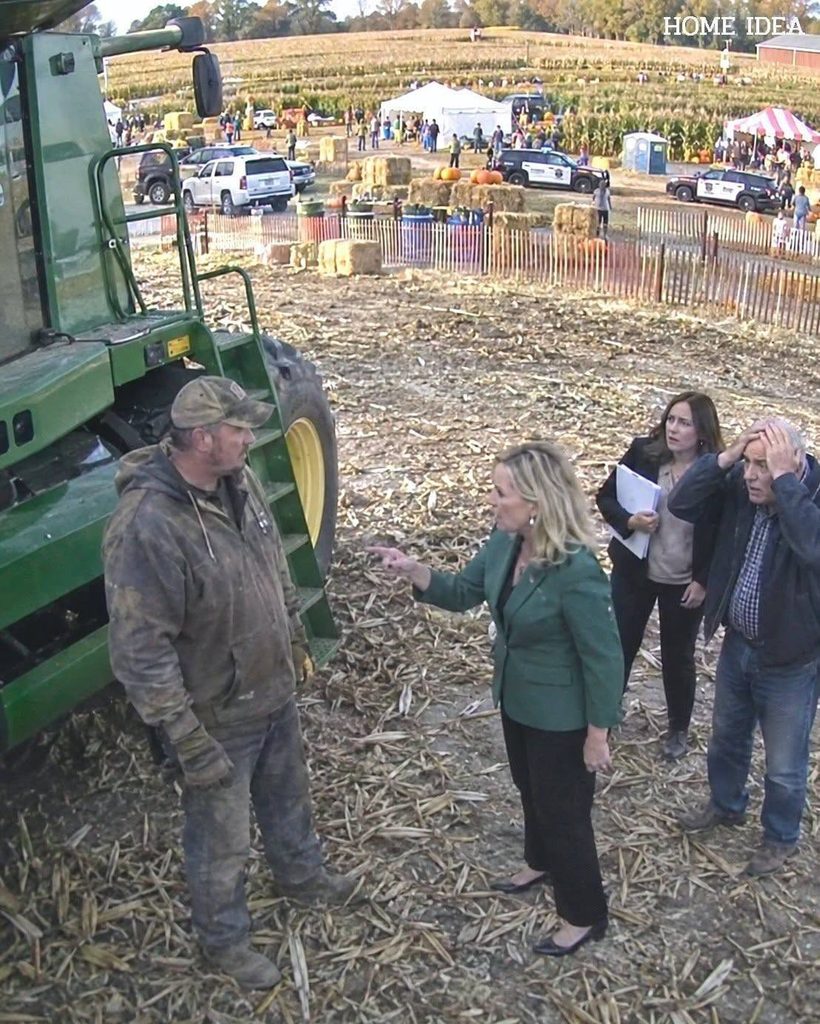
She marched across the gravel turnout wearing a green blazer and carrying a folder.
Two committee members hurried behind her.
She stopped near the combine and stared across the field.
Where she had expected towering rows of corn, there were now short stalks and harvested ground.
Her mouth fell open.
“What have you done?”
I climbed down from the tractor.
“Harvested my corn.”
“You destroyed the maze!”
I looked across the field.
“There was no maze.”
“We sold eighteen hundred tickets!”
“Then you’ve got eighteen hundred people to contact.”
Her face turned red.
“You knew what we were planning!”
“Yes,” I said. “And I told you not to use my property.”
She pointed at me.
“You did this on purpose!”
I took off my gloves.
“Denise, I harvested my crop when it was ready. That’s what farmers do.”
She looked around desperately.
“But the event starts in two hours!”
I nodded toward the clubhouse in the distance.
“Then I suggest you move it somewhere you have permission to use.”
The Guests Started Arriving
By one o’clock, cars were lining up near the Cedar Ridge entrance.
Families had come from neighboring towns.
Children wore autumn sweaters.
Parents carried cameras.
Some had driven more than an hour.
They were expecting a beautiful corn maze.
Instead, they found a field of harvested stalks.
A few people walked toward my fence, confused.
I had placed clear signs along the boundary explaining that the farm was private property and that no public event had been authorized there.
I also contacted local authorities to explain the situation and ask for assistance if unauthorized entry became a problem.
I didn’t want an argument with families who had purchased tickets in good faith.
They weren’t responsible for Denise’s decisions.
One father approached me from the public roadside.
“Excuse me, sir. Is this the corn maze?”
I shook my head.
“I’m sorry. The organizers advertised my farm without permission.”
He looked stunned.
“But we paid for tickets.”
“I understand. You’ll need to contact the event organizers about a refund.”
He looked back at his children.
They were disappointed.
And despite everything, I felt terrible for them.
Not because I’d harvested my crop.
But because someone had promised them an experience that had never been properly arranged.
The Refund Disaster
By late afternoon, the Cedar Ridge event page was flooded with complaints.
Families wanted their money back.
Vendors demanded explanations.
The company that had rented portable toilets wanted to know why the event location had changed.
A food truck owner claimed he’d been told the HOA had full permission to use the property.
A photographer said she’d booked several autumn family sessions inside the corn maze.
Denise tried to blame me.
She posted a statement claiming that an unexpected harvest had disrupted the event.
But Tyler had saved copies of the advertisements and my earlier written objections.
When questions arose, my attorney provided the relevant documentation to the appropriate parties.
The story spread through town.
People were understandably angry.
But their anger gradually shifted toward the organizers who had sold access to property they didn’t control.
The Meeting That Followed
Three days later, the Cedar Ridge board called an emergency meeting.
I didn’t attend.
I had crops to finish harvesting.
But Paul represented my interests in the discussions that followed.
The HOA’s attorney reviewed the available documents.
There was no signed lease.
No written permission.
No event agreement.
No arrangement for insurance or liability.
And no authorization from me to sell tickets for activities on the farm.
The board began reviewing how the event had been approved.
The committee was also instructed to address refunds and vendor complaints.
Denise eventually stepped down from her role as event chair.
I later heard that the association adopted a new policy requiring written authorization before advertising events on property it did not own.
That seemed like a reasonable place to start.
The Unexpected Visitor
About a week after the failed event, a woman named Rebecca came to the farm.
She had attended the festival with her two children.
I expected another complaint.
Instead, she brought a homemade apple pie.
“I wanted to apologize,” she said.
I looked at her, confused.
“For what?”
“For how some people treated you online. We didn’t know the organizers never asked your permission.”
I thanked her.
She looked across the harvested field.
“My kids were disappointed, but I explained what happened. They understand now.”
Then she smiled.
“Actually, my youngest asked whether farmers always harvest corn that quickly.”
I laughed.
“Only when the equipment behaves.”
Rebecca hesitated.
“Would you ever consider showing children how a real farm works?”
I thought about it.
The idea wasn’t bad.
But there was a difference between being asked respectfully and having my property volunteered without permission.
“Maybe someday,” I said. “If it’s planned properly.”
A Different Kind of Harvest Weekend
The following autumn, our county agricultural extension office approached me about participating in a small educational farm visit.
This time, everything was arranged in advance.
We discussed visitor numbers.
Safety requirements.
Insurance.
Parking.
Boundaries.
And exactly which areas of the farm could be accessed.
The visit was limited, supervised, and scheduled around the farm’s operations.
Families learned how corn grows.
Children saw harvesting equipment from a safe distance.
We talked about soil, weather, and the work involved in producing food.
There was no fake maze.
No unauthorized parking.
No surprise crowds.
And no HOA president trying to tell me where I could drive my tractor.
It was one of the nicest afternoons I’d had in years.
What This Story Teaches Us About Property Rights
Although this story is fictional, the underlying issues are worth understanding.
Private property generally cannot be used for a public event simply because it borders a neighborhood or would make an attractive venue.
Event organizers normally need permission from the property owner.
Depending on the location and nature of the event, they may also need permits, insurance, accessibility arrangements, emergency planning, and other approvals.
Written Agreements Matter
A written agreement can clarify:
- Which land may be used
- When access is permitted
- What activities are authorized
- Who is responsible for safety
- Whether compensation is required
- How damage or cancellations will be handled
Selling Tickets Does Not Create Ownership Rights
Accepting money from customers does not give an organizer permission to use someone else’s property.
Farmers Have Operational Responsibilities
Harvest schedules depend on crop conditions, weather, equipment availability, labor, and other practical factors.
An outside organization should never assume that a working field will remain untouched for an event.
Guests Deserve Accurate Information
People purchasing tickets should be able to trust that the organizer has arranged the venue and activities being advertised.
Why the Farmer’s Response Became the Heart of the Story
The most memorable part of this fictional tale isn’t simply that the corn disappeared.
It’s that Jack refused to let someone else’s poor planning dictate how he used his own land.
He didn’t sabotage a maze.
He didn’t destroy another person’s property.
He carried out the harvest he had already planned on his own farm.
The fictional conflict works because Denise assumed that selling enough tickets would force Jack to cooperate.
But pressure isn’t permission.
And a successful advertisement doesn’t replace a legitimate agreement.
Frequently Asked Questions
Is the story of the HOA selling 1,800 corn maze tickets true?
This article is an original fictional story inspired by a viral social media post. The events and characters have not been independently verified.
Can an HOA organize an event on a neighboring farm?
Only with the necessary legal permission and arrangements. Rules vary by location.
Does an HOA have authority over land outside its development?
An HOA’s authority depends on its governing documents, property interests, and applicable law. It does not automatically control neighboring private farmland.
Can a farmer harvest crops before an advertised event?
A farmer’s rights and obligations depend on the law and any valid agreements. In this fictional scenario, the farmer had not granted permission for the event.
What happens if an event organizer sells tickets without securing a venue?
The organizer may face refund obligations, contractual disputes, consumer complaints, or other consequences depending on the circumstances and applicable law.
Why do farmers need to harvest at particular times?
Harvest timing can depend on crop maturity, moisture content, weather forecasts, equipment, labor, and storage conditions.
Could a real corn maze be created in an ordinary cornfield?
Yes, but it requires planning, permission, safe access, and appropriate preparation. It is not something an event organizer should assume can be done without the landowner’s cooperation.
Final Thoughts: You Can’t Sell Tickets to Something You Don’t Own
Denise thought she had everything figured out.
The advertisements were ready.
The vendors were booked.
The tickets were sold.
The families were excited.
There was just one small problem.
The cornfield wasn’t hers.
Jack had spent his life working the land, and he wasn’t about to surrender his harvest because someone else had made promises without asking.
In the end, the lesson was simple.
Respecting boundaries isn’t just about fences.
It’s about recognizing that other people have rights, responsibilities, and lives that don’t revolve around your plans.
And sometimes, the biggest surprise comes when the person you underestimated simply continues doing what they were entitled to do all along.
If someone sold 1,800 tickets to an event on your property without permission, what would you do? Would you try to negotiate—or refuse to let the event happen?
Editor’s note: This is a fictional story written for entertainment. The accompanying viral social media material does not establish that these events occurred in real life.