Mother’s Day was supposed to be simple.
A nice brunch.
Flowers.
Cake.
A few photographs.
Maybe one afternoon where everyone behaved like a normal family.
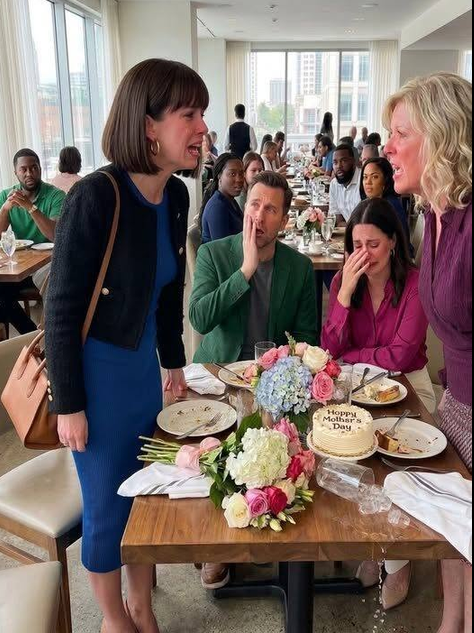
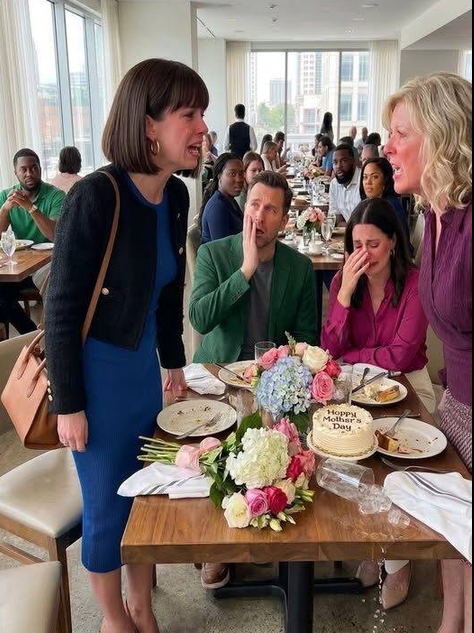
Instead, my mother looked directly at me across a restaurant table crowded with flowers and half-finished plates and said the sentence I had spent most of my life trying not to hear.
“I wish you’d never been my daughter.”
For a few seconds, the entire table went silent.
My brother stopped chewing.
My sister-in-law covered her mouth.
Even the waiter who had been walking toward us slowed down.
I stared at my mother, Diane, waiting for her to laugh.
She didn’t.
So I stood up, picked up my purse, and said the only thing I could think of.
“Then live as if you never had one.”
And I walked out.
By the next morning, my phone was ringing nonstop.
My relatives wanted explanations.
My brother wanted me to apologize.
My aunt said I had “ruined Mother’s Day.”
But almost nobody asked the question that actually mattered:
What makes a daughter finally walk away from her own mother?
The answer had started long before that restaurant.
I Had Spent Years Trying to Be the Daughter She Wanted
Growing up, I always felt like I was auditioning for my mother’s approval.
If I got a good grade, she asked why it wasn’t higher.
If I lost weight, she warned me not to gain it back.
If I got a promotion, she asked why I wasn’t earning more.
If I bought a house, she pointed out everything she didn’t like about the neighborhood.
Nothing was ever simply good.
There was always a correction.
A comparison.
A reminder that someone else had done better.
My younger brother, Daniel, had a completely different experience.
He could forget her birthday and she would laugh.
I could arrive five minutes late to dinner and spend the evening hearing about how “selfish” I had become.
For years, I told myself that this was just her personality.
Some mothers were warm.
Mine was difficult.
That didn’t mean she didn’t love me.
At least, that was what I kept telling myself.
The Criticism Got Worse After I Became Independent
Things changed when I stopped needing her approval as much.
I built a career.
I bought my own home.
I became financially independent.
I started making decisions without asking her permission first.
That seemed to bother her more than anything I had ever done wrong.
Suddenly, she had opinions about everything.
My clothes.
My hair.
My friends.
My relationship.
The way I decorated my house.
How often I called her.
How long I stayed when I visited.
If I disagreed with her, she would say:
“You’ve changed.”
For years, that phrase made me feel guilty.
Eventually, I realized she was right.
I had changed.
I was no longer a frightened teenager trying to avoid disappointing her.
Still, I Wanted Mother’s Day to Go Well
That year, I organized the entire brunch.
I chose a beautiful restaurant.
I made the reservation.
I ordered flowers.
I bought her favorite cheesecake.
I even paid for everyone.
My brother brought his wife.
My aunt came.
A few cousins joined us.
For the first hour, things were surprisingly peaceful.
My mother seemed happy.
We took photographs.
She opened her gifts.
She hugged everyone.
I remember thinking:
Maybe today will actually be nice.
Then she started talking about my brother.
Daniel and his wife had recently announced that they were expecting a baby.
My mother was thrilled.
She talked about becoming a grandmother.
She discussed baby names.
She described the nursery she wanted them to create.
Then she turned toward me.
“You could have given me grandchildren years ago,” she said.
I smiled awkwardly.
We had discussed this before.
I had told her repeatedly that my personal decisions were not appropriate conversation topics at family gatherings.
“Mom,” I said quietly, “not today.”
That should have ended it.
It didn’t.
She Kept Pushing
She looked around the table as though she had an audience.
“You’re always so sensitive.”
I said nothing.
Then she added:
“I don’t know where I went wrong with you.”
My brother looked down at his plate.
My aunt suddenly became fascinated with her coffee.
Everyone knew what was happening.
And everyone did what they had always done.
Nothing.
That silence was familiar.
My mother could say almost anything, and everyone else would wait for me to absorb it quietly so dinner could continue.
But that afternoon, I was tired.
Not angry yet.
Just tired.
I looked at her and said:
“I came here to celebrate you. Can we please just have one lunch without criticizing my life?”
Her expression changed instantly.
To anyone who had grown up around her, it was recognizable.
She hated being challenged.
Especially publicly.
Then She Said It
Her voice became cold.
“I sacrificed everything for my children.”
I nodded.
“I know.”
“No, you don’t.”
I took a breath.
“Mom, please.”
Then she leaned slightly forward and said:
“Sometimes I wish you’d never been my daughter.”
Nobody moved.
I looked at her for several seconds.
There are moments when you expect yourself to feel devastated.
Instead, I felt strangely calm.
Because the sentence didn’t feel new.
It simply felt like the first time she had said out loud what years of treatment had already taught me.
So I stood.
My chair scraped across the floor.
My mother stared at me.
“Where are you going?”
I picked up my handbag.
Then I said:
“You wish you never had a daughter? Then live as if you never had one.”
And I walked away.
My Hands Were Shaking When I Reached the Parking Lot
The confidence lasted until I reached my car.
Then my hands started trembling.
I sat behind the steering wheel without turning the engine on.
I cried harder than I had cried in years.
Not because of what she had just said.
Because suddenly I was remembering every smaller version of the same sentence.
Every birthday she had ruined.
Every achievement she had minimized.
Every apology I had made simply to restore peace.
Every family event where someone whispered:
“Just ignore her.”
“Don’t make it worse.”
“You know how she is.”
For the first time, I wondered why everyone had spent years asking me to tolerate behavior they would never accept from anyone else.
My Brother Called Before I Even Got Home
Daniel’s name appeared on my dashboard screen.
I ignored it.
He called again.
Then my aunt.
Then my cousin.
Then my mother.
By the time I reached home, I had eleven missed calls.
Daniel finally sent a message.
You need to call Mom. She’s devastated.
I stared at the screen.
Then I typed:
She told me she wished I’d never been her daughter.
His reply came almost immediately.
You know she didn’t mean it.
That sentence made something inside me snap.
Not angrily.
Clearly.
Because suddenly I understood the entire family system.
My mother could say something cruel.
I reacted.
Then everyone focused on my reaction instead of what had caused it.
I Asked My Brother One Question
I texted him:
If your wife said that to your future child one day, would you tell the child to apologize for leaving the room?
He didn’t answer.
Not for almost an hour.
Then he wrote:
That’s different.
I replied:
Why?
No response.
My Mother Finally Left a Voicemail
That evening, I listened to it.
She wasn’t apologizing.
She was furious.
“I cannot believe you embarrassed me like that in front of everyone.”
That was the first sentence.
Not:
I’m sorry.
Not:
I shouldn’t have said it.
Not:
Are you okay?
She was upset because people had witnessed the consequences of what she had said.
Then came the familiar phrases.
“You always overreact.”
“You twist everything.”
“I was angry.”
“A daughter should never walk out on her mother on Mother’s Day.”
I listened until the voicemail ended.
Then I deleted it.
For the First Time, I Didn’t Call Back
Normally, I would have.
I would have spent hours explaining why I was hurt.
She would have explained why I was wrong.
Eventually, I would apologize for my tone.
Then life would return to normal.
This time, I did nothing.
I made tea.
I turned off my phone.
And I went to bed.
The next morning, something unexpected happened.
I felt relieved.
The Family Group Chat Exploded
My aunt sent a message saying we needed to “fix this before it destroys the family.”
A cousin wrote that my mother was “from another generation.”
Someone else said:
“She says things she doesn’t mean.”
Then my sister-in-law, Rachel, wrote something nobody expected.
She shouldn’t have said that to her.
The group chat immediately went quiet.
A few minutes later, Rachel called me privately.
“I’m sorry,” she said.
“For what?”
“For sitting there and saying nothing.”
That meant more to me than she probably realized.
She told me that after I left, my mother had continued complaining.
Eventually, Rachel asked her:
“Do you actually think what you said was okay?”
My mother apparently replied:
“She knows I didn’t mean it.”
Rachel said:
“Then why haven’t you apologized?”
My mother had no answer.
I Decided to Take a Break
I didn’t dramatically announce that I was cutting my mother out of my life forever.
I simply stopped participating.
No phone calls.
No Sunday dinners.
No constant messages.
No immediate responses to every family crisis.
For the first few weeks, the guilt was terrible.
I had been trained to believe that setting a boundary was cruelty.
Every time my phone rang, my stomach tightened.
But slowly, the silence became peaceful.
I started noticing how much emotional energy I had spent managing my mother’s moods.
Without that constant tension, my life felt lighter.
Then a Letter Arrived
About six weeks later, there was an envelope in my mailbox.
My mother’s handwriting was on the front.
I almost threw it away.
Instead, I left it unopened on my kitchen counter for two days.
When I finally read it, the first paragraph sounded exactly like her.
She explained how hurt she was.
How embarrassed she had felt.
How difficult the situation had become.
I nearly stopped reading.
Then I reached a sentence I had never seen from her before.
“I said something cruel because I wanted to hurt you in that moment.”
I read it twice.
There was no excuse attached.
She continued:
“I have spent years believing that because I am your mother, you should forgive everything I say. I am beginning to understand that being your mother does not give me permission to hurt you.”
I sat at my kitchen table and cried.
It was the closest thing to accountability I had ever received from her.
I Didn’t Immediately Go Back
An apology doesn’t erase years of behavior.
And I didn’t want one emotional letter to restart the same cycle.
So I called her.
We spoke for twenty minutes.
For once, I didn’t argue about individual incidents.
I told her what would have to change if she wanted a relationship with me.
“No insulting my life choices.”
“No humiliating me in front of other people.”
“No expecting me to apologize because I respond to something hurtful.”
She was quiet.
Then she said:
“You’re giving your mother rules?”
I almost laughed.
There she was.
The mother I knew.
“Yes,” I said. “They’re called boundaries.”
Our Relationship Didn’t Magically Become Perfect
That’s not how real relationships work.
She slipped occasionally.
Sometimes she made a comment and then caught herself.
Other times, I reminded her.
Once, she became angry and didn’t speak to me for two weeks.
The difference was that I no longer chased after her.
If she wanted space, I let her have it.
Slowly, something changed.
Not just in her.
In me.
I stopped measuring my worth through her approval.
And strangely, once I stopped desperately trying to earn it, her criticism lost much of its power.
The Following Mother’s Day Was Very Different
A year later, I didn’t organize a large brunch.
I didn’t buy expensive flowers.
I didn’t plan a perfect family afternoon.
I invited my mother to coffee.
Just the two of us.
She arrived carrying a small gift bag.
Inside was an old photograph of us together when I was about six.
On the back, she had written:
“I am glad you are my daughter. I’m sorry it took me so long to learn how to say that properly.”
I didn’t suddenly forget everything that had happened.
But I kept the photograph.
It’s still in my house today.
What I Learned From Walking Away
People often say family is everything.
But that phrase can become dangerous when it is used to excuse behavior that would be unacceptable anywhere else.
Being related to someone doesn’t mean you must accept unlimited disrespect.
A boundary isn’t punishment.
It’s information.
It tells someone:
This is what I will and will not participate in.
And sometimes the most important boundary isn’t about changing another person.
It’s about changing what you are willing to tolerate.
You Can Love Someone and Still Need Distance
This was the hardest lesson for me.
For years, I thought there were only two options:
Love my mother and tolerate everything.
Or walk away and become a terrible daughter.
There was actually a third option.
I could love her while protecting myself.
I could accept an apology without pretending nothing happened.
I could allow the relationship to continue while refusing to return to the old version of it.
Sometimes distance destroys relationships.
Sometimes it is the only thing that gives them a chance to become healthier.
Final Thoughts
When my mother told me she wished I had never been her daughter, I thought that Mother’s Day had destroyed our relationship.
In reality, it exposed a relationship that had been unhealthy for years.
Walking out of that restaurant wasn’t the end.
It was the first time I stopped participating in a pattern that had controlled most of my life.
And surprisingly, that boundary eventually forced both of us to confront something we had avoided for decades.
She had to learn that motherhood didn’t make her immune from consequences.
And I had to learn that being a daughter didn’t require me to accept cruelty.
Sometimes walking away isn’t abandoning someone.
Sometimes it’s simply refusing to abandon yourself.