At first glance, this puzzle seems almost too easy.
The image simply asks:
“How many 8s?”
Below the question are four vertical columns of overlapping figure-eights. Most people take one quick look, count the obvious shapes, and confidently give their answer.
But then the comments begin.
Some people say 12.
Others insist the answer is 13.
A few count 16.
And many people argue that the correct answer is 14.
So who is right?
Take another careful look before scrolling down, because the answer depends on noticing two small details that are very easy to overlook.
Look at the Four Main Columns First
The center of the puzzle contains four identical-looking vertical designs.
Each column contains four oval loops arranged one underneath another.
The trick is that an “8” is created whenever two neighboring loops are combined.
In one column, you can find:
- One 8 using the top two loops
- One 8 using the middle two loops
- One 8 using the bottom two loops
That gives us:
3 eights in each column.
There are four columns.
So:
3 × 4 = 12
At this point, many people stop counting.
And that’s why 12 is one of the most common answers.
But the puzzle isn’t finished yet.
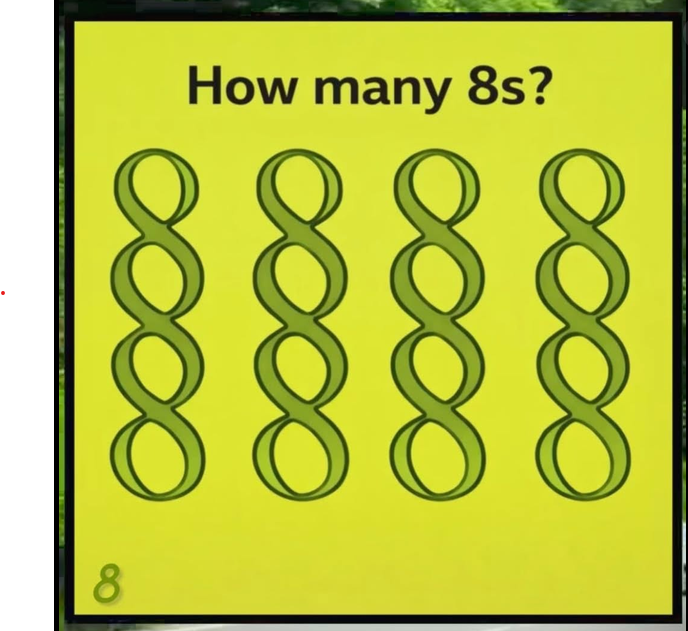
There’s Another 8 in the Question
Look back at the text at the top of the image:
“How many 8s?”
The number 8 appears directly in the question itself.
That’s another visible 8.
So now our total becomes:
12 + 1 = 13
This explains why many people answer 13.
But there’s still one more.
Check the Bottom-Left Corner
At the bottom-left of the puzzle, there is another small number:
8
It’s easy to miss because your attention is naturally drawn toward the large overlapping shapes in the center.
Add that final number:
13 + 1 = 14
The Answer Is 14
Using the straightforward intended interpretation of the puzzle, the count is:
12 hidden in the four columns
+ 1 in “How many 8s?”
+ 1 at the bottom-left
= 14 eights
So the most likely intended answer is:
14
Did you get it on your first attempt?
Why Do So Many People Answer 12?
The puzzle uses a simple attention trick.
When we see the instruction “How many 8s?”, our brains immediately focus on the large graphic underneath.
The four columns appear to be the actual puzzle, while everything else looks like decoration or instructions.
So people count the overlapping figures and stop at:
12.
They technically counted the central shapes correctly — they just didn’t search the entire picture.
Why Do People Answer 13?
People who answer 13 usually spot one of the two extra eights.
They count the 12 main figures and then notice the 8 in the question.
That produces:
12 + 1 = 13
But they miss the tiny 8 in the bottom-left corner.
Another person might do the opposite: spot the bottom 8 but ignore the one in the headline.
Either way, the result is 13.
What About the People Who Say 16?
Visual puzzles often produce different answers because people interpret the graphic differently.
Some viewers may try to count individual outlines, overlapping curves, or additional combinations inside the large shapes.
That can produce totals such as 15, 16, or even higher.
However, once you start treating every partial outline or decorative curve as an independent digit, the rules become subjective.
For the cleanest interpretation, each pair of neighboring loops forms one complete 8.
Under that method, the intended answer is 14.
Let’s Break the Puzzle Down Slowly
Here’s another way to visualize it.
Column 1
Four loops create three neighboring pairs:
Loop 1 + Loop 2 = one 8
Loop 2 + Loop 3 = one 8
Loop 3 + Loop 4 = one 8
Total: 3
Column 2
Same arrangement.
Total: 3
Column 3
Again:
Total: 3
Column 4
And finally:
Total: 3
So all four columns contain:
3 + 3 + 3 + 3 = 12
Now add the two printed numbers elsewhere in the puzzle:
12 + 1 + 1 = 14
Simple once you see it — but surprisingly easy to miss.
Why Optical Puzzles Like This Fool Our Brains
This puzzle isn’t really testing advanced mathematics.
It’s testing attention.
Humans are excellent at identifying patterns quickly.
That’s normally useful. If we had to analyze every tiny detail before understanding what we were looking at, everyday life would become extremely slow.
But puzzles take advantage of that ability.
Your brain sees four columns and quickly identifies what it thinks the task is:
“Count the shapes.”
Once you reach an answer, your brain may stop looking for additional information.
That’s known informally as overlooking details that don’t appear important to the main task.
The Question Itself Is Part of the Puzzle
One of the oldest tricks in visual riddles is hiding part of the answer inside the instructions.
When a puzzle asks:
“How many 8s?”
most people interpret the sentence purely as an instruction.
They don’t consider the possibility that the digit used in the question should also be counted.
That’s exactly what makes the trick effective.
The Tiny Bottom 8 Is Even Easier to Miss
The small number near the lower-left edge creates a second attention trap.
Our eyes tend to focus on large, high-contrast objects near the middle of an image.
The tiny number at the edge feels unimportant.
But once you know it’s there, it becomes impossible not to notice.
That’s the fun part of puzzles like this.
Try This Before Showing Someone Else
If you’re sharing this puzzle with friends or family, don’t immediately tell them the answer.
Show them the picture and ask:
“How many 8s can you find?”
Give them about 10 seconds.
Then ask them to explain how they counted.
You’ll probably hear several different answers.
Someone will almost certainly say 12.
Another person may proudly announce 13.
And someone who notices the tiny bottom number may reach 14 immediately.
Can Children Solve It Faster Than Adults?
Sometimes children perform surprisingly well on visual puzzles because they may approach the image without assuming complicated rules.
Adults often try to find a sophisticated mathematical trick.
Meanwhile, a child may simply scan the entire picture and notice the extra numbers.
Of course, there’s no guarantee — but comparing answers can make these puzzles especially entertaining for families.
A Good Puzzle Doesn’t Need Complicated Math
That’s part of the charm here.
There are no equations.
No algebra.
No calculator.
No advanced mathematical knowledge.
All you need is careful observation.
And yet thousands of people can look at the same image and confidently produce different answers.
That’s why these seemingly simple Facebook puzzles generate so many comments.
Before You Answer Any Visual Puzzle, Use This Trick
When you encounter another puzzle like this, don’t immediately focus only on the center.
Instead, scan the image in this order:
- Read the entire question carefully.
- Check the corners.
- Examine the main objects.
- Look for overlapping shapes.
- Check whether numbers in the instructions also count.
- Look around the borders one final time.
That five-second second look can completely change your answer.
Can You Spot All 14 Without Reading the Solution?
If you’ve reached this point, you already know where they are.
But try returning to the original image and identifying every 8 individually.
Count:
3 in the first column.
3 in the second.
3 in the third.
3 in the fourth.
That’s 12.
Then find the number in:
“How many 8s?”
That’s 13.
Finally, look at the:
bottom-left corner.
And there is number 14.
Final Answer
The most straightforward solution to the puzzle is:
14 eights
The calculation is:
4 columns × 3 visible 8s = 12
Then:
+ 1 eight in the question
+ 1 eight in the bottom-left corner
Final total = 14
If your first answer was 12 or 13, you weren’t far off — the puzzle simply succeeded at distracting you.
And if you got 14 immediately, your attention to detail was excellent.
Now comes the fun part:
Show the image to someone else without telling them the answer and see what they count.