When you think of McDonald’s, one of the first things that comes to mind is its famous golden arches.
That bright yellow letter “M” is one of the most recognizable symbols in the world. Whether you’re driving through a busy city or traveling along a quiet highway, the familiar sign is easy to spot.
But in one beautiful Arizona town, something is different.
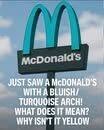
Instead of the traditional golden yellow, the McDonald’s arches are turquoise blue-green.
Yes, it’s real!
In Sedona, Arizona, a McDonald’s restaurant has become famous not for a special burger or unusual menu item, but for the unexpected color of its iconic logo.
And the story behind those turquoise arches is even more interesting than you might imagine.
Where Is the McDonald’s With Turquoise Arches?
The famous restaurant is located in Sedona, Arizona, a picturesque destination in the American Southwest.
Its address is:
2380 West State Route 89A, Sedona, Arizona.
Sedona is famous for its magnificent red sandstone formations, desert scenery, hiking trails, and distinctive Southwestern architecture.
The town attracts visitors who come to admire its natural beauty and peaceful surroundings.
But among the red rocks and scenic landscapes, an ordinary fast-food restaurant has become an unusual attraction.
At first glance, the building resembles a typical Southwestern-style commercial property.
Look closer, though, and you’ll notice something remarkable.
The McDonald’s logo is turquoise instead of yellow.
The location is widely recognized as the world’s only McDonald’s with turquoise arches.
Why Are the Arches Turquoise Instead of Yellow?
The answer has nothing to do with a printing mistake, a temporary promotion, or a new corporate logo.
The unusual color was chosen because of Sedona’s approach to protecting its natural scenery.
When McDonald’s planned to open a restaurant in Sedona in the early 1990s, local officials wanted the building and its signage to fit the character of the surrounding landscape.
Sedona is known for its dramatic red rocks, earthy colors, and scenic views.
Officials were concerned that the familiar bright yellow arches might stand out too strongly against the area’s natural surroundings.
The solution was an unexpected compromise.
Instead of using the traditional golden yellow, the restaurant adopted a softer turquoise color.
This blue-green shade complemented the Southwestern appearance of the shopping center and helped the business fit the town’s design expectations.
The result was one of the most distinctive McDonald’s signs ever created.
The Story Began in the Early 1990s
The history of Sedona’s turquoise arches goes back more than three decades.
In 1991, discussions began between McDonald’s representatives and Sedona city staff about opening a restaurant.
McDonald’s initially envisioned a more conventional design, including its recognizable yellow arches.
However, city officials preferred a building that reflected the surrounding Southwestern architectural style.
The proposed restaurant was part of a commercial area where colors and building materials were expected to complement the landscape.
Around 1992, as the project moved through planning and zoning review, attention turned to the restaurant’s signage.
The traditional yellow logo became an important design consideration.
City planning staff suggested that a color closer to those used in the surrounding shopping center would be more appropriate.
Turquoise emerged as the solution.
McDonald’s and local officials reached an agreement, and the restaurant opened in 1993.
What began as a local design decision would eventually become an internationally recognized curiosity.
Why Sedona Cares So Much About Building Colors
To understand the turquoise arches, you need to understand Sedona itself.
The town is surrounded by spectacular sandstone formations in shades of red, orange, and rust.
These landscapes are a major part of its identity and tourism appeal.
Sedona has long emphasized architectural design that respects the natural environment.
Commercial buildings are expected to fit the town’s character rather than dominate the scenery.
Earth-Toned Architecture
Many buildings feature colors inspired by the surrounding desert.
You may notice shades of:
- Terracotta
- Rust red
- Sand
- Beige
- Muted brown
- Soft green
- Other subdued Southwestern colors
These choices help commercial buildings blend with the landscape.
Thoughtful Sign Design
Sedona’s design standards also address commercial signs.
The goal is to create attractive, functional signage without overwhelming the visual character of the town.
Exterior Lighting
Sedona is also known for its efforts to protect dark night skies.
Its approach to outdoor lighting aims to reduce unnecessary glare and light pollution.
Building Height and Appearance
Design standards help maintain the area’s scenic views and distinctive architectural identity.
The McDonald’s turquoise arches are a particularly famous example of how these local priorities can influence even a global brand.
Was McDonald’s Forced to Change Its Logo?
The story is often summarized as “Sedona banned the Golden Arches.”
However, the real situation was more nuanced.
The restaurant’s design went through discussions with local planning officials.
The goal was to find a solution compatible with the town’s expectations for commercial development.
According to historical accounts, the turquoise color emerged through cooperation between McDonald’s representatives and city staff.
Rather than abandoning the project, the company adapted its familiar branding.
This is what makes the story so interesting.
A symbol recognized around the world was modified to reflect the identity of one small community.
Why Turquoise?
Turquoise is strongly associated with the visual character of the American Southwest.
The blue-green shade contrasts beautifully with the warm red and orange tones of Sedona’s landscape.
It was also compatible with the colors used in the surrounding commercial area.
Unlike bright yellow, turquoise offered a distinctive appearance that local officials considered more suitable for the setting.
The decision was primarily about architectural compatibility and community character.
It was not a sign that McDonald’s had changed its worldwide branding strategy.
When Did the Turquoise McDonald’s Open?
The Sedona McDonald’s opened in 1993.
That means the turquoise arches are not a recent invention.
They have been part of the town’s appearance for decades.
Social media periodically brings the unusual restaurant back into the spotlight, leading new audiences to discover its story.
For someone seeing the photograph for the first time, the color can look almost unbelievable.
But the arches have been turquoise since the restaurant’s early history.
Is It Really the Only McDonald’s With Turquoise Arches?
Sedona’s location is widely described as the only McDonald’s in the world with turquoise arches.
The City of Sedona itself highlights the unusual sign as an example of how local design standards shape commercial development.
However, that does not mean every other McDonald’s sign in the world is yellow.
Some locations have featured other unusual colors or architectural variations.
The important distinction is that Sedona is famous specifically for its turquoise arches.
Other McDonald’s Locations With Unusual Colors
The golden arches are globally recognizable, but their presentation can vary depending on the location.
Red Arches
Some McDonald’s locations have featured red arches rather than the traditional yellow.
Black Arches
Certain locations have used darker branding elements to suit surrounding architecture.
White Arches
Some McDonald’s signs have appeared in white, particularly in settings where a more restrained appearance was preferred.
These variations show that even a highly recognizable global brand can adapt to local architectural expectations.
Sedona’s turquoise arches remain one of the most famous examples.
Did the Color Change Make the Restaurant More Popular?
The turquoise arches have become a recognizable local curiosity.
Travelers frequently photograph the unusual sign.
The restaurant has appeared in travel articles, social media posts, and discussions about unusual roadside attractions.
For many visitors, spotting the turquoise arches is a fun addition to a Sedona trip.
It’s a small detail, but one that makes people stop and look twice.
The restaurant’s unusual appearance has given it a level of attention that most ordinary fast-food locations never receive.
Interestingly, the original purpose of the color change was to make the restaurant less visually disruptive.
Instead, the unusual design helped make it famous.
Does the Sedona McDonald’s Serve Different Food?
The turquoise arches might suggest something completely different inside.
But the restaurant is still a regular McDonald’s.
Its unusual identity comes primarily from its exterior design and signage.
It is not known for an entirely separate turquoise-themed menu.
Like other franchise locations, its available menu items and services may change over time.
The main attraction is the sign itself.
Can You Visit the Turquoise McDonald’s?
Yes.
The restaurant is located along West State Route 89A in Sedona.
Visitors traveling through the area can see the distinctive arches and appreciate the building’s Southwestern-inspired appearance.
If you’re planning a trip, remember that restaurant hours and access arrangements can change.
For photography, stay in public or permitted areas and avoid obstructing vehicles or pedestrians.
The turquoise arches make an interesting roadside stop, but Sedona offers much more to explore.
What Else Is Sedona Famous For?
Sedona is known for some of Arizona’s most striking natural landscapes.
Red Rock Formations
The region’s red sandstone cliffs and rock formations create dramatic scenery.
Scenic Hiking Trails
Sedona attracts hikers with trails offering views of canyons, rock formations, and desert vegetation.
Southwestern Architecture
Buildings throughout the area often reflect the colors and textures of the natural environment.
Arts and Culture
The town has galleries, art installations, and a strong creative identity.
Stargazing
Sedona’s dark-sky efforts make nighttime scenery another part of the visitor experience.
The turquoise McDonald’s is only one small piece of what makes the town distinctive.
What the Turquoise Arches Teach Us About Branding
The story offers an interesting lesson about the relationship between global brands and local communities.
Most people recognize McDonald’s because its branding is consistent.
The arches, colors, and overall design create a familiar visual identity.
But consistency does not always require complete uniformity.
In Sedona, the brand remained recognizable even after one of its most famous colors changed.
The shape of the arches stayed the same.
The restaurant name remained familiar.
Only the color was different.
Yet that small change created a memorable landmark.
Local Identity Can Influence Global Companies
Sedona demonstrated that a community’s architectural expectations can influence how a major international business presents itself.
Familiar Designs Can Be Adapted
The turquoise arches show that recognizable branding can survive thoughtful local modifications.
An Unexpected Detail Can Become an Attraction
A design intended to complement the landscape became a reason for visitors to take photographs.
The Story Matters as Much as the Appearance
The arches are interesting because they are turquoise.
But the history behind the color is what makes them memorable.
Common Myths About Sedona’s Turquoise McDonald’s
Myth 1: The Yellow Paint Faded Into Blue
False.
The turquoise color was intentional.
Myth 2: The Restaurant Was Built Recently
False.
The location opened in 1993.
Myth 3: McDonald’s Changed Its Logo Worldwide
False.
The familiar golden arches remain the brand’s standard symbol.
Myth 4: The Color Was Chosen for a Special Menu
There is no evidence that the color was connected to a unique food offering.
Myth 5: The Color Was Simply a Marketing Stunt
The original decision was connected to Sedona’s local design expectations.
The publicity came afterward.
Myth 6: Sedona Has No Rules About Commercial Signs
False.
The city has design standards addressing signage, building appearance, and community character.
Frequently Asked Questions
Why are the McDonald’s arches blue in Sedona?
The turquoise color was selected to fit the town’s design expectations and complement the surrounding red-rock landscape.
Where is the turquoise McDonald’s located?
It is located at 2380 West State Route 89A in Sedona, Arizona.
When did the turquoise McDonald’s open?
The restaurant opened in 1993.
Are the arches blue or green?
They are generally described as turquoise or teal, a blue-green shade.
Is this the only McDonald’s with turquoise arches?
It is widely recognized as the world’s only McDonald’s with turquoise arches.
Are all McDonald’s signs yellow?
No. A small number of locations have used alternative colors.
Did Sedona prohibit every yellow sign?
The famous story concerns the review of this particular restaurant’s design and the city’s broader architectural standards. It should not be interpreted as proof that every yellow sign is prohibited.
Does the restaurant have a special menu?
Its main distinction is its exterior design, not a completely different menu.
Why does Sedona have strict design standards?
The city aims to preserve its scenic beauty, architectural character, and relationship with the surrounding natural landscape.
Can tourists take photographs of the turquoise arches?
Visitors commonly photograph the landmark, provided they respect property rules and traffic safety.
Did McDonald’s object to the unusual color?
Historical accounts describe discussions and negotiations before the turquoise design was accepted.
Why is the restaurant famous online?
The unusual color surprises people who are accustomed to seeing McDonald’s traditional golden arches.
Final Thoughts: The McDonald’s That Changed Its Famous Golden Arches
For decades, the golden arches have been one of the world’s most recognizable commercial symbols.
But in Sedona, Arizona, those arches tell a different story.
The town’s commitment to protecting its natural scenery led to a remarkable compromise: a McDonald’s restaurant with turquoise arches instead of yellow ones.
Since opening in 1993, the unusual sign has become a memorable local landmark and a favorite subject for curious travelers.
It’s a reminder that even the world’s biggest brands sometimes adapt to the places they call home.
And sometimes, one small design decision can create something truly unforgettable.
So here’s the question: Do you prefer the classic GOLDEN McDonald’s arches or Sedona’s unique TURQUOISE version?