You may have seen a surprisingly simple home trick circulating online: fill a glass with water and salt, place it in a room, and leave it there.
Some posts make dramatic claims about what happens next. Depending on the version, the glass is said to “clean the air,” absorb excess humidity, eliminate bad odors, remove negative energy, or even reveal hidden problems inside your home.
A glass of salt water certainly can change after sitting in a room for several days. You might notice crystals around the rim, cloudy water, a lower water level, or residue inside the glass.
But what is actually happening?
The real explanation is less mysterious — and much more interesting.
Why Does the Water Level Go Down?
The easiest change to explain is the disappearing water.
Water naturally evaporates when exposed to air.
The rate depends on several factors, including:
- Room temperature
- Relative humidity
- Air circulation
- Surface area of the water
- How long the glass remains uncovered
A warm, dry room with good airflow will generally encourage faster evaporation than a cool, humid room.
So if you leave an uncovered glass for several days and notice less water inside, that doesn’t necessarily indicate that the glass has “absorbed” something harmful from your home.
Much of what you’re seeing is simply normal evaporation.
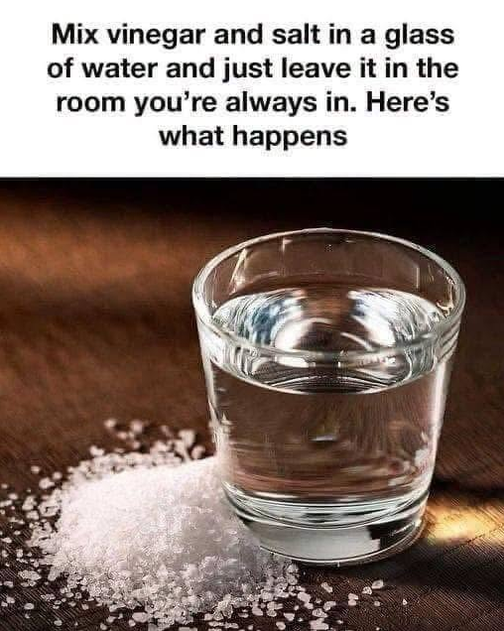
Why Do Salt Crystals Appear Around the Glass?
This is where the experiment becomes visually interesting.
Salt dissolves in water, but the salt itself doesn’t evaporate along with the water under normal household conditions.
As water gradually evaporates, the remaining solution becomes more concentrated.
Eventually, some dissolved salt may begin forming visible crystals.
You might find white deposits:
Around the rim, on the sides of the glass, or near the bottom.
This is ordinary crystallization.
It can look dramatic, particularly if the glass has been sitting undisturbed for a long time.
Why Can the Water Become Cloudy?
Cloudiness can have several explanations.
Impurities in the salt or water may become more noticeable as water evaporates.
Dust and other airborne particles can also settle into an uncovered glass.
Microbial growth is another reason you shouldn’t treat water that has been sitting open for days as drinking water.
If the container itself wasn’t perfectly clean, residue may also become visible over time.
So cloudy water isn’t reliable evidence that the glass has somehow pulled “toxins” or harmful energy out of the room.
Does Salt Absorb Moisture From the Air?
Salt and humidity have an interesting relationship, but the viral version of this claim is often oversimplified.
Some salts and salt-containing materials can interact with atmospheric moisture under suitable humidity conditions.
However, a normal drinking glass containing salt water isn’t a practical substitute for a household dehumidifier.
A real dehumidifier continuously moves air through the appliance and removes substantial quantities of moisture.
A small stationary glass simply doesn’t have that capacity.
If your bedroom, bathroom, or basement has a genuine humidity problem, controlling the source of the moisture and using proper ventilation or a suitable dehumidifier is far more effective.
Can a Glass of Salt Water Purify the Air?
There’s no good reason to rely on an ordinary glass of salt water as an air purifier.
Real air-quality problems can involve particles, smoke, allergens, volatile compounds, excessive humidity, mold, or inadequate ventilation.
Different problems require different solutions.
For example, reducing indoor particulate pollution may involve controlling the source, improving ventilation when appropriate, and using suitable filtration.
A stationary glass of salt water doesn’t circulate the room’s air through a filter.
So it shouldn’t be presented as an alternative to an actual air purifier.
What About Bad Smells?
Salt itself can be useful in certain household cleaning and deodorizing applications.
But placing a small glass of salt water in the corner of a room isn’t a reliable solution for persistent odors.
If a room smells unpleasant, identifying the source is much more important.
Possible causes include:
- Damp carpets
- Garbage
- Pet areas
- Mold or mildew
- Dirty drains
- Smoke
- Food residue
- Poor ventilation
Masking or attempting to absorb an odor without fixing its source may allow the underlying problem to continue.
Does It Remove “Negative Energy”?
This claim belongs to tradition and spiritual belief rather than established physical science.
Salt has played symbolic roles in many cultures and traditions, and some people choose to use salt water as part of personal or spiritual practices.
There’s nothing wrong with recognizing such traditions as traditions.
The important distinction is not to present a spiritual belief as a scientifically demonstrated effect.
If someone finds the ritual calming or meaningful, that’s a personal experience.
It isn’t evidence that the glass physically extracts measurable “negative energy” from the surrounding room.
Why Does the Glass Sometimes Look So Strange After a Week?
Imagine starting with a completely transparent glass of salt water.
Several days later, you might find:
A lower water level.
Salt deposits along the rim.
Crystals forming on the glass.
Dust floating on the surface.
Cloudiness near the bottom.
Taken together, these changes can look surprisingly dramatic.
But ordinary physical processes can explain much of what you’re seeing.
Water evaporates.
Salt becomes increasingly concentrated.
Crystals form.
An uncovered container collects material from its surroundings.
There’s no need to assume something mysterious has occurred.
Can You Use the Glass to Measure Humidity?
Not accurately.
Changes in a glass of salt water aren’t a reliable household humidity measurement.
If you’re concerned about indoor humidity, use a hygrometer.
These inexpensive devices measure relative humidity and give you a number you can actually monitor.
That information is far more useful when deciding whether a room needs additional ventilation, a humidifier, or a dehumidifier.
Why Indoor Humidity Matters
Humidity isn’t just about comfort.
Excessive indoor moisture can encourage condensation and create conditions favorable to mold growth.
On the other hand, extremely dry indoor air can also be uncomfortable.
Rather than relying on visual changes in a glass, measuring relative humidity gives you useful information about the room’s actual conditions.
If you’re repeatedly seeing condensation, damp walls, musty smells, or visible mold, investigate the moisture source rather than relying on home remedies.
A Glass of Salt Water Won’t Fix Mold
This point is particularly important.
If your home has visible mold, putting salt water nearby isn’t an appropriate treatment.
The underlying moisture problem must be addressed.
That could involve a leak, condensation, inadequate ventilation, plumbing problems, water intrusion, or excessive indoor humidity.
Small areas may sometimes be manageable with appropriate cleaning methods, while extensive or recurring mold problems may require professional assessment.
The important thing is to address why the area is staying damp.
Is It Safe to Leave Salt Water Sitting Around?
Generally, a small glass of salt water isn’t inherently dangerous, but there are practical considerations.
Don’t leave it somewhere children or pets might drink it or knock it over.
Salt water spilled onto certain furniture, flooring, electronics, or metal surfaces could cause damage or staining.
Also, don’t drink water that’s been sitting uncovered in a room for days.
If you’re simply experimenting with crystallization, dispose of it afterward and wash the glass.
Try It as a Simple Science Experiment
Instead of treating the salt-water glass as a mysterious household remedy, it can actually become an interesting experiment.
Try this:
You’ll Need
- 1 clear glass
- Warm water
- Table salt
- A spoon
Instructions
Fill the glass partway with warm water.
Add salt gradually while stirring.
Continue until you’ve created a concentrated salt solution.
Place the glass somewhere safe where it won’t be disturbed.
Observe it once a day.
You may notice the water level gradually decreasing and crystals beginning to appear as evaporation continues.
For an even better experiment, place an identical glass containing plain water nearby and compare them.
Take a Photo Every Day
If you want to see the transformation clearly, photograph the glass at approximately the same time each day.
After a week or two, compare the pictures.
You’ll be able to see changes that are difficult to notice from one day to the next.
It’s a simple demonstration of evaporation, concentration, and crystallization.
Salt Crystals Can “Creep”
One particularly fascinating effect is that crystals may sometimes appear above the original waterline.
This can make it look as though the salt is mysteriously climbing out of the glass.
What’s happening involves the movement of salt solution along surfaces and subsequent evaporation.
As water reaches a new area and evaporates, it can leave salt crystals behind. Continued movement and crystallization may create deposits extending farther along the surface.
The effect can be surprisingly beautiful.
It can also make a mess, which is why placing the glass on a washable tray is a good idea.
Don’t Place It Directly on Valuable Furniture
If you’re going to try the experiment, use a coaster or tray.
Concentrated salt solutions and salt crystals can be damaging to some surfaces and metals.
A decorative wooden table isn’t the best place for your experiment.
Choose a stable location away from electronics, pets, and children.
What If the Water Changes Color?
Don’t automatically interpret color changes as evidence of contamination in your room.
The glass itself, impurities, dust, microorganisms, or materials introduced into the water could affect its appearance.
If you genuinely suspect your home’s air contains a hazardous substance, use an appropriate detector or professional testing method for the specific concern.
A glass of water cannot diagnose indoor air-quality problems.
What This Trick Can — and Can’t — Tell You
A glass of salt water can demonstrate several interesting natural processes.
It can show you:
Evaporation.
Increasing salt concentration.
Crystal formation.
Deposition of salt on surfaces.
What it cannot reliably tell you is whether your room contains toxins, dangerous air, “negative energy,” mold hidden behind a wall, or unhealthy humidity levels.
Those claims require appropriate evidence and measurement.
Why the Trick Became So Popular
It’s easy to understand the appeal.
The method costs almost nothing.
Everyone has a glass, water, and salt.
And after several days, something visible really does happen.
When people see an ordinary clear solution transform into a glass surrounded by strange-looking crystals, it’s natural to search for an explanation.
The problem begins when ordinary chemistry gets turned into extraordinary claims.
The transformation is real.
The supernatural or health-related explanations often attached to it are not necessarily supported.
The Bottom Line
Yes, something interesting can happen when you leave a glass of concentrated salt water sitting in a room.
But the explanation doesn’t require a hidden household secret.
Water gradually evaporates.
The salt remains behind.
As the solution becomes concentrated, salt can crystallize and leave deposits on the glass and nearby surfaces.
Dust and other contaminants can also enter an uncovered container over time.
So while the experiment can be fascinating to watch, don’t rely on a glass of salt water to purify your air, diagnose humidity problems, eliminate mold, or remove toxins from your home.
Use it for what it genuinely is:
A simple and surprisingly interesting demonstration of everyday chemistry happening right in your home.