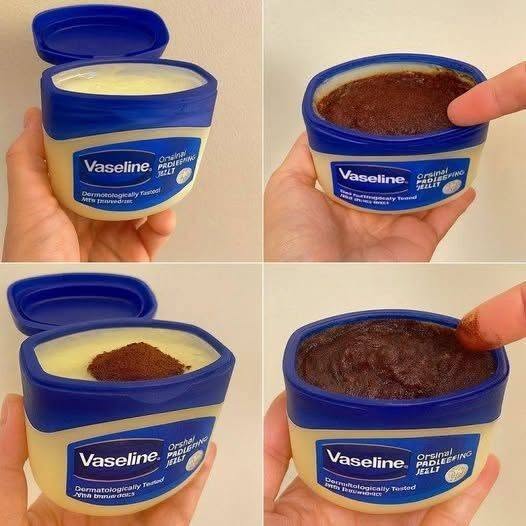
If you spend time on Facebook, TikTok or Pinterest, you may have seen this unusual beauty trick: mix coffee with petroleum jelly and apply it to your skin.
The photos make it look incredibly simple. Open a jar of petroleum jelly, add coffee, mix everything together, and apparently you have a homemade beauty treatment.
But what does this mixture actually do?
Petroleum jelly can be very effective at locking moisture into dry skin, while coffee grounds act as a physical exfoliant. However, the combination is not a miracle anti-aging treatment, and using rough coffee grounds—especially on the face—can irritate sensitive skin.
Here’s what you should know before trying it.
Why Do People Mix Coffee and Petroleum Jelly?
The idea behind the mixture is straightforward.
Petroleum jelly creates an occlusive layer that helps reduce moisture loss from the skin.
Coffee grounds, meanwhile, have a grainy texture that can physically remove some loose dead skin cells when rubbed across the surface.
Together, they create a thick homemade scrub.
Immediately afterward, the skin may feel:
- Softer
- Smoother
- More moisturized
- Less rough
- Temporarily brighter
That explains why the trick has become so popular online.
But those effects shouldn’t be confused with permanently changing the skin.
What Petroleum Jelly Actually Does
Petroleum jelly is primarily an occlusive moisturizer.
Instead of adding large amounts of water to the skin itself, it creates a protective barrier that helps reduce water loss.
That’s particularly useful for dry areas such as:
- Elbows
- Knees
- Heels
- Hands
- Cuticles
- Dry lips
Applying petroleum jelly when the skin is slightly damp can be especially useful because it helps trap that moisture.
What Coffee Grounds Do to the Skin
Ground coffee acts mainly as a mechanical exfoliant.
As the particles move across the skin, they can help remove loose dead cells from the outermost surface.
This may temporarily make rough skin feel smoother.
However, there is an important catch:
Coffee grounds can be abrasive.
If the particles are coarse or you scrub aggressively, they can irritate the skin rather than improve it.
The face is particularly sensitive compared with thicker areas such as the elbows or legs.
Does Coffee and Vaseline Remove Wrinkles?
No homemade scrub can simply erase wrinkles.
Petroleum jelly can make dry skin appear temporarily smoother because well-moisturized skin often looks plumper and less rough.
But that doesn’t mean wrinkles have permanently disappeared.
Coffee may also temporarily improve the appearance and feel of the skin after exfoliation.
Again, that’s very different from reversing skin aging.
Does It Remove Dark Spots?
This is another popular claim that should be treated carefully.
Exfoliating dead surface cells may make the skin look temporarily brighter.
But coffee mixed with petroleum jelly isn’t a proven treatment for persistent hyperpigmentation.
Dark spots can have many causes, including:
- Sun exposure
- Acne
- Skin irritation
- Hormonal changes
- Previous injuries
- Certain skin conditions
Aggressive scrubbing can actually make pigmentation worse in some people, particularly when irritation develops.
Does Coffee Tighten the Skin?
Caffeine is used in some professionally formulated skincare products.
However, rubbing ordinary kitchen coffee onto your skin isn’t equivalent to using a cosmetic formula containing a carefully measured concentration of caffeine.
Any “tightening” appearance after a DIY coffee treatment is likely to be modest and temporary.
Don’t expect a homemade scrub to produce facelift-like results.
Can It Remove Cellulite?
Coffee scrubs are frequently marketed as cellulite treatments.
You may notice a temporary change in how the skin looks after massage, exfoliation and moisturization.
But this doesn’t mean the underlying cellulite has disappeared.
Cellulite involves the structure of fat and connective tissue beneath the skin.
A surface scrub can’t permanently remove it.
A Safer Coffee and Petroleum Jelly Body Scrub ☕️
If your skin tolerates physical exfoliation and you’d like to try the trend, keep the recipe simple.
Ingredients
- 1 teaspoon finely ground coffee
- 1 to 2 teaspoons plain petroleum jelly
That’s all you need.
Avoid adding unnecessary ingredients such as lemon juice, baking soda, toothpaste or strong essential oils.
How to Prepare It
Step 1: Use a Clean Bowl
Rather than mixing coffee directly into an entire container of petroleum jelly, take out only the amount you’re going to use.
This helps keep the original jar clean.
Step 2: Add the Coffee
Add approximately one teaspoon of finely ground coffee.
Avoid extremely coarse grounds.
Step 3: Add Petroleum Jelly
Mix in one to two teaspoons of petroleum jelly.
Stir until you have a thick paste.
You can adjust the amount slightly depending on the consistency you prefer.
How to Use It on the Body
Start with clean skin.
Apply a small amount to an area such as your:
- Elbows
- Knees
- Hands
- Legs
- Heels
Using your fingertips, massage it very gently in small circular motions for around 20 to 30 seconds.
There’s no need to scrub hard.
Then rinse or wipe away the coffee thoroughly with lukewarm water and gently pat the skin dry.
Don’t Scrub Until Your Skin Turns Red
Redness isn’t proof that the treatment is “working.”
It can be a sign that you’ve irritated your skin.
Physical exfoliation should be gentle.
Scrubbing harder won’t make your skin renew itself faster.
Instead, excessive friction can damage the skin barrier and leave the area:
- Red
- Sore
- Dry
- Sensitive
- Itchy
If the mixture burns or stings, wash it off.
Should You Use It on Your Face?
This is where extra caution is needed.
Coffee grounds can be too abrasive for facial skin, especially if you have:
- Sensitive skin
- Acne
- Rosacea
- Eczema
- Very dry skin
- Irritated skin
A commercially formulated gentle exfoliant designed specifically for facial skin is usually a more predictable choice.
If your main goal is simply moisturizing a dry face, you don’t need coffee at all.
A suitable moisturizer may be enough, and some people use a very thin layer of petroleum jelly over moisturizer on particularly dry areas.
What About Acne-Prone Skin?
Petroleum jelly isn’t automatically harmful to everyone with acne.
However, a heavy occlusive layer may not feel comfortable on oily or acne-prone facial skin, and dermatologists note that it may contribute to breakouts in some people.
The bigger problem with this DIY mixture can be the physical scrubbing.
Aggressive exfoliation can aggravate already inflamed acne.
Don’t scrub pimples with coffee grounds.
Patch Test First
Before covering a large area, test a small amount.
Apply the mixture to a small patch of intact skin and watch for:
- Redness
- Itching
- Swelling
- Burning
- Rash
If your skin reacts, stop using it.
A DIY recipe being made from familiar household ingredients doesn’t guarantee that your skin will tolerate it.
Never Use It on Broken Skin
Don’t scrub coffee over:
- Cuts
- Scrapes
- Sunburn
- Active eczema
- Irritated rashes
- Open pimples
- Freshly shaved irritated skin
Give the skin time to recover first.
How Often Should You Use It?
More exfoliation doesn’t necessarily produce better skin.
If your skin tolerates physical exfoliation, occasional use is enough.
For many people, once a week is more than sufficient.
Some people with thicker, oilier skin may tolerate physical exfoliation more frequently, while people with dry or sensitive skin may be better off avoiding it entirely.
Pay attention to how your skin responds.
Don’t Mix It Directly Into the Whole Jar
The viral image shows coffee being added directly to a container of petroleum jelly.
That’s not the best approach.
Every time fingers, water or other ingredients enter a container, contamination becomes more possible.
Instead:
- Use a clean spoon.
- Remove a small amount of petroleum jelly.
- Place it in a separate clean bowl.
- Add coffee.
- Prepare only what you need.
Fresh preparation is simpler and cleaner.
Don’t Add Lemon Juice 🍋
One popular variation recommends adding lemon juice.
Skip it.
Lemon juice is acidic and can irritate the skin.
It can be particularly problematic when people apply DIY citrus mixtures and then expose their skin to sunlight.
You don’t need lemon juice to exfoliate your skin.
Don’t Add Baking Soda
Baking soda is another ingredient commonly included in viral beauty recipes.
But your skin has a carefully regulated barrier.
Repeatedly applying highly alkaline products can irritate that barrier.
Coffee plus petroleum jelly doesn’t become more effective simply because more kitchen ingredients are added.
Simple is better.
Don’t Add Toothpaste
Toothpaste belongs on your teeth—not in your skincare routine.
Ingredients formulated for oral care can be irritating when left on skin.
Avoid viral recipes combining:
coffee + petroleum jelly + toothpaste + lemon.
Adding more ingredients increases the chances of irritation without guaranteeing better results.
Don’t Use Sugar and Coffee Together
Both sugar and coffee are physical exfoliants.
Combining several abrasive ingredients can create an unnecessarily harsh scrub.
You only need very gentle exfoliation.
Your goal isn’t to sand the skin.
A Better Version for Very Dry Skin
If your real problem is dryness rather than rough buildup, you can skip the coffee entirely.
After bathing:
- Gently pat the skin so it remains slightly damp.
- Apply your regular fragrance-free moisturizer.
- Apply a thin layer of petroleum jelly over particularly dry areas.
This can help lock in moisture without unnecessary exfoliation.
Where Petroleum Jelly Really Shines
Despite exaggerated social-media claims, petroleum jelly itself is extremely useful.
Dry Heels
Apply a thin layer after bathing, then wear clean socks.
Dry Elbows
Apply it to slightly damp skin to help retain moisture.
Dry Lips
A small amount can protect dry, chapped lips.
Cuticles
Applying a little around dry nails and cuticles can help reduce dryness.
Chafing
Petroleum jelly can reduce friction in areas where skin or clothing repeatedly rubs.
These uses don’t require coffee at all.
Coffee Scrub for Hands
If your hands are rough but otherwise healthy, you can try a very gentle version.
Mix:
- ½ teaspoon finely ground coffee
- 1 teaspoon petroleum jelly
Massage gently over the backs of the hands for approximately 20 seconds.
Rinse thoroughly.
Pat dry.
Then apply a fragrance-free hand moisturizer if needed.
Don’t do this if your hands are cracked, bleeding or irritated.
Coffee Scrub for Elbows and Knees
Elbows and knees tend to have thicker skin and are therefore common areas for body exfoliation.
Use:
- 1 teaspoon finely ground coffee
- 2 teaspoons petroleum jelly
Massage very gently for about 30 seconds.
Rinse.
Don’t expect the treatment to permanently lighten naturally darker elbows or knees.
Its primary benefits are exfoliation and moisturization.
What About the Lips?
Avoid aggressive coffee scrubbing on cracked or irritated lips.
The skin there is delicate.
For dry lips, plain petroleum jelly is often the simpler option.
If your lips remain persistently dry, cracked or painful despite regular care, there may be another cause worth investigating.
What About Under the Eyes?
Don’t use a homemade coffee-ground scrub underneath your eyes.
The skin surrounding the eyes is particularly thin and delicate.
Physical scrubbing can easily cause irritation.
If you’re interested in caffeine for puffiness or dark circles, choose a skincare product specifically formulated for the eye area rather than rubbing coffee grounds near your eyes.
Can You Leave the Mixture on Overnight?
There’s little reason to sleep with coffee grounds stuck to your skin.
The exfoliation happens through gentle physical movement, not because the grounds need hours to “penetrate.”
If you want overnight moisturization, use an appropriate moisturizer or a thin layer of petroleum jelly on suitable dry areas without adding coffee.
The Biggest Mistake People Make
The most common mistake with DIY scrubs is assuming:
“If a little exfoliation is good, more must be better.”
It isn’t.
Your skin needs its protective outer barrier.
Constantly scrubbing away at that barrier can leave skin more irritated, dry and sensitive.
Gentle skincare usually produces better results than aggressive treatment.
What Actually Helps Skin Look Younger?
If your goal is healthier, smoother-looking skin, focus on habits with much stronger evidence behind them.
Moisturize Regularly
Well-hydrated skin tends to look smoother.
Protect Your Skin From the Sun
Daily sun protection is one of the most important ways to reduce premature skin aging.
Use broad-spectrum sunscreen with SPF 30 or higher on exposed skin.
Cleanse Gently
You don’t need to scrub aggressively to have clean skin.
Avoid Smoking
Smoking contributes significantly to premature skin aging.
Choose Proven Skincare Ingredients
Depending on your needs and skin type, ingredients such as retinoids, vitamin C, niacinamide and certain gentle exfoliating acids may offer more predictable benefits than DIY kitchen remedies.
When Should You Stop Using the Mixture?
Stop immediately if you notice:
- Persistent redness
- Burning
- Significant itching
- Swelling
- Rash
- Pain
- Worsening acne
- Increased pigmentation
Wash the mixture off gently.
If a significant reaction persists, seek advice from a healthcare professional or dermatologist.
So, Does the Viral Coffee + Vaseline Trick Work?
Yes—but only in a limited sense.
It can function as a homemade moisturizing body scrub.
Coffee provides physical exfoliation.
Petroleum jelly helps reduce moisture loss.
Together, they may leave suitable skin temporarily feeling smoother and softer.
But the mixture does not magically:
❌ Erase wrinkles
❌ Permanently tighten loose skin
❌ Remove cellulite
❌ Cure acne
❌ Permanently remove dark spots
❌ Reverse aging
❌ Replace sunscreen or evidence-based skincare
Those claims go far beyond what this simple mixture can realistically accomplish.
Final Thoughts ☕✨
The viral coffee-and-petroleum-jelly beauty hack isn’t completely pointless—but it’s often given far more credit than it deserves.
If you have healthy, non-sensitive body skin and enjoy an occasional physical scrub, mixing a small amount of finely ground coffee with petroleum jelly can provide temporary exfoliation and moisturization.
The secret is to be gentle.
Don’t scrub aggressively, don’t use it on irritated or broken skin, and be especially cautious about using coarse coffee grounds on your face.
And if your goal is simply to treat dry skin?
You may discover that the most useful ingredient in the viral recipe was already sitting in the jar: