You’ve probably seen it thousands of times.
Open almost any car door and look at the vehicle body near the edge of the doorway. You’ll notice a small U-shaped metal loop or thick metal pin bolted firmly to the frame.
Most drivers never give it a second thought.
Some call it a hook. Others assume it is simply a random piece of metal used during manufacturing. And viral posts sometimes claim that it has several mysterious “secret uses.”
But this little component actually has an extremely important job.
It is commonly known as the door striker or latch striker, and it forms a crucial part of the system that keeps your car door securely closed.
There are also accessories designed to take advantage of its convenient location—but before using it as a step or handle, there are some important things every driver should know.
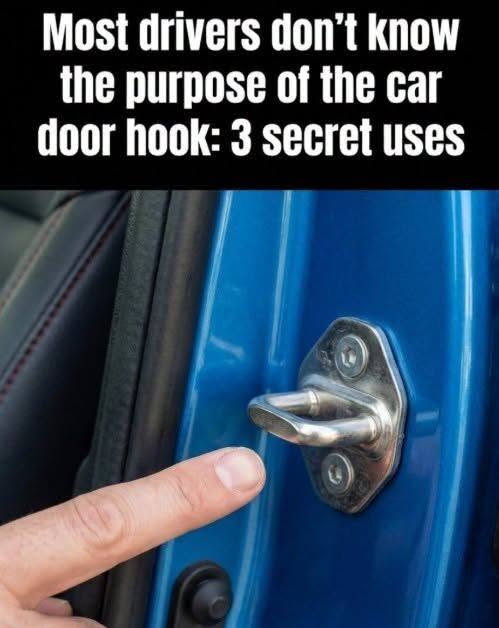
What Is the Small Metal Hook on the Car Door Frame?
The metal piece shown in the picture is generally called a:
Door striker
or
Latch striker.
It is mounted securely to the vehicle body, usually on one of the pillars surrounding the door opening.
The door itself contains a latch mechanism.
When you close the door, that latch moves around the striker and locks onto it.
In simple terms:
The latch grabs the striker.
That connection is what helps keep the door securely closed.
What Happens When You Close Your Car Door?
Closing a car door may feel incredibly simple.
You pull the door.
You hear a solid:
“CLICK.”
And you’re done.
But mechanically, several things happen almost instantly.
As the door moves toward the vehicle body, the latch approaches the striker.
The striker enters the latch mechanism.
The latch then rotates or closes around the striker and locks into position.
Once properly engaged, the door is held firmly against the vehicle body.
That’s why this tiny metal component is far more important than it looks.
Its Main Purpose: Keeping the Door Securely Closed
The primary function of the striker is straightforward:
It provides the fixed point that the door latch engages.
Without that secure connection, the latch wouldn’t have the proper anchor it needs on the vehicle body.
The hinges support one side of the door and allow it to swing.
The latch-and-striker system secures the opposite side when the door is closed.
Together, these components allow the door to open easily when needed while remaining securely positioned during driving.
Why the Striker Is So Strong
If you’ve ever touched one, you’ve probably noticed that it feels extremely solid.
That’s intentional.
The striker must repeatedly withstand the force of the door closing.
Think about how many times a car door is opened and closed during its lifetime.
Hundreds?
Thousands?
Potentially tens of thousands of times.
The striker needs to remain properly positioned throughout all of this repeated use.
It is therefore normally constructed from strong metal and firmly attached to a reinforced area of the vehicle body.
It Also Plays an Important Safety Role
The latch and striker aren’t simply there for convenience.
They’re part of the vehicle’s door-retention system.
A properly latched door needs to remain secured during ordinary driving and resist significant forces.
This becomes especially important during sudden movements or collisions.
That’s why a damaged latch or striker should never simply be ignored.
If a door doesn’t close securely, it can become a genuine safety concern.
Why Does a Car Door Sometimes Have Two “Clicks”?
You may have experienced this before.
You gently push the door closed.
It catches—but isn’t completely shut.
Then you push it again and hear another click.
Many automotive door-latch systems can have a secondary and fully latched position.
The partially engaged position can help prevent a door from immediately swinging completely open when it hasn’t been shut firmly enough.
However, you should never intentionally drive with a door only partially latched.
Before driving, make sure the door is fully closed.
The Striker Helps With Door Alignment Too
The striker’s exact position is important.
When correctly aligned, the latch meets the striker smoothly as the door closes.
This helps the door sit correctly against the surrounding body and weather seals.
If the alignment becomes incorrect, you may notice:
- Difficulty closing the door
- The need to slam the door
- Rattling while driving
- Uneven gaps around the door
- Increased wind noise
- A door that appears slightly higher or lower than surrounding panels
- A door that doesn’t feel securely latched
These symptoms shouldn’t automatically be fixed by randomly moving the striker.
Correct alignment can require precision.
Don’t Randomly Loosen the Bolts
Seeing the striker attached with visible bolts can make adjustment look easy.
You might think:
“I’ll loosen these and move it a little.”
Be careful.
Its position affects how the door latch engages and how the door aligns with the vehicle body.
Moving it incorrectly can make the problem worse.
If your door has suddenly become difficult to close, it’s better to determine why before changing the striker position.
The problem could involve the striker, latch, hinges, door alignment or previous body damage.
What About the “3 Secret Uses” Seen Online?
This is where viral posts become misleading.
The striker was designed primarily as part of the door-latching system.
However, because it’s strong and conveniently positioned, manufacturers have created accessories that attach to it.
Two popular examples are:
Portable roof-access steps
and
Vehicle support handles.
These can be useful—but they are accessories using the striker as an attachment point.
They shouldn’t be confused with the striker’s original primary purpose.
Extra Use #1: A Portable Car Door Step 🚙
You’ve probably seen small folding platforms sold as car door steps.
These accessories attach to the striker and provide a temporary elevated platform.
Why would someone need this?
Imagine you own:
- An SUV
- A crossover
- A tall van
- A vehicle with roof racks
Reaching the roof can be difficult.
A purpose-built door step can make it easier to:
- Load a roof box
- Secure luggage
- Attach sporting equipment
- Clean the roof
- Reach roof racks
The step hooks onto the striker and creates a small platform for your foot.
But Don’t Simply Stand on the Bare Striker
There’s an important difference between:
A properly designed vehicle door step
and
Putting your entire body weight directly onto the bare metal loop.
A purpose-built accessory is designed to distribute load and provide a stable stepping surface.
Standing directly on the striker itself is uncomfortable, unstable and potentially unsafe.
Never improvise with random pieces of wood, rope, metal or other objects.
Check Compatibility Before Using a Door Step
Not every accessory is appropriate for every vehicle.
Before using one, check:
- Vehicle compatibility
- Product weight rating
- Striker shape
- Manufacturer instructions
- Correct installation
- Condition of the striker
Also inspect the accessory itself for cracks, deformation or damage.
Never exceed its rated capacity.
Protect Your Car’s Paint
Some door-step accessories sit very close to painted body panels.
A poorly designed or incorrectly installed accessory could scratch or dent surrounding areas.
Look for a product with appropriate protective padding.
Make sure it is positioned correctly before placing weight on it.
Extra Use #2: A Support Handle
Another accessory designed around the striker is a portable vehicle support handle.
These handles can provide an additional handhold when entering or exiting the vehicle.
This may be useful for some people who find it difficult to lower themselves into a seat or stand back up.
The handle attaches temporarily to the striker and provides a more convenient gripping point.
Who Might Find a Support Handle Useful?
Depending on the individual and vehicle, it may help:
- Older adults
- People entering tall SUVs
- People who temporarily have limited mobility
- Anyone who wants an additional handhold
However, the accessory needs to be designed for this purpose and compatible with the vehicle.
A random rope or improvised handle shouldn’t be attached to the striker.
Extra Use #3: Helping You Reach Roof Cargo
This is really an extension of the portable-step idea, but it can be extremely practical.
Roof boxes are useful because they provide extra storage.
Unfortunately, loading them can be awkward.
Standing on the door sill sometimes doesn’t provide enough height.
A properly rated striker-mounted step can provide a higher position for accessing:
- Roof cargo boxes
- Bicycle racks
- Kayak carriers
- Ski racks
- Luggage
- Roof-mounted equipment
Again, this isn’t the original purpose of the striker.
It’s a modern accessory application taking advantage of its position.
Is It Safe to Hang Heavy Objects From the Striker?
Don’t assume so.
The striker is strong because it needs to perform a specific safety function.
That doesn’t mean it should become a universal anchor point for anything heavy.
Avoid hanging:
- Heavy equipment
- Hammocks
- Tow ropes
- Recovery straps
- Large cargo
- Unrated accessories
from it unless your vehicle manufacturer specifically approves that application.
Strong doesn’t mean indestructible.
Never Use It as a Towing Point
This deserves special attention.
A door striker is NOT a towing or vehicle-recovery point.
Don’t attach a tow rope, recovery strap or winch cable to it.
Vehicle recovery can generate enormous forces.
Use only designated towing or recovery points specified for your vehicle.
Why Is There Sometimes Plastic Around the Striker?
Some striker designs include plastic or nylon components.
These can help reduce:
- Metal-on-metal contact
- Noise
- Wear
- Rattling
If this material becomes severely worn or damaged, the door may start making unusual noises.
Don’t automatically remove it simply because it looks like an unnecessary piece of plastic.
It may be part of the original design.
What If the Door Starts Rattling?
A rattling door can have many possible causes.
The striker is one possibility, but not the only one.
Other causes can include:
- Worn latch components
- Loose interior trim
- Weather seals
- Door alignment problems
- Hinge wear
- Objects stored in door pockets
If the door itself visibly moves when fully closed, have the latch and striker inspected.
What If You Have to Slam the Door?
A car door shouldn’t suddenly require extreme force to close.
If you previously closed it normally and now need to slam it, something may have changed.
Possible causes include:
- Striker misalignment
- Worn latch
- Door sagging
- Hinge problems
- Damaged weather seals
- Previous collision damage
- Foreign objects around the latch
Repeatedly slamming the door isn’t a proper repair.
Have the cause investigated.
Can the Striker Become Loose?
Yes.
Like many mechanical components, it can potentially develop problems.
If you notice visible movement in the striker, don’t ignore it.
A loose component involved in keeping the door closed deserves prompt attention.
Have it correctly tightened or repaired according to the vehicle manufacturer’s specifications.
Should You Lubricate It?
Some door-latch mechanisms may benefit from appropriate lubrication as part of vehicle maintenance.
But don’t randomly coat everything with heavy grease.
Different vehicles may have different maintenance requirements.
Use an appropriate automotive lubricant if recommended for your vehicle and apply it only where intended.
Too much lubricant can attract dirt and debris.
Keep the Area Clean
Because the striker is exposed whenever the door opens, it can collect:
- Dust
- Sand
- Dirt
- Old grease
- Road debris
Occasional gentle cleaning can help you inspect the component properly.
Use appropriate automotive cleaning methods and avoid aggressive chemicals that could damage nearby paint or rubber seals.
Don’t Paint Over the Mechanism
If you’re doing bodywork or touching up paint around the door frame, avoid coating functional latch surfaces unnecessarily.
Heavy paint buildup could interfere with precise engagement.
If body repairs involve the striker area, professional alignment may be required afterward.
What If the Door Was Damaged in an Accident?
Even relatively minor impacts can affect door alignment.
If the vehicle has been involved in a collision and afterward you notice:
- Difficulty closing a door
- Unusual gaps
- Rattling
- Wind noise
- A door warning light that stays on
- Visible deformation around the striker
have the door system inspected.
Don’t simply reposition the striker until the door closes.
The underlying vehicle structure or hinges may have shifted.
The Door Warning Light Is Important
Modern vehicles often detect whether a door is properly closed.
If the dashboard repeatedly reports:
“DOOR OPEN”
even when the door appears closed, there may be an issue involving the latch sensor, alignment or another component.
Don’t simply ignore the warning.
Confirm that all doors are properly closed and have persistent problems checked.
Never Drive With a Door That Won’t Latch
If a door refuses to remain securely closed, don’t improvise by tying it with rope and continuing to drive normally.
The door-retention system is a safety component.
A malfunction should be properly repaired.
A Quick Inspection You Can Do
You don’t need to be a mechanic to visually inspect the striker.
With the vehicle safely parked:
1. Open the door.
Locate the metal striker on the vehicle body.
2. Look at the bolts.
They should not appear obviously loose or missing.
3. Check for severe damage.
Look for bending, cracking or significant wear.
4. Inspect any plastic sleeve or covering.
Notice whether it’s badly damaged.
5. Close the door normally.
It should latch securely without requiring excessive force.
6. Listen while driving.
Persistent rattling or unusual wind noise may deserve investigation.
Don’t loosen anything during this basic inspection.
Why Such a Small Part Matters So Much
Cars contain thousands of components.
Some are enormous and obvious:
- Engine
- Transmission
- Wheels
- Battery
Others are tiny and almost invisible.
The door striker is a perfect example.
You might never think about it until something goes wrong.
Yet every time you close your door, the striker helps:
🔒 Secure the door
🚗 Keep it correctly positioned
🤫 Reduce movement and potential rattling when properly aligned
🛡️ Contribute to the vehicle’s door-retention system
That’s a lot of responsibility for such a small piece of metal.
So What Are the “3 Uses”?
If we separate the actual engineering purpose from modern accessory uses, the picture becomes much clearer.
1. Its Real Purpose: Securing the Car Door
The latch engages with the striker to hold the door closed.
This is the reason the component exists.
2. Optional Accessory Use: Supporting a Purpose-Built Door Step
Compatible accessories can attach to the striker to help users reach roof racks and cargo.
3. Optional Accessory Use: Supporting a Purpose-Built Mobility Handle
Certain handles attach to the striker to provide an additional handhold when entering or exiting a vehicle.
The last two are accessory applications, not hidden factory functions built into every vehicle.
What You Should Never Do With the Car Door Striker ⚠️
Don’t:
- Use it as a towing point
- Hit it with a hammer to adjust it
- Randomly loosen its bolts
- Attach unapproved heavy loads
- Stand directly on it
- Use homemade climbing devices
- Ignore severe damage or looseness
- Continue driving normally if the door won’t securely latch
The striker may look simple, but it is part of an important mechanical system.
Final Thoughts 🚗✨
That mysterious metal “hook” beside your car door isn’t decorative.
It’s called the door striker, and its primary job is to give the door latch a strong, fixed point to engage when the door closes.
It helps keep the door securely positioned and is part of the vehicle’s door-retention system.
Its strength and convenient location have also inspired useful accessories, including portable roof-access steps and support handles.
But those accessories should be purpose-built, properly rated and compatible with your vehicle.
So next time you open your car door and notice that small metal loop, you’ll know exactly why it’s there.
It may be one of the simplest-looking parts of your car—but it’s doing an important job every single time you hear that familiar click. 🔒🚗