There are certain things in your home that are worth far more than their price tag.
For me, it was my mother’s old stand mixer.
It wasn’t new. It wasn’t shiny. The paint had faded in places, there were scratches around the base, and years of use had left little marks that no amount of polishing could completely remove.
But every time I looked at it, I remembered my mother standing in the kitchen.
She used that mixer for birthday cakes, Christmas cookies, Sunday desserts, and countless family dinners. After she passed away, it became one of the few everyday objects of hers that I kept using.
So when my neighbor Denise asked if she could borrow it, my first instinct was simple:
No.
Unfortunately, Denise was very good at turning a simple “no” into a twenty-minute negotiation.
And eventually, I gave in.
I would soon regret it.
It Started With Little Things
Denise had moved into the house next door several years earlier.
We weren’t best friends, but we were friendly.
She was the kind of neighbor who would wave from her driveway, stop for a conversation at the mailbox, and occasionally bring over tomatoes from her garden.
She was also constantly borrowing things.
It started innocently enough.
One spring afternoon, she knocked on my door and asked:
“Do you have a ladder I could borrow?”
I did.
She promised she’d return it the following afternoon.
Three days later, I finally spotted it leaning against the side of her house.
I walked over and brought it home myself.
I didn’t make a big deal about it.
That was probably my first mistake.
Then Came the Pressure Washer
A few weeks later, Denise needed my pressure washer.
“I’ll only need it for an hour,” she said.
This time, I hesitated.
But she reminded me that we were neighbors and laughed about how ridiculous it would be for her to buy one just to clean her patio.
So I lent it to her.
An hour became a day.
A day became an entire weekend.
When she finally returned it, the hose had been wrapped around the machine carelessly, and there was dried mud all over the wheels.
Still, I said nothing.
I cleaned it myself and put it back in the garage.
Soon, She Was Borrowing Everything
Once Denise realized I rarely refused, the requests became increasingly frequent.
My crock pot.
A cooler.
My roasting pan.
Garden tools.
Extension cords.
A folding table.
Sometimes she returned things promptly.
Other times, I had to ask.
But there was one rule I had never actually explained to her because I assumed it was obvious:
My mother’s mixer was off-limits.
The Mixer Was Different
The mixer had been in our family for decades.
My mother loved baking.
When I was a child, I’d sit at the kitchen table while she measured flour and sugar. Sometimes she’d let me pour ingredients into the bowl.
During the holidays, that mixer seemed to run constantly.
Cookies.
Cakes.
Bread dough.
Frosting.
After Mom died, I inherited it.
I could easily have purchased a newer model, but I never wanted to.
Using hers somehow made the kitchen feel less empty.
Denise knew this.
I had told her the story before.
That’s why I was surprised when she asked to borrow it.
“Just for One Afternoon”
Denise was preparing desserts for a family gathering.
Her own mixer had apparently stopped working.
“Please,” she said. “I only need yours for this afternoon.”
I immediately hesitated.
“I don’t really lend that one out,” I told her. “It belonged to my mom.”
“I know,” she replied. “I’ll be incredibly careful.”
I still wasn’t comfortable.
But she kept asking.
Finally, against my better judgment, I agreed.
I carried the mixer over myself and placed it on her kitchen counter.
“Please be careful with it,” I said again.
She smiled.
“Of course.”
The Mixer Didn’t Come Back That Night
That evening passed.
No mixer.
The next morning, still nothing.
By lunchtime, I texted Denise.
No response.
Later that afternoon, she finally replied.
“Sorry! Crazy day. I’ll bring it over.”
Several more hours passed.
Then, just before dinner, I heard something outside.
When I opened my front door, I couldn’t believe what I was looking at.
She Had Left It on My Porch
There was my mother’s mixer.
Sitting outside.
Alone.
Denise hadn’t knocked.
She hadn’t called.
She had simply placed it on the porch and gone home.
But that wasn’t even the worst part.
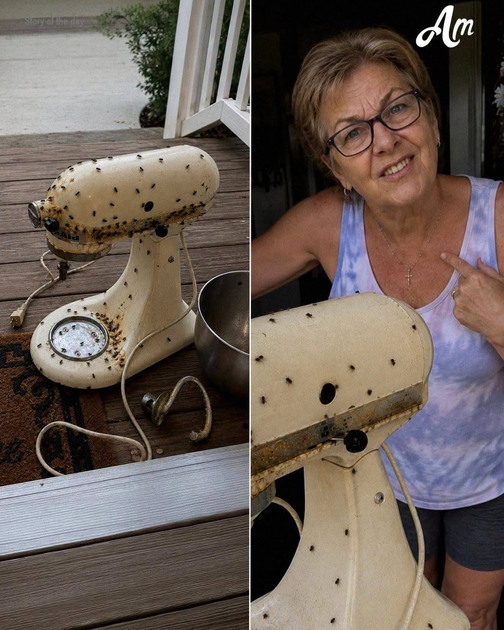
The mixer was filthy.
There was dried batter stuck around the head.
Something sticky had hardened near the controls.
The bowl had residue inside it.
The cord had been wrapped carelessly around the base.
There were splatters along the side that looked as though they’d been there for hours.
For a few seconds, I just stood there staring at it.
Then I picked it up and carried it inside.
I Was Furious
I’m usually a calm person.
I don’t enjoy confrontation.
But this wasn’t just another dirty kitchen appliance.
It was something I’d specifically told Denise was important to me.
She knew exactly why.
And after promising to take care of it, she couldn’t even be bothered to clean it before dumping it on my porch.
I texted her.
“Did you seriously leave my mixer outside like this?”
A few minutes later, she replied:
“Sorry! I was in a hurry. It just needs a quick wipe.”
A quick wipe?
I looked at the dried mess covering it.
That’s when something changed.
I wasn’t going to argue with her.
I wasn’t going to send an angry paragraph.
And I certainly wasn’t going to clean up after her and pretend nothing had happened.
Instead, I decided Denise needed to learn something that I should have made clear months earlier.
The Next Time She Knocked, She Wanted Something Else
It didn’t take long.
About a week later, someone knocked on my door.
Denise.
She smiled as though nothing had happened.
“Hey! Do you still have that big cooler?”
I did.
But this time, my answer was different.
“Yes.”
She waited.
“Could I borrow it for Saturday?”
“No.”
Her expression changed immediately.
“Oh.”
There was an awkward silence.
Then she laughed.
“Is this about the mixer?”
“Yes,” I said.
She rolled her eyes slightly.
“I told you I was in a hurry.”
“And I told you that mixer belonged to my mother.”
She didn’t say anything.
“You borrowed something that meant a lot to me,” I continued. “You returned it dirty and left it outside without even knocking. So I’m not lending things anymore.”
She Tried to Make Me Feel Guilty
Denise immediately became defensive.
“It was just some batter.”
That sentence confirmed I’d made the right decision.
It wasn’t about batter.
It was about respect.
If someone trusts you enough to lend you something — whether it’s worth $5 or $500 — you should return it in at least the same condition you received it.
And if the item has sentimental value?
You should be even more careful.
I wasn’t asking Denise to replace the mixer.
I wasn’t demanding money.
I simply wasn’t going to continue lending her my belongings.
Apparently, she wasn’t expecting that.
Then Something Interesting Happened
For the next several weeks, Denise stopped asking to borrow things.
Our conversations became shorter.
She still waved occasionally, but the constant requests disappeared.
And strangely enough, I felt relieved.
I hadn’t realized how much resentment had been building every time she borrowed something and returned it late, dirty, or only after being reminded.
The mixer incident wasn’t really the beginning of the problem.
It was simply the moment I finally stopped ignoring it.
A Month Later, She Came Back
One afternoon, Denise appeared at my door again.
But this time she wasn’t asking for anything.
She was holding a small bakery box.
“I wanted to apologize,” she said.
I wasn’t expecting that.
She admitted she’d become too comfortable borrowing my things.
“I guess I assumed you didn’t mind,” she said.
“I did mind,” I replied. “I just wasn’t saying it.”
That part was on me.
Boundaries only work when people actually communicate them.
Denise handed me the box.
Inside were four pastries from a local bakery.
We both laughed.
“Don’t worry,” she said. “I didn’t make them with your mixer.”
That finally broke the tension.
The Mixer Still Works
Thankfully, my mother’s mixer wasn’t permanently damaged.
I carefully cleaned it, paying attention to the areas around the controls and moving parts.
Once everything was dry and clean, I tested it.
The familiar motor started immediately.
I can’t describe how relieved I felt.
It still has its scratches.
It still looks old.
And it certainly wouldn’t win any beauty contests.
But that’s exactly how I want it.
Every mark reminds me that it was used.
That it belonged in a real kitchen.
That my mother made countless meals with it before it became mine.
What I Learned From the Experience
For years, I thought being a good neighbor meant saying yes whenever someone needed something.
But generosity without boundaries can quickly become resentment.
There’s nothing wrong with lending someone a ladder, appliance, tool, or kitchen item.
There’s also nothing wrong with saying:
“I’d rather not lend that out.”
You don’t need an elaborate excuse.
You don’t need to justify why something matters to you.
And you certainly don’t have to repeatedly lend possessions to someone who doesn’t treat them respectfully.
Borrowing Something Comes With a Simple Responsibility
There’s an unwritten rule that shouldn’t need explaining:
Return borrowed things in the same condition — or better — than you received them.
If you borrow someone’s pan, wash it.
If you borrow someone’s tool, clean it.
If something breaks, tell them.
If you’re going to be late returning it, send a message.
And if someone tells you an object has sentimental value, treat it as though it were irreplaceable.
Because sometimes it is.
The Real Lesson Wasn’t Revenge
Looking back, I’m glad I didn’t retaliate.
I didn’t damage anything Denise owned.
I didn’t embarrass her publicly.
I didn’t start a neighborhood argument.
I simply stopped lending her things.
That boundary communicated everything I needed to say.
Eventually, she understood.
And surprisingly, our relationship improved afterward.
We still talk.
We still occasionally help each other.
But now there’s a difference.
If Denise needs a ladder, she has her own.
If she needs a cooler, she has her own.
And if she needs a mixer?
Well…
She’s definitely not getting my mother’s.
Final Thoughts
Sometimes the smallest incidents reveal problems we’ve been ignoring for a long time.
For me, it took seeing my late mother’s beloved mixer sitting dirty and abandoned on the porch to realize that I’d allowed someone to repeatedly cross a boundary because I was afraid of seeming unfriendly.
Being kind doesn’t mean saying yes to everything.
And protecting something that’s important to you doesn’t make you selfish.
These days, the old mixer sits exactly where it always has in my kitchen.
I still use it.
And every time I do, I think about my mother.
But now it reminds me of something else too:
Some things simply aren’t meant to be loaned out.