Have you ever walked up an old staircase and noticed something that didn’t look quite right?
The railing appears perfectly symmetrical, with one decorative wooden baluster after another — until suddenly, one of them seems to be installed upside down.
At first glance, you might assume someone simply made a mistake.
But there’s a fascinating piece of architectural folklore surrounding these unusual staircase details. According to stories passed down about traditional craftsmanship, an intentionally reversed baluster may have been placed there for symbolic reasons.
However, the real explanation isn’t always as mysterious as social media posts sometimes suggest.
Here’s what an upside-down baluster can actually mean.
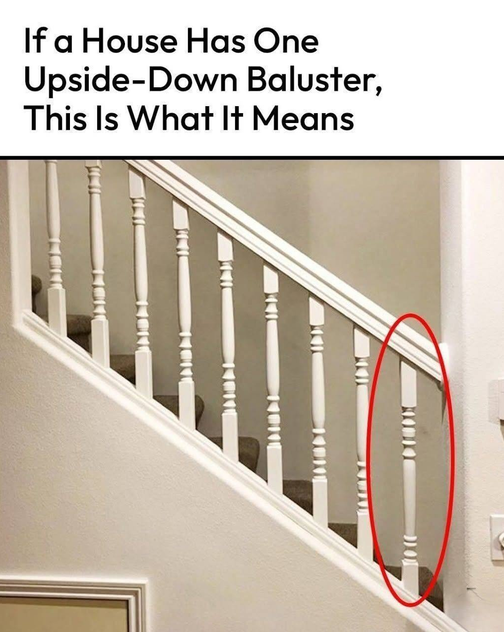
First, What Is a Baluster?
The vertical pieces supporting the handrail of a staircase are called balusters.
You may also hear them casually called stair spindles.
A series of balusters together with the handrail and supporting structure forms a balustrade.
In older houses, wooden balusters were often turned on a lathe to create elaborate shapes. Because identical pieces were repeated along a staircase, even a small difference can be surprisingly noticeable.
And that’s exactly why one reversed baluster tends to attract attention.
Why Would Someone Install One Upside Down?
There isn’t one universal explanation.
Depending on the house, period and craftspeople involved, a reversed baluster could be intentional — or simply an installation mistake.
But one particularly interesting explanation comes from architectural folklore.
The “Only God Is Perfect” Story
One popular story claims that some traditional craftsmen deliberately introduced a tiny imperfection into otherwise beautiful work.
According to this interpretation, creating something intentionally imperfect was a symbolic acknowledgment that human beings cannot achieve divine perfection.
A reversed baluster could therefore function as the deliberate “mistake.”
The same general idea is sometimes associated with other forms of traditional craftsmanship, where an irregularity in an otherwise symmetrical design becomes part of the object’s story.
It’s an appealing explanation — but it should be treated as folklore rather than a universal historical rule.
There isn’t evidence showing that every upside-down baluster found in an old house was installed for this reason.
It Could Have Been a Carpenter’s Signature
Another popular interpretation is that a reversed baluster acted almost like a craftsman’s signature.
Imagine spending weeks constructing an elaborate staircase.
Instead of carving your name somewhere visible, you might introduce one subtle difference that another skilled carpenter would notice.
A reversed spindle would certainly accomplish that.
Again, this explanation is frequently repeated in discussions about historic homes, but homeowners shouldn’t automatically assume that their staircase contains a secret carpenter’s signature.
Without documentation about the house or the person who built the staircase, determining the original intention can be difficult.
Sometimes the Simplest Explanation Is Correct
There’s also a much less romantic possibility:
Someone installed it incorrectly.
Balusters can look surprisingly similar from either direction, particularly when they’re symmetrical or nearly symmetrical.
During construction, renovation or repair, a worker could simply have turned one around without noticing.
Once installed, nobody may have considered the difference important enough to remove and reinstall it.
Decades later, what began as an ordinary construction mistake can suddenly look like a mysterious historical symbol.
It May Have Been Replaced During a Renovation
Another possibility is that the baluster isn’t original to the staircase.
Stair railings experience decades of wear. Individual balusters can crack, loosen or break and eventually require replacement.
A replacement spindle might have been:
- Installed upside down accidentally
- Shaped slightly differently from the originals
- Taken from another staircase
- Reproduced imperfectly
- Installed during a later renovation
This is particularly relevant when examining older houses that have undergone multiple renovations.
What appears to be a deliberate feature from the original builder may actually have been added many years later.
Why Is It So Noticeable?
Human beings are extremely good at detecting patterns.
A staircase containing 20 or 30 identical balusters creates a strong visual rhythm.
Once your brain recognizes that pattern, even a small deviation immediately stands out.
That’s why you may never notice the individual design of a normal baluster — but the moment one is reversed, it can become almost impossible to ignore.
The effect is similar to seeing one differently colored tile in an otherwise uniform floor.
Is an Upside-Down Baluster a Secret Code?
Probably not.
Social-media posts sometimes suggest that architectural details like these contain hidden messages with one definitive meaning.
Reality is usually more complicated.
An upside-down baluster doesn’t have a universally recognized meaning that applies to every house.
Its explanation depends on factors such as:
- The age of the staircase
- The architectural style
- Previous renovations
- Local building traditions
- The original carpenter
- Whether the baluster is actually original
Without historical documentation, it’s often impossible to determine exactly why a particular spindle was reversed.
Could It Have a Superstitious Meaning?
Possibly in some individual traditions, but claims about specific superstitions should be approached cautiously.
Old buildings naturally accumulate stories.
An unusual door, window, staircase or carving can eventually become associated with legends about luck, protection, religion or the original builders.
Those stories are fascinating parts of architectural folklore, but folklore and documented architectural history aren’t necessarily the same thing.
That’s why it’s better to say an upside-down baluster may have a traditional or symbolic explanation rather than claiming that it always means one specific thing.
How Can You Tell Whether It Was Intentional?
If you discover one in your own home, look closely at the staircase.
Start by comparing the reversed baluster with the surrounding ones.
Does the wood appear to be the same age?
Does the finish match?
Are the dimensions identical?
Does the way it’s attached look original?
If everything matches perfectly, it’s possible that the baluster was installed that way when the staircase was built.
On the other hand, differences in wood, paint, fasteners or craftsmanship could suggest that it was replaced later.
The Age of the House Can Provide Clues
Historical records can sometimes help solve the mystery.
If you know approximately when the house was constructed, research the architectural traditions common in that region and period.
Historic photographs may be especially useful.
An old photograph showing the same staircase could reveal whether the reversed baluster was already there decades ago.
Property records, renovation documents and information from previous owners can also provide clues.
For historically significant homes, a local architectural historian or preservation specialist may be able to examine construction techniques and estimate whether the feature is original.
Should You Turn It the Right Way Around?
Not necessarily.
If the baluster is secure and the staircase is safe, an unusual orientation is primarily an aesthetic or historical question.
In an old home, that little imperfection might actually be part of the staircase’s history.
Before modifying original architectural elements in a historic property, it can be worthwhile to determine whether they’re historically significant.
However, safety is more important than symbolism.
A loose, cracked or improperly secured baluster should be evaluated and repaired appropriately, particularly when children use the staircase.
Other Intentional Imperfections in Craftsmanship
The fascination surrounding reversed balusters belongs to a much broader human interest in deliberate imperfection.
Across different cultures and periods, craftspeople have sometimes incorporated irregularities into handmade objects.
But it’s important not to combine unrelated traditions into one universal story.
Different cultures have their own artistic philosophies, religious beliefs and craftsmanship practices. Similar-looking imperfections don’t necessarily share the same historical meaning.
That’s another reason why the history of a specific house matters.
Why Old Houses Are Full of Small Mysteries
Historic homes often contain evidence of everyone who lived and worked there.
Floorboards may reveal where walls once stood.
Doors may contain hardware from several different eras.
Old paint layers can reveal previous decorating choices.
Staircases can show repairs made generations apart.
And occasionally, one small architectural detail — like a reversed baluster — raises a question nobody can definitively answer.
That’s part of what makes old houses so fascinating.
So, What Does an Upside-Down Baluster Actually Mean?
The answer is:
It depends.
A deliberately reversed baluster has sometimes been associated in architectural folklore with the idea that human craftsmanship should contain an imperfection because only God can create perfection.
Other stories interpret it as a craftsman’s signature.
But there are also much simpler explanations. The spindle could have been accidentally installed upside down, replaced during a renovation or deliberately reversed purely for aesthetic reasons.
There is no universal architectural rule stating that one upside-down baluster always carries a specific symbolic meaning.
Without information about the particular house and its construction history, nobody can know for certain.
The Bottom Line
If you ever spot one upside-down baluster on an otherwise perfectly symmetrical staircase, don’t automatically assume the carpenter made a mistake.
It could be accidental.
It could be the result of a later repair.
Or perhaps someone deliberately placed it there many decades ago.
The popular stories surrounding reversed balusters — particularly the idea of deliberately leaving one imperfection in recognition that only God is perfect — add an intriguing layer of folklore to an otherwise tiny architectural detail.
Whether the story applies to a particular staircase is another question entirely.
But one thing is certain: after noticing a reversed baluster once, you’ll probably start checking every old staircase you see.