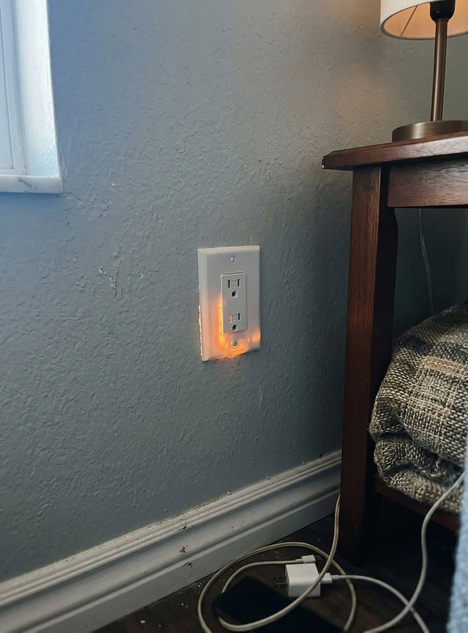
You walk into a room at night and notice something unusual: a faint orange or yellow glow appears to be coming from behind an electrical outlet or wall plate.
At first, it may look almost harmless—perhaps even like a tiny built-in night-light.
But when unexplained light appears around an electrical outlet, it is reasonable to wonder whether you’re seeing a normal indicator light, an electrical arc, overheating, or something else entirely.
The answer depends heavily on the type of outlet.
Some receptacles—especially GFCI outlets, surge-protective receptacles, smart outlets, and other electronic devices—contain small status LEDs that are completely normal. But an unexplained flickering, sparking, burning smell, unusual heat, buzzing, or discoloration can indicate an electrical problem that should not be ignored.
Here’s how to tell the difference and what to do safely.
First, Look at What Kind of Outlet You Have
The outlet in viral photos like this often isn’t a basic two-socket receptacle.
It may be a GFCI (Ground-Fault Circuit Interrupter) receptacle, recognizable by TEST and RESET buttons.
GFCIs are designed to reduce the risk of electric shock by quickly interrupting electricity when they detect certain current imbalances.
Some modern GFCI receptacles also contain an indicator or status light.
Depending on the manufacturer and model, that LED may indicate that the device has power, has tripped, needs to be reset, has reached the end of its service life, or has detected another condition.
So seeing a light near a GFCI does not automatically mean the outlet is burning.
But the color and behavior of that light matter.
1. It Could Simply Be a Normal Status LED
This is the least alarming explanation.
Modern electrical receptacles sometimes contain tiny LEDs that show their operating status.
For example, Leviton explains that its GFCI receptacles use an indicator light to communicate information about the device’s status. The exact meaning varies by product, which is why the manufacturer’s instructions for the particular model are important.
If the outlet has always produced the same small, steady indicator light and there are no signs of heat, smoke, odor, buzzing, or damage, it may simply be operating as designed.
However, a normal LED generally appears as a relatively defined point of light.
A large unexplained glow around or behind the wall plate deserves closer attention.
2. A Glow Is Not the Same as Electrical Arcing
People often see an orange light in a photograph and immediately assume:
“The wires are on fire inside the wall.”
That’s not something you can determine from a photograph alone.
Electrical arcing usually involves electricity jumping through an unintended path or across a gap. It may be accompanied by sparking, crackling, buzzing, intermittent power, heat, or burning odors.
A steady LED behind translucent plastic can look surprisingly dramatic in a dark room or photograph.
Therefore, color alone cannot tell you what’s happening.
The surrounding symptoms are much more important.
3. A Burning Smell Is a Major Warning Sign
If you smell something resembling burning plastic, melting insulation, smoke, or an unusual electrical odor near an outlet, take it seriously.
An overheating electrical connection can damage insulation and other components before visible flames appear.
Don’t keep plugging devices into the receptacle to “test” whether it still works.
If you can safely do so, stop using the outlet and arrange for it to be inspected by a qualified electrician.
If there is smoke, visible fire, or an immediate fire hazard, leave the area and contact emergency services.
4. The Outlet Shouldn’t Be Abnormally Hot
Electrical devices can sometimes become slightly warm depending on their design and load, but significant heat around a receptacle is concerning.
Pay attention if the wall plate or outlet becomes unusually hot during ordinary use.
Possible causes can include a loose connection, damaged wiring, an overloaded circuit, a defective receptacle, or another electrical fault.
Do not remove the cover plate or reach behind an energized outlet to investigate.
Electrical troubleshooting inside the box should be left to someone qualified to do it safely.
5. Buzzing or Crackling Deserves Attention
A basic wall receptacle should not normally make persistent crackling or buzzing noises.
If the glow is accompanied by sounds such as:
- Crackling
- Popping
- Persistent buzzing
- Repeated snapping
stop using the outlet.
Those symptoms can be associated with loose electrical connections or arcing and warrant professional evaluation.
6. Look for Brown or Black Discoloration
An outlet doesn’t have to produce flames before heat damage becomes visible.
Warning signs can include brown marks, blackened areas, melted plastic, warped components, or dark discoloration around the plug openings.
If you notice these changes, don’t simply wipe them off and continue using the receptacle.
The discoloration may be evidence that excessive heat has already occurred.
The outlet and potentially the wiring behind it should be inspected.
7. A Loose Outlet Can Also Be a Problem
When you insert a plug, it should generally remain securely seated.
If plugs constantly fall out or feel unusually loose, the receptacle’s internal contacts may be worn.
Loose electrical contact can contribute to heat generation.
Similarly, if the entire receptacle moves significantly inside the wall when you insert or remove a plug, it should be repaired rather than ignored.
What Exactly Is a GFCI Outlet?
A GFCI is a protective electrical device commonly used in areas where electricity and moisture may come into proximity.
You will often find them in locations such as bathrooms, kitchens, garages, basements, laundry areas, and outdoor installations, depending on local electrical requirements.
A GFCI monitors the electrical current flowing through the circuit.
If it detects an imbalance consistent with current potentially flowing through an unintended path, it can rapidly interrupt the circuit.
That protection is designed primarily to reduce the risk of serious electric shock.
Why Does a GFCI Have TEST and RESET Buttons?
The TEST button allows the protective mechanism to be checked.
Pressing TEST should cause the device to trip when it is operating correctly.
The RESET button restores power afterward when appropriate.
Manufacturers generally provide instructions explaining how and when their particular GFCI should be tested.
Don’t assume every device uses identical indicator colors or sequences.
The meaning of a red, green, amber, blinking, or absent LED can vary between manufacturers and models.
A Red Light Doesn’t Mean the Same Thing on Every Outlet
This is particularly important when interpreting a viral photograph.
On one manufacturer’s GFCI, a red indicator might signal a trip or a problem.
Another device may use different colors or patterns.
Some products perform automatic self-tests and use indicator lights to communicate whether their protective functions are working properly.
That’s why identifying the brand and model number is more useful than searching online for “red outlet light meaning.”
Use the manufacturer’s documentation for that exact device.
What If the Light Is Coming From Behind the Entire Wall Plate?
This deserves more caution.
If the glow isn’t coming from a recognizable indicator window but appears to illuminate a large area behind the cover plate, don’t immediately assume it is normal.
There are several possibilities.
A bright status LED could simply be shining through gaps or translucent plastic.
Another electronic device inside the receptacle could be producing visible light.
But electrical arcing or overheating cannot be ruled out simply by looking at the outside.
If the phenomenon is new or unexplained, having the outlet professionally inspected is the safest approach—particularly when any other warning signs are present.
What If the Light Flickers?
A small indicator LED may blink intentionally on certain devices.
But random flickering associated with electrical noise, intermittent power, or sparking is different.
If the outlet’s light suddenly begins behaving differently than before, consult the manufacturer’s instructions.
If you cannot identify the behavior—or if flickering is accompanied by buzzing, heat, odor, or visible sparking—stop using the outlet and have it checked.
What If You Actually See Sparks?
A tiny brief spark can occasionally occur when connecting certain powered devices because current begins flowing as electrical contacts meet.
But repeated, large, prolonged, or unexplained sparking is not something to ignore.
Especially concerning are sparks occurring when nobody is inserting or removing a plug.
If you can see ongoing sparking from inside or around the receptacle, stop using it.
If there is smoke or fire, treat the situation as an emergency.
What Should You Do Right Now?
If you discover an unexplained light around an outlet, don’t panic—but don’t dismantle the outlet either.
First, determine whether the receptacle has a clearly visible manufacturer status indicator.
Look for TEST and RESET buttons, a brand name, and a small LED window.
Then check for other warning signs from a safe distance.
Is there a burning smell?
Is the outlet visibly melted or discolored?
Do you hear buzzing or crackling?
Is there smoke?
Are there repeated sparks?
Has the outlet stopped working properly?
If any of those conditions are present, stop using the outlet.
Should You Turn Off the Circuit Breaker?
If an outlet appears to be overheating, arcing, smoking, or otherwise malfunctioning, disconnecting power to the affected circuit can reduce risk if you can safely identify and operate the correct breaker without approaching an active electrical fire or another dangerous condition.
Don’t touch an outlet that is smoking, sparking heavily, melted, wet, or visibly damaged.
And don’t remove the wall plate simply because the breaker appears to be off unless you’re qualified to verify that the circuit is actually de-energized.
If there is active fire or heavy smoke, prioritize getting people to safety and contacting emergency services.
Never Pour Water on an Electrical Fire
This is one of the most important safety rules.
Water can conduct electricity and can create additional danger when used on energized electrical equipment.
If an electrical device is actively burning, do not throw water onto it.
Leave the area and contact emergency services when the situation cannot be handled safely.
Don’t Remove the Outlet Cover to “Take a Quick Look”
It’s tempting.
You may think:
“I’ll just unscrew the plate and see where the orange light is coming from.”
But an electrical box can contain energized conductors even though the visible receptacle looks harmless.
Don’t insert screwdrivers, knives, metal objects, cameras, fingers, or other items into or behind an energized receptacle.
If internal inspection is necessary, have it performed safely by a qualified person.
Don’t Keep Resetting a GFCI That Repeatedly Trips
A GFCI can trip occasionally for legitimate reasons.
But if you press RESET and it immediately trips again—or repeatedly trips during ordinary use—don’t simply keep resetting it indefinitely.
Repeated tripping may indicate a problem with an appliance, wiring, moisture, the circuit, or the GFCI itself.
The protective device may be doing exactly what it was designed to do.
Find the cause instead of defeating or ignoring the protection.
Common Reasons an Outlet May Overheat
Electrical overheating can result from several conditions, including loose electrical connections, damaged receptacles, worn contacts, excessive electrical loads, defective devices, or poor wiring connections.
A plug that fits loosely can create a poor electrical connection.
Resistance at a bad connection can generate heat.
That is why an outlet that feels loose, looks scorched, or repeatedly produces problems should not simply be considered an inconvenience.
Extension Cords and Power Strips Can Add Risk
Sometimes the wall outlet isn’t the only thing involved.
If a high-power appliance is connected through an inappropriate extension cord or overloaded power strip, heat can develop elsewhere in the circuit.
Avoid connecting multiple high-wattage appliances to a power strip not designed for the load.
Space heaters and other high-power appliances require particular attention to manufacturer instructions.
An outlet glowing or overheating while supplying a heavy load deserves immediate attention.
Could an LED Really Create Such a Large Orange Glow?
Yes, under the right conditions.
Photography can make small lights look much brighter than they appear in person.
A tiny LED can illuminate translucent plastic, gaps around a wall plate, or the wall itself—especially in a dark room.
Camera exposure and image processing can exaggerate the effect even further.
So a photograph showing an orange glow does not prove there is an electrical fire inside the wall.
But the opposite is also true:
A photograph cannot prove the outlet is safe.
The actual device and its behavior must be evaluated.
Warning Signs You Should Never Ignore
An electrical outlet deserves prompt attention if you notice persistent burning odors, smoke, visible arcing, repeated unexplained sparks, melted plastic, black or brown scorching, unusual heat, persistent buzzing or crackling, repeated breaker trips, repeated GFCI trips, or plugs that fit dangerously loosely.
Those are much more significant than the presence of a small status LED alone.
When Should You Call an Electrician?
Arrange professional inspection if you cannot identify the source of an unexplained glow, particularly if the light is new.
You should also have the outlet checked if it becomes unusually hot, smells burnt, makes abnormal sounds, has visible damage, repeatedly loses power, repeatedly trips protective devices, or behaves differently when appliances are connected.
Electrical problems can occur inside the box where they aren’t visible from the room.
A qualified electrician can safely test the receptacle, connections, wiring, grounding, and protective devices.
Frequently Asked Questions
Is an orange light behind an outlet normal?
It can be. Some GFCI, surge-protective, smart, or electronic receptacles have status LEDs. The color and meaning depend on the manufacturer and model. A large unexplained glow should not automatically be assumed normal.
Does an orange glow mean the outlet is burning?
Not necessarily. A status LED can create a surprisingly noticeable glow. But if you also notice heat, smoke, burning odor, discoloration, buzzing, or sparking, stop using the outlet and have it evaluated.
Why does my GFCI outlet have a light?
Many modern GFCIs have indicator lights that communicate operating status, tripping, self-test results, or end-of-life conditions. Check the instructions for your exact model.
Is a red GFCI light dangerous?
It depends on the device. Different manufacturers use indicator colors differently. Identify the brand and model and consult its instructions rather than relying on a universal color rule.
Should an electrical outlet feel hot?
An outlet that becomes noticeably or unusually hot deserves attention. Excessive heat can indicate a poor connection, excessive load, defective receptacle, or another electrical problem.
Is buzzing from an outlet normal?
Persistent buzzing or crackling from a standard receptacle should be investigated, particularly when accompanied by heat, odor, flickering, or power problems.
Should I remove the wall plate to investigate?
Not if you aren’t qualified to work safely around electrical wiring. Internal components may remain energized and can cause serious shock.
Can I pour water on an outlet if it starts burning?
No. Never pour water onto energized electrical equipment or an electrical fire. Move to safety and contact emergency services when necessary.
What if my GFCI keeps tripping?
Repeated tripping can indicate an appliance, moisture, wiring, circuit, or device problem. Don’t simply keep resetting it without determining why it is happening.
Final Thoughts
Seeing an orange glow around an electrical outlet can certainly look frightening, but it doesn’t automatically mean your wiring is burning inside the wall.
If the receptacle is a GFCI or another electronic outlet, the glow may simply come from a built-in status LED.
However, you shouldn’t rely on appearance alone.
The most important warning signs are excessive heat, burning smells, smoke, melted or discolored plastic, persistent buzzing or crackling, repeated sparking, repeated breaker or GFCI trips, and sudden changes in how the outlet operates.
If you notice any of those signs, stop using the outlet and have the electrical system professionally evaluated.
And if you cannot confidently determine why a light has suddenly appeared behind an outlet, having a qualified electrician inspect it is far safer than removing the cover and experimenting yourself.
When electricity is involved, a small unexplained warning sign deserves sensible caution—not panic, but not guesswork either.