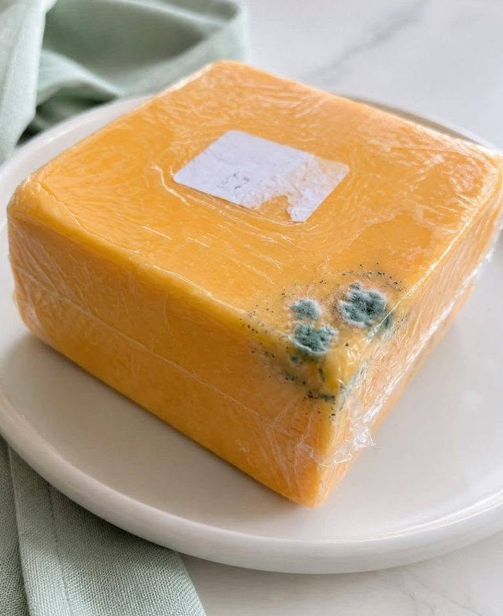
You open the refrigerator, reach for a block of cheddar, and notice an unwelcome surprise: a fuzzy green, blue, white, or gray patch growing on one corner.
The immediate question is obvious:
Can you simply cut the moldy part off and eat the rest, or does the entire block need to go in the trash?
The answer depends heavily on the type and texture of the cheese.
For a large, firm block of hard cheese such as cheddar, USDA guidance has traditionally indicated that you can generally cut away at least 1 inch (2.5 cm) around and below the mold spot, taking care not to touch the mold with the knife. Soft, shredded, sliced, or crumbled cheeses are a different story and generally should be discarded when unexpected mold appears.
Here’s how to handle moldy cheese more safely.
First, Why Does Cheese Grow Mold?
Mold is a type of fungus.
Its microscopic spores are common in the environment and can reach food through air, hands, utensils, surfaces, packaging, and other foods.
Cheese provides moisture and nutrients that can allow certain molds to grow.
The visible fuzzy patch is only the part of the mold you can easily see. Depending on the food’s structure, microscopic growth can extend beneath the surface.
That’s why simply scraping away the visible green spot isn’t always enough.
Is All Mold on Cheese Dangerous?
No.
Mold is deliberately used to make certain cheeses.
Blue cheeses, for example, are intentionally produced using selected mold cultures that contribute to their characteristic appearance and flavor.
The same is true for the edible rinds of some traditional cheeses.
That’s completely different from discovering unexpected fuzzy mold growing on a block of cheddar in your refrigerator.
When mold isn’t intentionally part of the cheese-making process, what you should do depends largely on whether the cheese is hard or soft.
Hard Cheese vs. Soft Cheese: The Important Difference
The density and moisture of the cheese matter.
A firm cheese has a relatively dense structure, making it more difficult for mold to penetrate deeply compared with a high-moisture soft cheese.
That’s why USDA food-safety guidance has allowed mold to be removed from certain hard cheeses by cutting well beyond the visibly affected area.
But this rule shouldn’t be applied to every cheese in the refrigerator.
Mold on a Hard Block of Cheddar
If you have a solid block of hard cheddar with one small area of surface mold, you may not necessarily need to discard the entire block.
The commonly cited USDA recommendation is to cut off at least 1 inch (2.5 centimeters) around and below the moldy area.
Don’t merely shave away the fuzzy surface.
You need to remove a generous section of apparently normal cheese surrounding it as well.
How to Cut Mold Off Hard Cheese Safely
If the cheese is a firm block and otherwise appears normal, follow these steps:
- Keep the knife away from the visible mold while making your cut.
- Remove at least 1 inch (2.5 cm) around and beneath the affected area.
- Don’t allow the knife blade to pass through the mold and then immediately touch the portion you plan to keep.
- Discard the removed section.
- Rewrap the remaining cheese in clean packaging.
- Wash your hands, knife, cutting board, and any surface that contacted the moldy portion.
The goal isn’t simply to make the cheese look clean.
It’s to reduce the chance of transferring mold from the contaminated area to the portion you’re keeping.
Don’t Scrape the Mold Off
One of the most common mistakes is using a knife to scrape the fuzzy patch away.
That’s not the same as removing a substantial portion of the cheese.
The visible mold represents only part of the growth.
For hard cheese, the recommendation to remove a full inch around and below the mold provides a much larger safety margin than simply scraping the surface.
What If the Cheddar Is Sliced?
This changes the recommendation.
If unexpected mold develops on sliced cheese, discarding the package is generally the safer approach.
Individual slices are thin, meaning there isn’t enough unaffected depth to cut a full inch around and beneath the mold.
Mold can also spread between adjacent slices.
So don’t apply the “cut around it” rule designed for a large hard block to a thin slice of cheddar.
What About Shredded Cheddar?
Throw moldy shredded cheese away.
Even though cheddar itself is a relatively hard cheese, shredding dramatically increases its exposed surface area.
Mold can spread between the small pieces, making it impossible to reliably remove the contaminated portion.
You can’t safely pick out the visibly moldy shreds and assume everything remaining is unaffected.
The same general caution applies to crumbled cheese.
Mold on Soft Cheese Is Different
Soft cheeses have much higher moisture levels and a less dense structure.
If unexpected mold appears on cheeses such as cream cheese, cottage cheese or ricotta, the safest choice is generally to discard the entire product.
The mold can potentially penetrate below the surface where you can’t see it.
Simply scooping away the visible patch isn’t sufficient.
What About Brie and Camembert?
This requires an important distinction.
Certain cheeses such as Brie and Camembert are intentionally made with characteristic surface molds.
That normal rind is part of the cheese.
However, if you see mold that isn’t supposed to be there—for example, an unusual color, texture, or growth inconsistent with the normal cheese—you shouldn’t automatically assume it’s harmless because the cheese already has a mold-ripened rind.
When uncertain, follow the manufacturer’s guidance or discard the product.
Can You Smell Moldy Cheese to See If It’s Safe?
Avoid putting visibly moldy food directly under your nose and taking a deep sniff.
Smelling isn’t a reliable safety test anyway.
Some food can contain harmful microorganisms without developing a dramatic odor, while perfectly safe fermented foods can naturally smell strong.
Appearance, food type, storage history and established food-safety recommendations are much more useful than the “sniff test.”
Why Isn’t Mold Always Just on the Surface?
Think of the fuzzy mold you see as the visible portion of a larger organism.
Molds can produce thread-like structures that penetrate food.
In dense foods, penetration is more limited, which is why certain hard cheeses can sometimes be salvaged.
In soft, porous or high-moisture foods, contamination can extend much farther beneath the surface.
This principle explains why the same rule doesn’t apply equally to cheddar, cream cheese, bread and yogurt.
What About Moldy Bread?
Don’t use the cheddar rule on bread.
If bread has visible mold, the safest choice is to discard it.
Bread is porous, and mold can spread beneath the surface beyond what is visible.
Cutting one green corner from a slice doesn’t make the rest reliably mold-free.
The same caution applies to many soft baked products.
Can You Eat Around Mold on Yogurt or Sour Cream?
No.
These are high-moisture foods.
If unexpected mold is growing on yogurt or sour cream, discard the container rather than scooping off the top layer.
The visible spot doesn’t necessarily represent the full extent of contamination.
Why Moldy Food Can Be More Than an Appearance Problem
Many molds primarily spoil food and make it undesirable.
But some molds can produce substances called mycotoxins, and moldy foods can sometimes have other microorganisms growing alongside the visible mold.
That doesn’t mean every green spot on cheddar is highly poisonous.
It does mean that mold shouldn’t be treated as nothing more than a cosmetic issue.
Follow food-safety guidance based on the type of food rather than guessing.
What If the Entire Cheddar Block Has Several Moldy Areas?
The hard-cheese trimming rule is most practical when you’re dealing with a small, localized mold spot on an otherwise normal large block.
If mold is widespread, appears in numerous locations, penetrates cracks throughout the cheese, or the cheese has significantly deteriorated, throwing it away is the more sensible option.
Saving a few dollars isn’t worth trying to surgically remove mold from a block that’s extensively spoiled.
What If Mold Is Under the Plastic?
Vacuum-sealed cheese can occasionally develop mold underneath its packaging after the seal is damaged or contamination occurs.
If you’re dealing with a single small patch on a sufficiently large, firm block of hard cheese, the hard-cheese guidance may still be applicable.
But inspect the entire block carefully.
If the package is swollen, leaking, badly damaged, or the cheese has extensive abnormal growth or deterioration, discard it.
Does Cooking Moldy Cheese Make It Safe?
Don’t rely on cooking to rescue food that should otherwise be discarded.
Heating cheese until it melts isn’t a substitute for proper handling of mold contamination.
If the type of cheese should be discarded because of mold, putting it on pizza, into a casserole, or inside a grilled sandwich doesn’t change that recommendation.
Can You Freeze Cheddar to Prevent Mold?
Freezing can extend storage life, but it can also change cheese texture.
Hard cheeses such as cheddar may become more crumbly after freezing, which can make them better suited to cooked dishes than serving on a cheese board.
Freezing also isn’t a way to “kill the mold” and rescue cheese that is already spoiled.
If the cheese needs to be discarded before freezing, freezing it doesn’t reverse that.
How to Keep Cheddar Fresh for Longer
Good storage can reduce waste.
Keep cheese refrigerated and don’t leave it sitting at room temperature unnecessarily.
Use clean hands and utensils when handling it.
After opening, wrap or store it properly rather than leaving cut surfaces exposed.
If you repeatedly touch the cheese with contaminated hands or knives, you’re providing new opportunities for microorganisms to reach it.
Keeping the refrigerator clean and appropriately cold is also important for food safety generally.
Don’t Let Moldy Cheese Touch Other Foods
If you find heavily moldy food in your refrigerator, remove it carefully.
Check foods that were touching it.
Mold spores can spread, particularly between nearby produce and other susceptible foods.
Clean the refrigerator shelf or drawer if spoiled food or liquid has contacted the surface.
And don’t reuse mold-contaminated wrapping around the portion of hard cheese you’ve decided to keep.
Use fresh packaging.
A Simple Rule to Remember
When unexpected mold appears, think about the food’s structure.
Large, firm block of hard cheese: a small localized mold spot may generally be cut away generously—at least 1 inch around and below.
Soft, shredded, sliced, or crumbled cheese: discard it when unexpected mold appears.
This is much safer than assuming that every cheese can be rescued—or throwing away every large block of cheddar because of one tiny surface spot.
Frequently Asked Questions
Can I eat cheddar with a little green mold?
If it’s a large, firm block of hard cheddar with a small localized mold spot, established food-safety guidance generally allows you to cut away at least 1 inch around and beneath the mold. If it’s shredded, sliced, extensively moldy, or otherwise deteriorated, discard it.
Is green mold on cheddar normal?
Unlike mold intentionally used to produce certain cheeses, unexpected fuzzy green growth on ordinary cheddar indicates spoilage.
Is cutting 1/4 inch around the mold enough?
No. The commonly recommended margin for salvageable hard cheese is at least 1 inch (2.5 cm) around and beneath the mold, not just the visible spot.
Can I just wash the mold off cheddar?
No. Washing or wiping the surface isn’t equivalent to removing the affected portion. If you’re salvaging a hard block, cut generously around and below the mold.
Should I throw away moldy shredded cheddar?
Yes. Shredded cheese should generally be discarded when unexpected mold appears because contamination can spread between the individual pieces.
What about moldy sliced cheddar?
Discard moldy sliced cheese rather than trying to cut tiny sections from individual slices.
Can I save moldy cream cheese?
No. Soft, high-moisture cheeses such as cream cheese should generally be discarded when unexpected mold appears.
Can I melt moldy cheese and eat it?
Cooking isn’t a reliable way to make cheese safe when food-safety guidance says it should be discarded.
Should pregnant people be more cautious?
Pregnant people, young children, older adults, and people with weakened immune systems are more vulnerable to certain foodborne illnesses. When there’s uncertainty about spoiled food, discarding it is the cautious choice.
The Bottom Line
So, if you open your refrigerator and discover green mold on cheddar, you don’t necessarily have to throw away an entire large block.
If it’s a firm, hard block with one small localized patch, cut away at least 1 inch around and below the mold, making sure the knife doesn’t touch the mold and then contaminate the portion you’re keeping.
But don’t extend that rule to every type of cheese.
Soft cheese? Throw it away.
Shredded cheese? Throw it away.
Sliced or crumbled cheese? Throw it away.
Hard block with widespread mold or significant deterioration? Throw it away.
The difference comes down largely to how easily contamination can spread through the food.
And when you’re uncertain about whether a questionable food is safe—particularly when serving someone at higher risk from foodborne illness—the safest option is simple:
When in doubt, throw it out.