Moving into a new home often comes with a few surprises.
You open a cabinet and discover a strange rack. You find an unfamiliar switch on the wall. Or, as in this case, you notice a long metal rod mounted beside the kitchen counter and wonder:
What on earth is this supposed to be used for?
Some homeowners immediately turn it into a place to hang grocery or trash bags. Others assume it’s simply a towel bar.
But this type of rod can actually be one of the most useful—and overlooked—storage features in a kitchen.
It’s generally known as a kitchen utility rail, utensil rail, or pot rail, depending on its design and intended use.
And there are many more things you can do with it than hang a plastic bag.
So, What Is the Rod Actually For?
The rod shown beside the counter resembles the type of horizontal kitchen utility or pot rail designed to provide convenient hanging storage.
These rails are commonly paired with S-hooks or purpose-made accessories so frequently used kitchen items can be kept within easy reach instead of taking up valuable drawer and countertop space.
Commercial kitchen-rail systems are specifically designed for this purpose. For example, IKEA describes its KUNGSFORS kitchen rail as a way to hang accessories, save countertop space, and even function as a towel rail or pot-lid rack.
That means the homeowners using a similar rod for trash bags aren’t necessarily doing anything wrong.
They’re simply using one of many possible functions.
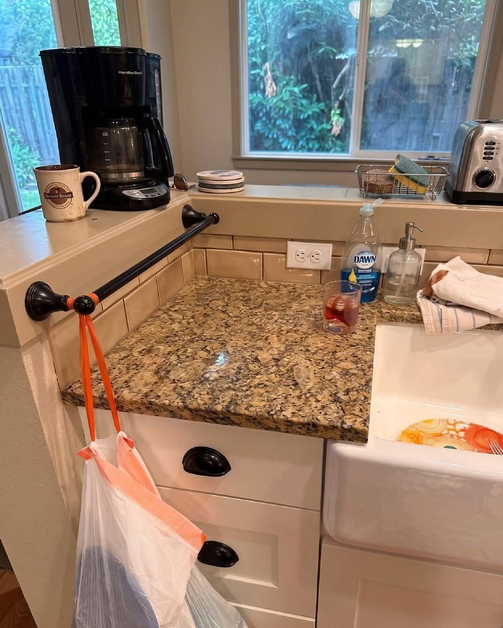
Why Would Someone Install It on the Side of a Cabinet?
At first, the location may seem strange.
Why put a rod on the side of a cabinet instead of above the stove?
Because the end panel of a cabinet is often wasted space.
Installing a rail there creates storage without sacrificing countertop or drawer space.
Interior-design examples specifically show pot rails mounted to the blank sides of end cabinets. Hooks can then hold towels, baskets, utensils, or pots.
In a compact kitchen, that little bit of extra storage can be surprisingly useful.
1. Hang Kitchen Towels
Probably the simplest use is as a dish-towel or hand-towel rail.
Just drape a towel directly over the rod.
Placing it beside a sink is particularly convenient because the towel remains within arm’s reach after washing your hands or cleaning the countertop.
Some kitchen rails are explicitly designed to double as towel rails.
And unlike leaving a damp towel crumpled on the counter, hanging it allows more of its surface to remain exposed to air.
2. Add S-Hooks for Cooking Utensils
This is where the rail becomes much more useful.
Add a few appropriately sized S-hooks and you can hang utensils such as:
- Spatulas
- Ladles
- Whisks
- Tongs
- Measuring cups
- Strainers
- Oven mitts
- Pot holders
Pot rails are commonly designed around exactly this concept: a horizontal bar plus hooks for hanging frequently used kitchen equipment.
Instead of digging through a crowded drawer while cooking, your favorite tools can stay visible and accessible.
3. Hang Small Pots and Pans
If the rail is securely anchored and designed to support the weight, it may also be used for cookware.
This is where the name pot rail comes from.
Pots and pans equipped with hanging holes in their handles can be attached with sturdy hooks.
This can be particularly useful in a kitchen with limited cabinet storage.
However, don’t assume every decorative bar can support heavy cookware.
Before hanging anything substantial, verify how the rail is mounted and, if possible, identify its manufacturer or weight rating.
4. Store Pot Lids
Pot lids are notoriously awkward to organize.
Stack them inside a cabinet and they fall over.
Put them inside one another and you may have to remove five lids to find the one you need.
Certain kitchen rails can be used as pot-lid racks, depending on the spacing between the rail and the wall. IKEA, for example, explicitly lists pot-lid storage as a use for its KUNGSFORS rail.
The lid’s knob or handle and rim can help keep it positioned against the rail.
Of course, whether this works depends on the dimensions of your particular rod and lids.
5. Hang Reusable Grocery Bags
This is one of the easiest everyday uses.
Instead of stuffing reusable bags into a drawer or cabinet, hang several from the rail.
You could dedicate one hook to:
reusable shopping bags
another to:
produce bags
and another to:
lunch bags.
Everything remains visible without consuming much space.
6. Use It for Trash Bags
And yes—the people who hang trash bags from it aren’t necessarily misusing it.
A bag hanging from the rail can be convenient while:
peeling vegetables, cleaning the counter, sorting recycling, or preparing food.
When you’re finished, remove the bag and dispose of it normally.
It’s probably not the most attractive permanent use, but it can be extremely practical during food preparation and cleanup.
7. Hang an Apron
An apron is another perfect candidate for a utility rail.
Add a hook and hang your apron there after cooking.
This makes especially good sense when the rail is located on the outside of a cabinet because the apron remains accessible without taking up drawer or cupboard space.
Kitchen peg and utility rails are commonly used for aprons, towels, brushes, baskets, and similar household items.
8. Add Small Hanging Baskets
Here’s where things get interesting.
A kitchen rail doesn’t have to hold individual objects.
Compatible hanging baskets or containers can transform it into a small storage system.
Depending on the rail and accessories, containers could hold:
wooden spoons, cleaning brushes, sponges, small utensils, or other lightweight kitchen essentials.
Modern kitchen-rail systems are specifically sold with hooks and containers for this purpose.
It’s essentially vertical storage occupying space that otherwise wouldn’t be used.
9. Create a Coffee Station
If the rod is near your coffee maker, you can make the location work even harder.
Use appropriate hooks to hang lightweight coffee accessories or mugs, provided the rail is securely installed and rated for the load.
The counter can then remain dedicated to the coffee maker while smaller accessories move onto the vertical surface.
Kitchen utility rails are commonly used for cups and other frequently accessed items.
10. Turn It Into a Cleaning Station
A rail positioned near the sink is ideal for organizing certain cleaning supplies.
You could use hooks or compatible containers for lightweight items such as dish brushes, cleaning cloths, reusable gloves, or small scrubbers.
This keeps wet items away from the countertop and makes them easier to reach.
Just avoid hanging chemicals or anything dangerous where children or pets could access them.
11. Hang Oven Mitts and Pot Holders
Oven mitts often end up stuffed into a drawer.
A rail solves that problem immediately.
Put one or two hooks on the bar and hang the mitts through their loops.
This is particularly convenient when the rail is near the oven—but keep textiles safely away from burners, flames, and other hot surfaces.
12. Use It for Cutting Boards
Some cutting boards have hanging holes in their handles.
Lightweight boards can therefore be hung from sturdy kitchen rails using suitable hooks.
Pot rails are frequently used for items beyond cookware; examples include cutting boards, measuring cups, pot holders, and utensils.
Again, check the rail’s load capacity before hanging heavier wooden boards.
Why Kitchen Rails Are Becoming Popular Again
The concept isn’t new.
Professional kitchens have long emphasized keeping frequently used equipment accessible.
The modern residential version follows the same basic philosophy:
Don’t hide everything you use every day.
A rail takes advantage of vertical space while keeping the worktop clear.
IKEA describes this style of kitchen storage as inspired by professional kitchens, where accessible tools and clear work surfaces can improve workflow.
It’s particularly useful in small kitchens where every drawer and cabinet matters.
What Should You NOT Hang From It?
Before loading the rail with cookware, there’s one important precaution.
You don’t know how strongly an unfamiliar rod in a newly purchased house was installed.
It might be secured into solid framing.
Or it might simply be attached to a relatively thin cabinet panel.
Until you know, don’t hang extremely heavy objects from it.
The same applies when installing a new rail. Manufacturers emphasize secure anchoring and suitable fasteners because an overloaded or poorly mounted rail can fall.
A lightweight towel is very different from several cast-iron pans.
Check the Mounting Before Using Heavy Items
Give the rail a careful inspection.
Look at the mounting points.
Does it move when gently pulled?
Are screws visible?
Is it attached to solid wood, a cabinet panel, drywall, or masonry?
If the bar feels loose, don’t load it.
If you want to use it for heavy cookware, determine how it’s anchored first.
The safest approach is to follow the load limits provided by the manufacturer whenever you can identify the product.
Could It Simply Be a Towel Bar?
Absolutely.
Not every rod of this shape is necessarily a specialized pot rail.
Based on a photograph alone, it isn’t possible to determine the original installer’s exact intention with certainty.
It could have been installed primarily as:
a towel bar, kitchen utility rail, pot rail, or multipurpose hanging bar.
And in practice, those functions overlap.
Some purpose-built kitchen rails are explicitly marketed as both accessory rails and towel rails.
So there may not be one single “correct” answer.
The Location Gives Us an Important Clue
The rod is positioned beside a kitchen work surface and close to the sink.
That makes a utility function much more likely than a purely decorative one.
Its location is convenient for towels, reusable bags, cleaning accessories, or hanging kitchen tools.
Installing a rail on the side of an end cabinet is also an established kitchen-storage technique.
So while we can’t know exactly what the previous homeowner hung there, the placement makes practical sense.
Why Not Just Put Everything in Drawers?
You certainly can.
But kitchen rails solve several small problems simultaneously.
They free drawer space.
They keep frequently used tools accessible.
They use otherwise wasted vertical surfaces.
And they can keep countertops less cluttered.
That’s why rail-storage systems remain common despite modern kitchens having sophisticated drawers and cabinets.
Sometimes the simplest storage idea is still one of the most useful.
A Clever Setup for the Rod in This Kitchen
Given its position beside the sink, one practical arrangement would be to use the bar itself for a hand towel while adding a few removable hooks.
One hook could hold reusable grocery bags.
Another could hold a dish brush or cleaning cloth.
Another could hold an apron or oven mitt.
And when preparing food, one could temporarily hold a waste bag.
That turns one mysterious rod into a surprisingly functional kitchen organizer.
Frequently Asked Questions
What is the rod on the side of the kitchen cabinet?
It appears consistent with a kitchen utility rail, pot rail, or towel rail. These bars can hold towels directly or accept hooks and accessories for additional storage.
Is it supposed to hold trash bags?
It can certainly be used that way, especially temporarily during food preparation or cleanup. However, kitchen rails can have many other uses.
Can I hang pots from it?
Potentially, but only after confirming that the rod and its mounting hardware can safely support the weight.
Can I put S-hooks on it?
If the bar diameter and clearance allow it, S-hooks are one of the most common ways to turn a kitchen rail into hanging storage.
Can it hold towels?
Yes. Some purpose-built kitchen rails are specifically designed to double as towel rails.
Why would someone install it on the side of a cabinet?
Because the blank side of an end cabinet is often unused space. Adding a rail turns it into accessible vertical storage without occupying the countertop.
Can I remove it?
Of course. If you don’t find it useful, it can generally be removed, although you’ll likely need to fill the screw holes afterward.
Final Thoughts
So what is that mysterious rod in the kitchen?
Most likely, you’re looking at a multipurpose kitchen utility rail—often called a pot rail or utensil rail—or a towel bar being used in essentially the same way.
And the people hanging trash bags from it aren’t necessarily wrong.
That’s simply one possible use.
With the right hooks and secure mounting, a rail like this can potentially organize towels, utensils, oven mitts, reusable bags, lightweight cookware, cleaning accessories, baskets, and other everyday kitchen essentials. Purpose-built kitchen rails are specifically designed to free up worktop space by moving frequently used items onto the wall or cabinet side.
The most important thing is not discovering exactly what the previous homeowner hung there.
It’s realizing that there isn’t necessarily only one correct use for it.
Sometimes the strangest feature left behind in a new house turns out to be one of the most practical.