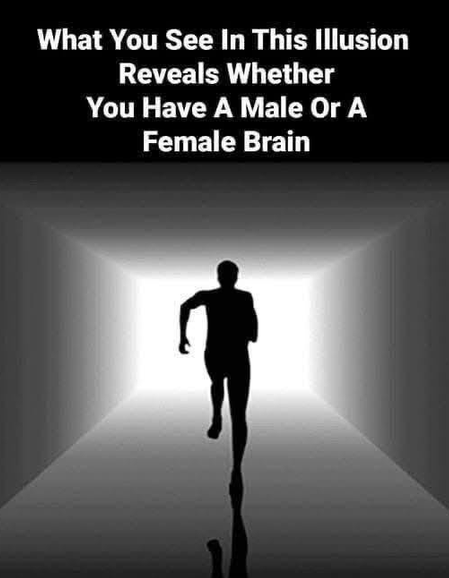
Optical illusions have a fascinating way of making us question what our eyes are telling us.
One person can look at an image and immediately see a figure running toward them. Another person may interpret the exact same silhouette as moving away. Sometimes, after staring at an illusion for several seconds, your perception can suddenly flip—even though nothing in the picture has changed.
That’s exactly why images like this one spread so quickly online.
A popular claim attached to this particular illusion says that the direction you see the figure moving can reveal whether you have a “male brain” or a “female brain.”
It sounds intriguing.
But is there actually science behind that conclusion?
The answer is much more interesting than the viral claim.
What Do You See First?
Look at the silhouette for a moment and answer without thinking about it too much:
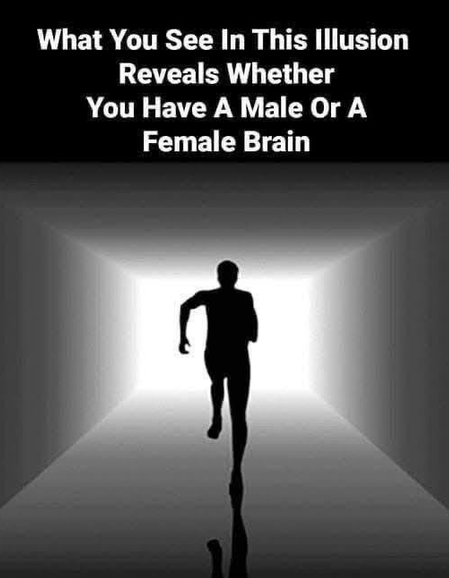
Does the person appear to be running toward you—or away from you?
Some viewers immediately interpret the figure as approaching.
Others are convinced the person is running deeper into the illuminated tunnel.
And some people may be able to switch between both interpretations after looking at the picture for a while.
That doesn’t mean one person’s eyes are working correctly and another person’s aren’t.
The image is intentionally ambiguous.
Why Can Two People See the Same Image Differently?
Vision isn’t simply a camera recording the outside world.
Your eyes collect visual information, but your brain has to interpret that information and construct a meaningful perception from it.
When an image lacks enough depth, lighting, facial, or perspective cues to produce one obvious interpretation, the brain has to resolve the ambiguity.
Researchers studying ambiguous figures have shown that the exact same unchanged stimulus can produce different perceptions—and perception can even spontaneously alternate between interpretations.
That’s one of the reasons optical illusions are so fascinating.
They reveal that seeing is partly an act of interpretation.
Is the Runner Coming Toward You or Going Away?
The image doesn’t provide all of the information we’d normally use to determine someone’s direction.
The figure is essentially a dark silhouette.
There are limited facial cues.
The lighting is unusual.
Depth information is deliberately reduced.
Parts of the body’s orientation can therefore be interpreted in more than one way.
Your brain makes its best guess based on the visual information available.
Once your brain settles on one interpretation, it can become surprisingly difficult to imagine the alternative.
Then suddenly it may flip.
The runner who appeared to be approaching may seem to turn around and run away—even though the pixels on your screen haven’t changed.
Does Seeing the Runner One Way Mean You Have a “Male Brain”?
This is where the viral claim becomes misleading.
There isn’t good evidence that this particular silhouette can reliably determine whether someone possesses a “male brain” or “female brain.”
Scientists have investigated sex-related differences in certain aspects of visual perception, and some studies have reported differences on particular tasks.
But those findings do not mean that one ambiguous internet image can classify an individual’s brain by sex.
A large study examining 15 visual tasks in more than 870 participants found sex-related differences on some tasks but no significant differences on many others, including four of the five visual illusions tested. The researchers described the pattern of differences as heterogeneous rather than the result of one simple mechanism.
That’s very different from saying:
“See the runner approaching = female brain.”
or:
“See the runner leaving = male brain.”
Those conclusions aren’t justified by the illusion alone.
But Haven’t Studies Found Differences Between Men and Women With Optical Illusions?
Yes—but this needs context.
Research on visual illusions has produced mixed and task-specific findings.
For example, a 1979 study involving 221 observers and 45 illusion variants found no significant male-female difference in illusion magnitude.
Other studies involving particular illusions have reported sex-related differences.
Research on the Poggendorff illusion, for example, has sometimes found differences between male and female participants.
Another study investigating optical illusions combined with working-memory reasoning reported differences in certain brain electrical responses between male and female participants.
The important point is that scientific findings about specific visual tasks cannot simply be transformed into a universal social-media personality test.
Why “Male Brain vs. Female Brain” Is Too Simplistic
Human brains vary enormously from person to person.
Visual perception can be affected by numerous factors, including attention, previous experience, expectations, context, contrast, depth cues, and the particular visual stimulus being viewed.
Even when researchers find an average difference between groups, that doesn’t automatically allow them to accurately classify every individual.
Think about height.
Men are taller than women on average in many populations.
But knowing that someone is 170 cm tall doesn’t reliably tell you whether that individual is male or female because the distributions overlap substantially.
The same caution applies when interpreting many group-level findings in neuroscience and psychology.
An average statistical difference isn’t necessarily a diagnostic test for an individual.
What the Illusion Actually Reveals About Your Brain
The illusion may not reveal whether you have a “male” or “female” brain.
But it does demonstrate something genuinely fascinating about perception.
Your brain doesn’t passively receive a perfect representation of reality.
Instead, it constantly interprets incomplete sensory information.
Research on ambiguous figures demonstrates that our visual system has to resolve incomplete or ambiguous information to produce a stable percept. When more than one interpretation is plausible, perception can alternate even while the stimulus remains exactly the same.
So when two people disagree about what an illusion shows, one doesn’t necessarily have to be wrong.
The visual stimulus itself may support multiple interpretations.
Try Looking at the Runner Again
Return to the silhouette.
If you originally saw the person running toward you, try imagining that you’re standing behind the runner.
Focus on the shoulders, legs, and surrounding tunnel.
Can you make the direction reverse?
If you originally saw the runner moving away, imagine that you’re standing at the end of the tunnel and the person is approaching you.
Some people can switch interpretations quickly.
Others find their original interpretation extremely persistent.
Neither response determines intelligence, personality, creativity, or biological sex.
It’s simply an interesting demonstration of perceptual ambiguity.
8 Fascinating Optical Illusions That Challenge Your Perception
The runner is only one example.
Here are several classic types of illusions that demonstrate different ways the visual system constructs what we perceive.
1. The Necker Cube
The Necker cube is one of the best-known ambiguous figures.
It’s a simple line drawing of a three-dimensional-looking cube.
But stare at it long enough and something strange happens.
The cube suddenly appears to reverse orientation.
The part that seemed closest to you becomes the back.
Then it may flip again.
Nothing on the page changes.
Your perception changes.
The Necker cube is frequently used in research on ambiguous perception precisely because the same physical stimulus supports multiple interpretations.
2. The Young Woman/Old Woman Illusion
Another classic ambiguous image can appear to show either:
a young woman looking away
or
an elderly woman’s face.
Once you discover both interpretations, your perception may alternate between them.
Researchers studying ambiguous figures specifically discuss the old/young woman image as a classic example of a stimulus capable of generating multiple perceptual interpretations.
3. The Rubin Vase
This famous illusion appears to contain either:
a vase in the center
or
two faces looking toward each other.
What you see depends partly on which region your brain treats as the foreground and which becomes the background.
The illusion demonstrates that separating an object from its background is itself an important part of visual perception.
4. The Müller-Lyer Illusion
Imagine two horizontal lines of identical length.
Put outward-pointing arrow-like ends on one and inward-pointing ends on the other.
Suddenly, one line can appear longer.
Measure them and you discover they’re actually the same length.
Your visual system’s interpretation of the surrounding geometry changes how you perceive the central lines.
5. The Ponzo Illusion
The Ponzo illusion uses perspective cues.
Two equal horizontal lines are placed between converging lines resembling railway tracks disappearing into the distance.
The upper line often appears longer.
Why?
Your brain interprets the converging lines as depth information.
Research continues to use the Ponzo illusion when studying visual perception, including investigations of individual and group differences.
6. Illusory Contours
Sometimes your brain perceives an edge or shape even though no physical line actually exists there.
Scientists call these illusory contours.
Research into these phenomena has helped neuroscientists investigate how the visual brain constructs boundaries and object representations rather than merely detecting physical changes in brightness.
In other words, your brain can effectively “complete” visual information that isn’t explicitly drawn.
7. Face Pareidolia
Have you ever looked at a wall socket and seen a surprised face?
Or noticed a face in:
clouds, car headlights, toast, tree bark, buildings, or household appliances?
That’s known as face pareidolia.
Your visual system is extremely good at detecting face-like configurations—even where no actual human face exists.
A large study involving 3,815 adults found that people readily attributed characteristics such as age, emotion, and gender to illusory faces in ordinary objects. Interestingly, the researchers found a strong bias toward perceiving those imaginary faces as male.
That finding is scientifically interesting.
But again, it doesn’t mean seeing a particular face or direction in a viral image determines the sex of your brain.
8. The Spinning Dancer
Another famous internet illusion depicts a rotating silhouette.
Some viewers initially perceive the dancer rotating clockwise.
Others see counterclockwise rotation.
Some can eventually make the perceived rotation reverse.
Like the running silhouette, insufficient depth information allows the brain to settle on more than one plausible interpretation.
It’s entertaining—but claims that the direction reveals whether you’re “left-brained,” “right-brained,” male, female, creative, or mathematical should be treated skeptically unless a specific validated test supports them.
Why Optical Illusions Feel So Convincing
Here’s perhaps the strangest part.
Even after you learn how an illusion works, you may continue seeing it.
You can measure two lines and prove they’re identical.
Your brain may still insist that one looks longer.
That’s because perception happens automatically.
Researchers use visual illusions precisely because they expose the constructive processes behind vision—situations in which what we consciously perceive differs from the straightforward physical properties of the stimulus.
You don’t consciously decide to be fooled.
Your visual system is applying processes that normally help you navigate the world successfully.
The unusual image exploits them.
Do Optical Illusions Reveal Your Personality?
Usually, not in the way viral quizzes suggest.
A post might claim:
“If you see a face first, you’re emotional.”
“If you see an animal first, you’re independent.”
“If you see a woman first, you’re highly intuitive.”
“If you see the runner approaching, you have a female brain.”
These statements can be entertaining as social-media games.
But entertainment shouldn’t be confused with psychological assessment.
A genuine personality test requires careful development, validation, reliability testing, and evidence that its results actually measure the psychological characteristics it claims to measure.
Simply attaching personality descriptions to two possible interpretations of an ambiguous picture doesn’t establish that relationship scientifically.
Does Seeing Something First Still Tell Us Anything?
It can tell us what interpretation your visual system happened to favor at that moment.
And that’s interesting.
What you perceive can be influenced by visual context and how your brain resolves ambiguity.
But you shouldn’t jump from:
“I saw interpretation A first”
to:
“Therefore I have personality type A.”
The second conclusion requires evidence that the first observation actually predicts the claimed trait.
Without that evidence, it’s just a fun interpretation.
Why These Illusions Are Still Worth Sharing
None of this makes optical-illusion posts boring.
Quite the opposite.
The real science is more fascinating than the viral personality labels.
Your brain is constantly transforming incomplete sensory information into a stable experience of the world.
Most of the time, the process works so smoothly that you never notice it happening.
Optical illusions create unusual situations where the assumptions made by the visual system become noticeable.
They give us a tiny window into how perception works.
Frequently Asked Questions
Does this running-person illusion reveal whether you have a male or female brain?
There’s no good basis for using this single ambiguous silhouette as a reliable test of whether someone has a “male” or “female” brain. Research on sex-related differences in visual perception is mixed and varies considerably by task.
Why do I see the runner coming toward me?
The silhouette contains limited depth information, so your visual system may interpret the body’s orientation as facing you.
Why does someone else see the runner moving away?
Their visual system may resolve the ambiguous depth and body-position cues differently.
Can the image suddenly change direction?
Your perception can. The image itself doesn’t need to change. Ambiguous figures can produce spontaneous perceptual reversals while the physical stimulus remains constant.
Does seeing one direction mean I’m more intelligent?
No reliable conclusion about intelligence can be made from which direction you perceive first.
Does it reveal my personality?
Not without scientific validation linking that particular response to a measurable personality characteristic.
Are optical illusions signs that something is wrong with your eyesight?
Ordinary visual illusions are experienced by people with normal vision and reflect how visual perception processes information. They aren’t, by themselves, evidence that something is wrong with your eyes or brain.
Do men and women ever perform differently on visual tasks?
Research has found average sex-related differences in some visual tasks, while many other tasks show little or no significant difference. A large study of 15 visual tasks found a heterogeneous pattern rather than a simple universal male-versus-female difference.
Final Thoughts
So, what did you see first?
Was the person running toward you—or away from you?
Your answer may be fun to compare with friends and family.
But don’t worry if a viral post tells you it proves you have a “male brain” or “female brain.”
Science doesn’t support using this single illusion as that kind of diagnostic test.
What the picture demonstrates is arguably much more impressive.
Your eyes provide information.
Your brain has to interpret it.
When the information is ambiguous, different interpretations can become possible—and your perception can sometimes switch between them even though the image hasn’t changed at all.
That’s why two people can look at exactly the same optical illusion and confidently describe two different things.
So share the picture, ask your friends what they see first, and enjoy comparing answers.
Just treat the “male or female brain” result as entertainment—not neuroscience.