After a long day of standing, walking, sitting at a desk, or running errands, your legs may feel heavy, tired, or swollen. Sometimes, one of the simplest ways to find relief is also one of the easiest to overlook: lying down and raising your legs.
This gentle habit requires no expensive equipment, complicated workout, or special fitness level.
For many people, elevating the legs for a short period can help relieve discomfort associated with spending long hours on their feet.
But what actually happens inside your body when you raise your legs?
Some viral health posts claim that elevating your legs every day can improve circulation, detoxify your body, reduce blood pressure, eliminate varicose veins, and even prevent serious diseases.
The reality is more nuanced.
Leg elevation can offer genuine benefits, particularly for temporary swelling and leg discomfort, but it is not a miracle treatment for circulation problems or other medical conditions.
Here are seven possible benefits, how to elevate your legs correctly, and the important warning signs you should never ignore.
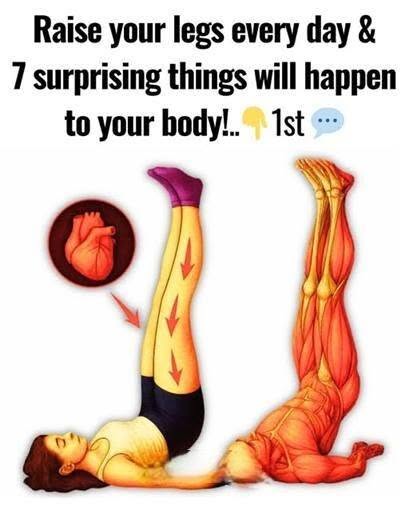
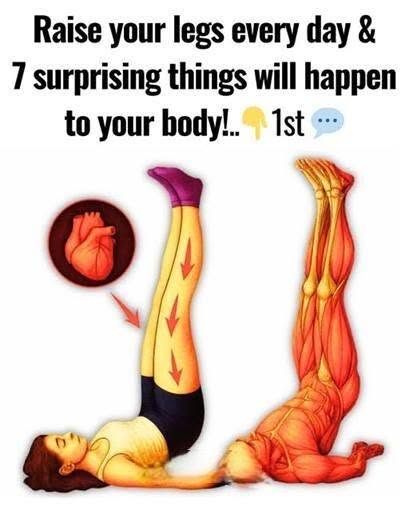
Why Does Raising Your Legs Feel So Good?
To understand the benefits of leg elevation, it helps to understand how blood and fluid move through the lower body.
Your heart pumps oxygen-rich blood through arteries to your legs.
After delivering oxygen and nutrients, blood returns toward the heart through veins.
Unlike arteries, veins in the legs must transport blood upward against gravity when you are standing or sitting upright.
The body relies on several mechanisms to support this process.
These include one-way valves inside the veins and contractions of the calf muscles during movement.
When you walk, your calf muscles help squeeze blood upward.
This mechanism is sometimes called the calf muscle pump.
But when you sit or stand still for long periods, the muscle pump is less active.
Gravity also increases pressure in the veins of the lower legs.
As a result, fluid may accumulate in the tissues, contributing to a sensation of heaviness or mild swelling.
When you lie down and raise your legs, gravity no longer works against venous return in the same way.
This can help reduce pressure in the lower extremities and encourage accumulated fluid to move away from the feet and ankles.
That is why leg elevation may feel particularly comfortable after a long day.
7 Surprising Benefits of Raising Your Legs Every Day
1. It May Help Reduce Mild Swelling in Your Feet and Ankles
One of the most recognized benefits of leg elevation is temporary relief from dependent edema.
Dependent edema is swelling that develops when fluid accumulates in lower parts of the body under the influence of gravity.
It may occur after prolonged standing, sitting, or travel.
You might notice that your shoes feel tighter in the evening.
Your socks may leave deeper marks around your ankles.
Or your feet may appear slightly puffier than they did in the morning.
Elevating your legs can help fluid redistribute away from the lower extremities.
For some people, this reduces swelling and discomfort.
Why It Works
When your legs are raised above the level of your heart, gravity can assist the return of venous blood and some accumulated fluid.
This may lower pressure in the small blood vessels of the lower legs and reduce further fluid leakage into the tissues.
However, the effectiveness depends on the cause of the swelling.
Leg elevation may help swelling associated with prolonged immobility or certain venous conditions.
It will not necessarily resolve swelling caused by heart, kidney, liver, lymphatic, or other medical problems.
What You Might Notice
After resting with your legs elevated, your ankles may look less puffy.
Your shoes may feel more comfortable.
You may also notice that your legs feel lighter.
Important: Sudden swelling in one leg, particularly with pain, warmth, or redness, requires prompt medical assessment because it may indicate a blood clot.
2. It Can Temporarily Support Venous Blood Return
Your veins are responsible for carrying blood back toward your heart.
When you remain upright, blood in the legs must travel against gravity.
Venous valves and muscle contractions help prevent excessive pooling.
However, prolonged inactivity can allow blood to accumulate in the lower extremities.
Leg elevation reduces the gravitational pressure affecting the veins.
This can make venous return easier while your legs are raised.
Does This Mean Leg Elevation Improves Circulation?
In a limited sense, yes.
It can temporarily assist venous return and reduce pooling.
But this does not mean it permanently improves the health of your blood vessels or treats every circulation disorder.
For example, peripheral arterial disease involves reduced arterial blood flow to the legs.
Some people with severe arterial disease experience more pain when their legs are elevated.
For them, raising the legs may worsen symptoms rather than relieve them.
If you have known circulation problems, follow your clinician’s advice about leg positioning.
What You Might Notice
Your legs may feel less heavy after sitting or standing for extended periods.
The effect is generally temporary.
Regular walking and appropriate physical activity remain important for long-term vascular health.
3. It May Relieve the Feeling of Heavy, Tired Legs
Have you ever reached the end of the day feeling as though your legs weigh twice as much as usual?
This sensation is especially common among people who spend many hours standing.
Teachers, retail workers, healthcare professionals, restaurant employees, and others with physically demanding jobs may experience it.
Prolonged standing can increase venous pressure in the lower legs.
Muscle fatigue may also contribute to discomfort.
Taking a break and elevating the legs can reduce gravitational pressure and provide an opportunity for the muscles to rest.
Why It Feels Relaxing
When you lie down, the muscles responsible for maintaining an upright posture can relax.
Your feet no longer support your body weight.
The lower legs are no longer subjected to the same gravitational pressure.
Together, these changes may make the legs feel more comfortable.
What You Might Notice
After 10–20 minutes of comfortable elevation, you may experience less heaviness or aching.
However, persistent leg pain or heaviness should not automatically be attributed to fatigue.
Venous disease, nerve problems, joint conditions, and other medical issues can produce similar symptoms.
4. It May Help With Symptoms of Chronic Venous Insufficiency
Chronic venous insufficiency occurs when veins in the legs have difficulty returning blood efficiently toward the heart.
This may happen when venous valves become damaged or do not close properly.
Blood can then pool in the lower extremities.
Common symptoms include:
- Leg heaviness.
- Aching.
- Ankle swelling.
- Visible varicose veins.
- Skin discoloration.
- Itching or discomfort around the lower legs.
Leg elevation is sometimes recommended as part of symptom management.
Raising the legs can temporarily reduce venous pressure and swelling.
However, it does not repair damaged vein valves.
It also does not permanently eliminate varicose veins.
What Else May Help?
Depending on the condition, a healthcare professional may recommend regular walking, calf muscle exercises, compression therapy, weight management when appropriate, or specific vein treatments.
Compression stockings should be selected carefully, especially for people with possible arterial disease.
What You Might Notice
Some people with venous insufficiency experience reduced swelling or aching after elevating their legs.
But recurring symptoms deserve medical evaluation.
5. It Can Provide a Comfortable Recovery Break After Physical Activity
After a workout, long walk, or physically demanding day, taking time to rest can be helpful.
Leg elevation offers a simple way to relax.
It may reduce temporary lower-leg swelling or discomfort related to prolonged activity.
Some people enjoy lying on their backs with their calves supported by pillows.
Others prefer placing their legs against a wall.
Does It Remove Lactic Acid?
A common claim is that elevating the legs flushes lactic acid from the muscles.
This explanation is oversimplified.
Lactate is a normal substance involved in energy metabolism, and the body processes it through several mechanisms.
There is no strong evidence that simply elevating the legs dramatically accelerates lactate clearance or prevents delayed-onset muscle soreness.
Does It Speed Muscle Recovery?
Evidence that passive leg elevation significantly improves athletic recovery is limited.
However, it can still be a comfortable way to rest.
Adequate sleep, hydration, appropriate nutrition, and sensible training remain more important recovery strategies.
What You Might Notice
Your legs may feel more relaxed.
You may experience temporary relief from heaviness or mild swelling.
But leg elevation should not be considered a substitute for proper recovery or medical treatment.
6. It May Help You Relax and Unwind
Many people find the legs-up position calming.
Lying on a comfortable surface, breathing slowly, and taking a break from daily activity can create a sense of relaxation.
This may be especially appealing after a stressful day.
The relaxation effect is not necessarily caused by a unique change in blood circulation.
It may result from resting, reduced muscular effort, and slow breathing.
A Simple Relaxation Routine
Find a comfortable place to lie down.
Support your legs with pillows or a cushion.
Allow your shoulders and arms to relax.
Breathe slowly and naturally.
Avoid holding your breath or forcing deep breathing.
Remain in the position for several minutes if comfortable.
Can Raising Your Legs Lower Stress Hormones?
Some online articles claim that leg elevation directly lowers cortisol or balances the nervous system.
However, strong clinical evidence supporting these specific claims is lacking.
The position may help you feel relaxed, but it should not be described as a proven hormonal treatment.
What You Might Notice
You may feel calmer and more comfortable after a short rest.
For many people, the greatest benefit is simply taking a quiet moment during a busy day.
7. It May Reduce Discomfort From Prolonged Sitting
Sitting for hours at a desk, in a car, or during a long flight can contribute to leg stiffness and mild swelling.
When you remain seated, the calf muscles are less active.
This reduces the pumping action that normally helps move venous blood upward.
Elevating your legs during breaks may help relieve some of the resulting discomfort.
However, leg elevation is not a substitute for regular movement.
Walking and moving the ankles are important because muscle contractions actively support venous return.
A Better Routine for Desk Workers
Try to stand up and move regularly throughout the day.
Take short walking breaks.
Move your ankles up and down while seated.
Avoid sitting in the same position for extended periods.
When you have the opportunity, rest with your legs elevated.
What You Might Notice
Your feet may feel less swollen after a long workday.
You may also experience less heaviness or stiffness.
But if you spend many hours sitting, movement should remain a central part of your routine.
How to Raise Your Legs Correctly
Leg elevation is simple, but positioning matters.
For relief of mild dependent swelling, raising the legs above heart level is generally more effective than placing them on a low footrest.
Here is a comfortable method.
Step 1: Choose a Supportive Surface
Lie on a bed, sofa, or comfortable floor mat.
Your back and neck should be supported.
Step 2: Place Pillows Under Your Legs
Use pillows or cushions to support your calves and lower legs.
Avoid placing excessive pressure directly behind the knees.
Step 3: Raise Your Legs Above Heart Level
For many people, this position helps reduce gravitational pressure in the lower extremities.
Do not force your hips, knees, or lower back into an uncomfortable position.
Step 4: Relax Your Muscles
Let your legs rest on the support.
You should not need to actively hold them up.
Step 5: Stay for a Short Period
A commonly used approach is to elevate the legs for approximately 10–20 minutes, depending on comfort and medical guidance.
There is no universally proven duration that works for everyone.
Step 6: Return to Sitting Slowly
Lower your legs gradually.
Sit up carefully, especially if you are prone to dizziness.
If you experience pain, numbness, dizziness, or shortness of breath, stop and seek appropriate medical advice.
Legs Up the Wall: Is This Position Better?
The legs-up-the-wall position is popular in yoga and relaxation routines.
It is sometimes called Viparita Karani.
In this position, a person lies on their back with their legs resting upward against a wall.
It may provide some of the same temporary benefits as supported leg elevation.
However, the wall position is not necessary.
For some people, it can place excessive tension on the hamstrings or lower back.
Others may experience tingling or discomfort.
A pillow-supported position may be easier and more comfortable.
How to Try Legs Up the Wall
- Sit beside a wall.
- Carefully lower yourself onto your back.
- Move your legs upward until they rest against the wall.
- Adjust your distance from the wall to avoid excessive stretching.
- Keep your knees slightly bent if needed.
- Relax for a few minutes.
- Roll gently onto your side before sitting up.
Do not force yourself into a vertical position.
Comfort is more important than achieving a perfect pose.
How Long Should You Raise Your Legs Each Day?
There is no single medically established duration for everyone.
For general comfort, some people find 10–20 minutes helpful.
People with certain venous conditions may receive more specific recommendations from their healthcare professionals.
The ideal duration depends on:
- The reason for elevation.
- The presence of swelling.
- Your comfort level.
- Your medical history.
- Any underlying circulation problems.
If your legs become numb, painful, or uncomfortable, change position.
Longer sessions do not automatically produce greater benefits.
Is It Better to Raise Your Legs in the Morning or at Night?
The best time depends on your symptoms and routine.
In the Morning
Some people enjoy a short elevation session after waking.
However, morning leg elevation is not necessary for everyone.
After Work
If you spend many hours standing, this may be a particularly comfortable time.
After Exercise
A short rest may help relieve temporary heaviness.
Before Bed
Some people find the position relaxing.
However, it has not been proven to cure insomnia or directly improve sleep quality.
Choose a time that feels comfortable and practical.
What Happens if You Raise Your Legs Every Day for 30 Days?
Viral posts sometimes suggest that raising your legs daily produces dramatic changes over a month.
For example, they may claim that your circulation will permanently improve, varicose veins will disappear, or your blood pressure will normalize.
These claims are not supported by strong evidence.
A more realistic timeline looks like this.
During the First Few Days
You may notice temporary relief from mild swelling or leg heaviness.
After One Week
You may become more comfortable with the routine.
If you previously spent long periods standing, regular rest breaks may feel beneficial.
After Two Weeks
You may notice that your legs feel more comfortable after certain activities.
However, the effect may not last once you return to prolonged sitting or standing.
After One Month
You may have established a useful relaxation habit.
But there is no evidence that 30 days of leg elevation permanently repairs veins, prevents blood clots, or reverses chronic disease.
The benefits are primarily related to temporary positioning and symptom relief.
Can Raising Your Legs Help With Varicose Veins?
Varicose veins are enlarged, twisted veins that often develop when venous valves do not function properly.
They may cause aching, heaviness, itching, or swelling.
Leg elevation can sometimes relieve these symptoms temporarily.
However, it cannot make damaged vein valves function normally again.
It also does not reliably eliminate visible varicose veins.
If varicose veins are painful, associated with skin changes, or causing persistent swelling, seek medical advice.
Modern treatment options may include compression, minimally invasive procedures, or other interventions depending on the individual case.
Can Raising Your Legs Prevent Blood Clots?
This is an important distinction.
Although leg elevation can assist venous return, it is not an established standalone method for preventing deep vein thrombosis.
Deep vein thrombosis, or DVT, occurs when a blood clot forms in a deep vein, usually in the leg.
Risk factors can include prolonged immobility, recent surgery, certain medical conditions, pregnancy, and previous blood clots.
Prevention may require movement, prescribed compression, or medication depending on individual risk.
Do not rely on leg elevation to prevent or treat a blood clot.
If you experience sudden swelling in one leg, new calf pain, warmth, or redness, seek urgent medical evaluation.
If these symptoms occur with chest pain, sudden shortness of breath, fainting, or coughing up blood, call emergency services immediately.
Can Raising Your Legs Lower Blood Pressure?
Some viral health claims suggest that leg elevation lowers blood pressure.
However, the relationship between body position and cardiovascular physiology is complex.
Raising the legs can temporarily change venous return and the amount of blood returning to the heart.
In certain medical situations, this may affect cardiac output or blood pressure.
But this does not establish leg elevation as a treatment for hypertension.
People with high blood pressure should follow evidence-based recommendations and prescribed treatment.
Leg elevation should not replace medication, exercise, dietary measures, or medical monitoring.
Can Raising Your Legs Improve Heart Health?
Leg elevation changes the distribution of blood and fluid in the body.
However, it has not been proven to strengthen the heart or prevent heart disease.
In people with certain cardiac conditions, especially decompensated heart failure, increasing the amount of blood returning toward the chest may worsen symptoms.
If you have heart failure or unexplained shortness of breath, ask your healthcare professional whether leg elevation is appropriate.
Is Leg Elevation Safe During Pregnancy?
Pregnancy can cause swelling in the feet and ankles.
Hormonal changes, increased blood volume, and pressure on pelvic veins may contribute.
Gentle leg elevation may help relieve some discomfort.
However, pregnant individuals should avoid prolonged flat-on-the-back positioning in later pregnancy if it causes dizziness, nausea, breathlessness, or discomfort.
A supported side-lying position with the legs comfortably elevated may be preferable.
Sudden or significant swelling of the face or hands, swelling accompanied by headache or vision changes, or sudden one-sided leg swelling requires prompt medical assessment during pregnancy.
These symptoms can sometimes indicate serious conditions.
Do not assume all pregnancy-related swelling is harmless.
Who Should Be Careful With Leg Elevation?
Although leg elevation is comfortable for many people, it is not appropriate in every situation.
People With Severe Peripheral Arterial Disease
Raising the legs may worsen pain when arterial blood flow is significantly reduced.
Some individuals experience rest pain that becomes worse with elevation.
Seek medical advice before using prolonged elevation for circulation problems.
People With Heart Failure
Changing leg position can increase blood returning to the heart.
People with significant heart failure should follow individualized medical advice.
People With Breathing Difficulties
Lying flat may worsen breathing in certain medical conditions.
Use a comfortable position and seek evaluation if breathlessness occurs.
People With Back or Hip Problems
A vertical legs-up-the-wall position may aggravate some musculoskeletal conditions.
Use pillows and avoid forcing the joints.
People With Recent Surgery or Injury
Follow the instructions provided by your surgical or rehabilitation team.
People With Unexplained Leg Swelling
Persistent or sudden swelling may indicate an underlying medical problem.
Do not use elevation as a substitute for diagnosis.
When Leg Swelling Is a Warning Sign
Mild swelling after prolonged standing may improve with rest.
However, some forms of swelling require urgent medical attention.
Seek prompt evaluation for:
- Sudden swelling in one leg.
- Leg swelling accompanied by pain, redness, or warmth.
- New swelling after surgery or prolonged immobility.
- Persistent swelling that does not improve.
- Swelling associated with fever or significant skin changes.
Seek emergency care if swelling occurs with chest pain, severe breathlessness, fainting, or other signs of a possible pulmonary embolism.
During pregnancy, sudden swelling accompanied by headache, vision changes, or upper abdominal pain also requires urgent assessment.
7 Common Mistakes People Make When Raising Their Legs
Mistake 1: Raising the Legs Too High
A nearly vertical position is not necessary.
Excessive stretching may cause discomfort.
Mistake 2: Ignoring Pain or Numbness
Tingling, pain, or numbness may indicate that the position is placing pressure on nerves or tissues.
Change position if symptoms develop.
Mistake 3: Staying Completely Still All Day
Leg elevation does not replace regular movement.
Walking and ankle exercises are important for circulation and general health.
Mistake 4: Expecting Varicose Veins to Disappear
Elevation may reduce symptoms but does not repair damaged venous valves.
Mistake 5: Using Elevation to Treat a Suspected Blood Clot
A possible DVT requires medical assessment.
Mistake 6: Assuming All Swelling Is Harmless
Heart, kidney, liver, vascular, and other conditions can cause swelling.
Persistent or unexplained symptoms deserve evaluation.
Mistake 7: Forcing the Position Despite Discomfort
The purpose is to feel more comfortable.
If the position causes pain, dizziness, or breathlessness, stop.
Other Ways to Support Healthy Leg Circulation
Leg elevation can be one part of a broader routine.
However, several habits have stronger evidence for supporting vascular health and reducing discomfort.
Walk Regularly
Walking activates the calf muscles, helping push venous blood toward the heart.
Take Movement Breaks
Avoid remaining seated or standing motionless for very long periods.
Practice Ankle Pumps
While seated, gently move your feet up and down.
Stay Physically Active
Choose activities appropriate for your health and fitness level.
Maintain a Balanced Diet
A varied diet supports overall cardiovascular health.
Follow Medical Advice About Compression
Compression stockings may help certain venous conditions, but they are not appropriate for everyone.
Address Persistent Swelling
If symptoms continue, seek evaluation to identify the cause.
Frequently Asked Questions About Raising Your Legs
What Happens When You Raise Your Legs Above Your Heart?
Gravity can assist venous return and help reduce some forms of dependent swelling.
Is Raising Your Legs Every Day Good for You?
It may provide temporary comfort and swelling relief for some people, but it is not necessary for everyone.
How Long Should You Elevate Your Legs?
Many people try approximately 10–20 minutes for comfort, although individualized medical recommendations may differ.
Can Leg Elevation Improve Circulation?
It can temporarily assist venous blood return, but it does not cure all circulation disorders.
Does Raising Your Legs Reduce Swelling?
It may help reduce mild dependent swelling, depending on the underlying cause.
Can Raising Your Legs Prevent Varicose Veins?
There is no strong evidence that leg elevation alone prevents varicose veins.
Does Leg Elevation Help Existing Varicose Veins?
It may relieve heaviness or swelling temporarily, but it does not eliminate the veins.
Can Raising Your Legs Help You Sleep?
Some people find it relaxing, but it is not an established treatment for insomnia.
Is It Safe to Sleep With Your Legs Elevated?
This depends on your comfort and medical circumstances. Ask a healthcare professional if you have significant heart, vascular, respiratory, or other health conditions.
Can Raising Your Legs Reduce Blood Pressure?
It is not an established treatment for high blood pressure.
Does Raising Your Legs Detoxify Your Body?
No. There is no scientific evidence that leg elevation removes toxins.
Can It Reduce Belly Fat?
No. Leg elevation does not directly burn abdominal fat.
Does It Improve Lymphatic Drainage?
Elevation may assist fluid redistribution in some situations, but established lymphedema often requires specialized management.
Can Pregnant Women Elevate Their Legs?
Gentle elevation may relieve mild swelling, but positioning should remain comfortable, and concerning symptoms require medical attention.
Should You Raise Your Legs After Walking?
You can if it feels comfortable, particularly when your legs are tired or mildly swollen.
Is Legs Up the Wall Better Than Pillows?
Not necessarily. Both can elevate the legs. A supported pillow position may be more comfortable for many people.
Can Leg Elevation Cause Numbness?
Yes, uncomfortable positioning or pressure on nerves may cause tingling or numbness. Adjust your position if this occurs.
A Simple Daily Leg Comfort Routine
If you spend many hours sitting or standing, consider this gentle routine.
Morning: Take a short walk or perform a few comfortable ankle movements.
During the day: Stand up and move regularly if you work at a desk. If you stand for long periods, take breaks when possible.
After work: Lie down comfortably and support your legs above heart level for approximately 10–20 minutes if appropriate for you.
Evening: Enjoy gentle movement, stretching, or relaxation.
Before bed: Avoid prolonged immobility and follow any individualized recommendations from your healthcare professional.
The goal is not to perform a perfect routine.
It is to make movement and rest work together.
Final Thoughts: A Simple Habit With Realistic Benefits
Raising your legs every day may sound like an unusual wellness trend, but the basic principle is grounded in human physiology.
When you elevate your legs, gravity can help reduce venous pressure and encourage some accumulated fluid to move away from the lower extremities.
For people who experience mild swelling or tired legs after prolonged sitting or standing, this can provide welcome relief.
The seven potential benefits include reduced swelling, temporary support for venous return, relief from heaviness, symptom management in certain venous conditions, comfortable recovery breaks, relaxation, and relief after prolonged sitting.
However, leg elevation is not a cure for varicose veins, blood clots, high blood pressure, heart disease, or other serious medical conditions.
It should complement—not replace—regular movement and appropriate medical care.
And if you experience sudden swelling, significant pain, or unexplained symptoms, seek professional evaluation rather than relying on home remedies.
Sometimes, a small change in position really can make your legs feel better.
You just need to understand what it can—and cannot—do.
Have You Ever Tried Raising Your Legs After a Long Day?
Do your feet or ankles feel swollen after standing or sitting for hours?
Have you noticed relief when you lie down and elevate your legs?
Share your experience in the comments, and let other readers know which simple habits help you feel more comfortable after a busy day.