Imagine running your fingers through your child’s hair and discovering a small, swollen, brown creature attached to the scalp. At first, you might think it’s an ordinary insect. But when you look closer, you notice tiny legs and a rounded body. What exactly is it—and should you be worried?
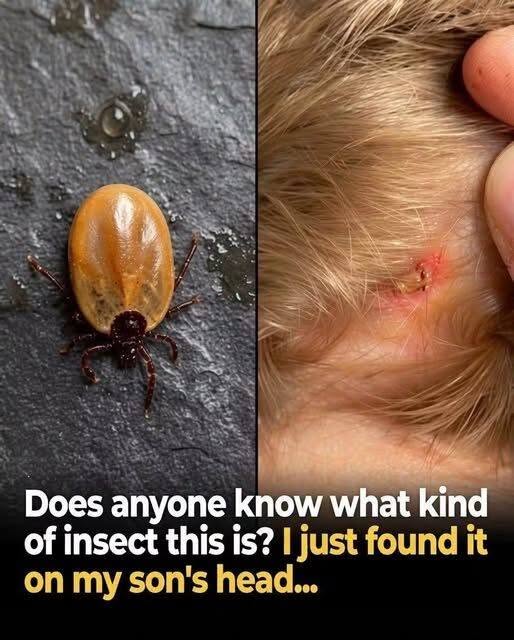
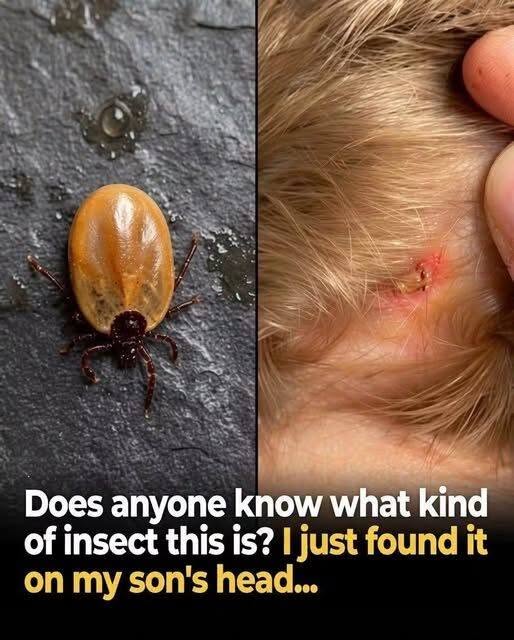
A social media photograph showing an unusual bug alongside a small irritated area of skin has sparked curiosity and concern.
The accompanying message reads:
“Does anyone know what kind of insect this is? I just found it on my son’s head.”
The creature pictured has a smooth, swollen, tan-colored body with a darker area near its head and several visible legs.
Its appearance strongly resembles an engorged tick—a tick that has been feeding on blood.
Although a photograph alone cannot establish the exact species, the image highlights something every parent should know: ticks can attach to the scalp, sometimes remaining unnoticed for hours or even days.
And unlike many harmless household insects, certain ticks can transmit infections.
The good news is that finding a tick does not automatically mean your child has contracted a disease.
Knowing how to recognize a tick, remove it safely, and monitor for warning signs can make a real difference.
What Is the Strange Bug in the Photograph?
The creature shown in the image appears consistent with an engorged tick.
Ticks are small arachnids, meaning they belong to the same broad group of animals as spiders and mites.
They are not insects.
Adult ticks and nymphs generally have eight legs, while tick larvae have six.
Ticks survive by feeding on the blood of animals, including mammals, birds, reptiles, and occasionally humans.
Their appearance can change dramatically during feeding.
An unfed tick may be small, flattened, and difficult to notice.
After feeding, however, its abdomen can expand considerably.
This can make the tick look like a swollen seed, bean, or tiny balloon.
In the photograph, the tan, rounded body is consistent with this type of expansion.
However, the exact species cannot be reliably determined from the image alone.
Different tick species have different geographic distributions, feeding behaviors, and potential health risks.
That distinction is important because not all ticks transmit the same diseases.
Why Does the Tick Look So Swollen?
One of the most surprising things about ticks is how much their bodies can change after feeding.
When a tick attaches to a host, it inserts specialized mouthparts into the skin.
It then feeds on blood.
Depending on the tick species and life stage, feeding may continue for an extended period.
As the tick takes in blood, its body expands.
This process is called engorgement.
A fully engorged female hard tick may become several times larger than she was before feeding.
That is why a tick found after feeding may look very different from the small, flat creatures shown in identification guides.
The degree of engorgement may suggest that feeding has occurred for some time, but it cannot reliably establish the exact attachment duration.
A photograph alone cannot tell you precisely when the tick attached.
Why Are Ticks Sometimes Found on Children’s Heads?
Ticks can attach to many parts of the body.
However, the scalp and hairline can be particularly difficult areas to inspect.
Children often spend time playing outdoors, where they may encounter ticks in vegetation.
Common exposure settings include:
- Grassy fields.
- Wooded areas.
- Gardens.
- Parks.
- Hiking trails.
- Areas with leaf litter.
- Places where wildlife or domestic animals are present.
Ticks do not jump or fly.
Instead, many species wait on vegetation and attach when a person or animal brushes past.
This behavior is called questing.
Once on the body, a tick may crawl to a suitable attachment site.
The scalp, behind the ears, neck, armpits, groin, and areas around the waist are among the locations worth checking.
Because a child’s hair can conceal a tick, an attached tick may go unnoticed.
This is one reason scalp checks are important after outdoor activities in tick-prone areas.
How to Tell the Difference Between a Tick and Other Bugs
Finding an unfamiliar creature in someone’s hair can be alarming.
But several different organisms can appear on the scalp.
Understanding the differences can help you decide what to do.
Ticks
Ticks are arachnids that attach to the skin to feed.
They may appear flat before feeding and swollen afterward.
Depending on their life stage, they have six or eight legs.
An attached tick may remain in place even when the surrounding hair is moved.
Head Lice
Head lice are insects that live among human hair.
They have six legs and are typically small, elongated, and grayish or tan.
Unlike ticks, lice move through the hair and do not become dramatically swollen after feeding.
Their eggs, called nits, are attached to hair shafts.
Head lice commonly cause scalp itching but are not known to transmit diseases in the way some ticks can.
Fleas
Fleas are small, dark insects with powerful hind legs adapted for jumping.
They may bite people but generally do not remain attached to the skin for prolonged feeding like ticks.
Bed Bugs
Bed bugs are flattened, oval insects that feed on blood.
They typically feed and then leave the skin rather than staying attached.
Skin Lesions or Scabs
Occasionally, a small scab, mole, or skin growth can be mistaken for an insect.
If you are unsure whether something is attached to the skin, avoid pulling at it forcefully.
Seek medical advice if necessary.
What Should You Do if You Find a Tick on Your Child?
If you discover an attached tick, prompt and careful removal is important.
You do not need to panic.
But you should avoid waiting for the tick to detach naturally.
The recommended method uses fine-tipped tweezers.
Step 1: Stay Calm
Ask your child to sit still.
Explain that you need to remove a small creature from their skin.
If the tick is hidden in the hair, gently separate the hair so you can see the attachment site.
Good lighting can help.
Step 2: Use Fine-Tipped Tweezers
Choose clean, fine-tipped tweezers.
Grasp the tick as close to the skin’s surface as possible.
Try to grip near the mouthparts rather than squeezing the swollen body.
Step 3: Pull Upward With Steady Pressure
Pull upward slowly and steadily.
Do not twist, jerk, or crush the tick.
These movements may cause the mouthparts to break off and remain in the skin.
If the tick is difficult to remove, ask a healthcare professional for assistance.
Step 4: Clean the Area
After removal, clean the bite site and your hands with soap and water or an appropriate antiseptic.
Avoid excessive scrubbing.
Step 5: Dispose of the Tick Safely
Do not crush the tick with your bare fingers.
You can place it in a sealed container or bag if identification may be useful.
A clear photograph can also help document its appearance.
Follow local health guidance about whether tick identification or testing is recommended.
Step 6: Monitor for Symptoms
Write down the date the tick was found and the location where your child may have been exposed.
Monitor for symptoms over the following days and weeks.
Contact a healthcare professional if your child develops concerning symptoms or if you are unsure about the tick’s removal.
Important: Do not wait for symptoms to develop before asking about preventive treatment if the exposure may be high risk. Some preventive measures are time-sensitive.
Five Tick Removal Mistakes You Should Never Make
Several popular home remedies are not recommended.
Some may delay safe removal or irritate the tick.
1. Do Not Apply Petroleum Jelly
Covering a tick with petroleum jelly is not a reliable way to make it detach.
It may simply delay removal.
2. Do Not Use Nail Polish
Applying nail polish to a tick is another common internet suggestion.
There is no good reason to use this method.
Fine-tipped tweezers are the preferred approach.
3. Do Not Burn the Tick
Never hold a match, lighter, or hot object against an attached tick.
This can burn the skin and does not provide a safe removal method.
4. Do Not Apply Essential Oils
Essential oils are sometimes promoted as natural tick removal treatments.
They are not a substitute for prompt mechanical removal.
Some essential oils can also irritate skin, particularly in children.
5. Do Not Squeeze the Swollen Body
Try to avoid crushing the tick while it remains attached.
Grip close to the skin with tweezers and pull steadily.
Can a Tick Bite Make Your Child Sick?
Some ticks can transmit pathogens that cause illness.
However, not every tick carries an infectious organism.
And not every tick bite leads to disease.
The risk depends on several factors, including:
- The tick species.
- The geographic location.
- Whether the tick carries a pathogen.
- How long it was attached.
- The specific infection involved.
- The child’s symptoms and medical history.
Certain tick-borne infections are more common in particular parts of the world.
For example, Lyme disease is associated with specific Ixodes ticks in regions where the bacteria circulate.
Other tick species can transmit different bacterial, viral, or parasitic infections.
Because risks vary geographically, a local healthcare professional is best positioned to assess an exposure.
Lyme Disease
Lyme disease is a bacterial infection transmitted by certain infected ticks.
It is found in parts of North America, Europe, and Asia.
Possible early symptoms include:
- Fever.
- Fatigue.
- Headache.
- Muscle or joint aches.
- An expanding skin rash.
A characteristic rash called erythema migrans may develop.
It is sometimes described as a bull’s-eye rash, but it does not always have a ring-shaped appearance.
Some rashes are uniformly red or otherwise atypical.
Not everyone with Lyme disease develops a recognizable rash.
Early treatment is important when Lyme disease is suspected.
Rocky Mountain Spotted Fever and Related Infections
Certain ticks can transmit bacteria that cause spotted fever illnesses.
Symptoms may include fever, headache, muscle aches, and rash.
Some forms can become serious rapidly.
A rash may not appear early in the illness.
Prompt medical assessment is essential when symptoms and exposure history raise concern.
Ehrlichiosis and Anaplasmosis
These are infections transmitted by certain tick species.
They can cause fever, headache, fatigue, and muscle aches.
Symptoms may resemble other common infections.
Diagnosis and treatment require medical evaluation.
Other Tick-Borne Diseases
Depending on the region, ticks may transmit additional pathogens.
These include organisms associated with babesiosis, tick-borne encephalitis, and other illnesses.
This is why identifying the region of exposure is often more useful than trying to guess the disease from the tick’s appearance alone.
What Does a Tick Bite Look Like?
A tick bite may leave a small red bump.
Sometimes there is mild irritation, itching, or tenderness.
The area may resemble an ordinary insect bite.
A small amount of local redness immediately after removal does not necessarily indicate a tick-borne infection.
However, certain changes deserve attention.
Watch for:
- A rash that expands over time.
- Fever.
- Headache.
- Unusual fatigue.
- Muscle or joint pain.
- Swollen lymph nodes.
- Increasing redness, warmth, or pain at the bite site.
Symptoms can appear days or weeks after exposure, depending on the condition.
A spreading rash or fever following a tick bite should prompt medical advice.
What About the Red Spot in the Photograph?
The social media image includes a close-up of an irritated area beneath hair.
It appears to show localized redness and a small lesion.
However, the photograph cannot establish whether this is the actual bite site, whether the tick was attached there, or whether infection is present.
A red spot alone is not enough to diagnose Lyme disease or any other tick-borne illness.
If a child develops a persistent, worsening, or expanding skin lesion after a suspected tick bite, a healthcare professional should evaluate it.
How Long Does a Tick Need to Be Attached to Transmit Disease?
This is an important question, but there is no single answer that applies to all tick-borne infections.
For Lyme disease caused by Borrelia burgdorferi in North America, transmission risk generally increases with prolonged attachment.
Many cases of transmission involve ticks attached for approximately 36 hours or longer.
However, transmission timing differs by pathogen and tick species.
Some tick-borne infections can be transmitted more quickly.
Therefore, you should never assume a tick bite is harmless simply because the tick may have been attached for only a short time.
Prompt removal remains important.
Should Your Child Take Antibiotics After a Tick Bite?
Not every tick bite requires antibiotics.
Preventive antibiotic treatment may be considered after certain high-risk exposures.
For example, in some Lyme-endemic areas, clinicians may consider a single dose of doxycycline for eligible children and adults when specific criteria are met.
These criteria include the type of tick, the likelihood of prolonged attachment, local disease risk, and the time since removal.
Preventive treatment for Lyme disease generally needs to be considered within 72 hours of tick removal.
However, the decision must be made by a healthcare professional.
Routine antibiotics are not recommended after every tick bite.
And preventive antibiotics used for Lyme disease do not reliably prevent all other tick-borne infections.
Do not give your child leftover antibiotics or start treatment without medical advice.
Can a Tick Stay Hidden in Hair for Days?
Yes.
Ticks may attach in areas that are difficult to inspect.
The scalp is especially challenging because hair can hide small parasites.
Some people do not feel the initial bite.
Tick saliva contains substances that can affect local inflammation and sensation.
As a result, an attached tick may remain unnoticed.
This is why routine checks after outdoor exposure are useful.
For young children, adults should inspect areas that the child cannot easily see.
How to Check Your Child for Ticks
After spending time outdoors in areas where ticks are present, perform a careful inspection.
Pay special attention to:
- The scalp and hairline.
- Behind the ears.
- The back of the neck.
- Under the arms.
- Around the waist.
- Behind the knees.
- Between the legs.
- Around the ankles.
- Inside the belly button.
Use good lighting.
For thick or long hair, separate the hair into sections.
A fine-toothed comb may help you inspect the scalp, but it does not replace careful visual examination.
Check clothing and outdoor gear as well.
Ticks can be carried indoors on clothing or pets before attaching to a person.
Seven Ways to Reduce Tick Exposure
Prevention is particularly important for families who spend time outdoors.
1. Use an Appropriate Insect Repellent
Use an EPA-registered repellent or another locally approved product that is effective against ticks.
Follow the label instructions carefully.
Age restrictions and application guidance vary by product.
Adults should apply repellent to young children according to the manufacturer’s directions.
Avoid applying repellent to children’s hands, eyes, mouth, or irritated skin.
2. Wear Protective Clothing
Long trousers, socks, and closed shoes can reduce exposed skin when walking through tick habitats.
Light-colored clothing may make ticks easier to spot.
3. Stay on Clear Trails
Avoid brushing against tall grass and dense vegetation when possible.
Many ticks wait on vegetation for passing hosts.
4. Treat Clothing When Appropriate
Permethrin-treated clothing and gear can help reduce tick exposure.
Follow product directions and local recommendations.
Do not apply permethrin clothing-treatment products directly to skin.
5. Check Everyone After Outdoor Activities
Examine children, adults, and pets after time spent in tick-prone environments.
6. Shower After Outdoor Exposure
Showering soon after returning indoors may help wash off unattached ticks and provides an opportunity to inspect the body.
7. Manage Your Yard
Keeping grass trimmed, reducing leaf litter in frequently used areas, and maintaining a separation between play spaces and dense vegetation may help reduce exposure.
No single method eliminates every tick, so combining preventive strategies is usually more effective.
Can Pets Bring Ticks Into the House?
Yes.
Dogs and cats can pick up ticks outdoors.
Some ticks may remain attached to pets, while others may crawl onto household surfaces or people.
Regular tick checks and veterinarian-recommended prevention are important.
Not all tick-control products are safe for every animal.
In particular, some products intended for dogs can be toxic to cats.
Always follow veterinary guidance.
If you find a tick on your pet, use an appropriate removal technique or ask your veterinarian for help.
When Should You Call a Doctor?
Contact a healthcare professional promptly if:
- You cannot safely remove an attached tick.
- You suspect the mouthparts remain and the area becomes inflamed.
- Your child develops fever or an expanding rash.
- Your child experiences unusual fatigue, headache, or muscle aches after a bite.
- The bite site becomes increasingly red, painful, swollen, or produces pus.
- You believe the tick may have been attached for a prolonged period in a region where tick-borne disease is common.
- You want to know whether time-sensitive preventive treatment is appropriate.
Seek emergency medical attention for severe symptoms such as difficulty breathing, confusion, fainting, or rapidly worsening illness.
If possible, tell the clinician when and where the exposure occurred.
Common Myths About Ticks
Myth 1: Ticks Are Insects
False.
Ticks are arachnids, related to spiders and mites.
Myth 2: Ticks Jump From Trees
False.
Ticks cannot jump or fly.
Many attach from vegetation when a host brushes past.
Myth 3: Every Tick Bite Causes Lyme Disease
False.
Only certain tick species can transmit the bacteria responsible for Lyme disease, and not every tick is infected.
Myth 4: A Tick Bite Always Hurts
False.
Tick bites can go unnoticed.
Myth 5: You Should Burn a Tick to Make It Release
False.
Burning an attached tick can injure the skin and is not recommended.
Myth 6: If There’s No Rash, There’s No Infection
False.
Some tick-borne illnesses may occur without a noticeable rash.
Myth 7: A Swollen Tick Means the Child Definitely Has an Infection
False.
Engorgement indicates feeding, not necessarily pathogen transmission.
Myth 8: All Ticks Carry the Same Diseases
False.
Different tick species transmit different pathogens, and disease risks vary by region.
Frequently Asked Questions
What Kind of Bug Looks Like a Brown Bean With Legs?
An engorged tick can resemble a small bean or seed because its body expands during feeding. However, identification should be confirmed when possible.
Is a Tick an Insect or a Spider?
A tick is an arachnid, related to spiders and mites, but it is not a true spider.
What Should I Do if I Find a Tick in My Child’s Hair?
Remove an attached tick promptly using fine-tipped tweezers, clean the area, document the date, and monitor for symptoms. Ask a healthcare professional whether further assessment is needed.
Can a Tick Bite Be Dangerous?
Yes, some ticks can transmit infections. However, many tick bites do not lead to illness.
Does a Tick Bite Always Leave a Mark?
Not always. Some bites leave a small red bump, while others produce little visible reaction.
Should I Put Alcohol on a Tick Before Removing It?
No. Remove the attached tick mechanically with fine-tipped tweezers. Clean the bite site afterward.
Can I Remove a Tick With My Fingers?
Fine-tipped tweezers are preferred because they allow you to grasp the tick close to the skin without squeezing its body.
How Long Should I Watch My Child After a Tick Bite?
Be alert for symptoms during the following weeks. The relevant monitoring period depends on the infection and exposure region.
Does an Engorged Tick Mean It Has Been Attached for Days?
Engorgement suggests feeding has occurred, but the exact attachment duration cannot be determined reliably from appearance alone.
Can Ticks Live in Human Hair?
Ticks can attach to the scalp, but they do not live and reproduce in human hair in the same way head lice do.
Can a Tick Bite Cause Hair Loss?
Localized irritation or inflammation may affect the skin, but hair loss is not a typical feature of an uncomplicated tick bite. Persistent scalp changes should be evaluated.
Is the Tick in the Viral Photo Definitely Dangerous?
The photograph appears consistent with an engorged tick, but its species and infection status cannot be determined from the image. Its appearance alone does not establish danger.
Final Thoughts: A Small Discovery That Every Parent Should Take Seriously
Finding a strange, swollen creature attached to your child’s head can be frightening.
The photograph circulating online shows an animal that strongly resembles an engorged tick.
Its rounded body and visible legs may look unusual, especially to someone who has never encountered a tick after feeding.
But the most important question isn’t whether the creature looks frightening.
It’s what you should do next.
If you find an attached tick, remove it promptly and carefully with fine-tipped tweezers.
Avoid burning it, squeezing its body, or applying questionable home remedies.
Clean the area and monitor for symptoms.
If the exposure occurred in a region where tick-borne diseases are present, seek timely medical advice about whether preventive treatment is appropriate.
Remember that most tick encounters do not automatically lead to serious illness.
But recognizing a tick early can help protect your family.
And sometimes, a simple habit—checking your child’s scalp after an afternoon outdoors—can prevent a much bigger problem.
The next time your child comes home from playing in the grass or exploring a wooded area, take a few minutes to check their hair and skin.
It’s a small precaution that can make a meaningful difference.
What Would You Do?
Imagine finding a swollen, unfamiliar bug attached to your child’s scalp.
Would you recognize it as a possible tick?
Would you know how to remove it safely?
Share this information with other parents and caregivers. Knowing what to look for—and what not to do—could help someone respond quickly and safely.