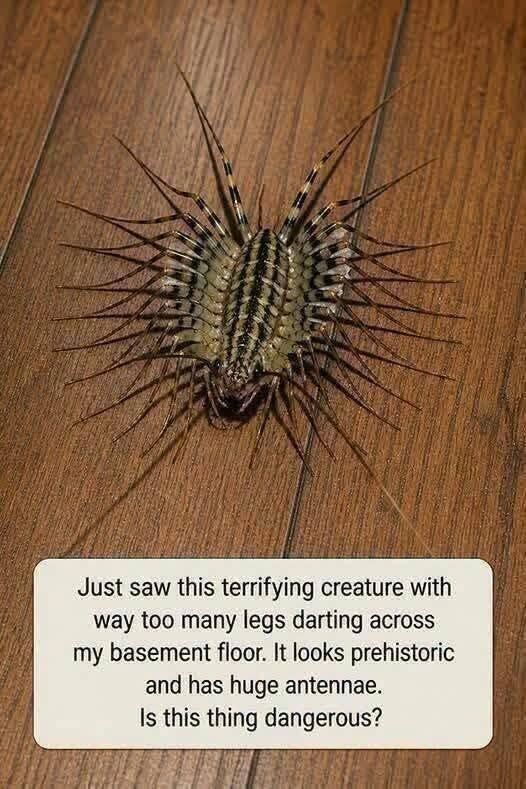
Imagine walking into your basement and seeing a strange, spiky creature racing across the floor. It has dozens of incredibly long legs, enormous antennae, and an appearance that seems straight out of a horror movie. What is it, and should you be worried?
For many homeowners, discovering an unfamiliar insect indoors is enough to cause alarm.
But some creatures are especially unsettling.
Picture something with a narrow body, countless delicate legs, and two long antennae extending from its head.
Now imagine watching it dart across your basement floor at surprising speed.
Your first reaction might be to scream, jump backward, or reach for the nearest shoe.
That’s exactly the kind of reaction a viral social media photograph has inspired.
The image shows a bizarre-looking creature resting on a wooden floor, surrounded by what appear to be long, spiky appendages.
The accompanying caption reads:
“Just saw this terrifying creature with way too many legs darting across my basement floor. It looks prehistoric and has huge antennae. Is this thing dangerous?”
The creature certainly looks unusual.
But here’s the surprising part.
The animal resembles a house centipede, one of the most misunderstood creatures commonly found inside homes.
And although its appearance can be frightening, house centipedes are generally far less dangerous to humans than many people assume.
In fact, they may even help control other household pests.
Let’s explore what these strange creatures are, why they enter homes, and whether you should leave them alone.
What Is This Strange Creature With So Many Legs?
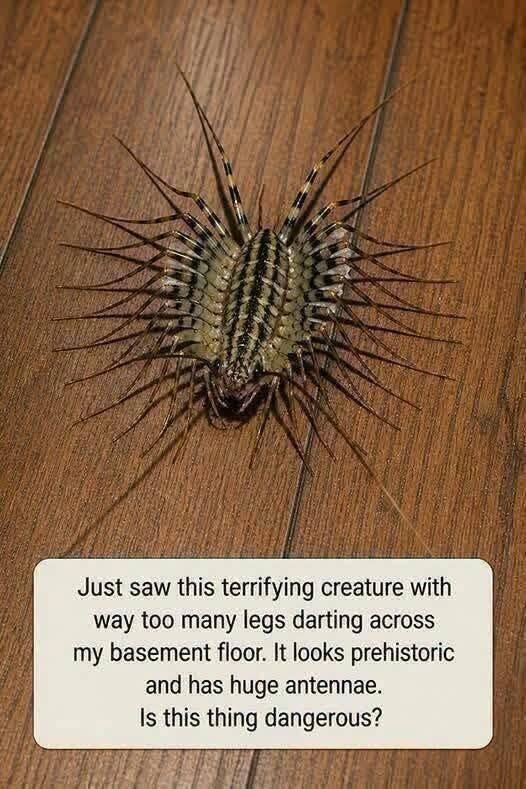
The creature in the viral photograph strongly resembles a house centipede, scientifically known as Scutigera coleoptrata.
House centipedes are arthropods belonging to the class Chilopoda.
Despite their appearance, they are not insects.
Insects have six legs.
Centipedes have many more.
House centipedes are especially recognizable because of their unusually long, slender legs.
Their bodies are generally yellowish-gray or tan, often marked with darker longitudinal stripes.
They also have long antennae and elongated rear legs that can resemble a second pair of antennae.
When viewed from above, all these appendages create a dramatic, almost spiky appearance.
However, the photograph alone cannot establish the species with absolute certainty.
Its visible features are strongly consistent with a house centipede, but precise identification may require closer examination.
Why Does a House Centipede Look So Terrifying?
The house centipede’s appearance is one of its most remarkable characteristics.
Unlike many other centipedes, which have relatively short legs, house centipedes possess exceptionally long appendages.
These legs extend outward from the body, creating the illusion of a creature much larger than it actually is.
The arrangement also gives the animal a somewhat prehistoric appearance.
The Legs Create an Optical Illusion
A house centipede has 15 pairs of legs when fully mature.
That’s a total of 30 legs.
Because the legs extend far beyond the body, they can make the animal look enormous.
The rear legs are particularly long.
In some individuals, they can resemble additional antennae.
The Antennae Are Extremely Long
House centipedes have two long antennae that help them detect their surroundings.
These structures contain sensory receptors.
They are useful for navigating dark environments and locating prey.
Their Bodies Have Distinctive Stripes
House centipedes commonly display darker stripes running along their bodies.
Their legs may also have alternating light and dark bands.
These patterns make them look even more unusual.
They Move Very Quickly
Perhaps the most startling feature is their speed.
House centipedes can run rapidly across floors and walls.
Their long legs allow them to move efficiently while pursuing prey or escaping disturbances.
A sudden burst of movement can be enough to frighten even someone who isn’t normally afraid of insects.
Are House Centipedes Dangerous to Humans?
This is the question most people ask immediately.
The reassuring answer is that house centipedes are generally not considered a significant threat to healthy humans.
They are predators that primarily hunt other small arthropods.
They do not seek out people.
They do not feed on human blood.
And they are not interested in attacking homeowners.
However, there is an important distinction.
House centipedes possess venom-bearing appendages called forcipules.
These are modified front legs used to capture and subdue prey.
Although house centipedes can potentially bite or sting defensively, such incidents are uncommon.
Their venom is primarily adapted for small prey.
For most people, a bite would be expected to cause localized symptoms rather than serious illness.
Still, reactions can vary.
If someone develops difficulty breathing, significant facial swelling, faintness, or other signs of a severe allergic reaction after a bite, they should seek emergency medical attention.
The safest approach is to avoid handling centipedes with bare hands.
Do House Centipedes Bite?
Yes, they can.
But bites are uncommon.
House centipedes usually attempt to escape when disturbed.
They prefer running away or hiding rather than confronting a much larger animal.
A bite is more likely if the centipede is trapped against the skin or handled.
What Might a Bite Feel Like?
Possible symptoms include:
- Brief pain or stinging.
- Localized redness.
- Mild swelling.
- Temporary irritation.
Most uncomplicated reactions can be managed with basic first aid.
Wash the area gently with soap and water.
Apply a cool compress if needed.
Monitor for worsening symptoms.
Seek medical advice if pain or swelling becomes significant, symptoms persist, or there are signs of infection.
People with a history of severe allergic reactions should be especially cautious.
Why Are House Centipedes Found in Basements?
Basements are among the most common places to encounter house centipedes.
That’s because these creatures prefer environments that provide moisture, shelter, and food.
1. Basements Are Often Humid
House centipedes are vulnerable to drying out.
They tend to prefer areas with relatively high humidity.
Basements, bathrooms, laundry rooms, and crawl spaces can provide suitable conditions.
2. They Prefer Dark Places
House centipedes are generally most active at night.
During the day, they often hide in cracks, behind objects, or in other sheltered areas.
A basement full of storage boxes and furniture can offer numerous hiding spots.
3. Other Insects Provide Food
House centipedes are predators.
They may hunt insects and other small arthropods found inside homes.
If your basement has plenty of prey, a centipede may find it an attractive hunting ground.
4. They Can Enter Through Small Openings
Gaps around doors, windows, foundations, and utility pipes can provide access.
Some house centipedes may also establish themselves indoors.
5. They Seek Stable Conditions
Indoor environments can provide protection from extreme outdoor temperatures.
This can make basements and other sheltered areas appealing.
The Surprising Reason Some People Welcome House Centipedes
Here’s something many homeowners don’t realize.
House centipedes can actually help reduce populations of certain household pests.
They are active hunters that feed on other small arthropods.
Their prey may include:
- Cockroaches.
- Silverfish.
- Small spiders.
- Flies.
- Moths.
- Other small insects.
Their speed and sensory abilities make them effective predators.
They use their venom-bearing forcipules to subdue prey.
Then they consume the captured animal.
This means a house centipede may help control some pests that homeowners find even more troublesome.
However, centipedes should not be treated as a complete pest-control solution.
Seeing one may suggest that other small arthropods are present, but it does not prove that your home has a major infestation.
Are House Centipedes Really Centipedes?
Yes.
Despite their unusual appearance, house centipedes belong to the centipede group.
The word “centipede” comes from terms meaning “hundred feet.”
But most centipedes do not have exactly 100 legs.
The number of legs varies between species.
House centipedes have 15 pairs as adults.
Other centipedes may have substantially more.
Centipedes also differ from millipedes.
Although both are many-legged arthropods, they belong to different groups.
House Centipede vs. Millipede: What’s the Difference?
People frequently confuse these two animals.
But they have several important differences.
| Feature | House Centipede | Millipede |
|---|---|---|
| Body shape | Relatively flattened | Usually rounded or cylindrical |
| Legs | 15 pairs in adults | Often many more pairs |
| Movement | Fast | Usually slower |
| Diet | Predatory | Mostly decaying plant material |
| Defense | Venom-bearing forcipules | Some release defensive chemicals |
| Typical appearance | Long, widely spread legs | Shorter legs beneath the body |
Millipedes generally move more slowly.
When disturbed, many curl into a spiral.
House centipedes are more likely to run quickly toward shelter.
Both can appear intimidating, but their biology is quite different.
Why Do House Centipedes Have Such Long Legs?
The legs of a house centipede are highly specialized for movement.
Their length helps the animal travel rapidly across surfaces.
The legs also contribute to agility when chasing prey.
House centipedes can move along walls and other vertical surfaces.
Their legs become progressively longer toward the rear of the body.
This arrangement helps accommodate their movement and reduces interference between adjacent legs.
The unusually long rear legs can also confuse observers.
At first glance, it may be difficult to determine which end of the animal is the head.
How Fast Can House Centipedes Run?
House centipedes are notably fast compared with many other household arthropods.
Their speed is one of the reasons people find them so alarming.
A centipede may remain hidden for hours and then suddenly dash across an open floor.
That rapid movement can make it seem as though the animal is chasing someone.
But house centipedes are not pursuing humans as prey.
They’re usually trying to escape, find shelter, or hunt smaller animals.
If one runs toward you, it is more likely responding to its surroundings than deliberately attempting to attack.
Do House Centipedes Crawl Into Beds?
House centipedes can climb and move through different areas of a home.
So it is physically possible for one to reach a bedroom or bed.
However, beds are not their preferred habitat.
They are generally more interested in sheltered, humid areas where prey is available.
They do not seek humans as food sources.
If you repeatedly encounter centipedes in bedrooms, consider checking for moisture problems, gaps, or other household pests.
Can House Centipedes Live in Bathrooms?
Yes.
Bathrooms can provide favorable conditions because of moisture.
You may find house centipedes near:
- Bathtubs.
- Showers.
- Sinks.
- Floor drains.
- Baseboards.
- Cabinets.
- Plumbing openings.
However, seeing a centipede near a drain does not necessarily mean it came through the plumbing.
It may have entered through a nearby gap or been attracted to the damp environment.
Properly functioning plumbing traps help block direct access through many drain systems.
Are House Centipedes Nocturnal?
House centipedes are primarily nocturnal.
They often remain hidden during daylight hours.
At night, they emerge to search for prey.
This explains why homeowners frequently encounter them when turning on a basement or bathroom light.
The sudden illumination may cause the centipede to run toward the nearest hiding place.
Because of their nighttime activity, a person may share a home with house centipedes without seeing them very often.
What Should You Do If You Find One in Your House?
If you discover a house centipede, you have several options.
Option 1: Leave It Alone
If the animal is in an out-of-the-way area and you’re comfortable with its presence, you may choose not to disturb it.
It may help reduce other small arthropods.
Option 2: Relocate It Carefully
If you prefer to remove it, avoid touching it directly.
Place a container over the centipede.
Carefully slide a stiff piece of paper or cardboard underneath.
Then move the container to a suitable outdoor location, if local conditions and regulations permit.
Keep your hands away from the animal.
Option 3: Reduce the Conditions Attracting It
If centipedes appear repeatedly, investigate why.
Check for excess moisture.
Look for other insects.
Inspect possible entry points.
Reducing favorable conditions is often more useful than removing individual centipedes repeatedly.
How to Keep House Centipedes Out of Your Home
If you would rather not share your house with these fast-moving creatures, prevention is possible.
Here are several practical steps.
1. Reduce Indoor Humidity
House centipedes prefer moist environments.
Use ventilation or a dehumidifier when appropriate.
Repair leaks.
Address condensation.
Keep basements as dry as practical.
2. Seal Cracks and Gaps
Inspect:
- Foundation openings.
- Door frames.
- Window frames.
- Utility pipe penetrations.
- Baseboards.
- Wall gaps.
Seal openings with appropriate materials.
3. Reduce Other Household Pests
Because centipedes feed on insects and other arthropods, reducing their prey may make your home less attractive.
Store food properly.
Clean spills.
Manage garbage.
Address insect infestations promptly.
4. Remove Excess Clutter
Storage boxes, piles of fabric, and unused materials can provide hiding places.
Organizing storage areas makes it easier to inspect for pests.
5. Maintain Outdoor Areas
Reduce unnecessary debris near the foundation.
Keep vegetation from creating excessive moisture against the building.
6. Check Door Sweeps
Damaged or poorly fitted door sweeps can allow small animals to enter.
Repair or replace them when needed.
7. Avoid Unnecessary Pesticide Use
A single house centipede usually does not justify extensive pesticide treatment.
If activity becomes frequent or concerning, consult a qualified pest-control professional.
Does Finding a House Centipede Mean Your House Is Dirty?
No.
House centipedes can appear in clean, well-maintained homes.
Their presence is influenced by moisture, shelter, access points, and available prey.
A clean house may still have occasional spiders, silverfish, or other small arthropods.
And house centipedes may follow those prey animals indoors.
However, repeated sightings can be a reason to inspect your home for moisture issues or hidden pest activity.
It is not automatically a sign of poor hygiene.
Should You Kill House Centipedes?
This is largely a matter of personal preference and circumstances.
House centipedes are generally beneficial predators.
They are not typically aggressive toward humans.
For these reasons, unnecessary killing is often avoidable.
If you are uncomfortable having one indoors, careful relocation may be an option.
If large numbers appear repeatedly, focus on identifying the environmental conditions supporting them.
Simply killing each centipede may not address the underlying cause.
Can House Centipedes Damage Your House?
House centipedes are not known for causing structural damage in the way termites or certain other pests can.
They do not eat wood as a food source.
They do not chew electrical wiring like rodents.
They do not feed on clothing or stored fabric.
Their primary diet consists of other small animals.
This makes them very different from many common household pests.
Do House Centipedes Carry Diseases?
House centipedes are not generally recognized as important vectors of human disease.
Unlike mosquitoes, they do not feed on human blood.
They are not known for transmitting diseases through routine contact in the way certain other pests can.
However, you should still avoid handling them directly.
Wash your hands after contact with any unfamiliar arthropod or contaminated surface.
Why Do They Look Like Prehistoric Creatures?
Centipedes belong to an ancient lineage of arthropods.
Their ancestors existed hundreds of millions of years ago.
The general body plan of a segmented animal with many legs has a long evolutionary history.
That helps explain why modern centipedes can seem prehistoric.
However, a modern house centipede is not literally an unchanged prehistoric animal.
Like all living species, it has an evolutionary history shaped by adaptation and environmental pressures.
Its unusual appearance reflects specialized anatomy rather than something supernatural or monstrous.
Are House Centipedes Found Around the World?
House centipedes occur in many regions.
Scutigera coleoptrata has become established in numerous parts of the world, including areas of Europe, North America, and elsewhere.
Its association with buildings has helped it spread beyond its historical range.
It is especially likely to be encountered in environments that provide shelter and suitable humidity.
However, different regions may have other centipede species with similar appearances.
For that reason, geographic location can help with identification.
Can House Centipedes Jump?
House centipedes are known primarily for their running and climbing abilities.
They may move abruptly or make quick changes in direction.
This can create the impression that they are jumping.
But they are not specialized jumping animals like fleas or certain spiders.
Their most impressive ability is rapid movement using their many long legs.
Do House Centipedes Have Eyes?
Yes.
House centipedes have relatively well-developed compound eyes compared with many other centipedes.
Their vision helps them navigate their environment.
They also rely on sensory information from their antennae and other structures.
This combination of senses supports their active hunting behavior.
What Do Baby House Centipedes Look Like?
Young house centipedes resemble smaller versions of adults, but they initially have fewer leg pairs.
As they grow and molt, they develop additional body segments and legs.
Adults have 15 pairs.
Young individuals may therefore look different from fully mature house centipedes.
Like other arthropods, they must shed their external skeleton as they grow.
How Long Do House Centipedes Live?
House centipedes can live for several years under favorable conditions.
Their development and lifespan depend on factors such as temperature, food availability, and environmental conditions.
This relatively long lifespan means an individual may remain in a suitable indoor environment for an extended period.
However, occasional sightings do not necessarily mean the same animal has been living in your house for years.
Common Myths About House Centipedes
Myth 1: They Have Hundreds of Legs
Adult house centipedes have 30 legs, arranged in 15 pairs.
Their long appendages make them appear to have far more.
Myth 2: They Are Extremely Poisonous
House centipedes possess venom used for hunting, but they are generally not a major danger to humans.
Myth 3: They Chase People
They do not hunt humans.
Their rapid movement is usually associated with escape or searching for prey.
Myth 4: They Mean Your House Is Filthy
Their presence does not automatically indicate poor cleanliness.
Moisture and prey availability are important factors.
Myth 5: They Eat Furniture
House centipedes are predators, not wood-eating pests.
Myth 6: Every Centipede Is the Same
There are many centipede species with different sizes, habitats, and defensive capabilities.
The relatively familiar house centipede should not be confused with larger centipede species that may deliver more painful bites.
Frequently Asked Questions
What Is the Creature With Long Legs and Huge Antennae?
The animal in the viral photograph strongly resembles a house centipede, Scutigera coleoptrata.
Is a House Centipede Dangerous?
House centipedes are generally not dangerous to healthy humans, although they can bite defensively in uncommon circumstances.
How Many Legs Does a House Centipede Have?
A mature house centipede has 15 pairs of legs, totaling 30 legs.
Why Are House Centipedes in My Basement?
They are attracted to suitable moisture, shelter, and prey.
Should I Kill a House Centipede?
Usually, there is no need. They can help control other small household pests. Careful relocation is an option if you prefer not to leave one indoors.
Do House Centipedes Bite While You Sleep?
They do not seek humans as prey, and bites are uncommon.
Can House Centipedes Climb Walls?
Yes. Their specialized legs allow them to move across various surfaces, including walls.
Do House Centipedes Eat Cockroaches?
They can prey on cockroaches and other small arthropods.
Are House Centipedes a Sign of an Infestation?
One sighting does not necessarily indicate an infestation. Frequent sightings may warrant checking for moisture or prey insects.
How Can I Get Rid of House Centipedes Naturally?
Reducing moisture, sealing entry points, removing clutter, and controlling other household pests can help discourage them without relying on unnecessary chemical treatments.
Final Verdict: Is the Terrifying Basement Creature Actually Dangerous?
The creature in the viral photograph certainly looks frightening.
Its long legs, striped body, enormous antennae, and unusual shape make it resemble something from another era.
And when it moves quickly across a basement floor, the experience can be startling.
But appearances can be deceiving.
The animal strongly resembles a house centipede—a fast-moving predator that is generally harmless to humans and may help control other household pests.
Although house centipedes can bite defensively, they rarely do so, and serious reactions are uncommon.
They do not eat furniture, destroy wooden structures, or actively seek out people.
Their main interests are moisture, shelter, and the small insects they hunt.
If you discover one in your home, you don’t necessarily need to panic.
Avoid touching it directly.
Consider relocating it if you’re uncomfortable.
And if you see them frequently, investigate moisture and pest conditions in your home.
Sometimes the creatures that look the most terrifying are actually performing a useful role in the household ecosystem.
So the next time you see a strange, many-legged animal racing across your basement floor, remember: It may look like a monster, but it could simply be a house centipede looking for its next insect meal.
Have you ever seen one of these creatures in your home?
Would you leave it alone because it eats other pests—or would you run in the opposite direction? Share your reaction in the comments!