A simple-looking math equation is sparking heated debates online, with people confidently giving different answers. Can you solve it without a calculator?
At first glance, the problem looks like something from an elementary school mathematics lesson.
There are no complicated fractions, no algebraic variables, and no mysterious symbols.
Just five numbers and four familiar mathematical operations.
Yet this seemingly straightforward expression has become exactly the kind of puzzle that makes people stop scrolling, grab a calculator, and question everything they remember about math class.
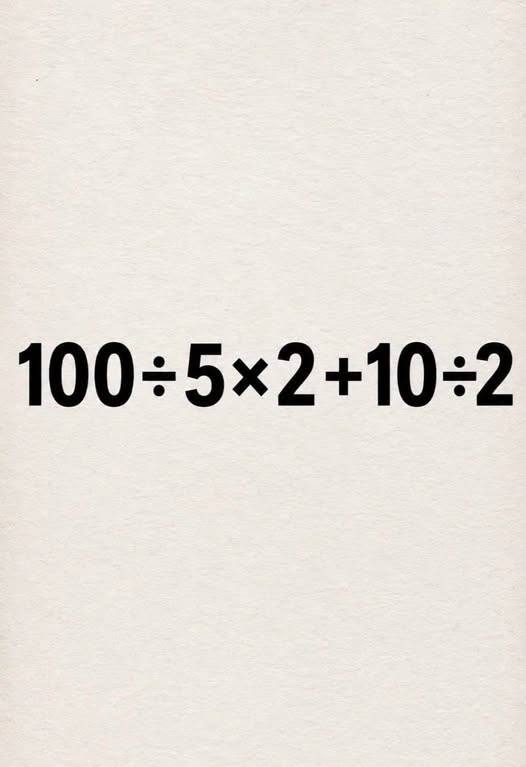
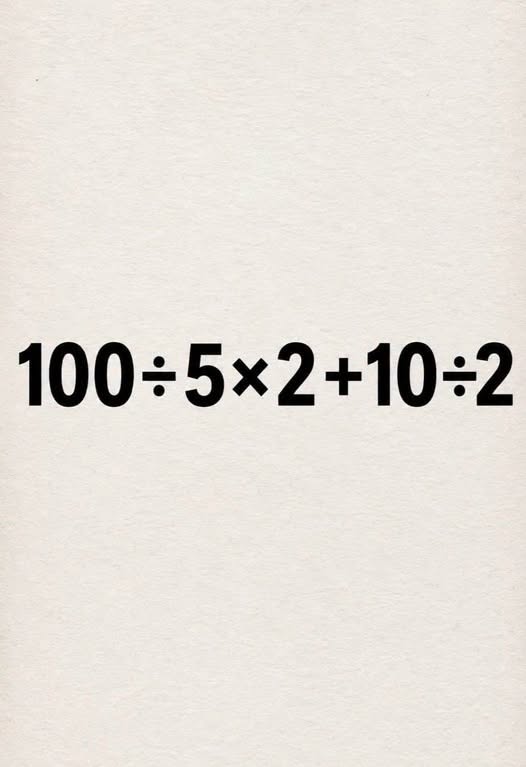
Here is the equation:
Can You Solve This Viral Math Problem?
100 ÷ 5 × 2 + 10 ÷ 2 = ?
Take a moment before reading further.
What answer comes to mind?
Some people rush through the calculation and arrive at a result they believe is obvious.
Others pause because they remember a classroom rule about multiplication and division.
And that’s where the disagreement begins.
The challenge isn’t really about difficult arithmetic.
It’s about knowing the correct order in which mathematical operations must be performed.
If you follow the rules carefully, the answer is unambiguous.
But one common misunderstanding can send you in the wrong direction.
Why This Simple Equation Confuses So Many People
Most people learn basic arithmetic at a young age.
Addition, subtraction, multiplication, and division are among the first mathematical skills taught in school.
However, when several operations appear together in a single expression, the order in which they are performed becomes essential.
Consider the difference between these two expressions:
10 + 5 × 2
and
(10 + 5) × 2
They contain the same numbers and operations.
But they produce different results.
The first expression equals 20 because multiplication is performed before addition.
The second equals 30 because parentheses require us to calculate the addition first.
This illustrates an important mathematical principle:
The order of operations determines the result.
And in the viral equation, that principle is everything.
Understanding the Order of Operations
Before solving the puzzle, let’s review one of the most important rules in arithmetic.
In many English-speaking classrooms, students learn the acronym PEMDAS.
It stands for:
- P — Parentheses
- E — Exponents
- M — Multiplication
- D — Division
- A — Addition
- S — Subtraction
In other countries, students may learn BODMAS or BIDMAS.
These acronyms communicate essentially the same mathematical convention.
However, there’s a detail that is often misunderstood.
Multiplication and division have equal priority.
Similarly, addition and subtraction have equal priority.
That means you don’t automatically perform every multiplication before every division.
Instead, when multiplication and division appear together, you calculate them from left to right.
This single rule is the key to solving the viral puzzle.
Step-by-Step Solution to 100 ÷ 5 × 2 + 10 ÷ 2
Let’s work through the expression carefully.
Our starting equation is:
100 ÷ 5 × 2 + 10 ÷ 2
Step 1: Start With the First Division
The first operation is:
100 ÷ 5 = 20
Now substitute the result back into the expression:
20 × 2 + 10 ÷ 2
Step 2: Perform the Multiplication
Moving from left to right among multiplication and division operations, we encounter:
20 × 2 = 40
The expression becomes:
40 + 10 ÷ 2
Step 3: Complete the Remaining Division
Next:
10 ÷ 2 = 5
Now the equation is:
40 + 5
Step 4: Add the Final Numbers
Finally:
40 + 5 = 45
<text></text>
The correct answer is 45.
The calculation can also be summarized as:
100 ÷ 5 × 2 + 10 ÷ 2
= 20 × 2 + 5
= 40 + 5
= 45
There is no need for advanced mathematics.
The entire problem depends on applying the standard order of operations correctly.
Why Some People Get 15 Instead
One of the most common incorrect answers is 15.
How does that happen?
Some people remember the acronym PEMDAS and mistakenly assume that multiplication must always happen before division.
They look at:
100 ÷ 5 × 2
And perform:
5 × 2 = 10
Then they calculate:
100 ÷ 10 = 10
After completing the final division, they add:
10 + 5 = 15
This gives an answer of 15.
But the reasoning is incorrect.
The expression 100 ÷ 5 × 2 does not mean 100 ÷ (5 × 2).
Those are two different mathematical expressions.
The parentheses change the meaning.
Without parentheses, division and multiplication are evaluated from left to right.
Therefore:
100 ÷ 5 × 2 = 40
Not 10.
This is the central mistake behind much of the confusion.
Does Multiplication Come Before Division?
This question causes more confusion than almost any other aspect of elementary arithmetic.
Many students memorize PEMDAS without fully understanding how operations of equal priority work.
Because the letter M appears before D, they assume multiplication always comes first.
But that’s not what the rule means.
Multiplication and division belong to the same priority level.
Let’s look at another example:
24 ÷ 4 × 3
If you calculate from left to right:
24 ÷ 4 = 6
6 × 3 = 18
So the answer is 18.
But if you multiply 4 × 3 first, you get:
24 ÷ 12 = 2
That is incorrect for the original expression.
The difference is significant.
The same principle applies to the viral equation.
PEMDAS vs. BODMAS: Do They Give Different Answers?
You may have seen arguments online suggesting that PEMDAS and BODMAS produce different results.
This is a misconception.
Both systems describe the same underlying mathematical conventions.
PEMDAS is commonly taught in the United States.
BODMAS is frequently used in the United Kingdom and other countries.
BODMAS stands for:
- Brackets
- Orders
- Division
- Multiplication
- Addition
- Subtraction
Notice that division appears before multiplication in BODMAS.
Does that mean division always takes priority?
No.
Just as PEMDAS does not place multiplication above division, BODMAS does not place division above multiplication.
Both operations share the same level of precedence.
When they occur in sequence, they are evaluated from left to right.
Therefore, whether you use PEMDAS, BODMAS, or BIDMAS, the correct answer remains:
45
Why Left-to-Right Calculation Matters
The left-to-right rule is sometimes called associativity.
For multiplication and division in a sequence, the conventional interpretation is to evaluate operations of equal precedence from left to right.
This matters because division is not generally associative.
For example:
(100 ÷ 5) ÷ 2 = 10
But:
100 ÷ (5 ÷ 2) = 40
The placement of parentheses changes the grouping and therefore changes the result.
Similarly:
(100 ÷ 5) × 2 = 40
While:
100 ÷ (5 × 2) = 10
Without parentheses, the original sequence is interpreted using the standard left-to-right convention.
That’s why mathematical notation matters.
It isn’t simply about which numbers appear.
It’s about how the expression is structured.
Why Viral Math Puzzles Generate So Many Comments
Mathematical puzzles are especially effective on social media because they encourage immediate participation.
Unlike complicated trivia questions, a basic arithmetic problem feels accessible.
Almost everyone has studied multiplication and division.
That makes people confident enough to share their answers.
But when other commenters disagree, curiosity takes over.
A person who believes the answer is 15 may be surprised to see hundreds of people answering 45.
Someone who calculates 45 may wonder why so many others disagree.
The result is a lively debate.
These puzzles also trigger a natural desire to prove that we remember what we learned in school.
And because the solution can be checked quickly, they encourage repeated calculations and discussions.
Why Smart People Still Make Arithmetic Mistakes
Getting a viral math puzzle wrong doesn’t mean someone lacks intelligence.
Even people with strong mathematical skills can make mistakes when solving problems quickly.
There are several reasons.
Rushing Through the Calculation
When an expression looks easy, people may skip steps.
That makes it easier to overlook the order of operations.
Relying on an Incomplete Memory of PEMDAS
Remembering the acronym without understanding equal precedence can lead to incorrect results.
Mental Calculation Errors
Working entirely in your head can increase the chance of making a small mistake.
Following Other People’s Answers
Social media comments can influence how people interpret a problem.
If the first several comments confidently give the same answer, others may assume it must be correct.
Misreading the Expression
A person may accidentally interpret the equation as though it contains parentheses that are not actually there.
The best solution is simple: slow down and calculate one step at a time.
A Simple Trick to Avoid Order-of-Operations Mistakes
Whenever you see a mathematical expression containing several operations, follow this method.
First, look for parentheses or brackets.
Second, calculate any exponents.
Third, perform multiplication and division from left to right.
Finally, perform addition and subtraction from left to right.
Don’t try to solve the entire expression mentally in one jump.
Instead, rewrite it after each step.
For the viral equation, that means:
100 ÷ 5 × 2 + 10 ÷ 2
Then:
20 × 2 + 10 ÷ 2
Then:
40 + 5
And finally:
45
Writing the intermediate steps makes the logic much easier to follow.
Can a Calculator Give the Wrong Answer?
A correctly functioning calculator should produce the mathematically appropriate result when the expression is entered using standard algebraic input rules.
However, not all calculators process input in exactly the same way.
Some basic calculators perform calculations sequentially as buttons are pressed.
Others use algebraic order of operations.
This can create confusion if you enter a long expression without checking how the calculator handles operator precedence.
For this problem, a scientific calculator or a calculator that follows standard mathematical precedence should return 45.
If a calculator produces a different result, check the input, settings, and whether the device uses immediate execution.
It’s also useful to verify the calculation manually.
Understanding the mathematical rule is more valuable than simply trusting a displayed number.
Try These Five Similar Math Challenges
Now that you’ve solved the viral equation, test your understanding with a few more examples.
Challenge 1
60 ÷ 3 × 2 + 5 = ?
Solution:
60 ÷ 3 = 20
20 × 2 = 40
40 + 5 = 45
Answer: 45
Challenge 2
80 ÷ 4 × 3 − 10 = ?
Solution:
80 ÷ 4 = 20
20 × 3 = 60
60 − 10 = 50
Answer: 50
Challenge 3
12 + 18 ÷ 3 × 2 = ?
Solution:
18 ÷ 3 = 6
6 × 2 = 12
12 + 12 = 24
Answer: 24
Challenge 4
90 ÷ 3 × 2 + 20 ÷ 5 = ?
Solution:
90 ÷ 3 = 30
30 × 2 = 60
20 ÷ 5 = 4
60 + 4 = 64
Answer: 64
Challenge 5
50 − 20 ÷ 4 × 3 = ?
Solution:
20 ÷ 4 = 5
5 × 3 = 15
50 − 15 = 35
Answer: 35
If you solved all five correctly, you’ve demonstrated a solid understanding of how multiplication and division interact.
What This Puzzle Teaches Us About Mathematics
The viral equation is more than a quick arithmetic challenge.
It highlights the importance of mathematical conventions.
In everyday life, we rely on agreed-upon rules to interpret numbers correctly.
Engineers use mathematical expressions to design structures.
Scientists rely on equations to describe physical phenomena.
Accountants use formulas to analyze financial information.
Computer programmers write expressions that must be evaluated according to defined rules.
In all these situations, order matters.
A misplaced parenthesis or incorrectly interpreted operation can change a result dramatically.
Learning the order of operations is therefore not just a classroom exercise.
It’s part of understanding the language of mathematics.
Frequently Asked Questions
What Is the Correct Answer to 100 ÷ 5 × 2 + 10 ÷ 2?
The correct answer is 45.
Why Isn’t the Answer 15?
Getting 15 usually involves multiplying 5 × 2 before performing 100 ÷ 5. That incorrectly treats multiplication as having higher precedence than division.
Does PEMDAS Mean Multiplication Always Comes Before Division?
No. Multiplication and division have equal precedence and are evaluated from left to right.
Is BODMAS Different From PEMDAS?
The acronyms use different terminology and ordering of letters, but they represent the same standard mathematical conventions.
Should Addition Be Done Last?
In this particular equation, yes. Multiplication and division are completed before addition.
Does the Equation Need Parentheses?
No. The expression is well-defined under standard order-of-operations rules. Parentheses could be added for clarity, but they are not necessary.
Can Different Calculators Show Different Results?
Some basic calculators use immediate-execution behavior rather than standard algebraic precedence. Scientific calculators generally follow conventional order-of-operations rules.
Why Are Math Problems Like This So Popular Online?
They are short, accessible, and often reveal common misunderstandings, making them ideal for discussion and debate.
Final Answer: Did You Get It Right?
Let’s return to the original viral puzzle one final time.
100 ÷ 5 × 2 + 10 ÷ 2
Following the standard order of operations:
100 ÷ 5 = 20
20 × 2 = 40
10 ÷ 2 = 5
40 + 5 = 45
<text></text>
The Correct Answer Is 45!
The secret is remembering that multiplication and division have equal priority.
You work through them from left to right before completing the addition.
It’s a simple rule, but forgetting it can completely change the answer.
And that’s why this little equation has managed to create such a big debate.
Now it’s your turn: Did you get 45 on your first attempt, or did another answer come to mind?
Share your answer in the comments and challenge your friends to solve it without using a calculator!