Imagine looking out of your window on a windy morning and seeing something unusual spinning above your roof.
It isn’t a giant wind turbine towering over a field.
It’s a compact turbine mounted directly on the house, generating electricity just a few metres above where your family lives.
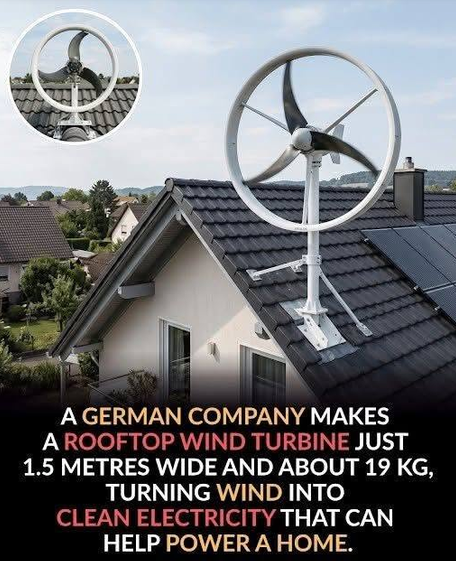
Images of small rooftop wind turbines have been circulating online with an exciting promise: a turbine roughly 1.5 metres wide and light enough for a residential roof could turn everyday wind into clean electricity for your home.
The basic technology is real. Small wind turbines can generate renewable electricity for homes, and building-mounted systems do exist. But there’s an important difference between helping power a home and producing enough electricity to power an entire home consistently.
Whether a small turbine is worthwhile depends heavily on wind speed, location, turbulence, turbine performance, installation, local regulations, and the amount of electricity your household consumes.
Here’s how residential wind power actually works — and what homeowners should know before getting excited about putting a turbine on the roof.
How Does a Small Home Wind Turbine Work?
The basic principle is surprisingly straightforward.
Moving air contains kinetic energy.
When wind passes across the turbine, it causes the blades or rotor to spin. That rotational motion drives a generator, producing electrical energy.
A residential system may also include controllers, an inverter, wiring, batteries, and grid-connection equipment depending on how the installation is designed.
In a grid-connected home, electricity generated by the turbine can reduce the amount of electricity the household needs to draw from the grid.
When there’s little or no wind, the home continues drawing electricity from the grid.
If the turbine generates more electricity than the home is using, an appropriately configured system may export excess electricity to the grid, depending on local rules and utility arrangements.
Yes, Residential Wind Turbines Really Exist
Home wind generation isn’t futuristic technology.
The U.S. Department of Energy describes residential distributed wind systems ranging from small units of a few hundred watts to turbines of tens of kilowatts. Turbines used near homes are commonly in the 1–10 kW range, although systems can be larger.
In the UK, the Energy Saving Trust describes two broad categories of domestic wind turbines:
Pole-mounted turbines, which are freestanding and generally perform best in large, exposed spaces.
And building-mounted turbines, which are smaller and can be installed on a home.
So the concept shown in the viral image is entirely plausible.
The more complicated question is how much electricity such a compact rooftop system can actually generate.
Can a Small Rooftop Turbine Power an Entire House?
Possibly in some circumstances — but don’t assume that a compact turbine will eliminate your electricity bill.
Wind-turbine output varies dramatically with the wind resource.
According to the U.S. Department of Energy’s Small Wind Guidebook, a turbine in roughly the 5–15 kW range may be required to make a significant contribution to the electricity demand of a typical U.S. home, depending on average wind speed and consumption.
That’s much larger than many miniature rooftop turbines.
A smaller unit can still produce useful electricity.
But “helps power a home” and “powers the home” are very different claims.
Rated Power Can Be Misleading
Suppose you see a turbine advertised as:
2 kW
It’s tempting to think:
2 kW × 24 hours = 48 kWh every day.
Unfortunately, that’s not how wind generation works.
The rated output is achieved under particular wind conditions.
Real wind speeds constantly change.
Sometimes the turbine will produce close to its rated output.
Sometimes it will produce considerably less.
And sometimes the wind will be too weak for meaningful generation at all.
What matters to homeowners is not simply the maximum number printed on the turbine.
It’s the expected annual energy production at their actual site.
Wind Speed Makes an Enormous Difference
Wind contains more energy as its speed increases.
This makes location extremely important.
A turbine installed in a consistently windy coastal or rural location may produce dramatically more electricity than the same turbine installed between houses in a sheltered suburban neighborhood.
The Department of Energy emphasizes that a small wind system makes sense only when there is an adequate wind resource at the site.
Energy Saving Trust similarly says domestic wind turbines work best in exposed, windy locations and are less suitable for sheltered or heavily built-up areas.
That means you shouldn’t buy a turbine simply because your neighborhood occasionally feels windy.
A proper site assessment matters.
The Hidden Problem With Rooftops: Turbulence
This is the part viral posts usually leave out.
Buildings disrupt airflow.
When wind hits a roof, wall, chimney, tree, or neighboring building, the smooth airflow can become turbulent.
Instead of receiving a consistent stream of air, the turbine may experience rapidly changing wind speed and direction.
And that’s bad for both performance and equipment.
The U.S. Department of Energy specifically warns that rooftop locations can experience increased turbulence, which may reduce electricity production and shorten turbine life.
This is one reason a turbine that looks impressive spinning rapidly on a roof doesn’t necessarily generate impressive amounts of electricity over an entire year.
Rooftop Wind Turbines Can Also Create Vibration and Noise
A wind turbine contains moving mechanical components.
Those components generate vibration.
When the turbine is attached directly to a building, some vibration can be transferred into the structure.
The Department of Energy notes that rooftop-mounted turbines can transmit vibration into the building, potentially creating noise problems.
That doesn’t mean every rooftop turbine will make a house unbearable.
Modern engineering can incorporate vibration isolation and other measures.
But it does mean installation shouldn’t be treated like mounting a television antenna.
The roof and mounting system need to handle the turbine’s weight and the dynamic forces created by wind and rotation.
Structural Assessment Matters
A turbine may weigh only a few dozen kilograms, but its static weight isn’t the whole engineering problem.
Wind pushes against the turbine.
The rotor spins.
The mounting structure experiences repeated loads.
Storms can dramatically increase those forces.
Before installing any rooftop turbine, a qualified installer or structural professional may need to determine whether the roof and supporting structure are appropriate.
A viral image cannot answer that question for your particular house.
Why Freestanding Turbines Often Perform Better
There’s a reason many successful residential wind installations use tall towers rather than roofs.
Higher installations can reach stronger, cleaner airflow above surrounding obstacles.
The Department of Energy’s guidebook gives a general siting rule of placing the bottom of the turbine rotor at least 30 feet (about 9 metres) above obstacles within roughly 300 feet (90 metres).
That’s obviously difficult to achieve with a tiny turbine sitting just above roof level in a dense neighborhood.
A freestanding tower can place the rotor much farther away from the turbulent air surrounding houses and trees.
That can significantly improve production.
Turbulence Can Reduce Annual Output
This isn’t merely theoretical.
DOE guidance notes that turbulence can reduce estimated annual energy output by roughly 15–25% in small-wind situations compared with expectations based on low-turbulence power-curve testing.
And actual performance varies enormously from one site to another.
That’s why where you put the turbine can matter almost as much as which turbine you buy.
Small Wind Can Work Extremely Well in the Right Location
None of these limitations mean residential wind power is a bad idea.
At an excellent site, it can be remarkably productive.
Energy Saving Trust documents one example from the windy Shetland Islands where a homeowner installed a 6 kW wind turbine. The reported average annual generation was around 17,320 kWh across the years cited in the case study.
That’s an exceptional illustration of the importance of location.
Put a good turbine in a strong, consistent wind resource and the results can be impressive.
Put the same technology in a sheltered urban garden surrounded by tall buildings and trees, and the economics may look completely different.
What Happens When the Wind Stops?
The lights don’t suddenly go out — assuming you’re connected to the electricity grid.
When the turbine isn’t producing enough electricity, the home draws the remaining electricity from the grid.
A battery can also be incorporated into some systems to store excess renewable electricity for later use.
This is similar to the concept behind solar-plus-battery systems.
Wind can also complement solar surprisingly well in certain climates.
Solar generation is naturally strongest during sunny periods.
Wind may sometimes be stronger at night or during cloudy and stormier seasons.
A hybrid renewable-energy system can therefore combine:
Solar panels + wind turbine + battery storage + grid connection.
Whether that combination is financially worthwhile is site-specific.
What About the Solar Panels Shown in the Picture?
Combining rooftop solar with wind sounds attractive because you’re harvesting two renewable resources.
And technically, hybrid systems are possible.
DOE notes that residential wind systems can be integrated with photovoltaic panels, battery storage, and power converters.
But don’t assume that adding a rooftop wind turbine automatically makes every solar home better.
Solar panels are comparatively straightforward because sunlight on an unobstructed roof is easier to predict than highly turbulent urban wind.
The wind turbine still needs its own feasibility assessment.
How Much Electricity Will a Home Turbine Generate?
There’s no meaningful universal answer.
Annual generation depends on factors including:
- Turbine size
- Rotor diameter
- Power curve
- Average wind speed
- Wind-speed distribution
- Tower or mounting height
- Nearby trees
- Nearby buildings
- Terrain
- Turbulence
- Equipment efficiency
- Downtime and maintenance
This is why buying a turbine based solely on its advertised maximum wattage can lead to disappointment.
Ask for an estimate of annual energy production in kWh at your site’s expected wind conditions.
That number is much more useful.
Don’t Judge a Turbine by How Fast It Spins
A rapidly spinning rotor looks impressive in a video.
But spinning doesn’t necessarily mean high electricity production.
A turbine may begin rotating in relatively light wind while producing only a small amount of power.
Output generally rises as wind becomes stronger until the turbine reaches its operating limits.
So a viral clip showing a small turbine spinning continuously doesn’t tell you how much useful energy it produced that day.
You need actual metered generation data.
Is a Rooftop Wind Turbine Better Than Solar Panels?
For many homes, especially in urban and suburban areas, solar may be easier to deploy effectively.
But there is no universal winner.
Wind can be excellent where:
- Average wind speeds are strong
- The property is exposed
- Obstacles are limited
- A tall tower can be installed
- Local planning rules permit it
Solar can be attractive where:
- The roof receives good sunlight
- Shading is limited
- Wind conditions are poor or turbulent
- Installing a wind tower isn’t practical
Energy Saving Trust specifically notes that wind turbines are best suited to homes with sufficient space and consistent wind speeds.
For some properties, a combination of both technologies may make sense.
Do You Need Planning Permission?
Possibly.
Wind turbines can be subject to local rules involving:
- Height
- Property boundaries
- Noise
- Visual impact
- Structural safety
- Grid connection
- Electrical standards
- Heritage areas
- Neighboring properties
Rules vary considerably by country and municipality.
For example, Energy Saving Trust notes that UK planning requirements vary across England, Scotland, Wales, and Northern Ireland.
Always check your own local requirements before purchasing equipment.
What Should You Check Before Buying a Small Wind Turbine?
Before spending money, answer several important questions.
How windy is my property throughout the year?
Not just during storms — what matters is the long-term wind resource.
Where will the turbine be installed?
A location surrounded by buildings and trees may experience severe turbulence.
What is its certified annual energy performance?
Don’t rely exclusively on maximum wattage.
How much electricity does my household actually use?
Check your electricity bills and calculate annual consumption.
Can my roof safely support the system?
A professional structural assessment may be necessary.
What maintenance will it require?
Turbines contain moving parts and operate outdoors in demanding conditions.
Can it legally connect to the grid?
Electrical and utility requirements vary.
What happens during extremely strong winds?
The turbine should have appropriate safety and overspeed controls.
DOE recommends purchasing small turbines certified to recognized standards for safety, performance, and reliability.
Don’t Fall for the “Powers Your Entire Home” Headline
This is probably the most important takeaway.
A small rooftop turbine can absolutely generate electricity for a home.
But that statement can easily become exaggerated into:
“This tiny turbine powers your entire house for free.”
Those are not equivalent claims.
Whether a turbine supplies 2%, 20%, 80%, or 100% of annual household electricity depends on the turbine, site, wind conditions, and household demand.
Ask for actual annual generation estimates rather than relying on dramatic marketing language.
Are Rooftop Wind Turbines the Future?
Small wind technology certainly has a role in distributed renewable energy.
Better generators, controls, power electronics, monitoring systems, and hybrid renewable systems continue to make small-scale generation interesting.
But physics remains physics.
A turbine needs sufficient wind energy.
No clever design can completely eliminate the importance of siting.
For a rural home on an exposed hill or a property in a consistently windy coastal area, small wind can be extremely compelling.
For an apartment or suburban house surrounded by taller buildings, rooftop wind may generate much less electricity than expected.
That’s why the most exciting innovation isn’t necessarily the smallest turbine.
It’s a turbine installed in the right place.
The Bottom Line
The viral idea is based on real technology: small residential wind turbines can generate clean electricity and can contribute to powering a home.
But a compact rooftop turbine shouldn’t automatically be viewed as a miniature power station capable of making every house energy-independent.
The U.S. Department of Energy specifically cautions that rooftop turbines can suffer from turbulence, lower energy production, vibration, and noise, making them less cost-effective than well-sited tower-mounted systems in many circumstances.
At the same time, domestic wind can perform extremely well in exposed locations with strong, consistent wind.
So before buying one, don’t ask only:
“How powerful is the turbine?”
Ask:
“How much electricity will this turbine realistically generate at my property over an entire year?”
That is the number that determines whether a small wind turbine is an exciting piece of technology — or a very expensive object spinning on your roof.