Discovering a lump beneath your skin can be frightening, especially when it appears suddenly on your neck, back, or behind your ear. But does finding a lump mean you have cancer?
The answer is no.
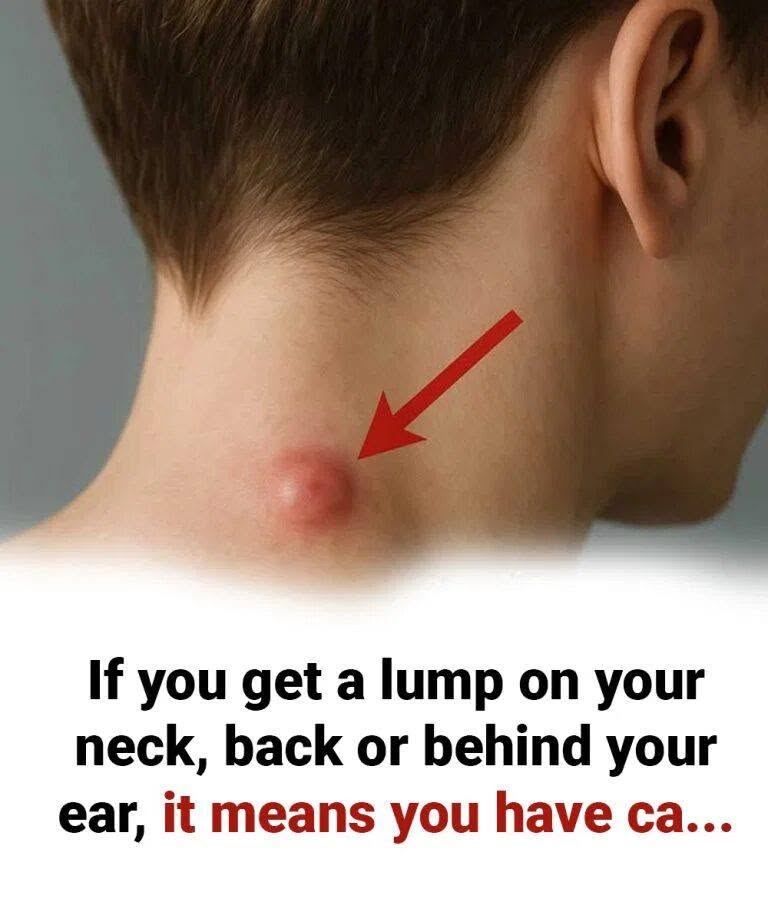
A viral social media image showing a swollen bump on the back of someone’s neck suggests that such lumps may indicate cancer. Although certain lumps can be associated with serious medical conditions, many are caused by common, treatable problems.
Swollen lymph nodes, skin cysts, lipomas, infections, and irritated hair follicles are just a few possible explanations.
The important thing is understanding which characteristics are usually reassuring and which deserve medical attention.
Let’s explore 12 possible causes, how to recognize warning signs, and when you should consult a healthcare professional.
Why Do Lumps Develop Under the Skin?
A lump is an area of swelling or tissue enlargement that can be felt or seen beneath the skin.
Lumps vary considerably.
Some are:
- Small and painless
- Soft and movable
- Firm or rubbery
- Red and tender
- Filled with fluid
- Slow-growing
- Suddenly noticeable
Their appearance depends on what is happening beneath the skin.
For example, a swollen lymph node may develop when the immune system responds to an infection.
A cyst may form when material accumulates inside a small sac beneath the skin.
A lipoma develops from fatty tissue.
Other lumps may originate from salivary glands, muscles, or deeper structures.
The location, size, consistency, duration, and associated symptoms all help determine the possible cause.
However, no single characteristic can reliably diagnose a lump without appropriate examination.
1. Swollen Lymph Nodes
Swollen lymph nodes are among the most common explanations for lumps in the neck and behind the ears.
Lymph nodes are small structures that form part of the immune system.
They help filter lymphatic fluid and participate in the body’s response to infections.
Why Do Lymph Nodes Swell?
When the immune system responds to an infection, nearby lymph nodes may enlarge.
Common triggers include:
- Colds
- Throat infections
- Ear infections
- Dental infections
- Scalp infections
- Certain viral illnesses
What Do Swollen Lymph Nodes Feel Like?
They may feel like small, rounded bumps beneath the skin.
Some are tender and movable.
Others are painless.
Lymph nodes associated with an infection often decrease in size as the illness resolves, although they can remain enlarged for some time.
When Should You Be Concerned?
Seek medical evaluation if a lymph node:
- Continues enlarging
- Persists without a clear explanation
- Feels unusually hard or fixed
- Appears with unexplained fever, night sweats, or weight loss
- Is located above the collarbone
Swollen lymph nodes do not automatically indicate cancer, but persistent unexplained swelling should be assessed.
2. Epidermoid Cysts
An epidermoid cyst is a common, usually benign lump that develops beneath the skin.
These cysts are lined with skin cells and contain keratin, a material naturally produced by the body.
They can appear on the:
- Neck
- Back
- Face
- Scalp
- Trunk
What Does an Epidermoid Cyst Look Like?
It may appear as a smooth, rounded bump.
Sometimes a small central opening, called a punctum, is visible.
The cyst may grow slowly over time.
Many are painless.
However, inflammation or infection can make them red, swollen, and tender.
Should You Squeeze a Cyst?
No.
Squeezing a cyst can cause inflammation, rupture, or infection.
It may also make the lump more difficult to treat.
A healthcare professional can determine whether observation, drainage, or removal is appropriate.
3. Lipomas: Soft Fatty Lumps
A lipoma is a benign growth made of fatty tissue.
Lipomas commonly develop beneath the skin of the back, shoulders, neck, and arms.
Common Characteristics
- Soft or rubbery texture
- Usually painless
- Often movable beneath the skin
- Generally slow-growing
Most lipomas are harmless.
However, not every soft lump is a lipoma.
A new lump should be assessed if its identity is uncertain.
When Does a Lipoma Need Attention?
Medical evaluation is particularly important when a lump is:
- Rapidly growing
- Deep beneath the skin
- Painful
- Firm or fixed
- Approximately 5 centimeters or larger
These characteristics do not necessarily mean cancer, but they may justify imaging or specialist assessment.
4. Boils and Skin Abscesses
A boil is a painful skin infection that often develops around a hair follicle.
An abscess is a localized collection of pus.
These can appear on the neck, back, or other areas of the body.
Common Symptoms
- Redness
- Swelling
- Warmth
- Tenderness
- A raised bump
- Sometimes visible pus
Unlike many harmless cysts or lipomas, an abscess often develops relatively quickly and becomes painful.
What Should You Do?
Avoid squeezing, puncturing, or cutting the lump yourself.
Small superficial boils may sometimes improve with warm, moist compresses, but larger or worsening abscesses may require medical drainage.
Antibiotics are sometimes necessary, depending on the infection.
Seek prompt care if redness spreads, fever develops, or the swelling is severe.
5. Ingrown Hairs and Folliculitis
Sometimes a lump is caused by inflammation around a hair follicle.
Folliculitis occurs when hair follicles become inflamed, sometimes because of infection.
Ingrown hairs develop when hair curls or grows back into the skin.
These problems may occur after shaving or from friction.
What Do They Look Like?
- Small red bumps
- Tender spots
- Pimple-like lesions
- Occasionally pus-filled bumps
They are often superficial and may improve with gentle skin care.
Avoid repeatedly shaving irritated areas or trying to dig out an ingrown hair with sharp objects.
Persistent, spreading, or recurrent inflammation should be evaluated.
6. Acne Nodules and Inflamed Skin Lesions
Acne can affect the face, neck, shoulders, and back.
Some forms of acne produce deep, inflamed bumps called nodules.
These can feel like firm lumps beneath the skin.
Possible Features
- Tenderness
- Redness
- Multiple nearby acne lesions
- Recurrent flare-ups
- Scarring in more severe cases
Deep acne lesions should not be squeezed.
A dermatologist can recommend appropriate treatment when acne is persistent, painful, or causing scars.
7. Lumps Behind the Ear Caused by Infection
A bump behind the ear may sometimes be related to nearby inflammation or infection.
The lymph nodes behind the ears can react to infections affecting the scalp, ear, or surrounding skin.
Possible Associated Symptoms
- Ear pain
- Scalp irritation
- Recent infection
- Tenderness behind the ear
- Swelling of nearby lymph nodes
Most causes are not emergencies.
However, an important condition to recognize is mastoiditis.
What Is Mastoiditis?
Mastoiditis is an infection involving the mastoid bone behind the ear.
It can sometimes develop as a complication of a middle ear infection.
Possible symptoms include:
- Pain and swelling behind the ear
- Redness
- Fever
- Ear discharge
- The ear appearing pushed outward
Suspected mastoiditis requires urgent medical assessment.
It is not something to treat with home remedies.
8. Salivary Gland Swelling
Not every lump near the jaw or ear is a lymph node.
Salivary glands produce saliva and help keep the mouth moist.
The parotid glands are located near the ears and jaw.
Swelling may develop because of:
- Salivary stones
- Infections
- Inflammation
- Other gland disorders
- Less commonly, tumors
Possible Symptoms
- Swelling near the jaw or ear
- Pain while eating
- Dry mouth
- Tenderness
- Recurrent swelling
A clinician may examine the area and recommend ultrasound or other testing if needed.
Persistent salivary gland swelling should not be ignored.
9. Skin Irritation and Insect Bites
An insect bite can produce a localized raised bump.
Some bites cause significant swelling, particularly in sensitive individuals.
Common Features
- Itching
- Redness
- Mild tenderness
- Sudden appearance
- A possible central puncture mark
Many uncomplicated bites improve with time.
However, spreading redness, increasing pain, pus, or fever may indicate infection.
Seek emergency care if swelling occurs with difficulty breathing, throat tightness, or other signs of a severe allergic reaction.
10. Enlarged Thyroid Gland or Thyroid Nodules
A lump in the front of the neck may originate from the thyroid gland.
The thyroid is a butterfly-shaped gland located in the lower front of the neck.
It produces hormones involved in regulating metabolism.
What Is a Thyroid Nodule?
A thyroid nodule is a growth within the thyroid gland.
Most thyroid nodules are benign.
Some are discovered during routine examinations or imaging performed for other reasons.
Possible Symptoms
Many thyroid nodules cause no symptoms.
Larger nodules may sometimes cause:
- Visible swelling in the front of the neck
- A sensation of pressure
- Difficulty swallowing
- Voice changes
A healthcare professional may recommend thyroid ultrasound and, in selected cases, additional testing.
A new or persistent thyroid-area lump deserves evaluation.
11. Enlarged Lymph Nodes Related to More Serious Conditions
Although infections are a frequent cause of enlarged lymph nodes, persistent swelling can occasionally be associated with more serious conditions.
These include certain inflammatory diseases and cancers such as lymphoma.
What Is Lymphoma?
Lymphoma is a cancer involving lymphocytes, a type of immune cell.
It can cause enlarged lymph nodes in the neck, armpits, groin, or other areas.
Possible associated symptoms include:
- Persistent painless lymph node enlargement
- Unexplained weight loss
- Drenching night sweats
- Unexplained fever
- Fatigue
These symptoms can also occur with noncancerous illnesses.
Having one symptom does not mean someone has lymphoma.
However, a persistent unexplained lump with these features should be assessed promptly.
12. Other Tumors and Rare Causes
A small proportion of lumps may represent tumors arising from skin, soft tissue, lymph nodes, or other structures.
Some tumors are benign.
Others are malignant.
For example, a persistent neck mass in an adult may occasionally be associated with cancer of the head and neck.
A growing lump on the back or elsewhere could rarely be related to a soft-tissue tumor.
Why Early Evaluation Matters
Some serious conditions are easier to treat when identified early.
That is why clinicians pay attention to lumps that:
- Persist without explanation
- Continue to enlarge
- Are firm and fixed
- Are associated with unexplained systemic symptoms
- Cause difficulty swallowing, breathing, or speaking
The goal of medical evaluation is not to assume the worst.
It is to identify the cause accurately.
How Can You Tell Whether a Lump Is Serious?
No home examination can definitively distinguish a harmless lump from a dangerous one.
However, certain features can help determine how urgently medical advice is needed.
| Lump characteristic | What it may suggest |
|---|---|
| Soft and movable | Often seen with benign lumps, but not diagnostic |
| Red, warm, and painful | Possible inflammation or infection |
| Slowly growing beneath the skin | May occur with cysts or lipomas |
| Firm, fixed, or progressively enlarging | Requires medical assessment |
| Swelling after a cold | May reflect reactive lymph nodes |
| Persistent unexplained adult neck lump | Should be evaluated |
| Lump with fever or spreading redness | Possible infection requiring prompt care |
| Lump with unexplained weight loss or night sweats | Needs medical assessment |
Even a painless lump can require attention.
Pain alone is not a reliable way to determine whether a lump is harmless.
The Viral Claim: Does a Lump Mean You Have Cancer?
The viral image suggests that a lump on the neck, back, or behind the ear automatically points to cancer.
This is misleading.
Many such lumps are caused by benign or treatable conditions.
For example:
- A swollen lymph node may follow a cold.
- A cyst may develop from skin structures.
- A lipoma may grow slowly beneath the skin.
- A boil may result from a localized infection.
But the opposite extreme is also unhelpful.
You should not assume that every lump is harmless.
A new, persistent, or changing lump deserves appropriate evaluation, especially when no clear cause is apparent.
The photograph alone cannot establish whether the bump shown is a cyst, abscess, swollen lymph node, or another condition.
What Does a Cancerous Lump Feel Like?
This is a common question, but there is no single answer.
Some cancer-related lumps may feel firm, irregular, or fixed to surrounding tissues.
Others may not have these characteristics.
Likewise, benign lumps can sometimes feel firm.
Cancer cannot be diagnosed by touching a lump alone.
A clinician may need to examine it, review the medical history, and order tests.
Depending on the situation, these may include ultrasound, other imaging, or a biopsy.
When Should You See a Doctor?
Arrange medical evaluation if you notice:
- A new neck lump without an obvious cause
- A lump that persists beyond approximately two weeks
- A lump that continues growing
- A hard or fixed lump
- A lump near or above the collarbone
- Persistent swelling behind the ear
- Unexplained weight loss
- Drenching night sweats
- Persistent unexplained fever
- A lump that repeatedly becomes inflamed
An unexplained adult neck mass persisting for two weeks or more should be assessed rather than simply watched indefinitely.
If you are unsure how long it has been present, seek advice.
When Is Urgent Care Necessary?
Seek urgent medical attention if the lump is accompanied by:
- Rapidly spreading redness
- Severe pain
- High fever
- Significant swelling behind the ear with ear symptoms
- Rapid enlargement
- Difficulty swallowing
- Increasing neck swelling
Seek emergency care immediately for difficulty breathing, rapidly progressing throat or neck swelling, or inability to swallow saliva.
These symptoms can indicate a serious condition.
How Do Doctors Diagnose a Lump?
A healthcare professional usually begins with a physical examination.
They may ask:
- When did the lump appear?
- Has it grown?
- Is it painful?
- Have you recently been ill?
- Have you noticed fever or weight changes?
- Are there any skin changes?
- Do you have difficulty swallowing?
The next steps depend on the findings.
1. Physical Examination
The clinician checks the lump’s size, location, tenderness, and mobility.
They may also examine nearby lymph nodes, the ears, mouth, throat, or skin.
2. Ultrasound
Ultrasound can help determine whether a lump is fluid-filled, solid, or associated with a particular anatomical structure.
It is often useful for superficial lumps.
3. Blood Tests
Blood tests may be recommended if infection, inflammation, or another medical condition is suspected.
They are not necessary for every lump.
4. Additional Imaging
In some cases, CT or MRI may be needed to evaluate deeper structures.
5. Biopsy or Needle Sampling
If the cause remains uncertain or concerning features are present, a clinician may recommend obtaining a tissue or cell sample.
This can help establish a diagnosis.
Can You Treat a Lump at Home?
Treatment depends entirely on the cause.
Some small, uncomplicated skin lesions improve without medical procedures.
But there is no universal home remedy for all lumps.
What You Can Do Safely
- Keep the surrounding skin clean.
- Avoid squeezing or puncturing the lump.
- Note when it appeared.
- Monitor whether it changes in size.
- Seek medical advice for concerning symptoms.
For a small superficial boil, a warm, moist compress may sometimes provide comfort.
However, do not apply intense heat or attempt to drain an abscess yourself.
Never try to cut open, squeeze, or remove an unidentified lump at home.
Doing so can cause infection, bleeding, or tissue damage.
7 Common Mistakes People Make When They Find a Lump
1. Assuming It Must Be Cancer
This can create unnecessary fear.
Many lumps are benign.
2. Assuming It Can Never Be Serious
Persistent or unusual lumps should not be ignored.
3. Squeezing the Lump Repeatedly
This can worsen irritation or inflammation.
4. Using Harsh Home Remedies
Applying irritating chemicals or attempting to burn away a lump can damage the skin.
5. Taking Antibiotics Without Medical Advice
Not every lump is caused by a bacterial infection.
6. Waiting Months Despite Warning Signs
Delaying evaluation can postpone appropriate treatment.
7. Trying to Diagnose the Lump From Internet Photos
Many conditions look similar.
A photograph cannot replace a medical examination.
How Long Should a Swollen Lymph Node Last?
Lymph nodes may enlarge during an infection and gradually shrink as the illness resolves.
Some remain slightly enlarged for a while.
However, duration alone cannot determine the cause.
If a neck lump persists for approximately two weeks without a clear explanation, continues growing, or has concerning features, seek medical evaluation.
Children and adults may require different assessment approaches.
Do not assume that a lump is harmless simply because it has been present for a long time.
Lumps in Children vs. Adults
The possible causes of neck lumps vary with age.
In Children
Reactive lymph nodes associated with infections are common.
Other possibilities include congenital cysts and localized infections.
Persistent, enlarging, or unusual lumps should be evaluated by a pediatric healthcare professional.
In Adults
Infections and benign conditions remain common explanations.
However, persistent unexplained neck masses deserve particular attention because the range of possible causes includes more serious conditions.
The appropriate investigation depends on age, medical history, symptoms, and examination findings.
Frequently Asked Questions
Does a lump on the back of the neck mean cancer?
No. Possible causes include swollen lymph nodes, cysts, lipomas, and infections. A persistent or changing lump should be examined.
What causes a small lump behind the ear?
Common possibilities include reactive lymph nodes, skin cysts, and localized infections.
Is a painless lump dangerous?
Not necessarily. Many harmless lumps are painless, but some serious conditions can also cause painless swelling.
Can stress cause lumps in the neck?
Stress does not directly explain most physical lumps. Muscle tension may cause discomfort or tightness, but a distinct persistent lump should be assessed.
What does a swollen lymph node feel like?
It may feel like a rounded bump beneath the skin. Its size, tenderness, and mobility vary.
Can a cyst turn into cancer?
Most common epidermoid cysts are benign. Rarely, other conditions may resemble cysts, which is why unusual or changing lesions should be evaluated.
Are lipomas dangerous?
Most lipomas are benign, but a new, growing, deep, or unusually firm mass should be assessed.
Should I squeeze a lump to see what’s inside?
No. Squeezing or puncturing it may cause infection or worsen inflammation.
Can a lump disappear without treatment?
Yes, some lumps associated with infections or temporary inflammation resolve. Others persist and may need treatment.
How can I tell whether a lump is a lymph node or a cyst?
Location and examination can provide clues, but ultrasound or other testing may sometimes be needed.
Can a lump behind the ear be caused by an ear infection?
Yes. Nearby lymph nodes can enlarge during an ear infection. Painful swelling behind the ear with fever or the ear pushed outward requires urgent assessment.
When should I worry about a neck lump?
Seek evaluation if it persists, grows, feels hard or fixed, or occurs with unexplained systemic symptoms.
Can a lump be cancer even if it doesn’t hurt?
Yes, although many painless lumps are benign. Pain is not a reliable diagnostic indicator.
What test is used to examine a lump?
Depending on its location and characteristics, a clinician may recommend ultrasound, other imaging, blood tests, or a biopsy.
Final Thoughts: Don’t Panic, but Don’t Ignore Persistent Lumps
Finding a lump on your neck, back, or behind your ear can be unsettling.
But a lump does not automatically mean cancer.
Many are associated with swollen lymph nodes, harmless cysts, lipomas, or treatable skin infections.
The viral warning shown in the image oversimplifies a medical issue that has many possible explanations.
The most useful approach is to pay attention to the lump’s duration, growth, and associated symptoms.
If a lump is new, persistent, enlarging, or accompanied by concerning symptoms, arrange a medical examination.
Avoid squeezing it or relying on homemade treatments.
And remember: only an appropriate clinical assessment can determine what a lump actually is.
Early evaluation provides clarity—and, when treatment is necessary, the opportunity to address the problem promptly.
Medical disclaimer: This article is for educational purposes only and does not replace professional medical advice, diagnosis, or treatment.