Three tiny dots arranged in a triangle might seem like a simple tattoo design. But in certain communities, this small symbol has carried meanings connected to prison culture, personal identity, and life experiences.
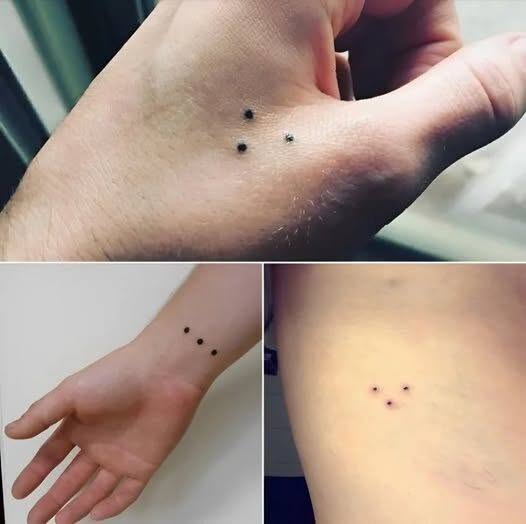
A viral social media post shows several people with three small dots tattooed on their hands and wrists. Its warning is dramatic: “If you see someone with a three-point tattoo, run as far as you can.”
But is this warning actually justified?
The short answer is no.
Although the three-dot tattoo has historically been associated with prison culture and the phrase “mi vida loca,” meaning “my crazy life,” its meaning varies widely.
Some people choose it as a symbol of their past. Others associate it with friendship, spirituality, personal struggles, or simply an attractive minimalist design.
And importantly, a tattoo alone cannot tell you whether someone is dangerous, involved in criminal activity, or connected to a gang.
Let’s explore the history of this mysterious symbol, the different meanings it can carry, and why the viral warning leaves out some important facts.
What Is the Three-Dot Tattoo?
The three-dot tattoo typically consists of three small dots arranged in a triangular pattern.
It is sometimes placed on:
- The hand between the thumb and index finger
- The wrist
- The fingers
- The forearm
- The face or near the eye
- Other parts of the body
The dots may be very small and subtle, or they may be more visible.
Historically, this design has appeared in some prison and street-culture contexts.
However, the same arrangement can also be found in decorative tattoos with no criminal association.
The design itself is too simple to have one universal meaning.
1. The Traditional Meaning: “Mi Vida Loca”
One of the best-known interpretations of the three-dot tattoo is the Spanish phrase:
“Mi vida loca.”
In English, this means:
“My crazy life.”
The expression has been associated with certain street and prison subcultures, particularly in the United States and parts of Latin America.
In those settings, the tattoo may represent a turbulent lifestyle, loyalty to a particular social environment, or experiences involving hardship and risk.
For some individuals, it can reflect a past shaped by violence, incarceration, or difficult circumstances.
However, it is important to understand that this interpretation is not universal.
Not everyone with three dots identifies with the phrase.
And even among people who do, its personal meaning can differ.
2. Is the Three-Dot Tattoo a Gang Symbol?
This is one of the most frequently asked questions.
The three-dot tattoo has appeared in some gang-associated environments, but it is not an exclusive identifier of any one gang.
Unlike certain highly specific symbols, three dots arranged in a triangle are not sufficient to establish membership in a particular organization.
Some people may have received the tattoo while incarcerated.
Others may have adopted it through social circles where the symbol was common.
Still others may have no connection to either setting.
Why Context Matters
Interpreting a tattoo requires more than recognizing a shape.
Meaning can depend on:
- Geographic location
- Cultural background
- The person’s own explanation
- Other accompanying symbols
- The time and circumstances in which the tattoo was made
Even with additional context, assumptions can be wrong.
A tattoo is not proof of someone’s behavior or intentions.
3. Why Is It Sometimes Associated With Prison?
The three-dot tattoo is sometimes discussed in connection with prison tattoo traditions.
In certain correctional environments, small tattoos have historically been used to communicate personal experiences, social connections, or aspects of identity.
Simple designs may have been especially common because they required relatively little space and could be made with limited equipment.
The three-dot design became recognizable in some prison-related contexts.
But this does not mean every person with the tattoo has been incarcerated.
A symbol can spread beyond the environment where it first became widely recognized.
Over time, tattoos move between communities and acquire new meanings.
4. Does the Tattoo Mean Someone Has Committed Three Crimes?
Some viral posts claim that each dot represents a crime, a prison sentence, or an act of violence.
There is no reliable universal rule supporting these interpretations.
The three dots do not automatically represent:
- Three murders
- Three criminal convictions
- Three prison sentences
- Three gang members
- Three violent acts
These claims often circulate online because they sound mysterious or frightening.
But they should not be treated as established facts.
A tattoo cannot function as a criminal record.
5. The Meaning of Three Dots in Different Cultures
Three dots are an extremely simple visual pattern.
That simplicity makes the design open to many interpretations.
Depending on the individual, the dots may represent:
- Three important people
- Three stages of life
- The past, present, and future
- Personal growth
- Friendship
- Faith or spirituality
- A private memory
- A minimalist aesthetic
These are possible personal interpretations, not standardized meanings shared by everyone.
For many tattoo wearers, the design is meaningful precisely because it allows them to define it for themselves.
6. Can Three Dots Represent Faith or Spirituality?
Some people associate groups of three with religious or spiritual ideas.
For example, the number three has symbolic importance in several traditions.
An individual might choose three dots to represent faith, balance, or a personal spiritual concept.
However, a three-dot tattoo is not a universally recognized religious symbol.
It would be inaccurate to assume someone’s beliefs from this tattoo alone.
If a person wishes to share its significance, their explanation is more informative than a general internet interpretation.
7. Why Is the Tattoo Often Placed Near the Thumb?
The area between the thumb and index finger is one of the locations historically associated with the three-dot tattoo.
There are several practical reasons why small hand tattoos may appear there.
The space is visible.
The design fits easily.
And a tiny tattoo can be placed without requiring a large area.
In some cultural settings, placement may contribute to the tattoo’s interpretation.
But the same placement can also be chosen for purely aesthetic reasons.
A hand tattoo does not automatically indicate prison experience or gang membership.
8. What About Three Dots Near the Eye?
Small tattoos near the eye can attract attention because facial tattoos are highly visible.
However, the meaning of a facial tattoo depends on the design, individual, and cultural context.
Different facial tattoo traditions have different histories.
Three dots near the eye should not automatically be confused with other tattoo symbols, such as a teardrop.
Even symbols that have well-known associations can carry different personal meanings.
Appearance alone is not a reliable basis for determining someone’s criminal history.
9. Three Dots vs. Five Dots: What’s the Difference?
People sometimes confuse the three-dot tattoo with the five-dot tattoo.
They are not the same design.
Three-Dot Tattoo
Usually arranged in a triangle.
One historical association is the phrase “mi vida loca.”
Five-Dot Tattoo
In some prison tattoo traditions, five dots arranged like the number five on a die have been interpreted as representing a person surrounded by four walls.
This design is sometimes called a quincunx.
However, the meaning of five dots also varies by location and individual.
Neither symbol should be used alone to make assumptions about someone’s background.
10. Why Do Some People Get the Tattoo After Leaving Prison?
For some individuals, tattoos become permanent reminders of earlier periods in life.
A tattoo received during incarceration may remain long after the person has returned to the community.
It may represent:
- A difficult chapter
- Survival
- A personal transformation
- A past social identity
- A reminder of mistakes
- A commitment to a different future
People change.
Someone who once identified with a particular lifestyle may no longer have any connection to it.
Treating a tattoo as proof of present-day behavior ignores that possibility.
11. Why Has the Three-Dot Tattoo Become Popular Online?
Minimalist tattoos have become increasingly common.
Small dots, lines, shapes, and symbols are often chosen because they are subtle and visually simple.
Social media has also made tattoo imagery more widely accessible.
A person may encounter the three-dot design through fashion photography, tattoo inspiration pages, or friends.
They may choose it without knowing its historical associations.
That doesn’t erase the symbol’s history.
But it does demonstrate why a single design can carry multiple meanings.
12. Why the Viral Warning Is Misleading
The viral image tells viewers to run away if they see someone with a three-dot tattoo.
That message creates fear without establishing a real threat.
It relies on the assumption that a small tattoo identifies a dangerous person.
But there is no sound basis for treating everyone with this design as a safety risk.
A person’s behavior matters far more than a symbol on their skin.
What Actually Indicates a Potential Threat?
Situational warning signs may include:
- Direct threats
- Attempts to intimidate or physically harm someone
- Aggressive behavior that is escalating
- Stalking or harassment
- Possession or threatening use of a weapon
- Refusal to respect clear safety boundaries
These are behaviors and circumstances that may justify taking precautions.
A tattoo by itself is not one of them.
If you feel unsafe because of someone’s actions, move to safety and seek assistance as appropriate.
But there is no reason to fear a stranger solely because of three dots on their hand.
Can a Tattoo Reveal Someone’s Personality?
Not reliably.
Tattoos can express identity, culture, memories, artistic preferences, and personal experiences.
But they do not provide a complete picture of someone’s character.
Two people may have identical tattoos for entirely different reasons.
One might associate the design with a difficult past.
Another might have chosen it to remember three loved ones.
A third might simply like geometric patterns.
The only way to understand the personal meaning is to hear it from the person wearing it.
And nobody is obligated to explain their tattoos to strangers.
Why Tattoo Stereotypes Can Be Harmful
Assuming someone is dangerous because of a tattoo can contribute to unfair treatment.
This may affect:
- Employment opportunities
- Social relationships
- Everyday interactions
- Personal safety
- The way people are treated in public
People with visible tattoos already encounter stereotypes in some environments.
Sharing frightening claims without context can reinforce those assumptions.
Recognizing the historical associations of a tattoo is different from labeling everyone who wears it.
Responsible interpretation requires both accuracy and fairness.
What Should You Do If You Notice a Three-Dot Tattoo?
In most situations, nothing.
There is no reason to react to the tattoo itself.
If the person is behaving normally, treat them as you would anyone else.
If you know them and have a respectful relationship, you may ask about the tattoo’s meaning if it seems appropriate.
But avoid making assumptions.
And if someone behaves in a genuinely threatening way, respond to the behavior rather than the tattoo.
What If You Want to Get a Three-Dot Tattoo?
If you’re considering this design, it’s worth understanding its possible associations before making a permanent decision.
Research Its History
Learn about the contexts in which the symbol has been used.
Think About Placement
A visible hand or facial tattoo may attract more attention than one placed elsewhere.
Consider Possible Misinterpretations
Some people may associate the design with prison culture even if that is not your intention.
Choose a Reputable Tattoo Artist
Professional tattooing practices help reduce the risk of infections and other complications.
Make the Meaning Your Own
If the tattoo represents something personal, consider whether the design communicates what you want it to mean.
Are Three-Dot Tattoos Illegal?
In general, a simple three-dot tattoo is not inherently illegal.
However, laws and institutional policies vary by jurisdiction.
Some workplaces, schools, or other organizations may have rules concerning visible tattoos.
A tattoo’s appearance should not be confused with evidence of criminal conduct.
Can a Three-Dot Tattoo Be Removed?
Yes, some tattoos can be reduced or removed through professional laser treatment.
The effectiveness depends on several factors, including:
- Ink color
- Ink depth
- Tattoo age
- Skin characteristics
- Tattoo size
- Treatment method
Multiple sessions may be necessary.
Complete removal is not always possible, and side effects such as pigment changes or scarring can occur.
Anyone considering removal should consult a qualified professional.
Frequently Asked Questions
What does a tattoo of three dots mean?
One historically recognized meaning is “mi vida loca,” or “my crazy life.” However, the tattoo can also have many other personal or decorative meanings.
Is the three-dot tattoo a gang tattoo?
It has appeared in some gang-associated and prison-related contexts, but it is not an exclusive or reliable indicator of gang membership.
Does a three-dot tattoo mean someone is dangerous?
No. A tattoo alone cannot establish whether someone poses a threat.
Why are the dots arranged in a triangle?
The triangular arrangement is a recognizable version of the design, but there is no single universally accepted explanation for why every wearer chooses it.
What does a three-dot tattoo on the hand mean?
It may carry historical associations with “mi vida loca,” but its meaning depends on the individual.
Does the tattoo mean someone has been to prison?
Not necessarily. Some people with the tattoo have prison-related experiences, while many others do not.
What is the difference between three dots and five dots?
The designs have different historical associations in some prison tattoo traditions. Three dots are often associated with “mi vida loca,” while five dots in a quincunx arrangement may symbolize a person within four walls.
Can women have three-dot tattoos?
Yes. The design is not exclusive to any gender.
Is the tattoo associated with a specific country?
The design has been documented in several cultural contexts, including parts of the United States and Latin America. Its use is not limited to one country.
Does a three-dot tattoo represent three murders?
There is no universal evidence supporting that claim.
Should I avoid someone who has this tattoo?
Not solely because of the tattoo. Judge safety based on behavior and circumstances.
Can someone get the tattoo simply because they like it?
Yes. Some people choose it as a minimalist design without any criminal or prison-related meaning.
Final Thoughts: Three Small Dots Don’t Tell Someone’s Whole Story
The three-dot tattoo is a small design with a complicated history.
In some contexts, it has been associated with prison culture, street life, and the phrase “mi vida loca.”
But it has also taken on other meanings through personal expression, spirituality, friendship, and modern tattoo trends.
The dramatic social media warning telling people to run away from anyone with this tattoo is misleading.
A three-dot tattoo is not proof that someone is dangerous, violent, or involved in a gang.
Symbols can tell stories.
But they rarely tell the whole story.
And the most important thing to remember is that people should be judged by their actions—not by three tiny marks on their skin.
Have you ever seen someone with a three-dot tattoo? Did you know about its historical associations, or did you think it was simply a decorative design?
Editor’s note: This article explains possible cultural and historical associations of the three-dot tattoo. Meanings vary, and no tattoo alone establishes a person’s identity, criminal history, or behavior.