Blackheads can be frustrating.
They often appear on the nose, chin, forehead, and other oily areas of the face, and because they look like tiny dark dots, it’s tempting to scrub, squeeze, or apply a strong household product to make them disappear.
One popular internet remedy is hydrogen peroxide.
You’ll find posts claiming that wiping hydrogen peroxide over the nose will dissolve blackheads, disinfect pores, and leave the skin completely clear.
But should you actually put hydrogen peroxide on blackheads?
For routine blackhead treatment, there are better-supported and more skin-friendly options. Dermatologists recommend ingredients such as salicylic acid and topical retinoids because they address the clogged pores that actually cause blackheads.
Here’s what you should know before trying the viral hydrogen-peroxide trick.
First, What Exactly Is a Blackhead?
A blackhead is a type of acne known medically as an open comedo.
It develops when excess oil and dead skin cells accumulate inside a pore.
As that material builds up, it widens the pore’s opening and becomes exposed to air. A chemical reaction with oxygen causes the material at the surface to darken.
This explains one of the biggest misconceptions about blackheads:
The black material isn’t simply trapped dirt.
So aggressively washing or scrubbing your face won’t necessarily eliminate them.
Why Do Blackheads Commonly Appear on the Nose?
Your face contains many sebaceous glands that produce sebum, the natural oil that helps protect your skin.
The nose and central face can be particularly oily for many people.
When oil combines with dead skin cells and blocks a follicle, a comedo can develop.
Acne commonly affects the face, forehead, chest, upper back, and shoulders because these areas contain many oil glands.
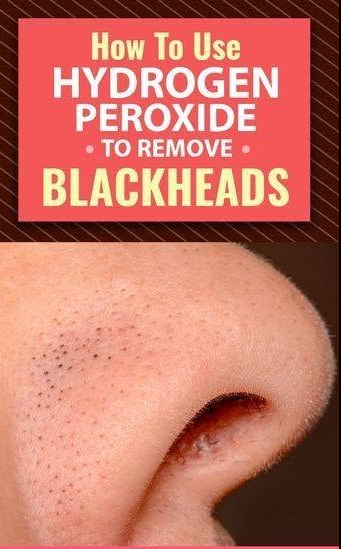
Can Hydrogen Peroxide Remove Blackheads?
Hydrogen peroxide is an oxidizing chemical with disinfecting properties, which is one reason people assume it should work against acne.
But blackheads aren’t simply dirty pores that need to be disinfected.
The underlying problem is a plug of sebum and dead skin cells inside the follicle.
Current American Academy of Dermatology acne guidance recommends evidence-based treatments such as topical retinoids, salicylic acid, benzoyl peroxide, and azelaic acid depending on the type of acne being treated. Hydrogen peroxide isn’t among the standard recommended topical acne therapies in these guidelines.
So there’s little reason to choose a potentially irritating household antiseptic when treatments specifically formulated for acne are available.
Why Hydrogen Peroxide Isn’t My First Choice
Facial skin can be sensitive.
Applying harsh chemicals can lead to irritation, dryness, redness, or disruption of the skin barrier.
And irritation creates another problem: you may start adding more products in an attempt to “fix” the reaction.
That can create a cycle of:
Treatment → irritation → more treatment → more irritation.
For routine blackhead care, choose a product specifically designed and labeled for facial acne instead.
What Actually Works for Blackheads?
Fortunately, blackheads are one of the types of acne that can often respond well to appropriate topical treatment.
Two particularly useful ingredients are salicylic acid and retinoids such as adapalene.
Let’s look at each one.
1. Salicylic Acid
Salicylic acid is widely available in:
- Facial cleansers
- Gels
- Lotions
- Leave-on treatments
- Acne products
The American Academy of Dermatology notes that salicylic acid helps unclog pores and exfoliate the skin and works particularly well for blackheads and whiteheads.
That’s much closer to what you actually want from a blackhead treatment.
Rather than trying to bleach or aggressively scrub the visible dark surface, you’re treating the clogged pore.
How to Start
Choose a facial product containing salicylic acid and follow the directions on its label.
Mayo Clinic notes that nonprescription salicylic-acid acne products are available in various strengths, including approximately 0.5% to 2%, and that irritation or mild stinging can occur.
If your skin becomes excessively dry or irritated, reduce how frequently you use it.
More isn’t necessarily better.
2. Adapalene
For persistent blackheads, adapalene can be another effective option.
Adapalene is a topical retinoid.
Retinoids help clear clogged pores and can prevent new comedones from forming. The AAD specifically notes that adapalene can help clear blackheads, whiteheads, and pimples.
Depending on where you live, some strengths may be available without a prescription.
Don’t Expect Overnight Results
Acne treatments need time.
The AAD advises giving an appropriate acne treatment approximately 6 to 8 weeks to judge improvement rather than constantly switching products.
Consistency is much more useful than applying a different viral remedy every few days.
3. Azelaic Acid
Azelaic acid is another ingredient used in acne care.
It can help keep pores from becoming clogged and may also help with dark marks left behind after acne clears.
It can be useful for some people, although the best choice depends on your skin and the type of acne you have.
4. Benzoyl Peroxide
Benzoyl peroxide is an established acne treatment, particularly useful when inflammatory pimples are also present.
The AAD strongly recommends topical benzoyl peroxide as an acne treatment because it reduces acne-causing bacteria.
However, if your main concern is simply blackheads, salicylic acid or a retinoid may be more directly targeted toward unclogging pores.
Benzoyl peroxide can also cause dryness and irritation, especially at higher concentrations.
Should You Squeeze Blackheads?
It can be incredibly tempting.
You look closely in the mirror, see a black dot on your nose, and think:
“I’ll just squeeze this one.”
Then one becomes ten.
Dermatologists advise against squeezing blackheads because doing so can damage the skin and increase the risk of infection or permanent scarring.
Repeated picking can also contribute to inflammation and dark marks.
What About Blackhead Extraction Tools?
Metal comedone extractors are widely available online.
But having the tool doesn’t mean using it aggressively at home is a good idea.
Too much pressure can injure the skin.
If you have stubborn blackheads that don’t respond to appropriate skincare, a dermatologist can assess them and determine whether professional extraction or another treatment is appropriate.
What About Pore Strips?
Pore strips can make the nose look dramatically cleaner immediately after use because they may remove material from the surface.
But they don’t necessarily address the underlying tendency for pores to become clogged again.
That’s why the dots can return.
For longer-term control, a routine that prevents pore blockage is generally more useful.
Stop Scrubbing Your Nose Aggressively
Blackheads aren’t evidence that your face is dirty.
Scrubbing harder isn’t the answer.
Aggressive exfoliation can irritate the skin and may make your overall complexion look worse.
Instead, cleanse gently.
Avoid rough brushes, excessive physical scrubs, and repeated picking.
A Simple Blackhead Routine
You don’t necessarily need a bathroom cabinet containing ten different products.
For mild blackheads, a straightforward routine can be more sustainable.
Morning
Wash your face gently with a mild cleanser.
If appropriate for your skin, use a salicylic-acid product according to its directions.
Apply a lightweight, non-comedogenic moisturizer.
Finish with broad-spectrum sunscreen.
Evening
Cleanse gently again.
If you’re using adapalene, apply it according to the product instructions or your healthcare professional’s advice.
Follow with a non-comedogenic moisturizer if needed.
Some acne treatments can irritate the skin, particularly when you’re first starting them, so introduce products carefully rather than applying several new active ingredients at once.
Sunscreen Matters Too
Some acne treatments can make skin more vulnerable to irritation, and sun exposure can worsen the appearance of post-inflammatory discoloration.
The AAD recommends broad-spectrum, water-resistant sunscreen with SPF 30 or higher, including for acne-prone skin.
Look for labels such as:
Non-comedogenic
Oil-free
or
Won’t clog pores
Be Careful Combining Products
Another common mistake is starting everything simultaneously.
Someone sees blackheads and immediately begins using:
Salicylic acid.
A retinoid.
Benzoyl peroxide.
Scrubs.
Peels.
Masks.
And several home remedies.
Within days, their skin is red, dry, and burning.
Start conservatively.
Give your skin time to adjust, and follow product directions.
If you’re unsure how to combine acne medications, ask a pharmacist, doctor, or dermatologist.
Can Moisturizer Make Blackheads Worse?
The right moisturizer shouldn’t necessarily worsen acne.
Look for products labeled non-comedogenic or “won’t clog pores.”
Acne treatments such as retinoids and salicylic acid can sometimes dry or irritate the skin, so an appropriate moisturizer can make the routine easier to tolerate.
How Long Does It Take to Clear Blackheads?
Don’t expect perfect pores tomorrow morning.
The AAD recommends giving acne treatments time to work, often around 6–8 weeks before assessing improvement.
The goal isn’t simply to remove today’s visible blackheads.
A good routine should also help prevent new clogged pores from developing.
Are Those Dots Definitely Blackheads?
Not every dark dot on the nose is necessarily a blackhead.
Sebaceous filaments, for example, are normal structures associated with the flow of sebum through pores and can be especially noticeable around the nose.
They can resemble tiny blackheads.
Trying to permanently squeeze every visible pore on your nose can therefore become an endless battle.
If you’re uncertain whether you actually have acne, a dermatologist can identify what you’re seeing.
When Should You See a Dermatologist?
Mild blackheads can often be managed with nonprescription acne products.
But professional advice is worthwhile if:
- Your acne isn’t improving despite consistent treatment.
- You develop painful nodules or cysts.
- You’re developing scars.
- Acne is leaving significant dark marks.
- Your skin becomes persistently irritated by treatments.
- You’re uncertain whether the bumps are actually acne.
The AAD notes that deep, painful acne or acne that leaves scars often requires dermatologic treatment rather than relying only on products purchased at a store.
Special Note About Pregnancy
If you’re pregnant or trying to become pregnant, don’t automatically start every over-the-counter acne treatment.
The AAD recommends consulting a dermatologist before self-treating acne during pregnancy because some acne treatments aren’t appropriate during pregnancy.
This is particularly important when considering retinoids.
Hydrogen Peroxide vs. Better-Supported Options
Here’s the practical takeaway:
Hydrogen peroxide: Not a standard dermatologist-recommended blackhead treatment and can be unnecessarily irritating.
Salicylic acid: Helps unclog pores and is particularly useful for blackheads and whiteheads.
Adapalene: Helps unclog pores and prevent new blackheads.
Azelaic acid: Can help prevent clogged pores and may improve post-acne discoloration.
Benzoyl peroxide: An evidence-based acne treatment particularly useful when inflammatory acne is also present.
The Bottom Line
The viral idea of using hydrogen peroxide to “clean out” blackheads sounds logical because hydrogen peroxide is associated with disinfection.
But blackheads aren’t simply dirt or bacteria sitting on top of your skin.
They’re open pores clogged with oil and dead skin cells, with the characteristic dark color developing after the contents are exposed to air.
That’s why treatments designed to unclog pores and prevent them from becoming blocked again make more sense.
For most people with mild blackheads, evidence-based ingredients such as salicylic acid or adapalene are better places to start than hydrogen peroxide.
And whatever you choose, remember:
Don’t squeeze. Don’t aggressively scrub. Don’t expect overnight results.
Gentle, consistent skincare usually wins the race.
Medical Disclaimer: This article provides general educational information and isn’t a substitute for diagnosis or personalized treatment from a dermatologist or other qualified healthcare professional.