Imagine coming home after a long day, putting a frozen pizza in the oven, and looking forward to a quick, delicious dinner.
Everything seems perfectly normal until you notice something unusual embedded in the crust.
You take a closer look, carefully remove the object, and realize it looks nothing like an ordinary pizza ingredient.
That’s exactly the situation described in a viral Facebook post that has people asking one unsettling question:
“What is this strange thing that was baked into my frozen pizza?”
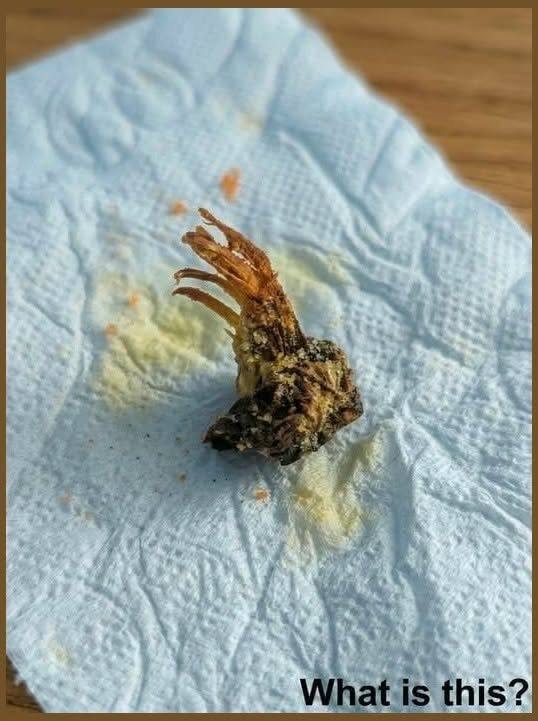
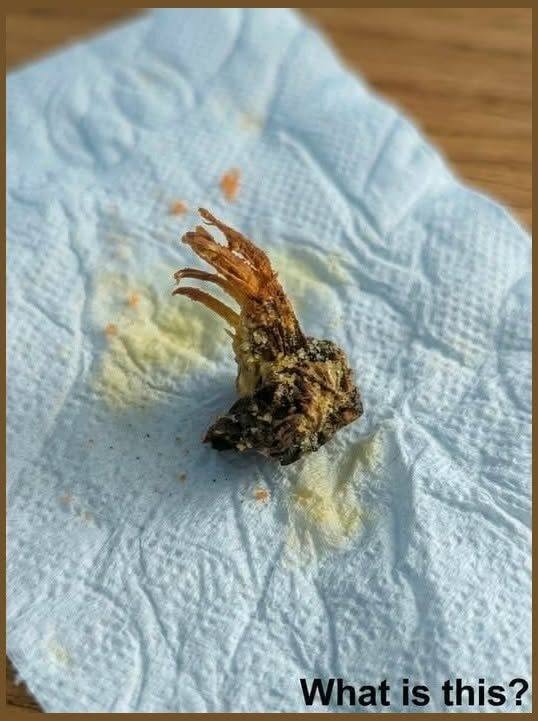
The accompanying photograph shows a small, dark, irregular object resting on a paper towel. Several thin, pointed projections extend from one side, making it resemble part of an insect or another small organic object.
The appearance is unusual enough to raise concerns about food contamination.
But can anyone reliably identify it from a photograph alone?
And more importantly, what should you do if you discover an unidentified object inside packaged food?
Here’s what you need to know before taking another bite.
What Does the Viral Photo Actually Show?
The image shows a small, brownish-black object with a rough, irregular shape.
Several narrow projections extend from its upper portion, creating an appearance that some viewers might associate with insect legs, a dried plant fragment, or another piece of organic material.
The object appears to have been placed on a white paper towel after being removed from the food.
According to the accompanying post, it was discovered baked into the dough of a frozen pizza.
However, the photograph does not establish exactly what the object is, where it came from, or when it entered the food.
It is important not to jump to conclusions.
A photograph alone cannot confirm whether the object is an insect, plant material, or another type of foreign matter.
A closer examination would be needed for a reliable identification.
Could It Be Part of an Insect?
One possibility is that the object could be an insect or insect fragment.
Some insects have rigid body parts, jointed legs, and structures that can remain recognizable after exposure to heat.
When an insect becomes dried or damaged, its appearance may change significantly.
Its body can darken, shrink, or become distorted.
This can make identification difficult, especially when only a fragment remains.
What Features Might Suggest an Insect?
Investigators may look for:
- Jointed legs
- A segmented body
- A recognizable head or thorax
- Wings or wing fragments
- A hard outer covering
- Distinctive antennae
However, several of these features can resemble dried stems, roots, or other materials in a low-resolution photograph.
Without examining the object closely, it would be premature to name a particular insect species.
Could It Be Dried Plant Material?
Another possibility is a fragment of plant material.
Pizza production involves several agricultural ingredients, including flour, herbs, spices, and vegetables.
Dried plant stems, roots, or other fibrous fragments can sometimes look surprisingly similar to insect parts.
After baking, they may become darker and more brittle.
Some plant structures also have pointed projections or branching shapes.
This does not mean the object in the photograph is definitely a plant fragment.
It simply illustrates why visual identification can be misleading.
Could It Be Something Else?
Depending on its texture and structure, an unidentified object might also be:
- A hardened fragment of food
- A piece of dried vegetable matter
- A foreign particle introduced during handling
- A fragment from packaging or production equipment
- Another unidentified organic material
The photograph does not provide enough information to distinguish confidently among these possibilities.
For that reason, the safest response is to treat the object as unidentified foreign matter until it can be examined.
How Can Foreign Objects End Up in Packaged Foods?
Modern food manufacturing uses numerous procedures designed to prevent contamination.
These may include ingredient inspections, filtration, sieving, equipment maintenance, pest-control programs, and quality checks.
Despite these precautions, foreign-material incidents can occasionally occur.
Potential points of entry include raw ingredients, processing equipment, packaging, storage, and handling after purchase.
The presence of an object in a photograph does not establish which stage was responsible.
An investigation would need to consider the product’s manufacturing history, packaging, and other evidence.
Is the Pizza Still Safe to Eat?
If you discover an unidentified foreign object baked into your pizza, the safest decision is to stop eating it.
Even if the object appears small, you cannot determine its composition or potential risks simply by looking at it.
Some foreign materials may create physical hazards, while others may indicate possible contamination.
Why Removing the Object Isn’t Enough
It might be tempting to remove the strange object and eat the rest of the pizza.
However, doing so assumes that the surrounding food is safe.
Without knowing what the object is or how it entered the product, that assumption cannot be confirmed.
For this reason, avoid eating the remaining pizza until the concern has been appropriately addressed.
What to Do If You Find Something Strange in Frozen Pizza
Here are seven practical steps.
1. Stop Eating Immediately
Set the pizza aside.
Avoid tasting or handling the unidentified object unnecessarily.
2. Take Clear Photographs
Photograph the object, the area of pizza where it was discovered, and the packaging.
If possible, include an object such as a ruler for scale.
3. Keep the Original Packaging
The box contains information that may help identify the product and manufacturing batch.
Look for:
- Brand and product name
- Lot or batch number
- Best-before date
- Barcode
- Manufacturer information
4. Preserve the Object
If it can be handled safely, place the object in a clean, sealed container.
Avoid crushing, washing, or chemically treating it.
5. Keep the Remaining Food
If practical, seal the remaining pizza separately and refrigerate or freeze it promptly while seeking instructions from the manufacturer or food safety authority.
Do not eat it.
6. Contact the Manufacturer
Explain what happened and provide the product details.
The manufacturer may request photographs, packaging information, or the object itself for examination.
7. Report the Incident
You can also contact the retailer and the appropriate food safety authority in your country.
A formal report can help determine whether the issue is isolated or requires further investigation.
What If You’ve Already Eaten Part of the Pizza?
Discovering a foreign object after eating part of a meal can be unsettling.
However, finding something unusual does not automatically mean you will become ill.
The risk depends on what the object is, whether you swallowed any part of it, and whether the food was contaminated.
Watch for symptoms such as:
- Vomiting
- Diarrhea
- Abdominal pain
- Fever
- Unusual gastrointestinal discomfort
Seek medical advice if symptoms develop.
If you experience choking, difficulty breathing, severe abdominal pain, blood in vomit or stool, or difficulty swallowing after possibly ingesting a sharp object, seek emergency medical care.
Do not induce vomiting.
Does Baking Kill All Food Contamination?
Cooking food to an appropriate temperature can destroy many harmful microorganisms.
However, baking does not eliminate every possible hazard.
For example, heat does not necessarily remove:
- Sharp fragments
- Metal particles
- Glass
- Certain chemical contaminants
- All heat-stable toxins
Even if an object has been exposed to oven temperatures, that does not establish that it is safe to consume.
How Are Frozen Pizzas Manufactured?
Frozen pizzas are generally produced through several stages.
Dough Preparation
Flour, water, yeast, salt, and other ingredients are mixed to create the dough.
Shaping
The dough is formed into pizza bases.
Sauce and Toppings
Tomato sauce, cheese, vegetables, and other ingredients are added.
Freezing
The pizza is frozen to help preserve its quality during storage and distribution.
Packaging
The product is placed in protective packaging and labeled.
Distribution
Frozen pizzas are transported to stores under temperature-controlled conditions.
Food manufacturers use safety systems throughout these processes.
However, any unexpected object should still be investigated rather than dismissed.
Can Food Factories Detect Foreign Objects?
Many manufacturers use equipment designed to reduce the risk of foreign-material contamination.
Depending on the facility and product, this may include:
Metal Detectors
These can identify certain metal contaminants.
However, they do not detect every possible foreign material.
X-Ray Inspection
Some production lines use X-ray systems to detect objects with different densities from the surrounding food.
Detection capabilities vary depending on the object and the equipment.
Ingredient Screening
Flour and other ingredients may pass through sieves, filters, or inspection systems.
Visual Inspection
Workers and automated systems may inspect ingredients, products, and packaging.
Pest Management
Manufacturing facilities use pest-control and sanitation programs intended to prevent contamination.
No inspection system can guarantee that every possible foreign object will always be detected.
Does One Viral Photo Mean a Pizza Brand Is Unsafe?
Not necessarily.
A single social media photograph cannot establish a widespread manufacturing problem.
Important questions remain unanswered:
- Was the product packaging intact?
- Was the object actually embedded in the dough?
- Could it have entered during preparation at home?
- Has the manufacturer examined it?
- Are there other confirmed complaints involving the same batch?
- Has a food safety authority identified a problem?
Without this information, it would be unfair to accuse a specific manufacturer of negligence.
At the same time, a credible contamination complaint deserves appropriate attention.
How to Check Whether a Frozen Pizza Has Been Recalled
If you’re concerned about a particular frozen pizza, check official food recall announcements from the relevant food safety authority.
Look for the exact:
- Product name
- Brand
- Package size
- Lot number
- Best-before date
- Distribution area
A recall involving one batch does not necessarily apply to every product sold under the same brand.
Follow the instructions in any official recall notice.
How to Reduce Food Safety Risks at Home
Although consumers cannot control every stage of food production, a few habits can help reduce everyday risks.
Inspect Packaging Before Buying
Avoid packages that are torn, opened, leaking, or visibly damaged.
Keep Frozen Foods Properly Frozen
Store frozen pizza according to its package instructions.
Follow Cooking Directions
Use the recommended oven temperature and cooking time.
For pizzas containing raw meat or other ingredients requiring thorough cooking, follow the manufacturer’s safety instructions carefully.
Wash Your Hands
Wash your hands before and after handling food.
Keep Preparation Surfaces Clean
Clean countertops, utensils, and cutting boards appropriately.
Inspect Food Before Serving
If you notice an unusual object, unexpected odor, or other concerning change, don’t ignore it.
Report Suspected Contamination
Reporting a credible concern can help manufacturers and regulators identify potential problems.
Frequently Asked Questions
What is the strange object in the viral frozen pizza photo?
The object appears to be an irregular brown fragment with several pointed projections. It could resemble an insect fragment or dried plant material, but the photograph alone does not permit reliable identification.
Could it be an insect?
Possibly, but that has not been confirmed.
Could it be a piece of a plant?
That is another possibility. Certain dried stems and plant structures can resemble insect parts.
Is it safe to eat pizza after removing a strange object?
The safest approach is to stop eating the product until the contamination concern has been assessed.
Does baking make an insect safe to eat?
Cooking may reduce some biological risks, but it does not guarantee the safety of an unidentified object or the surrounding food.
Should I throw away the pizza immediately?
If possible, preserve the food, object, and packaging temporarily for documentation and reporting. Follow instructions from the manufacturer or food safety authority.
Can I ask for a refund?
You can contact the retailer or manufacturer. Refund and replacement policies vary.
Should I contact the manufacturer?
Yes. Provide clear photographs and identifying information from the packaging.
Can frozen pizza contain accidental foreign material?
Foreign-material incidents can occur in packaged foods, although manufacturers use preventive measures to reduce these risks.
Does the viral photo prove the manufacturer is responsible?
No. Determining the source of contamination requires additional evidence.
Final Thoughts: A Strange Discovery That Raises Important Questions
Finding an unidentified object inside a frozen pizza is understandably alarming.
The viral photograph shows something unusual, but its exact identity remains uncertain.
It may resemble part of an insect, dried plant matter, or another type of foreign material.
What matters most is not guessing what it looks like, but responding safely.
Stop eating the product, preserve the evidence, document the packaging, and report the concern to the appropriate parties.
A photograph may spark thousands of comments, but proper examination is what can establish the facts.
Now it’s your turn: Looking at the photo, what do YOU think this mysterious object could be? 🍕😳