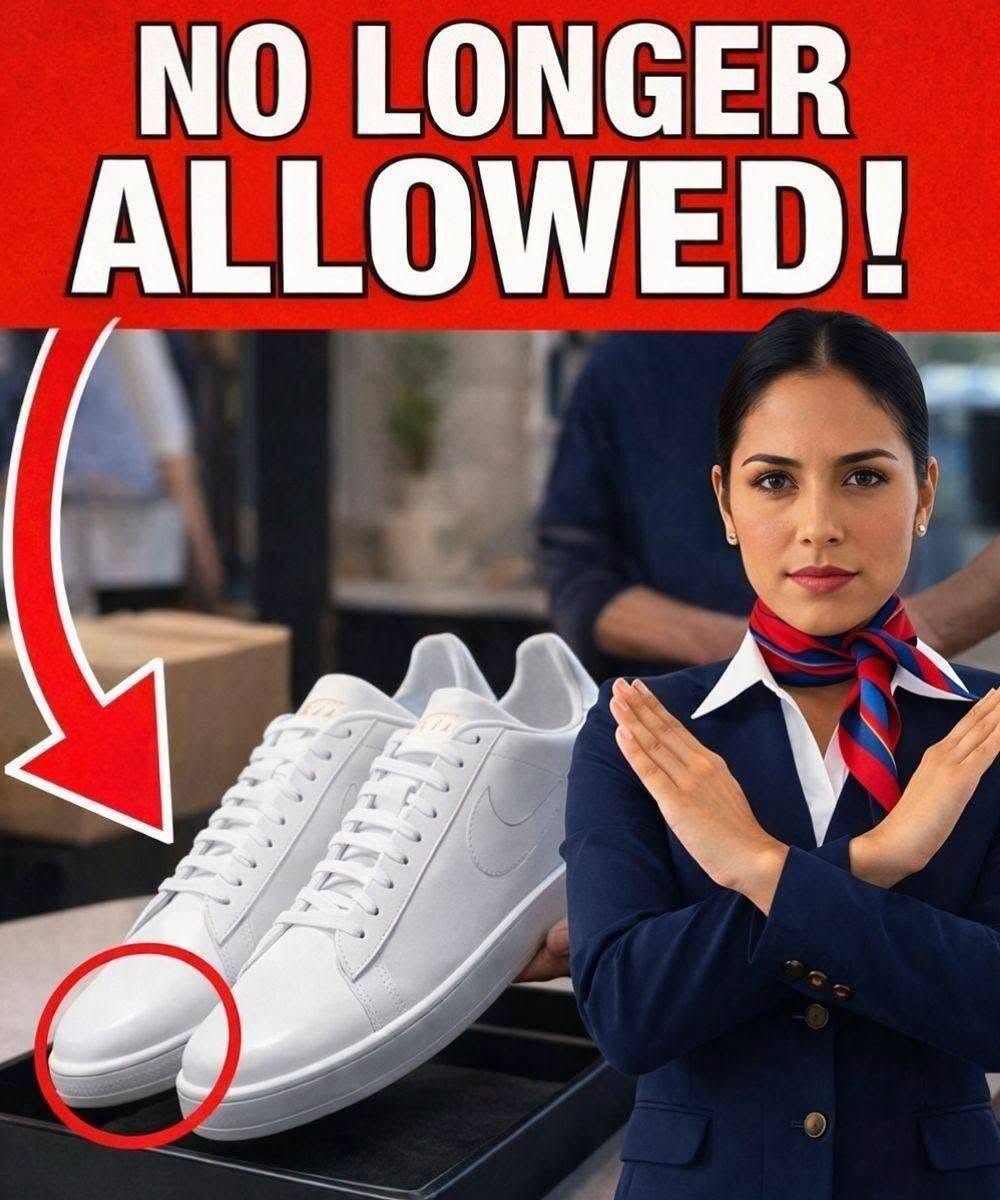
A dramatic warning is circulating on social media, telling travelers that a familiar type of footwear is supposedly no longer allowed when flying.
The image features a flight attendant making a warning gesture beside a pair of white sneakers. Above them, large letters announce: “NO LONGER ALLOWED!”
The accompanying message urges people not to travel in 2026 without learning about the alleged new rule.
For anyone preparing for a vacation, business trip, or international flight, a warning like this can be alarming.
But are airlines really banning white sneakers? Could your shoes prevent you from boarding a plane? And what footwear rules should passengers actually know before heading to the airport?
The answer is less dramatic than the viral image suggests.
There is no general aviation rule that prohibits passengers from wearing white sneakers simply because they are white.
However, airlines and airport security authorities do have rules that can affect what passengers wear, and some footwear choices may be less practical or safe than others.
Here’s what travelers should understand before their next flight.
Why the Viral White Sneakers Warning Is Getting Attention
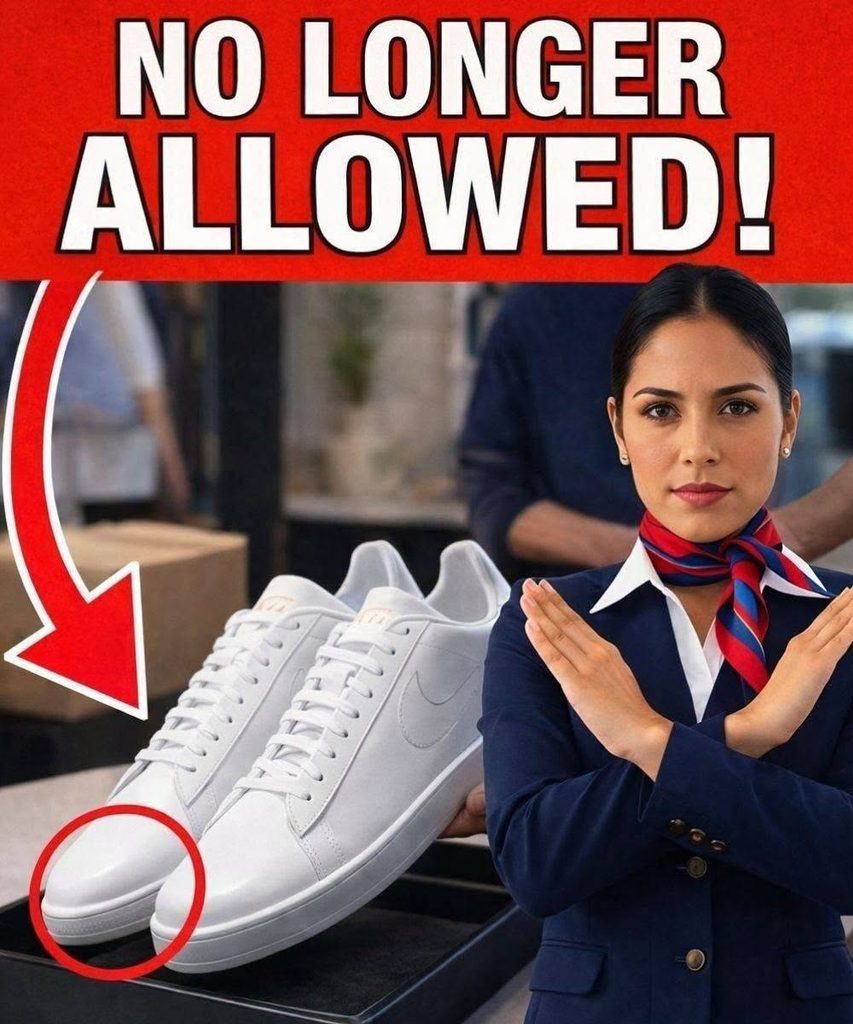
The image uses several elements designed to create urgency:
- A large red warning banner
- The words “NO LONGER ALLOWED!”
- A flight attendant appearing to reject something
- A pair of white sneakers highlighted with a red circle
- A caption suggesting travelers need to know about a rule change in 2026
These details make the post look like an official travel announcement.
However, the image does not identify an airline, aviation authority, airport, country, or regulation responsible for the supposed ban.
That is an important warning sign.
Real aviation restrictions are generally communicated through official airline policies, airport security guidance, or government aviation authorities.
A viral image alone is not proof of a new travel rule.
Are White Sneakers Banned on Airplanes in 2026?
There is no general rule banning ordinary white sneakers from passenger flights.
White sneakers are common travel footwear because they are comfortable, versatile, and easy to combine with different outfits.
Passengers routinely wear sneakers through airports and aboard aircraft.
The color of ordinary footwear is not, by itself, a standard reason for refusing someone permission to board.
Nevertheless, airlines may maintain their own dress or conduct policies.
For example, certain carriers can refuse boarding when clothing or footwear presents a safety concern or violates their published conditions of carriage.
This is different from banning white sneakers.
What Airlines Actually Say About Passenger Footwear
Airline clothing policies vary.
Some carriers have rules about inappropriate clothing, bare feet, or items that could create safety problems.
Others provide more general guidance requiring passengers to wear suitable clothing.
These policies do not establish a universal ban on a particular sneaker color.
For most travelers, clean, comfortable, ordinary sneakers are an acceptable choice.
Before traveling, it is sensible to check the conditions of carriage for your specific airline, especially if you plan to wear unusual footwear.
Can Airport Security Make You Remove Your Shoes?
Yes, depending on the airport, country, screening procedures, and any applicable exemptions.
This is one of the most common sources of confusion about footwear rules.
Being asked to remove your shoes during security screening does not mean those shoes are prohibited aboard the aircraft.
Security officers may need to inspect footwear for concealed objects or other concerns.
Screening requirements can change over time and differ between airports.
Why Shoes May Be Screened
Footwear can be examined as part of aviation security procedures.
Officers may use screening equipment or request additional inspection when necessary.
In some locations, passengers can keep their shoes on during routine screening.
In others, removing shoes may still be required for particular passengers or situations.
The correct procedure is to follow the instructions given by authorized security personnel.
What About the White Sneakers Shown in the Viral Image?
The picture highlights the toe area of a white sneaker.
That visual detail may lead viewers to believe that a particular design feature has become prohibited.
However, the image provides no credible explanation of what is supposedly wrong with the shoe.
Ordinary rubber soles, white leather, canvas uppers, and typical sneaker construction do not automatically make footwear unsuitable for air travel.
Specialized shoes containing unusual materials, concealed compartments, or prohibited objects could attract additional security attention, but that is not a rule against white sneakers.
The distinction matters.
A specific security concern involving an object is not the same as a broad ban on a common clothing item.
A Real Change to Airport Shoe Rules: What Happened in the United States?
Interestingly, one significant change to airport footwear screening did occur recently, but it was almost the opposite of what the viral image suggests.
In July 2025, the U.S. Transportation Security Administration ended its general requirement for passengers to remove shoes during routine security screening.
The change allowed most travelers to keep their shoes on while passing through TSA checkpoints.
Security officers can still request shoe removal when additional screening is necessary.
This is a United States policy, not a universal rule covering every airport worldwide.
Travelers departing from other countries should follow the procedures used by their local airport security authorities.
7 Types of Footwear That May Be Less Convenient for Air Travel
Although white sneakers aren’t generally banned, certain shoe styles can make the travel experience less comfortable or may require additional screening.
1. Heavy Boots With Metal Components
Some boots contain steel toes, metal shanks, or other structural components.
These materials may trigger screening equipment and lead to additional checks.
2. Shoes With Large Metal Buckles
Footwear with decorative chains, oversized buckles, or substantial metal hardware may attract additional security attention.
Simple shoes are often more convenient.
3. Very High Heels
High heels may be uncomfortable during long walks through airport terminals.
They can also make it harder to move quickly on stairs or uneven surfaces.
4. Loose Flip-Flops
Flip-flops are easy to remove but may offer little protection or support.
They can also be inconvenient during an unexpected long walk or evacuation.
5. Extremely Tight Shoes
Feet may swell during prolonged sitting, particularly on long flights.
Tight footwear can become uncomfortable.
6. Complicated Lace-Up Boots
Boots with multiple straps, buckles, or lengthy laces may take longer to remove and put back on if security inspection is required.
7. Uncomfortable New Shoes
Wearing brand-new shoes on a long travel day can cause blisters and discomfort.
A familiar, properly fitting pair is usually the better option.
Why Comfortable Sneakers Are Often a Good Choice
For many travelers, sneakers are among the most practical footwear options.
A suitable pair can provide:
- Cushioning for long airport walks
- Support during standing and walking
- Better traction than some smooth-soled footwear
- Protection for the feet
- Comfort during long travel days
Choose shoes that fit properly and are appropriate for your mobility needs.
There is no requirement to choose a particular sneaker color.
Should You Remove Your Shoes During a Flight?
Some passengers like to remove their shoes during long flights.
However, walking barefoot through the cabin is generally not a good idea.
Airplane floors, especially in lavatories, may not be clean.
Shoes also provide protection when moving around the aircraft.
If you want additional comfort, consider wearing breathable socks and footwear that is easy to put back on.
Always follow cabin crew instructions.
Why Feet Can Swell During Long Flights
Sitting for extended periods can contribute to temporary swelling in the feet and ankles.
Limited movement can slow the return of blood and fluid from the lower legs.
To improve comfort:
- Move your ankles regularly.
- Change position when possible.
- Walk occasionally when it is safe to do so.
- Avoid footwear that feels excessively tight.
- Follow medical advice about compression stockings if recommended.
For people at increased risk of blood clots, long-haul travel may require additional precautions.
Seek urgent medical attention for symptoms such as sudden unexplained shortness of breath or chest pain.
Can an Airline Refuse Boarding Because of Your Shoes?
In certain circumstances, an airline may refuse transportation because of inappropriate attire, safety concerns, or violations of its conditions of carriage.
For example, some airlines explicitly prohibit bare feet, with certain exceptions.
But this doesn’t mean an airline can automatically reject ordinary white sneakers under a worldwide rule.
A genuine restriction should be assessed against the carrier’s published policies and applicable laws.
How to Check Whether a Viral Travel Warning Is Real
Before believing a dramatic airport announcement, ask yourself a few questions.
Does the post name an airline or aviation authority? A real policy normally identifies who issued it.
Does it explain the exact restriction? Vague phrases such as “no longer allowed” don’t provide enough information.
Is there an effective date? Genuine policy changes generally specify when they take effect.
Does the rule apply to passengers, airline employees, or security screening? These are three very different situations.
Is the image being used as evidence without any official announcement? An edited graphic is not proof of a new regulation.
Taking a moment to verify a claim can prevent unnecessary anxiety before traveling.
Frequently Asked Questions
Are white sneakers banned on flights in 2026?
No general ban on ordinary white sneakers has been established.
Can I wear Nike, Adidas, or other sneakers on a plane?
Ordinary sneakers are generally acceptable, subject to an airline’s applicable dress and safety policies.
Do I have to remove my shoes at airport security?
It depends on the country, airport, and screening circumstances. In the United States, the general shoe-removal requirement ended in July 2025, although additional screening may still require removal.
Are shoes with metal components prohibited?
Not necessarily. However, metal components may trigger additional security screening.
Can I wear sandals on a plane?
Sandals are generally permitted, although secure, comfortable footwear may be more practical.
Are high heels banned?
There is no universal passenger ban on high heels, but they may be less comfortable for long travel days.
Do flight attendants have different shoe rules?
Yes. Airline employees may have uniform requirements that don’t apply to passengers.
Can I travel barefoot?
Some airlines prohibit bare feet, and suitable footwear is recommended for comfort and safety.
What are the best shoes for a long flight?
Comfortable, properly fitting shoes with adequate support and easy fastening are often a practical choice.
Final Verdict: Don’t Throw Away Your White Sneakers
The viral image creates the impression that a new 2026 rule has made white sneakers unacceptable for air travel.
But the available evidence does not support a general ban.
In fact, a major recent change in U.S. airport security made it easier for many travelers to keep their shoes on during screening.
Specific footwear may still require additional inspection, and airlines can enforce their own legitimate safety and dress requirements.
The important travel lesson is simple: choose comfortable footwear, follow airport security instructions, and verify dramatic claims before believing them.
Your favorite white sneakers are not automatically a reason to miss your flight. ✈️👟