At first glance, this viral math puzzle looks incredibly simple.
A few grains of rice appear on a blue background, followed by addition signs and numbers. The first three equations seem easy enough to understand.
But when you reach the final line, everything changes.
Instead of another small group of rice grains, there’s an entire pile of rice beside three individual grains.
And the puzzle asks one question:
What is the final answer?
Thousands of people enjoy puzzles like this because they appear straightforward but encourage viewers to look closely, count carefully, and question their assumptions.
Before reading the explanation, take another look at the image and see whether you can solve it yourself.
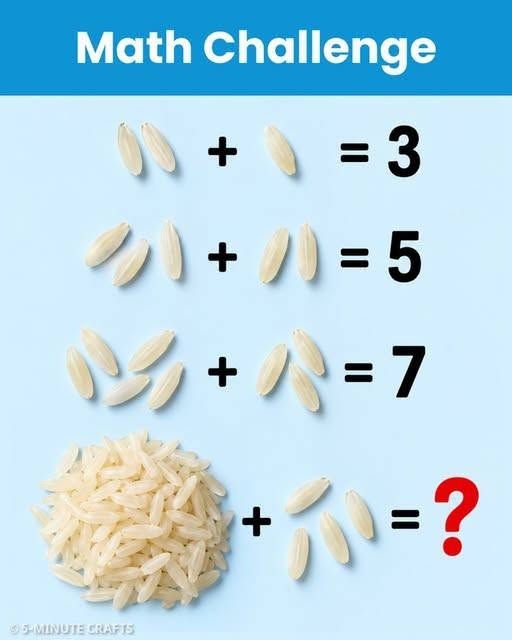
The Viral Rice Puzzle
The image presents four lines.
First equation:
Two grains of rice + one grain of rice = 3
Second equation:
Three grains of rice + two grains of rice = 5
Third equation:
Four grains of rice + three grains of rice = 7
Final equation:
A pile of rice + three grains of rice = ?
The first three equations follow a familiar pattern.
But does that pattern provide enough information to calculate the final answer?
Let’s examine the puzzle step by step.
Step 1: Understand the First Equation
The first line shows two grains of rice on the left and one grain on the right.
The equation is:
2 + 1 = 3
This is correct.
Each individual grain represents one unit.
Nothing unusual happens here.
Step 2: Examine the Second Equation
The second line contains three grains of rice in the first group and two grains in the second.
Therefore:
3 + 2 = 5
Again, the equation is correct.
The important observation is that the grains are counted individually, regardless of their arrangement.
Step 3: Check the Third Equation
The third equation shows four grains of rice plus three grains.
That gives:
4 + 3 = 7
All three equations are mathematically consistent.
So far, there is no hidden multiplication, subtraction, or unusual mathematical operation.
The rule is simply addition.
Step 4: Look Carefully at the Final Equation
Now comes the difficult part.
The last line shows a large pile of rice plus three individual grains.
We already know that each visible individual grain counts as one.
Therefore, the final equation can be written as:
Number of grains in the pile + 3 = ?
But there’s a problem.
The image doesn’t tell us exactly how many grains are in the pile.
Some grains overlap, and others may be hidden underneath.
Without knowing the total number of grains, we cannot calculate one exact numerical answer.
This is the key to understanding the puzzle.
So What Is the Correct Answer?
The most mathematically defensible answer is:
It cannot be determined exactly from the information provided.
If we represent the number of grains in the pile by the letter N, the final answer is:
N + 3
To calculate a specific number, we would need to know how many individual grains are in the pile.
The first three equations don’t provide that missing information.
Why Some People Think the Answer Is 9
Many people notice the pattern in the results:
3, 5, 7
These are consecutive odd numbers.
The next odd number is 9.
That makes 9 an appealing answer.
But there’s an important distinction.
The first three results follow a numerical sequence, yet the final image doesn’t show the next clearly countable pair of groups.
If the final line had five grains plus four grains, the answer would indeed be 9.
Instead, it contains a large pile with an unspecified number of grains.
So 9 is a possible pattern-based guess, not a result established by counting the rice shown.
Why the Puzzle Is More Difficult Than It Looks
The challenge isn’t really advanced mathematics.
It’s about interpreting information.
The first three equations teach you to count individual grains.
Then the final line replaces a small, countable group with a pile.
That creates a difference between what the image suggests and what the mathematics can prove.
A viewer may assume that the final line must continue the sequence.
Another viewer may try to count every visible grain.
A third may realize that the exact number is not provided.
This is why the puzzle can generate so many different answers.
Could You Count the Rice in the Pile?
You could attempt to count the grains visible in the photograph.
But even if you counted every grain you could see, the result might still be incomplete.
That’s because the rice is piled on top of itself.
Some grains are partially covered, while others may be completely hidden.
This creates a problem known as incomplete information.
Imagine someone shows you a closed jar filled with rice and asks exactly how many grains are inside.
Without counting them or knowing their total weight and the average weight per grain, you cannot give an exact answer.
You could make an estimate, but an estimate is not the same as an exact calculation.
Three Popular Ways to Interpret the Puzzle
Different viewers may approach the image in different ways.
Interpretation 1: Continue the Odd-Number Sequence
The results are 3, 5, and 7.
Continuing the pattern gives 9.
This is a reasonable guess about the puzzle creator’s intended sequence, but it requires an assumption that isn’t established by the final picture.
Interpretation 2: Count Every Grain
Under this interpretation, every grain is worth one unit.
The answer is the number of grains in the pile plus three.
This follows the counting rule demonstrated in the first three equations.
However, the exact number remains unknown.
Interpretation 3: Treat the Pile as One Object
Someone might argue that the pile is one group, so the answer should be 1 + 3 = 4.
But this changes the meaning of the images.
The earlier equations count individual grains, not groups of grains.
There is no indication that a pile suddenly represents the value one.
Therefore, 4 is not justified by the original counting rule.
What Makes a Good Math Puzzle?
A well-designed mathematical puzzle should provide enough information to determine an answer, even if the solution requires creativity.
Some puzzles deliberately include ambiguity to encourage discussion.
Others use visual distractions to test attention.
This rice puzzle combines both elements.
The early equations create a sense of certainty.
The final line introduces information that cannot be counted reliably.
As a result, the puzzle is better understood as a test of reasoning than as a standard arithmetic exercise.
Why Our Brains Want to Find a Pattern
Human beings are naturally good at recognizing patterns.
We use them to understand language, solve problems, and predict what might happen next.
When we see:
3, 5, 7 …
Our brains quickly suggest:
This is useful in many situations.
But recognizing a pattern doesn’t guarantee that the pattern provides enough information to solve every problem.
Sometimes, the correct response is to recognize what we don’t know.
Try These Three Similar Brain Teasers
Puzzle 1: The Missing Number
2, 4, 6, 8, ?
Answer: 10, if the intended rule is adding two each time.
Puzzle 2: The Apples
Three apples plus two apples equals five apples.
Now imagine a photograph showing a basket filled with apples plus two apples.
Can you determine the total?
Answer: Not exactly, unless you know how many apples are in the basket.
Puzzle 3: The Hidden Coins
A closed box contains an unknown number of coins.
Someone places five additional coins beside it.
How many coins are there altogether?
Answer: If the box contains N coins, the total is N + 5.
These examples illustrate the difference between recognizing a sequence and having enough information to calculate a result.
Frequently Asked Questions
What is the answer to the viral rice math puzzle?
The exact answer cannot be determined because the number of grains in the pile is unknown.
Why do some people answer 9?
Because the first three results are 3, 5, and 7, making 9 the next number in the apparent sequence.
Could the answer be 4?
Only if the entire pile is treated as one object, which isn’t consistent with counting individual grains in the earlier equations.
Is there a hidden mathematical trick?
The main trick is the replacement of countable grains with a pile containing an unspecified number.
Can you estimate the number of grains in the picture?
You might estimate the visible grains, but overlapping and hidden grains prevent a reliable exact count.
Is this a math problem or a logic puzzle?
It’s best described as a visual logic puzzle involving simple arithmetic and incomplete information.
Final Answer: The Secret Is in the Pile!
The first three equations are straightforward:
2 + 1 = 3
3 + 2 = 5
4 + 3 = 7
But the final equation introduces a pile of rice whose exact quantity is unknown.
Therefore:
Unknown number of grains + 3 = Unknown total
The most rigorous answer is that the result cannot be determined exactly from the image.
You may guess 9 by extending the pattern, but the picture doesn’t establish that the pile contains six grains.
And that’s what makes this seemingly simple puzzle so interesting.
Now it’s your turn: Would you answer 9, try counting the rice, or say there’s not enough information? 🧠🍚