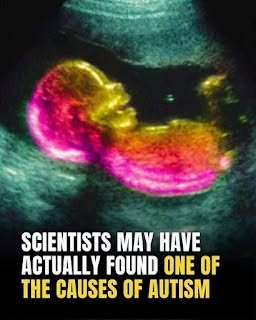
A striking image circulating on social media shows what appears to be a developing baby inside the womb, accompanied by a dramatic headline:
“Scientists may have actually found one of the causes of autism.”
It’s the kind of statement that immediately attracts attention, especially among parents, expectant mothers, and families of autistic children.
For decades, scientists have been studying how autism develops, why it affects people differently, and which genetic and biological processes are involved.
And research continues to reveal important clues.
But there’s something essential to understand before interpreting a viral headline: autism does not have one single, universally established cause.
Instead, evidence indicates that autism develops through a complex combination of genetic influences and developmental processes, with some environmental factors potentially contributing to risk.
So what have scientists actually discovered? Could autism begin developing before birth? And does finding a biological association mean researchers have discovered a cause?
Let’s explore what the science tells us—and what remains uncertain.
What Is Autism?
Autism spectrum disorder, often abbreviated as ASD, is a neurodevelopmental condition.
It affects how a person experiences, processes, and interacts with the world.
Autistic people may have differences in:
- Social communication and interaction
- Sensory processing
- Patterns of behavior and interests
- Responses to changes in routine
- Language and communication
- Learning and information processing
Autism is described as a spectrum because experiences, strengths, challenges, and support needs vary significantly.
Some autistic people communicate verbally and live independently.
Others may use alternative forms of communication or need substantial daily support.
Autism is not caused by poor parenting, and it is not something that can be identified simply by looking at a person’s appearance.
Can Autism Begin Before Birth?
Research suggests that some biological processes associated with autism occur during prenatal brain development.
The brain begins forming early in pregnancy.
During this period, nerve cells develop, migrate, form connections, and gradually organize into complex networks.
These processes are influenced by genetic instructions and the developing biological environment.
Researchers have identified genetic variants and developmental pathways associated with autism, including pathways involved in how neurons communicate and how brain circuits form.
This doesn’t mean autism can be reliably diagnosed from an ordinary pregnancy ultrasound.
It means that some developmental differences associated with autism may originate long before behavioral characteristics become apparent.
Why Scientists Study the Developing Brain
Understanding prenatal brain development is important because the brain undergoes rapid changes before birth.
Researchers investigate how:
- Neurons are produced
- Brain cells migrate into position
- Synapses develop
- Genes regulate brain development
- Different cell types communicate
- Immune and inflammatory signals interact with developing tissues
Changes in these processes may influence later neurodevelopment.
However, identifying a biological difference doesn’t automatically establish that it causes autism.
A difference might be a contributing factor, a consequence of another process, or simply an associated finding.
1. Genetics Plays a Major Role in Autism
One of the strongest findings from decades of research is that genetics contributes substantially to autism.
Scientists have identified many genetic variants associated with autism.
Some are inherited from parents.
Others arise spontaneously during the formation of reproductive cells or early development.
These are sometimes called de novo genetic variants.
Certain rare genetic changes can have relatively large effects, while many common genetic variants each contribute small amounts to overall likelihood.
This helps explain why autism can occur in families but may also appear in a child without any known family history.
Does Having an Autistic Parent Mean a Child Will Be Autistic?
Not necessarily.
Genetic influences are complex, and inheritance does not follow one simple rule in most cases.
A family history can affect likelihood, but it doesn’t determine an individual child’s developmental outcome.
2. Brain Development May Hold Important Clues
Scientists have studied differences in brain structure, connectivity, and activity among autistic and non-autistic people.
Some research suggests that particular neural pathways or developmental processes may differ in certain groups.
However, findings are not identical across all autistic individuals.
Autism is highly heterogeneous, meaning different people may have different combinations of genetic and biological influences.
There is no single brain scan pattern that reliably identifies every autistic person.
This is one reason researchers are cautious about dramatic claims that one study has finally discovered the cause.
3. What About the Immune System During Pregnancy?
Another area of scientific investigation involves maternal immune activity and fetal development.
The immune system plays important roles during pregnancy.
Researchers have examined whether certain infections, inflammatory processes, or immune signals may be associated with differences in offspring neurodevelopment.
Some observational studies have found associations between particular maternal health conditions and autism diagnoses in children.
Animal studies have also explored mechanisms through which immune signaling might influence brain development.
But these findings require careful interpretation.
An association between maternal inflammation and autism does not mean that a routine illness during pregnancy causes autism.
Many pregnancies involve common infections or temporary inflammation without resulting in autism.
The type, severity, timing, and broader biological context may matter, and many questions remain unanswered.
4. Could Environmental Factors Contribute?
Scientists also investigate non-genetic factors that may influence autism likelihood.
Research has explored associations involving:
- Certain prenatal medication exposures
- Some maternal metabolic conditions
- Prematurity
- Certain pregnancy complications
- Environmental pollutants
- Parental age
- Specific prenatal health conditions
These associations differ greatly in strength and quality of evidence.
Some may reflect causal contributions, while others may be influenced by genetics, underlying health conditions, or other confounding factors.
No single environmental exposure explains autism as a whole.
5. Why Timing During Pregnancy Matters
The developing brain changes rapidly across pregnancy.
Different structures and neural networks develop at different stages.
Researchers therefore investigate whether the timing of a particular biological influence affects developmental outcomes.
For example, a factor that affects early cell development might have different consequences from one that affects later neural connectivity.
This is an important scientific question.
However, it would be inaccurate to claim that autism begins at one specific week of pregnancy for everyone.
Autism involves diverse developmental pathways, and scientists have not established one universal prenatal starting point.
6. Why a Single Study Cannot Prove a Cause
Scientific discoveries are often presented in headlines that sound more definitive than the research itself.
A study might identify a difference in a particular protein, gene, immune signal, or brain cell population.
That finding may be valuable.
But scientists must still ask several questions:
- Was the finding observed in humans or laboratory animals?
- How large was the study?
- Was the result reproduced independently?
- Could another factor explain the association?
- Does the finding apply broadly or only to a subgroup?
- Does changing the biological factor actually change the developmental outcome?
A result from mice or laboratory-grown cells may help researchers understand mechanisms, but it doesn’t automatically establish a cause of human autism.
7. Could Researchers Eventually Identify Different Biological Pathways?
This is an important possibility.
Because autism is so diverse, scientists increasingly study whether different groups of autistic people have distinct biological pathways contributing to their development.
Some people have identifiable genetic syndromes associated with autism.
Others have combinations of many genetic influences without a single identifiable genetic cause.
Understanding these differences could eventually improve diagnostic approaches, identify co-occurring medical needs, and support more individualized care.
But such advances should not be confused with the idea that every autistic person needs to be cured.
Research can also focus on improving communication, reducing distress, addressing health problems, and making environments more accessible.
What Recent Research Has Revealed
Several scientific developments in 2026 illustrate why autism research is advancing—and why caution remains necessary when interpreting new findings.
Researchers Are Studying Brain Differences Before Birth
A 2026 scientific review examined eight human studies involving fetal MRI and later autism-related outcomes.
The researchers described evidence of differences in certain brain structures and functional connections during prenatal development.
Some studies identified variations in the size of particular brain regions, including the insular cortex.
Others investigated how developing brain networks communicate.
These findings suggest that some autism-associated developmental differences may be detectable before birth.
But the researchers also emphasized that larger, more standardized studies are needed before these findings could become clinically useful.
An experimental fetal MRI finding is not a prenatal autism diagnosis.
Scientists Are Investigating Genetic and Epigenetic Clues
Another 2026 study examined patterns of DNA methylation in cell-free DNA obtained from maternal blood.
DNA methylation is one way biological systems regulate gene activity.
Researchers investigated whether certain methylation patterns during pregnancy were associated with a later autism diagnosis.
The findings offer a potential direction for future research into prenatal biological markers.
However, they do not establish a reliable prenatal screening test, nor do they prove that those methylation patterns caused autism.
Laboratory Studies Are Exploring Maternal Immune Signaling
Researchers have also investigated how inflammation during pregnancy may influence the developing brain.
In one 2026 mouse study, experimentally induced maternal inflammation was associated with later differences in offspring brain activity and behavior.
The researchers also studied how particular biological pathways affected those outcomes.
This work may help scientists understand mechanisms worth investigating further.
But mouse behaviors described as autism-like are not equivalent to human autism, and results in animals cannot automatically be applied to pregnant people or autistic children.
These studies do not establish that a common infection, fever, or brief episode of inflammation during pregnancy causes autism.
Does This Mean Autism Can Be Prevented During Pregnancy?
No scientifically established method can guarantee that a child will not be autistic.
Autism has substantial genetic contributions, and many of the processes involved occur outside a parent’s control.
Healthy prenatal care is important for many reasons, but it should never be presented as a guarantee against autism.
Pregnant people can support their own health and fetal development by:
- Attending recommended prenatal appointments
- Taking prescribed prenatal supplements
- Managing existing medical conditions
- Avoiding alcohol and tobacco
- Following appropriate food-safety guidance
- Discussing medications with healthcare professionals
- Seeking medical care when infections or other symptoms require attention
These recommendations support general pregnancy health.
They do not eliminate the possibility of autism.
Can Prenatal Vitamins Prevent Autism?
Prenatal vitamins provide important nutrients that support normal pregnancy and fetal development.
Folic acid, for example, is recommended before and during early pregnancy because it helps prevent neural tube defects.
Researchers have also investigated associations between prenatal nutrition and autism likelihood.
However, no prenatal vitamin has been proven to prevent autism.
Taking more than the recommended amount is not necessarily beneficial and can sometimes be harmful.
Follow the advice of your pregnancy healthcare professional rather than taking high-dose supplements based on viral claims.
Do Vaccines Cause Autism?
No. Extensive scientific research has not established a causal relationship between vaccines and autism.
The claim that routine childhood vaccines cause autism has been repeatedly investigated and is not supported by reliable evidence.
Vaccination protects against potentially serious infectious diseases.
Parents who have questions about vaccination should discuss them with qualified healthcare professionals.
Are Parents Responsible for Their Child’s Autism?
No.
Autism is not caused by a lack of affection, poor parenting, or ordinary mistakes in raising a child.
Nor should research into prenatal risk factors be used to blame mothers for their children’s neurodevelopment.
Scientists study population-level associations to understand biology, not to assign responsibility to individual families.
Even when a factor is statistically associated with autism, that does not mean it caused autism in any particular child.
Can an Ultrasound Detect Autism?
Routine pregnancy ultrasounds cannot diagnose autism.
Ultrasound examinations can assess many aspects of fetal anatomy and development, but autism is not identified through a single anatomical feature.
Researchers are exploring whether advanced fetal imaging could eventually contribute to understanding neurodevelopmental differences.
At present, however, autism is diagnosed through developmental history, observation, and clinical assessment—not ordinary prenatal imaging.
When Do Signs of Autism Usually Become Noticeable?
Autistic characteristics may become apparent during infancy or early childhood, although the timing varies.
Some children show developmental differences early.
Others become more noticeably different as social and communication expectations increase.
Possible early signs include:
- Differences in eye contact or social attention
- Limited use of gestures
- Delayed or unusual language development
- Repetitive movements or behaviors
- Strong preferences for routines
- Differences in sensory responses
- Unusual patterns of play or interaction
No single behavior proves that a child is autistic.
Some children develop at different rates without being autistic, while some autistic children reach early milestones on time.
A developmental evaluation can help clarify concerns.
Why Early Identification Matters
Early identification can help families understand a child’s needs and access appropriate support.
Depending on the child, helpful services may include:
- Speech and language therapy
- Occupational therapy
- Communication support
- Educational accommodations
- Family guidance
- Support for co-occurring medical or developmental conditions
The goal should be to improve communication, participation, comfort, and quality of life while respecting the individual’s needs and identity.
Does Autism Have a Cure?
Autism is a lifelong neurodevelopmental condition, not an infection or illness that can simply be removed with medication.
There is no established cure for autism.
However, many autistic people benefit from individualized support, accessible environments, and treatment of co-occurring conditions when needed.
Scientific research into biological mechanisms may eventually lead to more targeted treatments for particular difficulties or associated medical conditions.
That is different from claiming that scientists are about to eliminate autism.
Why the Viral Image Should Be Interpreted Carefully
The image shows what appears to be a fetus alongside a dramatic statement about scientists discovering a cause of autism.
But it doesn’t identify a particular research study, explain the methods used, or provide enough information to verify the claimed discovery.
The picture itself cannot demonstrate that a fetus has autism.
It may be illustrative rather than a diagnostic medical image.
The headline also leaves out a critical distinction: identifying a possible contributing factor is not the same as proving a cause.
That distinction matters enormously when discussing pregnancy and child development.
Frequently Asked Questions
Have scientists discovered the cause of autism?
Scientists have identified many genetic and developmental factors associated with autism, but there is no single explanation that accounts for every case.
Can autism develop before a baby is born?
Research suggests that some biological differences associated with autism may arise during prenatal brain development.
Can doctors diagnose autism during pregnancy?
There is currently no routine prenatal test that reliably diagnoses autism.
Is autism genetic?
Genetics plays a substantial role, but the genetic architecture is complex and differs among individuals.
Can a healthy pregnancy guarantee a child won’t be autistic?
No. Healthy prenatal care supports pregnancy health but cannot guarantee any particular neurodevelopmental outcome.
Can a mother’s stress cause autism?
Research has investigated associations involving prenatal stress, but it has not established that ordinary maternal stress causes autism in an individual child.
Does maternal inflammation always affect the baby’s brain?
No. Research into specific immune mechanisms does not mean that every episode of maternal inflammation causes developmental harm.
Can autism be identified from a baby’s appearance?
No. Autism cannot be diagnosed by facial appearance or a viral photograph.
Can autism be detected through fetal MRI?
Certain experimental studies have investigated possible prenatal imaging markers, but fetal MRI is not an established autism diagnostic test.
Does discovering autism-related genes mean scientists can prevent autism?
No. Identifying genetic contributors improves scientific understanding, but it doesn’t automatically lead to prevention or treatment.
Final Thoughts: An Important Scientific Clue, Not a Final Answer
The viral claim that scientists may have found one of the causes of autism touches on a genuinely important area of research.
Scientists are making progress in understanding genetics, prenatal brain development, immune signaling, and other biological pathways associated with autism.
Research published in 2026 has added new information about fetal brain imaging and potential molecular markers.
These findings may help researchers ask better questions and design future studies.
But they don’t mean that scientists have identified one universal cause, developed a prenatal diagnostic test, or discovered a way to prevent autism.
The most important message is that autism is complex, science is still learning, and families deserve accurate information rather than fear-inducing headlines.
As research continues, the hope is not only to understand neurodevelopment more deeply, but also to improve healthcare, accessibility, and quality of life for autistic people and their families. 💙