When my husband, Mark, and I learned that we were finally expecting a baby, it felt as though everything we had been waiting for was falling into place.
We had been married for three years, but we’d been together much longer. From the beginning, we’d talked about having children, buying a home, growing old together, and eventually becoming the kind of grandparents who spoiled everyone at Christmas.
For six months, pregnancy filled our house with excitement.
Then Mark got sick.
At first, neither of us imagined it was serious.
Within weeks, however, we were sitting across from a doctor hearing words no young family expects to hear.
Mark was gravely ill.
The doctors told us treatment options were limited.
Our baby hadn’t even been born yet, and suddenly I was facing the possibility that my husband might never get to meet his child.
But before Mark died, he made one final decision.
He wanted to be an organ donor.
And after he was gone, his doctor stopped me in the hospital hallway and said:
“There’s something he made me promise to give you only after he was gone.”
What the doctor placed in my hands changed the way I understood my husband’s final months.
Everything Had Seemed Perfect
Mark and I weren’t wealthy, and our life certainly wasn’t glamorous.
But we were happy.
We’d recently moved into a small house that needed far more work than we’d anticipated. The kitchen cabinets were outdated, the backyard fence leaned slightly to one side, and one bedroom was still filled with unopened moving boxes.
We didn’t care.
We planned to turn that spare room into a nursery someday.
When the pregnancy test finally came back positive, I ran into the bedroom crying.
Mark thought something was wrong.
Then I showed him the test.
He stared at it.
“Is that…?”
I nodded.
He hugged me so tightly that I had to remind him I still needed to breathe.
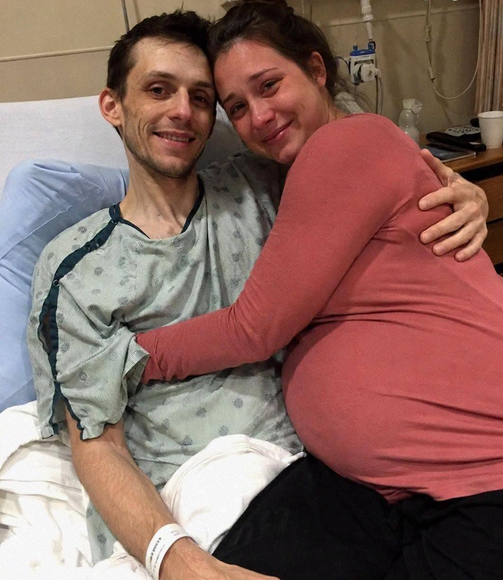
He Immediately Started Planning
Mark approached fatherhood the same way he approached everything else: enthusiastically and slightly chaotically.
Before my first major appointment, he’d already researched cribs.
He downloaded parenting apps.
He started making lists of baby names.
At night, he’d sometimes talk to my stomach even though I kept reminding him the baby couldn’t possibly understand his elaborate speeches.
“Doesn’t matter,” he’d say. “We’re bonding.”
Those are the memories that became the hardest to revisit later.
Then He Started Feeling Tired
It happened gradually.
Mark began coming home exhausted.
We blamed work.
Then he started losing weight.
At first, he joked about it.
“Apparently pregnancy is making both of us change size,” he said.
But the fatigue became worse.
Then came the pain.
Eventually, I convinced him to see a doctor.
Several appointments and tests followed.
I remember sitting beside him waiting for results, still believing we’d be told he needed medication, rest, or perhaps a minor procedure.
Instead, our lives divided into two parts:
Before that appointment and after it.
The Diagnosis Changed Everything
Mark had a serious illness that was already advanced.
There were treatment options, but his doctors were careful not to give us unrealistic expectations.
Mark listened quietly.
I cried.
Then I became angry.
I was angry at the doctors.
Angry at myself for not recognizing the symptoms sooner.
Angry at every healthy stranger I saw walking down the street.
Most of all, I was angry at time.
We had finally gotten everything we’d wanted.
And suddenly we didn’t know how much time we had left.
Mark’s Biggest Fear Wasn’t Dying
One night, I found him sitting alone in the unfinished nursery.
He had assembled half of the crib but stopped midway through.
I sat beside him.
“I’m scared,” I admitted.
“So am I.”
It was the first time he’d said it.
Then he looked at my stomach.
“I’m not scared about me.”
I knew exactly what he meant.
He was afraid our baby would grow up without him.
He Started Preparing for a Future He Might Never See
Mark became determined to leave pieces of himself behind.
He recorded videos.
Some were serious.
Others were ridiculous.
He made one for our child’s first birthday.
Another for the first day of school.
One was labeled:
“Watch this when your mom tells you I’m the reason you’re stubborn.”
I couldn’t watch that one without laughing and crying at the same time.
He wrote letters too.
Letters for birthdays.
A letter for graduation.
A letter for the day our child might get married.
“You’re planning too far ahead,” I once told him.
“That’s the point,” he replied.
Then He Mentioned Organ Donation
One evening, Mark brought up something we’d never seriously discussed before.
“If they can use anything when I’m gone, I want them to.”
I immediately understood.
Organ and tissue donation is highly regulated and depends on medical circumstances, consent, eligibility, and local procedures. Not every person who wishes to donate will ultimately be medically able to donate every organ or tissue.
But Mark wanted his wishes known.
“If something from me can help somebody else,” he said, “why wouldn’t I?”
I didn’t know how to answer.
The conversation made his possible death feel unbearably real.
Still, I listened.
His Health Continued to Decline
We hoped treatment would give us more time.
For a while, it seemed possible.
Then things changed quickly.
Mark spent more time in the hospital.
Eventually, there were more difficult conversations with his medical team.
Through everything, he kept asking about the baby.
“How’s our little one?”
I’d take his hand and place it against my stomach whenever the baby moved.
Sometimes Mark would smile.
Sometimes he’d turn his face away because he didn’t want me to see him crying.
He Knew He Might Not Make It to the Birth
That possibility became harder to avoid.
Our baby’s due date was still weeks away.
Mark was becoming weaker.
One afternoon, he asked me to make him a promise.
“Tell our child I wanted to be there.”
I started crying immediately.
“You’ll tell them yourself.”
He squeezed my hand.
“Promise me anyway.”
So I promised.
The Call I Had Been Dreading Came
There are moments in life you remember with impossible clarity.
The lighting.
The sound of someone’s voice.
The chair you were sitting in.
The exact position of your hands.
Mark died before our baby was born.
No matter how much doctors had prepared me for that possibility, I wasn’t prepared.
I don’t think anyone ever is.
Everything after that became a blur of conversations, paperwork, family members, and grief.
There were also discussions involving Mark’s donation wishes and what was medically possible under the circumstances.
I tried to answer questions because I knew how important the decision had been to him.
Then the Doctor Stopped Me
I was preparing to leave the hospital when one of Mark’s doctors approached me.
There was something unusual about his expression.
“Can I speak with you for a moment?”
I nodded.
We stepped into a quieter area.
Then he reached into his coat and removed a sealed envelope.
“Mark asked me to make sure you received this.”
I stared at it.
“When?”
“A little while ago.”
“Why didn’t he give it to me himself?”
The doctor paused.
“He specifically asked that you receive it afterward.”
I couldn’t bring myself to open it there.
I Waited Until I Got Home
The house felt different without Mark.
His shoes were still near the door.
His coffee mug was still beside the sink.
A jacket he’d worn weeks earlier remained hanging over the back of a chair.
I sat at the kitchen table with the envelope in front of me.
My name was written across it in Mark’s handwriting.
For nearly twenty minutes, I couldn’t open it.
Finally, I did.
Inside was a letter.
And a small key.
“If You’re Reading This…”
The letter began exactly as I feared it would.
“If you’re reading this, then I didn’t get the miracle we were hoping for.”
I had to stop.
Eventually, I continued.
Mark wrote about our marriage.
He apologized for leaving me to raise our child without him, even though we both knew it wasn’t his choice.
He told me not to make grief the center of our baby’s childhood.
Then he mentioned the key.
It belonged to a small locked box he’d stored with some important documents.
I found it in our bedroom closet.
The Box Was for Our Baby
Inside were several things.
Mark’s watch.
A few photographs.
A flash drive containing the videos he’d recorded.
The letters I’d already known about.
And one final notebook.
On the first page, Mark had written:
“Things I want my child to know about life.”
I sat on the bedroom floor reading it for hours.
Some pages contained serious advice.
Others contained jokes.
There were stories from his childhood I’d never heard.
He wrote about mistakes he’d made.
People he’d loved.
Things he regretted.
Things he hoped our child would someday experience.
One Page Was About Organ Donation
Near the end, Mark explained why the decision mattered so much to him.
He wrote that he couldn’t control what happened to his own body.
He couldn’t control the illness.
He couldn’t control whether he lived long enough to meet our child.
But he wanted one of his final decisions to be about helping rather than losing.
He knew donation wouldn’t erase our grief.
He knew it wouldn’t make his death fair.
But if medically possible, he wanted something good to come from an unbearable situation.
That was Mark.
Even while facing the end of his own life, he was thinking about strangers.
Our Baby Arrived Weeks Later
Giving birth without Mark beside me was one of the most emotionally complicated experiences of my life.
I was devastated.
And incredibly happy.
Those two feelings existed together.
When the nurse placed our baby on my chest, I stared at that tiny face and immediately thought of Mark.
I whispered:
“Your daddy wanted to be here.”
It was the promise I’d made.
And I kept it.
I Didn’t Want Our Child to Know Mark Only Through Tragedy
As the years passed, I made a deliberate decision.
I wouldn’t introduce Mark as simply “the father who died.”
I wanted our child to know who he had been when he was alive.
The man who couldn’t cook pasta without making a mess.
The man who sang badly in the car.
The man who once spent an entire afternoon trying to assemble furniture before realizing he’d been holding the instructions upside down.
The man who talked to my pregnant belly every night.
The man who made videos because he desperately wanted to remain part of a future he knew he might miss.
The Videos Became Priceless
On certain birthdays, we’d watch one.
Seeing Mark appear on the television was always emotional.
But he had deliberately made the recordings funny.
“Hello, future teenager,” he began in one video. “At this point, there’s a good chance you think your mother knows absolutely nothing.”
Our child laughed.
I cried.
Mark had somehow managed to parent from the past.
Not in the way either of us wanted.
But in the only way he’d had available.
The Letter Changed Something in Me Too
For a long time, I’d viewed Mark’s final months entirely through the lens of everything we’d lost.
The letter made me see something else.
Even while dying, Mark had still been making choices.
He chose to record those videos.
He chose to write the letters.
He chose to leave stories for our child.
And he expressed his wish to become a donor because he wanted the possibility of helping others after his death.
Those decisions couldn’t give us more time.
But they gave meaning to some of the time we had.
Years Later, I Finally Understood His Final Gift
The doctor’s envelope hadn’t contained money.
It didn’t reveal a dramatic family secret.
There was no hidden fortune.
What Mark left behind was much more valuable to me.
He had created a bridge between himself and a child he feared he’d never meet.
The key opened a box.
But the box opened something much larger:
a way for our child to know their father.
What Organ Donation Really Means
Stories about organ donation can sometimes make the process sound simple, but real-world donation is carefully managed by medical and donation professionals.
A person’s ability to donate depends on many factors, including medical condition, circumstances of death, the organs or tissues involved, and applicable laws and consent procedures.
People who want to become donors should follow the official registration process where they live and, importantly, discuss their wishes with their family.
Making those wishes clear in advance can help loved ones understand what the person wanted during an extremely difficult time.
Final Thoughts
Mark never got the future we’d planned together.
He didn’t get to stand beside me at our child’s birth.
He didn’t get the first birthday, the first day of school, or all the ordinary mornings we’d once taken for granted.
But he refused to let his final chapter be defined only by illness.
He left letters.
He left videos.
He left his stories.
And through his wish to donate, he hoped that even after his own life ended, something positive might continue.
Years later, I still have the envelope the doctor handed me.
I still have the key.
And I still have Mark’s notebook.
Someday, it will belong entirely to our child.
Because sometimes the most meaningful inheritance isn’t money or property.
Sometimes it’s simply knowing:
“I loved you before I ever got the chance to meet you.”