Swollen feet and ankles are extremely common. After a long day of standing, sitting for hours, traveling, or spending time in hot weather, you may notice that your shoes feel tighter and your ankles look puffier than usual.
That’s why social media posts claiming that a simple herbal tea can “drain excess fluid” and make swollen legs return to normal attract so much attention.
The idea sounds appealing: drink a cup of tea, urinate more, and watch the swelling disappear.
But leg swelling—medically called edema—has many possible causes. Some are harmless and temporary, while others require medical attention.
So before reaching for a “detox” tea, here’s what you should know.
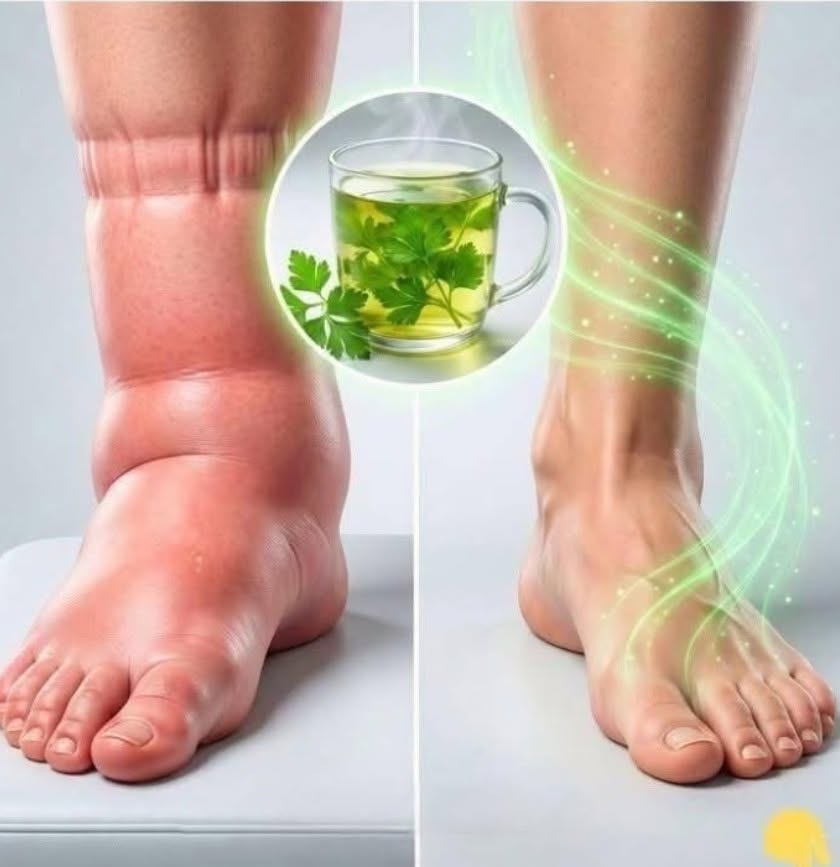
What Actually Causes Swollen Legs?
Edema occurs when excess fluid accumulates in the tissues.
Mild swelling can happen after:
- Sitting for many hours
- Standing for a long time
- Eating a lot of salty food
- Pregnancy
- Certain medications
- Being physically inactive
In these situations, gravity and fluid retention can contribute to swelling around the ankles and feet.
However, persistent or severe swelling can sometimes be related to conditions involving the veins, heart, kidneys, liver or lymphatic system, and sudden swelling in one leg can be associated with a blood clot.
That’s why it’s important not to assume that every swollen ankle simply needs a herbal drink.
Can Herbal Tea Really Remove Excess Fluid?
Some herbs and beverages may have mild diuretic effects, meaning they can increase urine production.
That’s where the idea of “water-removing” teas comes from.
But here’s the important distinction:
Making you urinate more doesn’t necessarily treat the cause of swollen legs.
For example, if swelling is related to chronic venous insufficiency, the problem involves blood having difficulty returning efficiently through the veins.
If swelling is related to lymphedema, the lymphatic drainage system isn’t functioning normally.
And if swelling is related to heart or kidney disease, treating the underlying medical condition is far more important than simply drinking something that increases urination.
The “Parsley Tea” Remedy 🌿
One homemade drink frequently promoted for water retention is parsley tea.
A typical homemade version involves steeping fresh parsley leaves in hot water and drinking the resulting infusion.
Parsley is nutritious as a culinary herb, and compounds in parsley have been investigated for several biological effects.
But there isn’t strong clinical evidence showing that ordinary parsley tea can reliably treat medically significant leg edema.
So it shouldn’t be advertised as a substitute for medical treatment.
If you simply enjoy parsley tea as a beverage, that’s one thing.
Using it to treat unexplained persistent swelling is another.
What About Dandelion Tea?
Dandelion tea is another popular “natural diuretic.”
You’ll frequently see claims that it:
“flushes excess water from your body.”
Some preliminary research has explored its potential effects on urination, but that doesn’t establish dandelion tea as a treatment for the many medical conditions that can cause swollen legs.
And herbal products aren’t automatically harmless simply because they’re natural.
They can interact with medications or be inappropriate for certain medical conditions.
What Actually Helps Mild Leg Swelling?
If you’ve been sitting or standing for a long time and the swelling is mild, several simple measures may help.
1. Elevate Your Legs
Lie down and raise your legs so they’re above the level of your heart when practical.
Elevation can help excess fluid move away from the lower extremities.
Mayo Clinic includes elevation among the home measures that can help reduce edema.
You can place pillows beneath your legs while resting.
2. Get Moving 🚶
Your calf muscles act somewhat like pumps.
When you walk and contract these muscles, they help move blood back toward your heart.
If you’ve been sitting at a desk for hours, get up periodically and walk around.
If you’ve been standing still for a long period, movement may also help.
Mayo Clinic notes that moving and using the muscles in a swollen limb can help move excess fluid.
3. Watch Your Salt Intake 🧂
Salt contains sodium, which influences fluid balance in the body.
For some forms of edema, reducing excessive dietary salt can help limit fluid retention.
Both Mayo Clinic guidance on edema and varicose veins mentions limiting salt as a measure that can help with swelling.
This doesn’t mean you need a completely salt-free diet.
The goal is avoiding excessive sodium, particularly from highly processed foods.
4. Compression Stockings May Help
Compression stockings gently squeeze the legs.
This can help prevent blood and fluid from pooling in the lower extremities and is commonly used for certain circulation-related causes of swelling.
However, compression isn’t appropriate for everyone.
If you have significant arterial circulation problems or unexplained swelling, it’s wise to ask a healthcare professional before starting strong compression garments.
5. Stay Normally Hydrated 💧
It may sound strange to drink water when you’re retaining fluid.
But deliberately dehydrating yourself isn’t a good solution.
Your body still needs adequate hydration.
Instead of trying to “flush” yourself aggressively with diuretic teas, maintain normal hydration unless a healthcare professional has specifically advised you to restrict fluids.
What About Prescription “Water Pills”?
Real diuretic medications exist.
One example is furosemide, which helps the kidneys eliminate additional salt and water through urine.
These medications can be very useful for certain medical causes of edema.
But they aren’t something to take casually.
A healthcare professional determines whether a diuretic is appropriate because removing too much fluid or altering electrolyte levels can create other problems.
A herbal “water pill” shouldn’t automatically be considered safer.
The Most Important Question: One Leg or Both?
This distinction matters.
Mild swelling in both ankles after standing all day can have relatively simple explanations.
But if one leg suddenly becomes swollen, especially if it’s painful, warm or discolored, seek prompt medical evaluation.
A deep vein thrombosis (DVT)—a blood clot in a deep vein—can cause sudden swelling in one leg.
A blood clot can become dangerous if part of it travels to the lungs.
Don’t try to treat sudden unexplained one-sided swelling with tea.
When Leg Swelling Is an Emergency 🚨
Seek emergency medical care if swelling occurs along with:
- Chest pain
- Difficulty breathing
- Sudden shortness of breath
- Fainting or severe dizziness
- Coughing up blood
These symptoms can indicate a serious heart or lung problem or a blood clot that has traveled to the lungs.
Pregnancy and Swollen Feet
Mild swelling of the feet and ankles is common during pregnancy.
But sudden or severe swelling—particularly when accompanied by other concerning symptoms—should be discussed promptly with a healthcare professional.
Pregnancy itself is one of the situations in which edema can occur.
Don’t start herbal diuretic teas during pregnancy simply because they’re described online as “natural.”
Discuss herbal products and supplements with your healthcare professional first.
Could Your Medication Be Causing the Swelling?
Yes.
Several medications can contribute to edema.
These can include certain:
- Blood-pressure medicines
- Anti-inflammatory medicines
- Steroids
- Estrogens
- Diabetes medicines
- Medicines used for nerve pain
Mayo Clinic lists these among medications associated with edema.
However, don’t stop a prescribed medication on your own because you notice swelling.
Talk to your healthcare professional.
Sometimes changing the dose or medication can solve the problem safely.
What If Your Legs Swell Every Evening?
Swelling that becomes worse toward the end of the day can sometimes occur with circulation problems such as venous insufficiency.
Other clues may include:
- Heavy legs
- Aching
- Visible varicose veins
- Skin discoloration
- Swelling around the ankles
Elevation, movement and appropriately selected compression stockings can sometimes help circulation-related swelling.
But recurring swelling deserves evaluation rather than being continually masked with homemade remedies.
What About Lymphatic Swelling?
Not all swollen legs are simply “water retention.”
Lymphedema occurs when the lymphatic system cannot adequately drain fluid from tissues.
It can cause:
- Persistent swelling
- Heaviness
- Tightness
- Reduced movement
- Thickening of the skin
Treatment may involve specialized exercises, compression garments, manual lymphatic drainage and careful skin care.
A cup of tea cannot repair a blocked or damaged lymphatic system.
A Simple Routine After a Long Day
If your ankles occasionally become mildly swollen after sitting or standing for hours and you don’t have concerning symptoms, try this:
Walk gently for several minutes.
Then lie down and elevate your legs above heart level.
Avoid excessively salty meals.
Drink normally.
And avoid spending many consecutive hours completely inactive.
These simple measures have much stronger clinical rationale than relying on a viral “detox tea.”
Can You Still Drink Herbal Tea?
Of course—if the particular tea is appropriate for you.
A warm cup of unsweetened herbal tea can simply be an enjoyable beverage.
The problem begins when it’s marketed as something that can:
“Drain your lymphatic system.”
“Remove all retained water overnight.”
“Cure swollen legs.”
“Replace water pills.”
Those claims go far beyond what evidence supports.
Why the Cause Matters More Than the Remedy
Two people can have ankles that look almost identical but have completely different underlying problems.
One person may have been standing for eight hours.
Another may have venous insufficiency.
Another may be taking a medication that causes edema.
Another may have kidney disease.
And another may have a blood clot.
They shouldn’t all receive the same treatment.
That’s why persistent swelling needs a cause, not simply a tea.
When Should You See a Doctor?
Arrange a medical evaluation if swelling:
- Persists or repeatedly returns
- Becomes progressively worse
- Has no obvious explanation
- Is painful
- Is accompanied by skin changes
- Interferes with walking
- Appears suddenly
- Occurs mainly in one leg
Persistent edema sometimes requires blood tests, ultrasound, vein studies or other investigations to identify its cause.
The Bottom Line 🍵🦵
The viral idea of drinking a “powerful tea” to eliminate swollen legs sounds wonderfully simple.
Unfortunately, there isn’t one herbal tea proven to treat all forms of leg swelling.
Occasional mild swelling after prolonged sitting or standing may improve with movement, leg elevation, reduced excessive salt intake and, in appropriate cases, compression garments.
Herbal tea can be something you enjoy, but don’t use it to delay medical evaluation of persistent or unexplained edema.
And remember the most important warning:
Sudden swelling in one leg—especially with pain—or swelling accompanied by chest pain or difficulty breathing requires prompt medical attention.
Sometimes swollen feet really are just the result of a long day.
But when your body repeatedly sends the same signal, it’s better to understand why the swelling is happening than to simply try to make the fluid disappear.