I never thought an old kitchen mixer would become the reason I finally learned how to say “no.”
My neighbor, Marlene, had borrowed plenty of things from me over the past year.
A ladder.
My pressure washer.
A slow cooker.
A steamer.
A cooler.
Even my favorite roasting pan.
At first, I didn’t mind.
That’s what neighbors do, right?
You help each other.
But gradually, I started noticing a pattern.
Things came back late.
Sometimes dirty.
Once, a lid mysteriously disappeared.
Another time, I had to ask three times before getting my ladder back.
Still, I never made an issue of it.
Then one Tuesday afternoon, Marlene knocked on my door and asked to borrow something I should never have agreed to lend her.
My late mother’s mixer.
And what happened next finally pushed me too far.
The Mixer Wasn’t Just an Appliance
The mixer was old.
The paint had faded in places, and there were scratches around the base from decades of use.
Anyone looking at it might have thought:
“Why not just buy a new one?”
But they wouldn’t understand.
It had belonged to my mother.
Growing up, I watched her use that mixer for almost everything.
Birthday cakes.
Christmas cookies.
Sunday desserts.
Bread dough.
And the chocolate cake she made whenever someone in the family needed cheering up.
After Mom passed away, I kept several things from her kitchen.
But the mixer was special.
Every time I turned it on and heard that familiar mechanical hum, I could almost picture her standing beside me.
So when Marlene asked to borrow it, I hesitated.
“I’ll Bring It Back Tomorrow”
She was hosting a family dinner and told me her mixer had suddenly stopped working.
“Please,” she said. “I just need it for one evening.”
I looked toward the kitchen.
“I don’t usually lend that one.”
“Why?”
“It belonged to my mother.”
Her expression softened.
“Oh, I completely understand. I’ll take good care of it.”
Then she added:
“I’ll bring it back tomorrow morning.”
I should have listened to my instincts.
Instead, I smiled.
“Okay. Just be careful with it.”
She thanked me repeatedly and carried it across the street.
Tomorrow morning came.
No mixer.
Then Tomorrow Became Three Days
I waited.
I didn’t want to be annoying.
By Thursday evening, I sent her a message.
“Hey Marlene, whenever you’re finished with the mixer, could you bring it back? I need it this weekend.”
She replied:
“Of course! Totally forgot. Tomorrow.”
Friday came.
Nothing.
Saturday morning, I sent another message.
No response.
That afternoon, I saw her car in the driveway.
I considered walking over.
Then I stopped myself.
Why should I have to chase someone to get my own property back?
But because the mixer mattered so much to me, I decided I’d ask her directly the following morning.
I never got the chance.
Sunday Morning, I Opened My Front Door
There it was.
Sitting on my porch.
My mother’s mixer.
No box.
No note.
No knock on the door.
Marlene had apparently left it there and walked away.
At first, I was simply relieved to have it back.
Then I got closer.
Something was wrong.
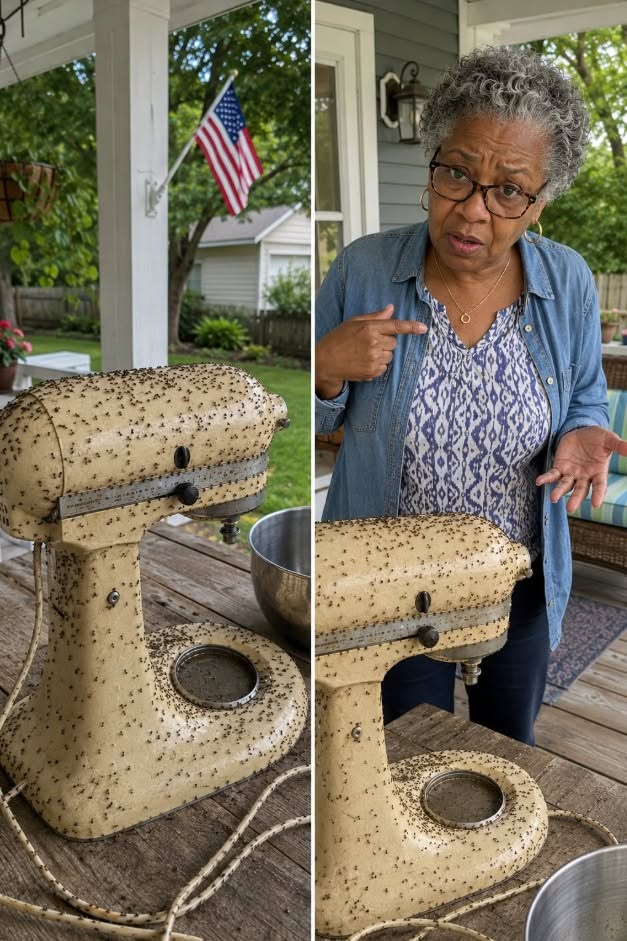
There was dried batter across the side.
Sticky frosting around one of the controls.
The bowl hadn’t been properly washed.
And the cord was loosely wrapped around the base.
I carried it inside.
“Unbelievable,” I muttered.
But the dirt wasn’t the worst part.
I Plugged It In
Nothing.
I checked the outlet.
Still nothing.
I unplugged it and tried another socket.
The mixer made a strange sound, struggled for a second, and stopped.
My stomach dropped.
I tried again.
Same thing.
The mixer that had worked perfectly before I lent it to Marlene was now broken.
For a few moments, I simply stood there staring at it.
Then my phone buzzed.
It was Marlene.
“Left your mixer outside! Thanks again 😊”
That smiley face nearly did me in.
I Asked Her What Happened
I called her.
“Hey,” she answered cheerfully.
“Marlene, something’s wrong with the mixer.”
Silence.
“What do you mean?”
“It isn’t working.”
Another pause.
“Oh. Yeah. It started making a weird noise yesterday.”
I couldn’t believe how casually she said it.
“What happened?”
“I don’t know. We were making dough and it just stopped.”
“And you didn’t think you should tell me?”
“Well, I figured it’s pretty old.”
There it was.
It’s pretty old.
As though that somehow made it okay.
I reminded her that I’d specifically told her the mixer had belonged to my mother.
Her response?
“I mean, appliances don’t last forever.”
That’s When Something Changed
Normally, I would have avoided confrontation.
I would have said:
“It’s okay.”
Then I’d hang up and quietly feel angry for three weeks.
But standing there looking at dried batter stuck to something my mother had cared for all those years, I realized this wasn’t really about a mixer.
It was about respect.
Marlene hadn’t just returned something damaged.
She hadn’t even bothered to clean it.
She hadn’t apologized.
She hadn’t told me it broke.
She had simply left it outside and expected me to deal with it.
And suddenly I remembered every other thing I’d lent her.
The missing lid.
The dirty roasting pan.
The ladder I’d practically had to retrieve myself.
I’d been teaching Marlene how she could treat my belongings.
And I’d done it every time I smiled and said:
“No problem.”
So I Made a Decision
I didn’t yell.
I didn’t insult her.
I didn’t demand money immediately.
Instead, I said:
“Marlene, I need you to come over.”
“For what?”
“I want to show you something.”
Ten minutes later, she walked onto my porch.
I had placed the mixer on a small table.
She looked at it.
“I told you it stopped working.”
“I know.”
I pointed to the dried food covering the machine.
“You also returned it like this.”
She shrugged.
“We were busy.”
That answer confirmed everything I needed to know.
“I’m Not Lending You Anything Else”
Her expression changed.
“What?”
I kept my voice calm.
“I’ve lent you a lot of things this year. They come back late, dirty, or incomplete. This time, something important to me came back broken.”
“I didn’t break it intentionally.”
“I didn’t say you did.”
“Then what’s the big deal?”
I looked at her.
“The big deal is that when you borrow something, you’re responsible for treating it carefully and telling the owner if something happens.”
She crossed her arms.
“So what do you want me to do?”
I had already decided.
“First, I’m going to take the mixer to a repair shop. If the repair person says it was damaged through misuse, we’ll discuss the repair cost.”
She stared at me.
“And second?”
“There isn’t a second. I’m simply not lending you my things anymore.”
She Didn’t Like That
Marlene became defensive immediately.
“Wow. Over a kitchen mixer?”
“No.”
I shook my head.
“Over a pattern.”
That stopped her.
I listed everything.
The roasting pan returned greasy.
The cooler she’d kept for almost two weeks.
The missing slow-cooker lid.
The ladder.
The pressure washer.
She looked genuinely surprised that I remembered.
Of course I remembered.
I’d simply never said anything.
Finally, she muttered:
“I didn’t realize you were keeping score.”
That sentence bothered me.
“I wasn’t keeping score, Marlene. I was noticing.”
Then She Said Something Unexpected
She became quiet.
After a moment, she looked at the mixer again.
“Was it really your mom’s?”
“Yes.”
“How long did she have it?”
“More than thirty years.”
Marlene’s expression changed.
For the first time since the conversation started, she seemed to understand why I was upset.
“I didn’t know it meant that much to you.”
“I told you when you borrowed it.”
She looked down.
“You did.”
And then, finally:
“I’m sorry.”
It wasn’t a dramatic apology.
But at least it was an apology.
The Repair Shop Called Two Days Later
I had prepared myself for bad news.
The technician explained that one of the internal components had failed.
The good news?
The mixer could be repaired.
I can’t describe the relief I felt.
I asked whether we’d done something wrong.
He couldn’t say with certainty.
Given the mixer’s age, normal wear could have contributed.
That mattered to me.
I didn’t want to blame Marlene for damage she might not actually have caused.
So I didn’t ask her to pay for the repair.
But my new boundary remained.
A Week Later, She Knocked Again
I opened the door.
Marlene stood there holding something.
My missing slow-cooker lid.
I stared at it.
“Where did you find that?”
She laughed awkwardly.
“Apparently it was in the back of one of my cabinets.”
Then she handed me a small bag.
Inside was a box of cookies.
“I made these,” she said.
“With your own mixer?”
She laughed.
“Yes.”
Then she became serious.
“I’m sorry about your mom’s mixer. And the other stuff.”
I thanked her.
Before leaving, she said:
“I guess I’m going to have to start buying my own things.”
I smiled.
“That might be a good idea.”
The Mixer Came Home
When I picked it up from the repair shop, I cleaned it carefully.
I removed the remaining dried batter.
I polished the bowl.
Then I placed it back on my kitchen counter.
A few days later, I decided to test it.
I made my mother’s chocolate cake.
When I switched the mixer on, that familiar sound filled the kitchen again.
And for some reason, I started crying.
Not because of Marlene.
Because suddenly I remembered being eight years old, standing on a chair beside my mother while she let me scrape cake batter from the bowl.
Some objects really are more than objects.
But I Learned Something Else
For years, I thought being a good neighbor meant always saying yes.
Need my ladder?
Sure.
Need my cooler?
Of course.
Need my pressure washer?
Take it.
But kindness without boundaries can slowly become resentment.
You say yes because you don’t want to seem difficult.
Then you become frustrated when people don’t treat your belongings the way you would.
Sometimes the healthier response is simply:
“Sorry, I don’t lend that out.”
You don’t need an elaborate excuse.
You don’t need to be angry.
And you don’t need the other person to agree with your decision.
Saying No Doesn’t Make You a Bad Neighbor
I still help Marlene.
When she was sick, I brought her soup.
When a package arrived while she was away, I kept it safe.
When her car battery died, I helped her find someone with jumper cables.
We’re still neighbors.
We’re actually getting along better than before.
The difference is that now there are boundaries.
And strangely enough, once I started respecting my own boundaries, she started respecting them too.
The Lesson Wasn’t Really for Marlene
When I first saw that dirty, broken mixer sitting on my porch, I thought:
“She needs to learn a lesson.”
Looking back, I think I was the one who needed it.
Marlene needed to learn how to respect borrowed belongings.
But I needed to learn that repeatedly allowing behavior that bothered me wasn’t kindness.
It was avoidance.
Sometimes people don’t realize they’ve crossed your boundary because you never told them where the boundary was.
One Old Mixer Changed Everything
My mother’s mixer is back where it belongs.
It still has scratches.
The paint is still faded.
And someday, it probably will stop working permanently.
Nothing lasts forever.
But until that day comes, I’ll continue using it.
I’ll make birthday cakes.
I’ll make cookies.
I’ll make Mom’s chocolate cake.
And if someone knocks on my door and asks:
“Can I borrow your mixer?”
I’ll smile politely.
And say:
“Sorry. That one’s staying right here.” ❤️