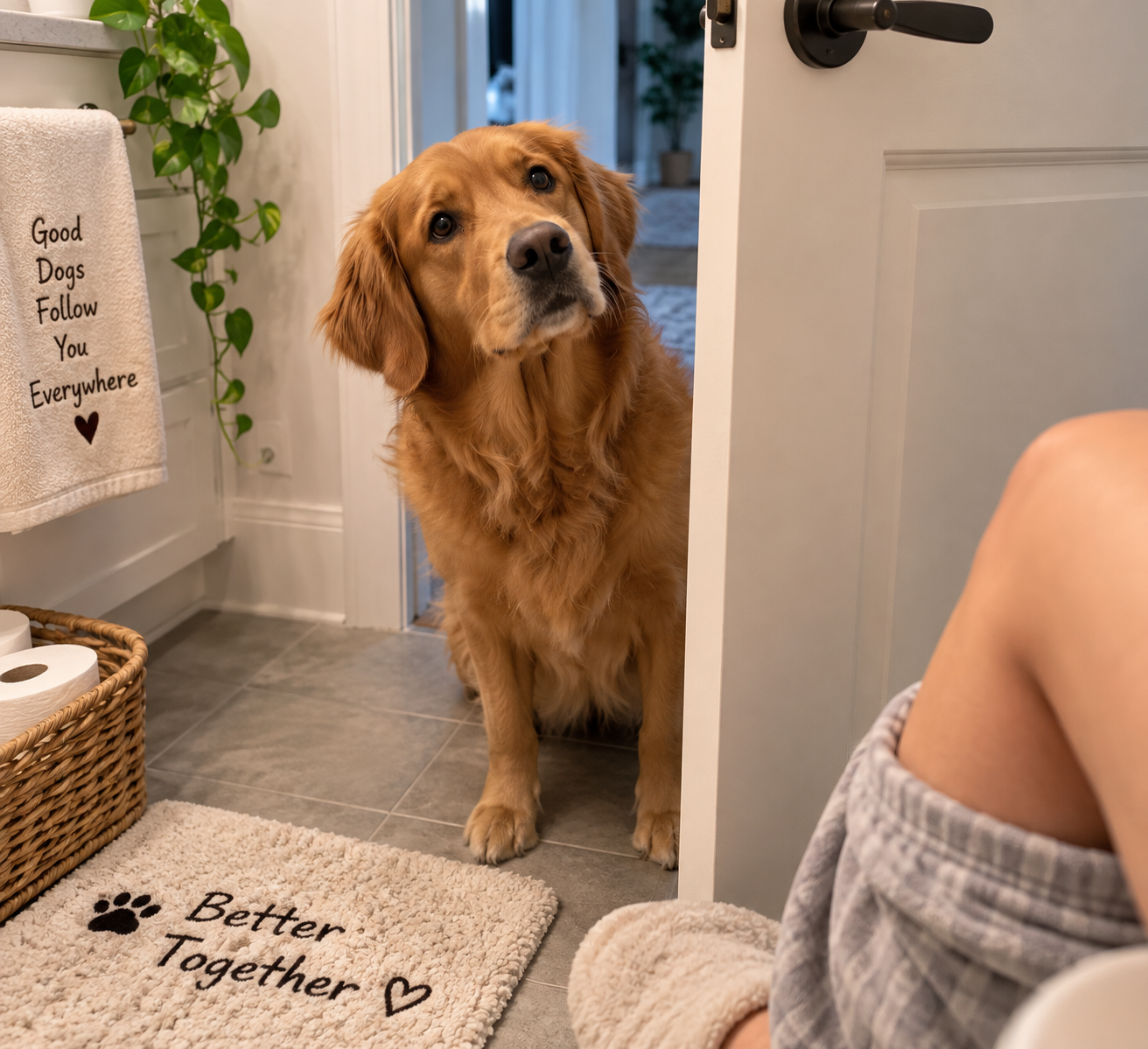
You stand up from the couch and walk toward the bathroom.
A few seconds later, you hear tiny footsteps behind you.
You close the door—and suddenly there’s a nose waiting on the other side.
Sound familiar? 🐕🚪
Many dog owners know the feeling of having a four-legged shadow who follows them from room to room—even into the bathroom.
It can seem funny, strange, or sometimes a little excessive. But in many cases, your dog’s behavior has a perfectly understandable explanation.
From companionship and routine to simple curiosity, there are several reasons your dog may insist on joining you during one of the few moments when you’d prefer some privacy.
And sometimes, how your dog follows you can tell you more than the fact that they follow you at all.
1. Your Dog Simply Wants to Be Near You
The simplest explanation may also be the most common:
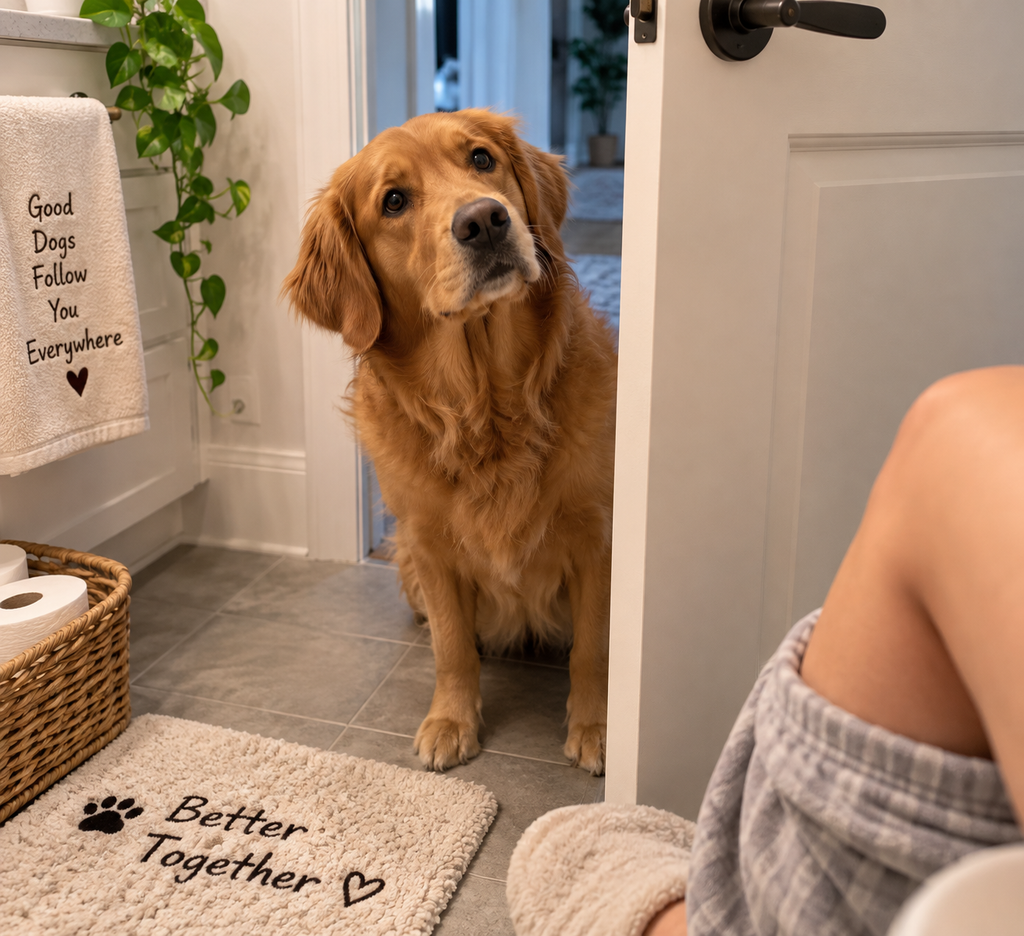
Your dog likes being with you.
Dogs are social animals, and many form strong bonds with the people they live with.
If your dog spends much of the day near you, following you into the bathroom isn’t necessarily a special bathroom-related behavior.
You’re moving somewhere.
Your dog notices.
And naturally, they come along.
For them, following you down the hallway may be no different from following you into the kitchen or bedroom.
2. You’ve Accidentally Made It Part of Their Routine
Dogs can become remarkably good at learning household patterns.
Think about your morning.
Maybe you wake up, walk into the bathroom, get dressed, and then take your dog outside.
Or perhaps your evening bathroom routine happens shortly before their final walk or bedtime treat.
Over time, your dog can begin associating one action with whatever happens next.
So when you stand up and walk toward the bathroom, your dog may think:
“Something is about to happen, and I don’t want to miss it.”
The bathroom visit may simply be one step in a routine your dog has memorized.
3. They’re Curious About What You’re Doing
To you, going to the bathroom is completely uninteresting.
To your dog?
A closed door can suddenly become the most fascinating thing in the house.
Dogs explore their environment through smell, sound, observation, and movement.
If you regularly allow your dog to follow you everywhere, closing one particular door can make that room even more interesting.
They may wonder:
Where did you go?
Why can’t I come?
What’s happening in there?
Sometimes there’s no deep psychological explanation.
Your dog may simply be curious.
4. Following You May Have Been Rewarded
Here’s something many owners don’t realize.
You can reinforce a behavior without intentionally training it.
Imagine your dog follows you into the bathroom.
You look down and say:
“Why are you following me again?”
Then you pet them.
From your perspective, you’re just talking to your dog.
From your dog’s perspective, following you resulted in:
attention + eye contact + affection.
That’s a pretty good reward.
If this happens repeatedly, your dog may learn that staying close to you produces positive attention.
5. Your Dog May Be Looking for Something
Let’s be practical.
Dogs aren’t always following us because of a profound emotional connection.
Sometimes they’re hoping something good will happen.
Maybe you keep treats nearby.
Maybe walking into a certain room usually means you’re getting ready to go outside.
Maybe your dog has learned that after you shower, breakfast happens.
Dogs are excellent observers of patterns that benefit them.
What looks like:
“My dog can’t stand being away from me.”
might occasionally be closer to:
“My dog thinks this routine ends with breakfast.” 😄
6. They May Feel Safer Near You
Some dogs naturally prefer staying close to a familiar person, particularly in unfamiliar or stimulating environments.
If there are visitors in the house, unusual noises outside, construction nearby, fireworks, or another change in the environment, you may notice your dog following you more closely than usual.
In those situations, proximity to you may be reassuring.
This is especially worth considering when the behavior suddenly becomes more intense.
The change may matter more than the behavior itself.
7. Is Your Dog “Protecting” You?
You’ll often see social-media posts claiming dogs follow people into the bathroom because they believe their owner is vulnerable and need to guard them.
That’s a cute explanation.
But don’t automatically assume it’s the reason.
A dog standing near the bathroom door could be staying close because of attachment, habit, curiosity, learned reinforcement, anticipation, or many other factors.
Some dogs certainly display guarding or watchful behavior, but you can’t determine your dog’s motivation simply because they followed you into one room.
Look at the dog’s overall body language and behavior instead.
8. Why Does My Dog Sit Outside the Bathroom Door?
This is another common variation.
You close the door.
Your dog doesn’t bark or scratch.
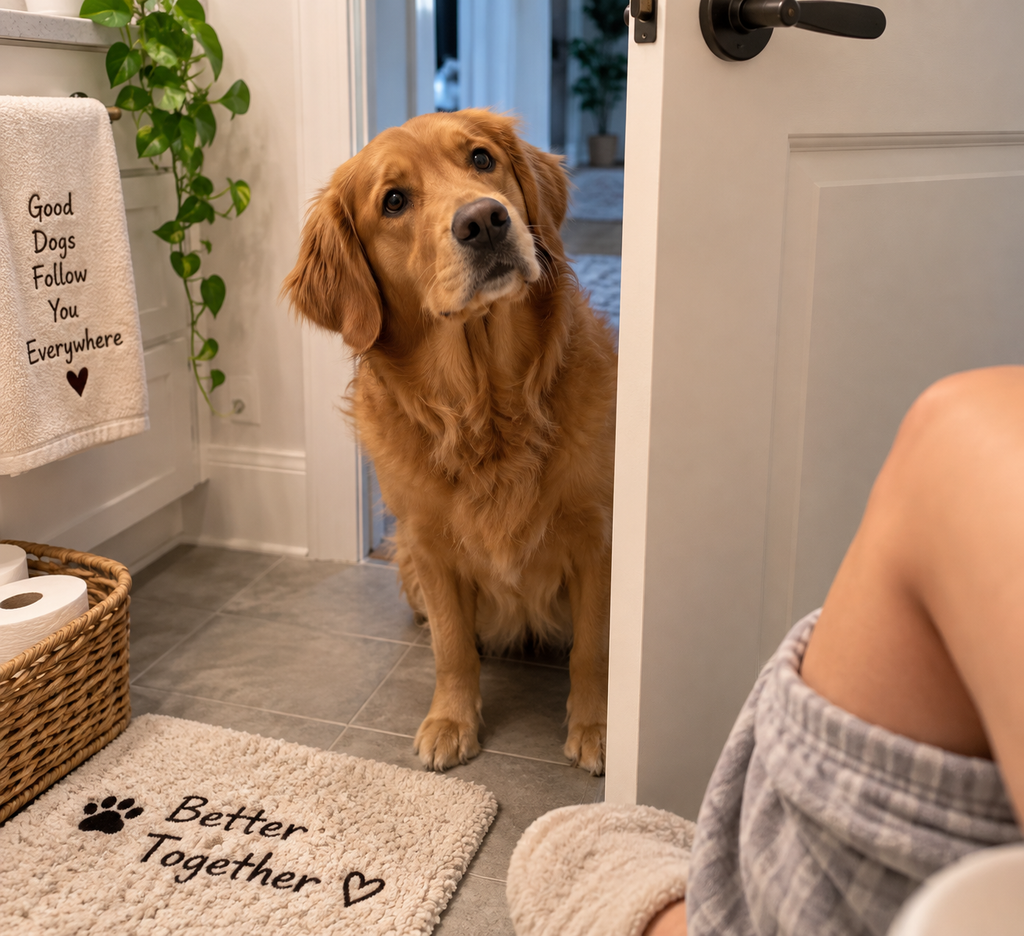
They simply lie down outside and wait.
For many dogs, this can be ordinary proximity-seeking behavior.
They know where you are.
They expect you to come back.
So they wait nearby.
If your dog is relaxed—loose body, normal breathing, calm posture—and simply gets up when you return, there’s usually a big difference between that and a dog showing obvious distress.
9. When Following You Could Signal Anxiety
Following isn’t automatically a sign of separation anxiety.
That’s important.
A dog can love following their owner and still be perfectly comfortable when left alone.
Separation-related distress involves more than simply wanting to stay close.
According to the ASPCA, signs associated with separation anxiety can include behaviors such as persistent barking or howling, destructive behavior, attempts to escape, pacing, and inappropriate elimination when the dog is separated from its guardian. ASPCA guide to separation anxiety in dogs
So ask yourself:
What happens when I actually leave?
If your dog calmly sleeps, plays with a toy, or relaxes, bathroom-following alone isn’t enough to conclude that there’s an anxiety disorder.
10. Pay Attention If the Behavior Suddenly Changes
Suppose your dog has been independent for years.
Then suddenly they won’t let you out of their sight.
They follow you to the bathroom.
They follow you into the kitchen.
They wake up whenever you move.
They seem restless or behave differently in other ways.
That’s worth paying attention to.
Behavior changes can sometimes accompany stress, environmental changes, discomfort, aging, or medical issues.
This doesn’t mean that sudden clinginess automatically indicates illness.
It means a significant unexplained change from your dog’s normal behavior deserves attention, especially if it’s accompanied by changes in appetite, sleep, movement, bathroom habits, vocalization, or general activity.
In those circumstances, contacting your veterinarian is a sensible next step.
Should You Stop Your Dog From Following You?
Not necessarily.
If you don’t mind the company and your dog is otherwise relaxed and healthy, there’s usually no need to turn bathroom privacy into a training project.
But perhaps you’d prefer five minutes alone.
That’s reasonable too.
You can encourage your dog to become comfortable staying elsewhere.
Give them a comfortable bed or designated resting spot.
Reward calm behavior when they remain there.
A food puzzle or appropriate chew can also give them something enjoyable to do while you’re occupied.
The goal isn’t to punish your dog for wanting to be near you.
It’s simply to teach them that being apart for short periods is normal too.
Avoid Making Departures Dramatic
If your dog becomes mildly excited whenever you move around the house, try not to turn every separation and reunion into a major event.
Calm routines can help make your movements feel ordinary.
Walk into another room.
Come back.
Continue with your day.
Your dog can gradually learn that you disappearing behind a door doesn’t mean anything exciting—or frightening—is happening.
For dogs with genuine separation-related problems, however, treatment can be more involved, and professional guidance may be appropriate. The American Veterinary Medical Association recommends discussing behavior concerns with a veterinarian, since behavioral changes can sometimes have medical contributors. AVMA pet behavior guidance
Why Do Some Dogs Follow One Person More Than Others?
In a household with several people, a dog may still choose one person as their favorite shadow.
That can happen for many reasons.
Perhaps that person handles most of the feeding.
Maybe they take the dog on walks.
Maybe they play together more often.
Or perhaps their daily schedules simply overlap more.
Dogs learn which people are associated with things they value, including food, attention, play, walks, and comfort.
So if your dog follows you but rarely follows your partner, don’t immediately interpret it as a ranking of who they “love more.”
Behavior is usually more complicated than that.
What If Your Dog Follows You Everywhere?
Bathroom.
Kitchen.
Bedroom.
Laundry room.
Garage.
Back to the kitchen.
Still there. 🐕😂
For many dogs, being a “Velcro dog” is simply part of their normal personality and relationship with their household.
The key question isn’t:
“Does my dog follow me?”
It’s:
“Can my dog also relax without me?”
A dog that enjoys following you but can comfortably rest elsewhere is very different from a dog that becomes distressed whenever physical access to you is blocked.
The Bathroom Test
Next time your dog follows you, pay attention to what happens rather than immediately interpreting it.
Does your dog calmly lie down?
Do they stare at you waiting for something?
Do they immediately head toward the kitchen afterward?
Do they scratch frantically when you close the door?
Do they appear relaxed or distressed?
Those details provide much more information.
You might discover your dog’s mysterious bathroom habit isn’t mysterious at all.
They may simply have learned your routine better than you realized.
The Bottom Line
So why does your dog follow you to the bathroom?
There isn’t one universal answer.
For many dogs, it’s a combination of social attachment, curiosity, routine, learned behavior, and anticipation of what happens next.
And yes, sometimes your dog may simply prefer being wherever you are.
The behavior becomes more concerning when it comes with significant distress when separated or represents a sudden unexplained change from your dog’s normal personality.
Otherwise, that furry face waiting outside the bathroom door may be communicating something much simpler:
“You got up, so I got up too. Where are we going next?” 🐶❤️