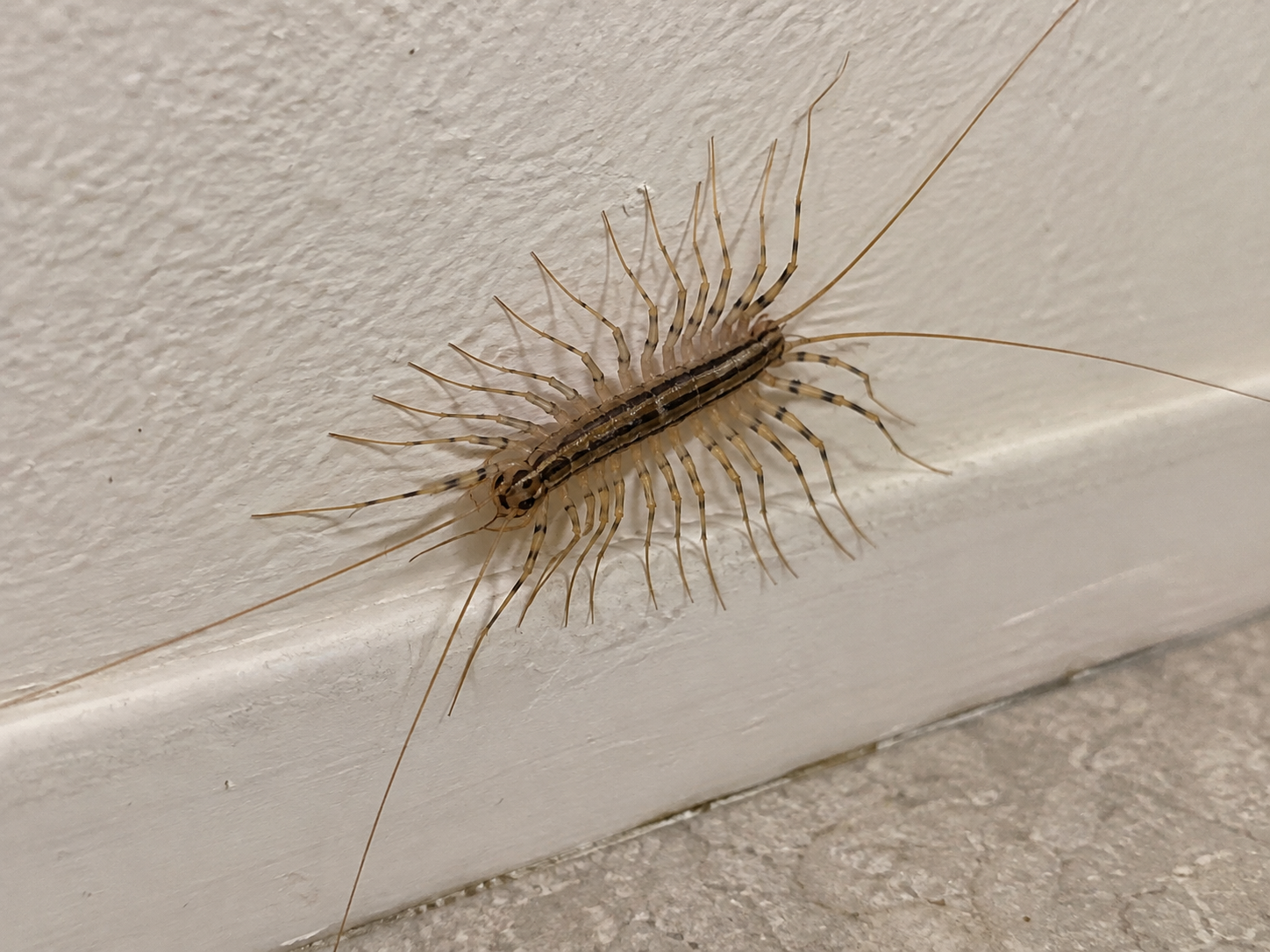
You walk into the bathroom late at night, turn on the light, and suddenly something with what looks like dozens of legs races across the floor and disappears under the cabinet.
For many people, the first reaction is simple: panic.
That strange-looking creature is probably a house centipede (Scutigera coleoptrata). Despite its unsettling appearance and incredible speed, seeing one doesn’t necessarily mean your home is dirty—or that the centipede itself is your biggest problem.
In fact, it may be telling you something useful about what’s happening elsewhere in your home.
First: What Exactly Is a House Centipede?
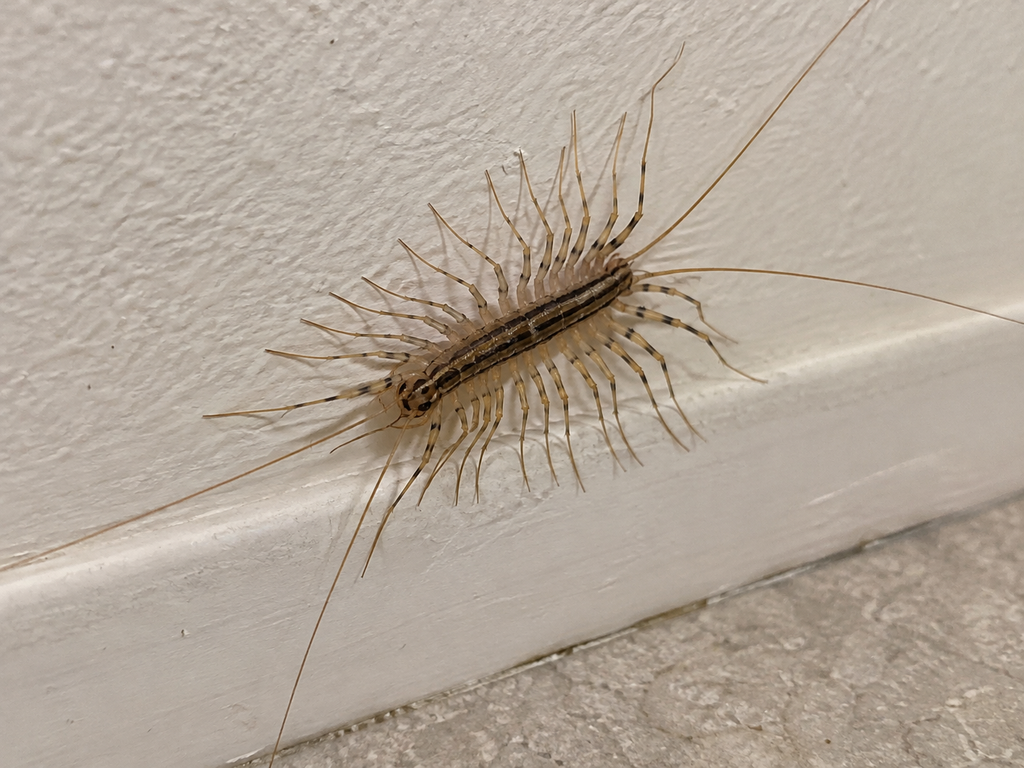
House centipedes are arthropods, not insects. Adults have 15 pairs of long legs, along with long antennae and a flattened, grayish-yellow to brown body that often has darker stripes. Their body is only around 1 to 1½ inches long, although their legs and antennae make them appear much larger.
They’re also surprisingly fast.
That’s why you often see one sprint across a bathroom wall or basement floor before disappearing into a crack.
House centipedes usually hide during the day and come out at night to hunt.
But here’s where things get interesting.
Seeing One Could Mean There Are Other Bugs Nearby
House centipedes are predators.
They don’t enter your kitchen looking for crumbs, and they aren’t interested in eating your furniture.
They’re looking for other small creatures to eat.
Their prey can include:
- Cockroaches
- Silverfish
- Carpet beetle larvae
- Spiders
- Firebrats
- Other small arthropods
Penn State Extension notes that seeing house centipedes frequently can indicate that prey arthropods are abundant somewhere in the home.
So if you see one house centipede occasionally, there may be little reason for concern.
But if you’re suddenly seeing them again and again, it may be worth asking:
What are they finding to eat?
That could be the more important question.
They May Also Be Telling You Something About Moisture
There’s another reason house centipedes may like your home:
moisture.
They’re strongly associated with dark, damp areas and are commonly found around bathrooms, sinks, tubs, basements and other humid locations.
If you’re repeatedly finding them in one part of your house, check for:
- Leaking pipes
- Condensation
- Damp basement walls
- Poor bathroom ventilation
- Excess indoor humidity
- Moist crawl spaces
- Water collecting near the foundation
A centipede isn’t proof that you have a plumbing leak. But repeated sightings in a damp area are a good reason to inspect the space more carefully.
Here’s the Surprising Part: They’re Actually Helping You
This is probably not what you want to hear while watching one run across your bedroom floor.
But house centipedes can actually be beneficial predators.
They hunt other household arthropods, including some species that homeowners would generally consider much more troublesome. University extension sources describe them as beneficial because of this predatory behavior.
They don’t chew through your wooden furniture.
They don’t eat your clothing.
And they aren’t damaging the structure of your house.
So that terrifying creature disappearing behind the baseboard may actually be hunting something you’d like even less.
Should You Kill a House Centipede?
Not necessarily.
If you see only an occasional house centipede and can tolerate it, there’s generally no urgent reason to treat your entire home.
University of Maryland Extension even suggests simply moving an unwanted centipede outdoors.
If you don’t want to touch one—and most people understandably don’t—a container can be used to capture it without direct handling.
A vacuum is another option for removing individual centipedes. Washington State University recommends nonchemical approaches first, including vacuuming, reducing moisture and blocking entry points.
But if you’re seeing many of them, simply removing each centipede may not solve the underlying issue.
Why Are There So Many in My House?
If house centipedes keep appearing, think about the three things that make your home attractive:
1. Food
A house centipede needs prey.
If there’s a steady population of silverfish, cockroaches, spiders or other arthropods, there’s a reason for a predator to stay.
Penn State recommends addressing the centipede’s food source as an important part of controlling a population.
2. Moisture
Bathrooms, basements and crawl spaces can provide the humid conditions they prefer.
Reducing humidity can make those areas less attractive.
3. Places to Hide
Cracks, crevices, cardboard boxes and clutter can provide sheltered areas.
Removing unnecessary clutter and sealing openings can reduce hiding places.
Where Should You Look?
If you recently spotted one, don’t immediately tear your entire house apart.
Start with areas where house centipedes are most likely to find moisture, prey or shelter.
Check around:
Basements: Look behind stored boxes, near foundation cracks and around damp areas.
Bathrooms: Inspect around tubs, sinks, toilets and plumbing penetrations.
Crawl spaces: Poor ventilation and moisture can create favorable conditions.
Closets and storage areas: Especially those in basements or other humid parts of the home.
Around pipes and wall openings: Small gaps can provide routes between hiding areas.
House centipedes can also shelter beneath stored cardboard boxes on concrete slabs and inside cracks or openings in masonry.
How to Make Your Home Less Attractive to Them
If you don’t want these many-legged visitors racing across your floor, focus on changing the conditions that allow them to thrive.
Start by fixing leaks and reducing unnecessary moisture. A dehumidifier can be useful in persistently humid basements or other damp spaces.
Then reduce clutter, particularly cardboard boxes stored directly on basement floors.
Seal cracks and crevices around walls, foundations, windows, doors and utility penetrations where practical.
Finally, investigate other insects in your home. Sticky monitoring traps placed in areas of activity can help reveal what other arthropods are present.
Getting rid of the centipede’s food supply can make your home much less attractive to it.
Do House Centipedes Bite?
They can, but bites are uncommon.
House centipedes are generally shy and more interested in escaping from people than confronting them. University of Minnesota Extension notes that bites are rare; if one does occur, some swelling may result, but pain generally isn’t severe.
Still, you shouldn’t intentionally handle one with bare hands.
Give it space or use a container or vacuum if you want to remove it.
Does One Centipede Mean You Have an Infestation?
No.
Seeing one house centipede does not automatically mean your house is infested.
An occasional individual can simply be present because your home provides temporary shelter, moisture or prey.
Repeated sightings are more informative.
If you’re seeing house centipedes frequently, especially in multiple rooms, that’s when it makes sense to investigate moisture levels and look for other household pests.
A large population can be a clue that there’s plenty of prey available.
One Mistake Many Homeowners Make
It’s easy to focus entirely on killing the creature you can see.
But imagine you have silverfish or another pest population hidden in a damp basement.
The house centipede is feeding on them.
You remove one centipede.
The moisture remains.
The prey remains.
Another centipede can eventually take its place.
That’s why long-term control should focus on the conditions supporting the problem, rather than only the centipede you happened to notice.
When Should You Consider Professional Help?
An occasional centipede usually doesn’t justify panic.
But consider having the situation investigated if you’re seeing them constantly, you suspect a significant cockroach or other pest problem, or you discover persistent moisture that you can’t identify or correct.
A qualified pest professional can help identify the prey insects and possible entry points. For unexplained dampness or leaks, the appropriate building or plumbing professional may be more useful.
So, What Is That Centipede Really Telling You?
The next time you see a house centipede sprint across the bathroom floor, remember this before reaching for your shoe:
The centipede itself may not be the real problem.
Its presence can point toward moisture, hiding places, or other small arthropods that are providing it with food.
And strangely enough, it’s also helping hunt some of those unwanted visitors.
So while nobody is asking you to welcome house centipedes as roommates, seeing one can be a useful reminder to take a closer look around your home.
Sometimes the creepy creature you notice is simply the clue that leads you to the problem you haven’t noticed yet.