For eleven years, I had learned to ignore the little things my daughter-in-law did when she was embarrassed by me.
The way she introduced me simply as “Nolan’s mother” while everyone else received a full introduction.
The way she sometimes looked at my clothes before we left the house.
The way she avoided talking about what I did for a living whenever her wealthy friends were around.
I never confronted her.
She was my son’s wife, and keeping peace in the family mattered more to me than proving a point.
But one Sunday afternoon at an exclusive country club, everything changed.
My daughter-in-law walked me through the dining room as though she wished I were invisible.
Then the club manager spotted me from across the room.
He immediately put down what he was carrying and walked straight toward our table.
My daughter-in-law smiled politely.
But what he said next made that smile disappear.
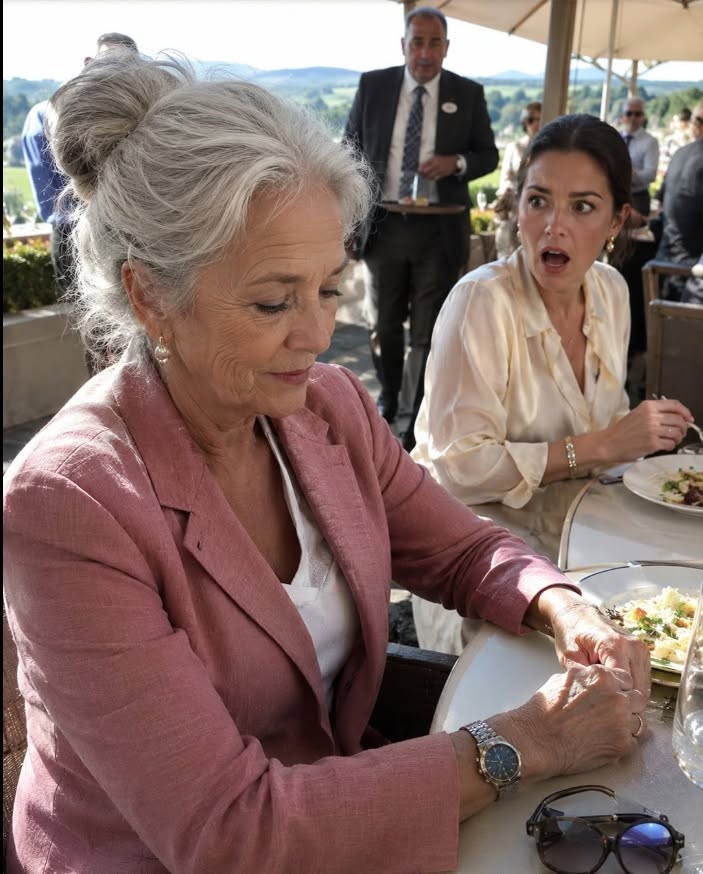
“Mom, Just Keep It Low-Key About Work”
My name is Harriet Clifton. I’m 71 years old, and my son Nolan has been married to Vivian for eleven years.
Vivian and I had never been particularly close.
She came from a very different world.
Her friends belonged to private clubs, attended charity events, and seemed to know exactly which restaurant had opened before everyone else did.
I lived more simply.
My house wasn’t enormous. My car was old but reliable, and I still went downtown several mornings a week because I enjoyed having something to do.
Vivian apparently assumed that meant I needed the money.
I never corrected her.
Five days before that Sunday lunch, Nolan called me.
“Mom, Vivian wants you to come to the country club with us.”
I was surprised.
Vivian rarely invited me when her friends would be there.
Then Nolan added something.
“Mom… just keep it low-key about work.”
I paused.
“Low-key?”
He sounded uncomfortable.
“Vivian’s friends ask a lot of questions. She doesn’t want to spend the whole afternoon explaining things.”
I understood exactly what he meant.
Vivian didn’t want me discussing my job.
“Don’t worry,” I said. “I’ll behave myself.”
The Moment We Arrived, I Knew Why
The club was beautiful.
Perfectly trimmed gardens surrounded the entrance, and inside, everything seemed designed to remind visitors that membership was a privilege.
Vivian immediately spotted several friends.
She hugged them and began making introductions.
“This is Caroline. Her husband runs an investment company.”
“This is Rebecca. She’s on the museum board.”
Then she reached me.
“And this is Harriet… Nolan’s mother.”
That was it.
I smiled and shook everyone’s hands.
If Vivian wanted to keep things simple, I wasn’t going to embarrass her.
We sat down for lunch.
The conversation moved from vacations to property prices, business, and charity events.
Then one of Vivian’s friends turned toward me.
“So, Harriet, what do you do?”
Before I could answer, Vivian jumped in.
“Oh, Harriet still helps out at a little office downtown.”
I looked at her.
“Helps out?”
Vivian smiled.
“She likes keeping busy.”
The woman nodded politely and changed the subject.
I said nothing.
Then One of Her Friends Asked Another Question
Later, another woman asked where my office was.
I began explaining, but Vivian interrupted again.
“It’s above an old dry cleaner,” she said with a small laugh. “Nothing exciting.”
This time, even Nolan looked uncomfortable.
I could have corrected her.
I could have told everyone exactly why I went to that office three mornings a week.
But I didn’t.
Some lessons are more powerful when you don’t force them.
And, as it turned out, I wouldn’t have to wait long.
The Club Manager Suddenly Stopped
We had almost finished lunch when I noticed a man walking across the terrace.
He was carrying a tray and speaking with one of the servers.
Then he looked toward our table.
He stopped.
For a second, I wasn’t sure he had recognized me.
Then he handed the tray to the server and began walking directly toward us.
Vivian straightened in her chair.
The manager reached our table and smiled.
“Mrs. Clifton?”
I smiled back.
“Hello, Thomas.”
Vivian looked from him to me.
“You two know each other?”
Thomas seemed confused by the question.
Then he laughed.
“Ma’am, I don’t think you know who your mother-in-law actually is.”
The table went silent.
Vivian’s Expression Completely Changed
Thomas pulled out an empty chair but remained standing beside us.
“I’ve been hoping to see you here again,” he told me. “We haven’t forgotten what you did for this place.”
Vivian stared at him.
“What she did?”
I could already see Nolan beginning to smile.
He knew.
Of course he knew.
Thomas looked around the table.
“Mrs. Clifton wasn’t simply working in some little office downtown.”
Then he turned toward me.
“Do you want to tell them, or should I?”
I laughed.
“You’ve already started. You might as well finish.”
The Office Above the Dry Cleaner Wasn’t What Vivian Thought
More than four decades earlier, my husband and I had started a small property-management business.
It wasn’t glamorous.
In the beginning, we worked long days, answered our own phones, cleaned properties ourselves, and reinvested almost everything we earned.
Eventually, that little company grew.
We began acquiring commercial properties.
Then apartment buildings.
Then land.
Years later, when my husband retired, I continued managing several investments from the same modest office where we’d started.
The office above the dry cleaner.
I never saw a reason to move.
The rent was reasonable, the location was convenient, and after more than forty years, the place felt like home.
But that wasn’t the part that shocked Vivian.
Thomas Revealed the Connection to the Club
Years earlier, the country club had gone through a difficult financial period.
The property needed major renovations, and several planned projects had stalled.
A group of local investors became involved.
I was one of them.
My company had helped restructure part of the property’s financing and supported renovations that allowed the club to modernize without losing its character.
I hadn’t done it for recognition.
And I certainly hadn’t expected anyone to remember me years later.
Thomas did.
“We probably wouldn’t be sitting on this terrace today without people like Mrs. Clifton,” he said.
Nobody spoke.
Then Vivian finally looked at me.
“You never told me.”
I took a sip of water.
“You never asked.”
Nolan Couldn’t Hide His Reaction
My son looked down at the table, trying not to laugh.
Vivian turned toward him.
“You knew?”
“She’s my mother,” he replied. “Of course I knew.”
“But why did you let me think—”
Nolan interrupted her.
“Think what?”
That question hung in the air.
Because suddenly Vivian had to confront something uncomfortable.
Nobody had lied to her.
She had simply made assumptions.
She saw my old car and assumed I couldn’t afford a new one.
She saw my small house and assumed I couldn’t afford a larger one.
She heard “office above a dry cleaner” and decided my work couldn’t possibly be important.
And because I never corrected her, those assumptions became facts in her mind.
The Conversation on the Way Home Was Very Different
Vivian was unusually quiet after lunch.
Eventually, she turned toward me.
“Harriet, I’m sorry.”
I looked at her.
“For what?”
She hesitated.
“For making assumptions about you.”
That answer mattered more to me than an apology for one particular comment.
I didn’t want Vivian to respect me because she had discovered I had money or business experience.
That would miss the entire point.
So I told her something I’d learned many years earlier:
“Don’t treat people well because you discover they’re important. Treat them well before you know whether they’re important.”
She didn’t answer immediately.
But I could tell she understood.
After That Sunday, Something Changed
Our relationship didn’t magically become perfect.
Real relationships rarely work that way.
But Vivian stopped interrupting when people asked me questions.
She stopped introducing me only as “Nolan’s mother.”
And, more importantly, she became more careful about judging people based on clothes, cars, jobs, or appearances.
A few months later, we attended another gathering together.
Someone asked what I did.
Vivian looked at me and smiled.
Then she said:
“You should ask Harriet yourself. She has quite a story.”
For the first time, I felt that she wasn’t embarrassed to have me beside her.
And strangely enough, I didn’t need her wealthy friends to know anything about my bank account, my investments, or my past.
I only wanted the same thing most people want:
To be treated with respect before anyone knows what we have, who we know, or what we’ve accomplished.
Because the person sitting quietly at the end of the table may have a story you know absolutely nothing about.