What began as an ordinary drive quickly turned into a confrontation Victoria never expected.
She had been driving along a quiet country road when flashing lights suddenly appeared in her rearview mirror. She checked her speed. Nothing seemed wrong.
Still, she pulled over.
At first, Victoria thought it would be a routine traffic stop lasting only a few minutes. But when two officers approached her car, their attitude immediately made her uneasy.
She had no idea that minutes later she would be standing beside her vehicle in handcuffs — and that something hidden in her pocket would completely change the situation.
A Routine Stop Takes an Unexpected Turn
Victoria rolled down her window as one of the officers approached.
“License and registration.”
She handed over the documents without arguing. The officer examined them, looked around the vehicle, and then returned his attention to her.
Victoria waited for an explanation.
“Why did you stop me?” she asked.
“Routine check,” the officer replied.
The answer confused her. As far as she knew, she hadn’t been speeding or driving dangerously.
She calmly asked what the officers were checking and why she had been pulled over.
Instead of giving her a clear explanation, the conversation became increasingly tense.
Then came an order she hadn’t expected.
“Get out of the vehicle.”
Victoria Reached for Her Phone
Victoria stepped out but decided to record what was happening on her phone.
One of the officers noticed.
“Put that phone away.”
Victoria questioned why she needed to stop recording. Within moments, the encounter escalated.
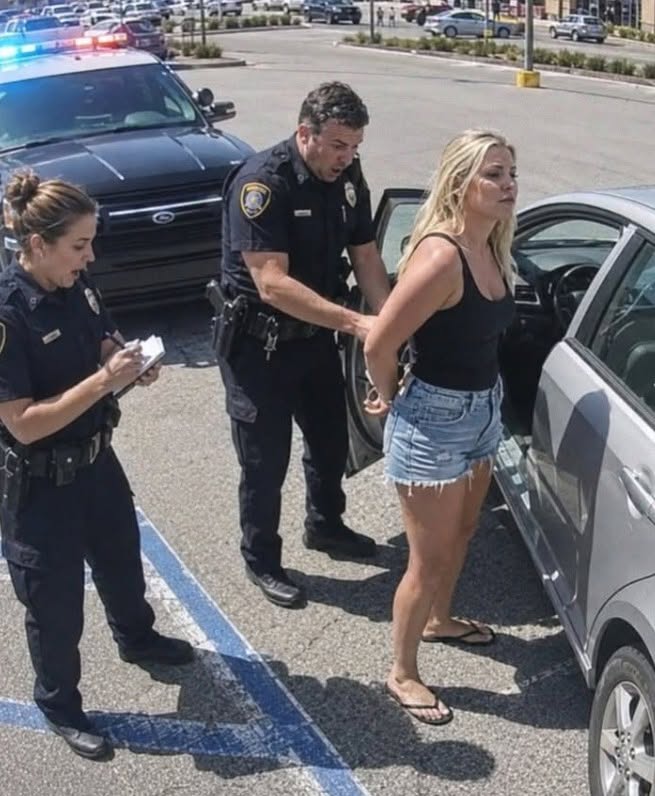
One officer grabbed her arm and moved her toward the car. Her hands were placed behind her back, and she was handcuffed.
Victoria didn’t scream or try to run.
Instead, she looked at the officers and said something that briefly changed the mood.
“Are you sure you want to continue?”
The officers apparently weren’t impressed.
But Victoria knew something they didn’t.
“Take Something Out of My Pocket”
With her hands restrained behind her back, Victoria suddenly made a strange request.
“Fine. But take something out of the right pocket of my shorts. I can’t do it myself.”
The two officers looked at each other.
For the first time since the stop began, they seemed uncertain.
“What’s in there?” one asked.
“Take it out and see for yourselves.”
One officer cautiously reached toward her pocket.
What he pulled out made him stop.
His expression changed.
The confidence that had defined the encounter only moments earlier suddenly disappeared.
The Detail They Hadn’t Expected
Inside Victoria’s pocket was identification connected to her professional work.
She wasn’t simply a frightened driver who had no idea how these situations worked. She had a background that meant she understood procedures, documentation, and the importance of preserving evidence.
More importantly, the encounter had already been recorded.
The officers suddenly realized that every decision they had made could potentially be reviewed afterward.
Victoria remained calm.
She didn’t threaten them. She didn’t celebrate.
She simply asked them to look carefully at what they were holding.
The atmosphere changed almost immediately.
Everything Suddenly Became More Formal
Questions replaced accusations.
The officers began discussing what had happened and reviewing the circumstances of the stop.
Victoria asked why she had originally been pulled over and what violation she was suspected of committing.
This time, her questions were taken much more seriously.
After several tense minutes, the handcuffs were removed.
What had started as an apparently simple roadside encounter had become something none of them expected.
But Victoria wasn’t finished.
What Happened After the Traffic Stop?
After leaving the scene, Victoria reportedly documented everything she remembered about the encounter.
Times.
Statements.
Actions.
And the sequence in which everything happened.
The point wasn’t revenge. It was accountability.
Whether someone is an ordinary driver, a lawyer, a journalist, or someone familiar with law enforcement procedures shouldn’t determine how they are treated during a traffic stop.
That was ultimately the most important part of Victoria’s story.
The officers’ behavior shouldn’t change because of who someone turns out to be.
It should be professional from the beginning.