Few laundry accidents are more frustrating than discovering orange, yellow, pink, or white spots on a favorite dark shirt after cleaning with bleach.
At first glance, they look like ordinary stains.
So naturally, you may reach for stain remover, rubbing alcohol, vinegar, or another popular household remedy.
But there’s an important fact to understand first:
A true bleach mark usually isn’t a stain at all.
Chlorine bleach can chemically remove or alter the dye that originally gave the fabric its color. Once that happens, washing the area won’t simply bring the missing color back. Clorox notes that color loss caused by contact with undiluted bleach cannot be reversed in the usual sense.
That doesn’t necessarily mean your shirt belongs in the trash.
Depending on the fabric, size of the damaged area, and original color, you may be able to disguise, recolor, redesign, or repurpose the garment surprisingly well.
Here’s how.
First, Understand What a Bleach “Stain” Really Is
Suppose you spill coffee on a navy-blue shirt.
The coffee adds foreign material to the fibers. If you use the correct stain-removal method, you may be able to remove that material and reveal the original blue underneath.
Bleach damage is fundamentally different.
When chlorine bleach contacts a colored fabric, it can alter or destroy the dye itself.
That’s why a black garment may turn orange, brown, reddish, yellow, or eventually very pale where bleach landed.
The discoloration isn’t necessarily something sitting on top of the fabric.
It’s often missing or chemically changed color.
That’s also why ordinary laundry detergent doesn’t make the spot disappear.
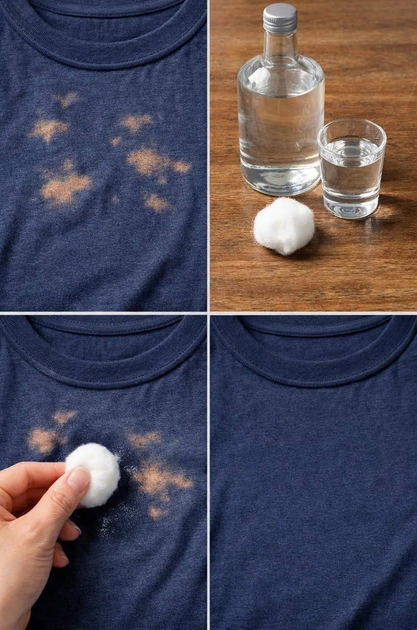
Can Rubbing Alcohol Remove a Bleach Spot?
This is where many viral clothing hacks become misleading.
Rubbing alcohol is useful for certain genuine stains—particularly some inks—but that doesn’t mean it can magically reconstruct fabric dye destroyed by chlorine bleach.
For example, Clorox recommends alcohol-based products as part of certain permanent-marker stain treatments because alcohol can help break up the ink that was added to the fabric.
That’s completely different from bleach removing the garment’s original dye.
So if your navy shirt has turned orange because chlorine bleach removed its blue dye, rubbing alcohol can’t simply regenerate the missing dye molecules.
At best, some DIY techniques may redistribute surrounding dye enough to make a very small mark less noticeable on certain fabrics.
Results are unpredictable, however, and rubbing can make the damaged area look worse.
What About the Cotton-Ball Trick Shown Online?
A common viral method suggests soaking a cotton ball in rubbing alcohol and gently rubbing from the unaffected colored fabric toward the bleached area.
The theory is that alcohol may loosen some surrounding dye and move it into the lighter patch.
It sounds clever.
And occasionally, someone may get a cosmetically improved result depending on the particular dye and fabric.
But this should not be described as actually removing a bleach stain.
Once bleach has permanently removed the original color, the reliable way to restore that color is generally to add color back, not try to wash the bleach mark away.
If you decide to experiment with any solvent-based method, always test it on an inconspicuous area first.
The Most Practical Fix for Tiny Bleach Spots: Add the Color Back
For a few small dots on a dark garment, one of the simplest solutions is surprisingly straightforward:
color the damaged area to match the surrounding fabric.
Even Clorox recommends a black permanent marker as a possible cosmetic solution for small bleach spots on black clothing, while noting that larger patches can be difficult to match and marker color may fade over time.
For black clothes, this is relatively easy because black fabric markers and permanent markers are widely available.
Other colors require more patience.
A navy shirt, for example, needs a marker or fabric dye that closely matches that particular shade of navy.
How to Repair a Small Bleach Spot With a Fabric Marker
For a small splash, start by washing and completely drying the garment so no bleach residue remains.
Find a fabric marker as close as possible to the garment’s original color.
Before touching the visible mark, test the marker somewhere hidden, such as inside the hem.
Let the test area dry completely.
Colors can look different when wet.
If the match looks good, lightly apply color to the center of the bleach mark.
Build the color gradually rather than saturating the area immediately.
Allow it to dry.
Then evaluate the shirt under normal lighting.
A second light application usually looks more natural than one heavy layer.
Why a Fabric Marker May Be Better Than an Ordinary Marker
A standard permanent marker can work as a quick repair, particularly on black fabric.
But a marker specifically designed for textiles may provide better durability and a more natural appearance.
The challenge isn’t simply making the spot dark.
It’s matching:
color, undertone, saturation, and how the fabric reflects light.
A black T-shirt is relatively forgiving.
Navy, burgundy, olive, charcoal, faded denim, and pastel colors can be harder.
What If There Are Many Bleach Spots?
If your shirt looks like the garment in the viral image—with multiple scattered marks—trying to individually color every spot may produce an uneven result.
At that point, you have several better options.
Option 1: Dye the Entire Garment
If the fiber content allows it, overdyeing the entire garment can help disguise widespread discoloration.
This works best when moving toward a darker color.
For example, a faded dark-blue cotton shirt might potentially be redyed navy or black.
The results depend heavily on the fiber composition and existing color.
Natural fibers such as cotton generally accept certain dyes differently from polyester and other synthetics, so choose a dye specifically designed for the garment’s fiber content and follow its instructions.
Option 2: Turn the Accident Into a Design
Instead of hiding the bleach marks, make them intentional.
You could transform scattered spots into:
a reverse tie-dye pattern, stars, flowers, a galaxy effect, abstract shapes, or another decorative design.
Bleach art and reverse tie-dye intentionally use controlled color removal to create patterns. Clorox publishes instructions for bleach-art projects but emphasizes using diluted bleach, monitoring the color change, and thoroughly rinsing afterward.
A ruined shirt can sometimes become a one-of-a-kind garment.
Option 3: Cover the Damage
If the bleach mark is concentrated in one area, consider covering it rather than recoloring it.
Embroidery can work beautifully.
So can:
iron-on patches, sew-on patches, appliqué, fabric paint, decorative stitching, or a small graphic.
This is particularly useful when the bleach has damaged more than just the color.
Check Whether the Fabric Itself Has Been Damaged
Bleach doesn’t only affect dye.
Strong or improperly used chlorine bleach can also damage fibers.
Clorox warns against applying full-strength bleach directly to fabric because concentrated bleach can cause permanent discoloration and weaken material.
Inspect the affected area carefully.
If it feels noticeably thinner, brittle, rough, or weak compared with the surrounding fabric, recoloring it won’t restore its structural strength.
A hole could eventually develop.
In that case, reinforcing the area with stitching or a patch may be more appropriate.
Don’t Put Undiluted Bleach Directly on Clothing
One of the easiest ways to prevent these accidents is also one of the most important:
Never pour full-strength chlorine bleach directly onto fabric.
Clorox’s laundry guidance says concentrated bleach should not be used directly on fabric; it should be appropriately diluted or dispensed according to the product and washing-machine instructions.
Even a bleach-safe white garment can be damaged by incorrect application.
Always read both the garment’s care label and the bleach product instructions.
Not Every Fabric Can Handle Chlorine Bleach
Another common mistake is assuming that anything white can safely be bleached.
Fiber content matters.
Clorox specifically advises avoiding chlorine bleach on materials including wool, silk, mohair, leather, and spandex.
Colored garments present an additional issue because dyes vary greatly in bleach resistance.
If you’re unsure whether a colored garment is bleach-safe, a colorfastness test on an inconspicuous area can reveal whether its dye changes when exposed to a properly diluted solution.
Never Mix Bleach With Random Household Cleaners
This is much more important than saving a shirt.
Do not experiment by mixing chlorine bleach with other household cleaning chemicals.
In particular, chlorine bleach should never be mixed with ammonia or acidic cleaners because dangerous gases can be produced.
If you’ve accidentally spilled bleach on clothing, rinsing the garment thoroughly with plenty of water is much safer than improvising a cocktail of household chemicals.
What Should You Do Immediately After Splashing Bleach on Colored Clothes?
If you notice the accident while the bleach is still wet, act quickly.
Remove the garment from continued exposure and rinse the affected area thoroughly with plenty of cool water.
The purpose isn’t to restore dye that’s already been chemically altered.
It’s to remove remaining bleach and limit additional exposure.
Then wash the garment according to its care label.
Don’t keep pouring other chemicals onto the area in an attempt to “neutralize” it unless you’re following a validated method appropriate for that particular textile.
Can Vinegar Restore Bleach Stains?
No.
Vinegar cannot recreate dye that chlorine bleach has removed.
More importantly, you should never combine vinegar directly with chlorine bleach.
Acids and chlorine bleach are an unsafe combination.
So skip this particular internet hack.
Can Baking Soda Fix Bleach Marks?
Baking soda can be useful for various household cleaning purposes, but it cannot restore the original dye molecules removed from your shirt.
It might help in unrelated cleaning situations.
It isn’t a color-restoration treatment.
Can Hydrogen Peroxide Fix Them?
Hydrogen peroxide is another bleaching/oxidizing agent, although it behaves differently from chlorine bleach.
It doesn’t magically replace missing fabric dye either.
Interestingly, controlled bleach-art techniques may use hydrogen peroxide after diluted chlorine bleach to stop further bleaching action, but that’s part of a specific crafting procedure—not a method for restoring the original garment color.
Can You Dye Only the Bleached Spots?
Yes, and for small marks this can be an effective approach.
The challenge is color matching.
You’ll need to find a dye or textile marker very close to the original shade.
Start lighter than you think necessary.
You can usually add more color.
Removing excess added dye is much harder.
For very valuable clothing, a professional textile repair or dye service may be worth considering.
What About Jeans?
Denim can actually be one of the easier materials to creatively rescue because variation in color already looks natural.
A few bleach spots can sometimes be incorporated into:
distressed styling, embroidery, patches, fabric paint, or intentional reverse-dye patterns.
If the damage is tiny, a denim-colored textile marker may also make it much less noticeable.
What About a Black Shirt?
Black clothing offers perhaps the easiest cosmetic repair.
For tiny bleach splashes, carefully filling the lighter area with a matching black fabric or permanent marker may be enough.
Clorox specifically suggests this approach for small bleach spots on black garments.
Just remember that black isn’t always truly black.
Some garments have blue-black, brown-black, charcoal, or faded-black undertones.
Test first.
What About Navy Blue Clothes?
Navy is trickier.
A black marker can leave an obvious dark patch.
Instead, look for a dark-blue or navy textile marker.
Test it inside the garment.
If necessary, build the color using multiple light applications rather than one heavy layer.
The goal isn’t necessarily perfect restoration.
It’s making the discoloration difficult to notice during normal wear.
What About Large Bleached Areas?
A marker is rarely the best solution.
If a large section has lost color, your options are generally:
redye the whole garment, intentionally redesign it, cover the damaged area, or repurpose the item.
Large bleach marks are much harder to spot-correct because even a small difference in shade becomes visible over a broad area.
When Should You Give Up on Repair?
Sometimes repair simply isn’t worthwhile.
If bleach has severely weakened the fibers, created holes, or affected a very large irregular area, you may be better off repurposing the garment.
An old shirt can become:
cleaning cloths, craft material, a painting shirt, a sleep shirt, or fabric for patches.
But don’t throw it away immediately.
Color loss can sometimes become an opportunity for creative repair.
The Best Method Depends on the Damage
For one or two tiny bleach dots, try a matching fabric marker.
For several small splashes, spot recoloring may still work.
For many scattered marks, consider intentional reverse tie-dye or another decorative design.
For one large patch, consider textile dye, embroidery, appliqué, or a patch.
For widespread fading, overdyeing the entire garment may provide the most consistent appearance.
And if the fibers themselves have become weak, repair the structure rather than focusing only on color.
Frequently Asked Questions
Are bleach stains permanent?
The color loss caused by chlorine bleach can be permanent because the bleach has altered or removed the original dye. Clorox explicitly notes that color loss from undiluted bleach can’t simply be reversed.
Can rubbing alcohol remove bleach stains?
Not in the same way it can help remove certain ink stains. Alcohol may affect some dyes, but it doesn’t reliably recreate color that chlorine bleach has destroyed.
Why do bleach spots turn orange instead of white?
Different fabric dyes contain different color components. Bleach may alter some components before others, producing intermediate shades such as orange, pink, yellow, or brown rather than immediately turning the area white.
Can a black marker fix bleach spots?
For small spots on black clothing, it can be an effective cosmetic trick. Clorox itself recommends a black permanent marker as an option for small bleach marks, although the marker may fade and need reapplication.
Should I use bleach directly on a stain?
No. Full-strength chlorine bleach shouldn’t be poured directly onto fabric. Follow the product’s dilution and washing instructions.
Can bleach eventually make a hole in clothing?
Improper exposure to concentrated bleach can weaken fibers, and Clorox warns that using undiluted bleach directly on fabric can cause damage.
Can I completely redye a bleach-damaged shirt?
Potentially. Success depends on the fiber, original dye, amount of damage, and type of textile dye. Always select a dye appropriate for the garment’s fiber content.
Final Thoughts
If bleach splashes onto your favorite shirt, don’t automatically throw it away.
But don’t fall for the idea that a true bleach mark is just another stain that can be magically “removed,” either.
When chlorine bleach has taken color out of fabric, the most practical solution is usually to put color back or creatively disguise the damage.
For tiny marks, a matching fabric marker can work remarkably well.
For larger areas, textile dye, embroidery, patches, fabric paint, or an intentional reverse tie-dye design may give the garment a second life.
And if you’re tempted to try the viral cotton-ball-and-rubbing-alcohol trick, remember what you’re dealing with: alcohol can be useful against certain actual stains such as ink, but permanent bleach color loss is a different problem entirely.
Sometimes the best laundry “hack” isn’t removing the mark.
It’s turning an accident into a repair that nobody notices.