Slow cookers are famous for making cooking almost effortless.
Add your ingredients, put on the lid, choose a setting, and several hours later you can have tender meat, flavorful soups, stews, beans, or sauces waiting for you.
But there’s one mistake many first-time slow-cooker owners make:
assuming absolutely anything can go into the pot for eight hours.
It can’t.
Some ingredients can become curdled, mushy, rubbery, bitter, or completely overcooked. Others require special preparation before slow cooking. And certain practices—such as using a slow cooker to slowly reheat refrigerated leftovers—can create genuine food-safety concerns.
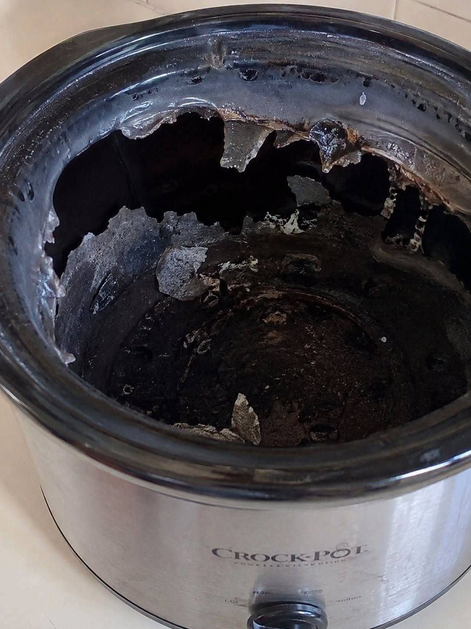
The damaged slow cooker in the viral photograph is an extreme example, and a photograph alone can’t establish exactly what caused the damage. But it raises an important question:
What should you avoid putting in a slow cooker?
Here’s what every slow-cooker owner should know.
First: Slow Cookers Are Safe When Used Correctly
Despite some alarming posts online, slow cookers themselves are designed to cook food safely when they’re used according to instructions.
The USDA explains that slow cookers generally operate between approximately 170°F and 280°F (77°C to 138°C). The combination of direct heat, long cooking time, and steam inside the covered pot allows food to cook safely.
However, slow cooking is different from stovetop cooking.
That’s why ingredient selection, timing, preparation, and temperature matter.
1. Refrigerated Leftovers for Slow Reheating
This is probably the most important mistake on the list.
A slow cooker is excellent for cooking food.
It isn’t the recommended appliance for reheating cold leftovers from the refrigerator.
Why?
Because a slow cooker heats gradually. Previously cooked food may therefore spend too long warming through the temperature range in which bacteria can multiply rapidly.
The USDA specifically advises against reheating leftovers in a slow cooker. Instead, leftovers should first be reheated to 165°F (74°C) using a stove, microwave, or conventional oven. Once properly reheated, the hot food can be transferred to a preheated slow cooker for hot holding at 140°F (60°C) or above.
Better approach
Reheat yesterday’s chili, soup, stew, or casserole quickly using an appropriate method.
Then use the slow cooker to keep it hot, rather than bringing it slowly from refrigerator temperature.
2. Frozen Meat or Poultry — Unless Your Specific Instructions Allow It
This one requires an important clarification because advice varies.
The USDA recommends thawing meat and poultry before putting them into a slow cooker. Frozen meat takes longer to reach a safe internal temperature and can also lower the temperature of the other ingredients.
Some appliance manufacturers provide model-specific instructions for cooking certain frozen meats. For example, Crock-Pot publishes guidance for doing so with additional liquid, cooking time, and temperature checks.
So the safest general rule is:
Follow the instructions for your exact appliance and recipe. When in doubt, thaw first.
And don’t simply take an oven recipe using frozen meat and assume the same timing applies to a slow cooker.
3. Milk Added at the Beginning
Milk can technically go into many slow-cooker recipes.
The problem is when you add it.
Regular milk doesn’t always respond well to many hours of prolonged cooking.
It can separate or develop an unpleasant texture.
Crock-Pot specifically advises adding dairy during approximately the last 15–30 minutes of slow cooking rather than simmering it for the entire cooking period.
For creamy soups and sauces, add milk near the end unless the recipe has been specifically developed for long slow cooking.
4. Heavy Cream and Sour Cream Too Early
The same principle applies to many other dairy products.
Cream, sour cream, and similar ingredients can break down during prolonged cooking.
That doesn’t necessarily make the dish dangerous.
It can simply make it look—and sometimes taste—far less appealing.
Crock-Pot recommends stirring dairy ingredients in near the end and heating them through rather than boiling them for hours.
Better approach
Prepare the main dish first.
Then during the final portion of cooking, stir in the cream, milk, yogurt, or sour cream according to your recipe.
You’ll usually get a smoother result.
5. Delicate Fish for an All-Day Cook
Imagine putting a beautiful fish fillet into the slow cooker at 8 a.m. and returning at 6 p.m.
The result probably won’t be the tender fish you imagined.
Fish cooks much faster than tough cuts of beef or pork.
Extended cooking can make delicate seafood dry and overdone.
Crock-Pot’s own ingredient guidance recommends adding delicate fish during roughly the last 15–30 minutes unless a particular recipe says otherwise.
That’s very different from a chuck roast that may benefit from hours of gentle cooking.
6. Shrimp and Other Delicate Shellfish Too Early
Shrimp is another classic slow-cooker mistake.
It cooks quickly.
Leave it simmering for hours and it can become firm and rubbery.
For many recipes, shrimp should be added toward the end.
Crock-Pot similarly recommends adding shellfish during approximately the last 15–30 minutes for ideal results, while noting that larger quantities may require additional time.
So if you’re making a slow-cooker seafood stew, let the sauce and slower-cooking ingredients develop first.
Add delicate seafood later.
7. Pasta at the Beginning
Pasta seems perfect for a slow cooker.
After all, there’s plenty of liquid.
Unfortunately, pasta can become extremely soft when cooked for several hours.
Instead of distinct noodles, you may end up with something closer to paste.
Crock-Pot recommends fully cooking pasta separately and adding it during roughly the final 30 minutes when converting recipes that otherwise call for uncooked pasta.
Some recipes are specifically engineered to cook pasta directly in the slow cooker, of course.
Those are different.
The key is not to take an ordinary all-day stew recipe, throw dry pasta into it at breakfast, and expect perfectly al dente noodles at dinner.
8. Rice Without the Right Recipe and Liquid Ratio
Unlike some viral lists claim, rice is not forbidden in a slow cooker.
You absolutely can cook rice in one.
But rice requires the correct variety, amount of liquid, and cooking time.
Crock-Pot recommends long-grain or risotto-style rice for certain slow-cooker applications and notes that additional liquid may be necessary if the rice isn’t fully cooked.
So the better rule isn’t:
“Never put rice in a slow cooker.”
It’s:
Don’t casually add rice to an unrelated slow-cooker recipe without adjusting the liquid and timing.
Otherwise, you could end up with crunchy rice, mushy rice, or a dish that absorbs far more liquid than expected.
9. Certain Dried Beans Without Proper Preparation
Beans require special attention.
This is especially important for red kidney beans.
Crock-Pot’s own ingredient guidance says dried beans should be boiled before being added to a recipe, specifically highlighting red kidney beans. Its instructions call for boiling and cooking them until tender before slow-cooker use.
This isn’t merely about texture.
Raw or inadequately cooked kidney beans can contain high levels of phytohaemagglutinin, a naturally occurring lectin that can cause illness.
So don’t simply dump a bag of raw red kidney beans into an unfamiliar slow-cooker recipe and assume hours on low will automatically make them appropriate to eat.
Use properly tested preparation instructions.
Canned beans are already cooked and can generally be added later in the cooking process if you want them to retain their shape.
10. Too Much Alcohol
Adding wine or another alcoholic ingredient can give stews and braises excellent flavor.
But slow cookers don’t behave exactly like uncovered pans.
Because the lid stays on and evaporation is limited, adding a large amount of alcohol can leave a stronger flavor than expected.
The solution isn’t necessarily to avoid alcohol entirely.
Instead:
Use a slow-cooker-specific recipe with appropriate quantities.
For recipes converted from stovetop cooking, you may need to adjust liquid amounts because slow cookers lose less moisture through evaporation.
And never pour high-proof alcohol near an open flame or ignition source.
11. Far Too Much Liquid
This surprises many new slow-cooker owners.
A slow cooker generally doesn’t lose liquid as rapidly as an uncovered pot on the stove.
The lid traps steam.
That means ingredients—especially meat and vegetables—can release moisture during cooking while relatively little escapes.
If you fill the slow cooker with the same amount of liquid you’d use for an uncovered stovetop stew, dinner may end up looking like soup.
Follow slow-cooker-specific recipes until you become familiar with how much moisture your particular appliance retains.
Bonus: Don’t Use the “Warm” Setting to Cook Raw Food
This isn’t an ingredient, but it’s important enough to include.
Many slow cookers have settings such as:
LOW – HIGH – WARM
“Warm” does not mean “extra-low cooking.”
It’s intended to hold already cooked food at serving temperature.
The USDA specifically states that the Keep Warm/Hot setting should not be used for cooking; it should be used only after food has reached safe internal temperatures.
Crock-Pot gives similar guidance, explaining that its Warm setting is for already-cooked food.
Another Important Mistake: Don’t Overfill Your Slow Cooker
More food isn’t always better.
Overfilling can interfere with proper cooking.
FoodSafety.gov advises keeping a slow cooker approximately one-half to two-thirds full for food-safety purposes, noting that an overly full cooker may leave food undercooked.
Your appliance’s manual should take priority because capacity recommendations can vary.
Don’t Keep Opening the Lid
We all do it.
Something smells incredible, so you lift the lid to check.
Then ten minutes later, you check again.
Each time you remove the lid, heat and steam escape.
The USDA recommends keeping the lid in place and removing it only when necessary for stirring or checking doneness.
Crock-Pot similarly advises resisting the temptation to repeatedly lift the lid because lost heat can increase cooking time.
Don’t Delay the Start of Raw Perishable Food
Another tempting idea is to load raw meat and other refrigerated ingredients into the slow cooker in the morning, then program it to begin cooking several hours later.
Don’t do that unless your appliance and recipe specifically provide a food-safe system designed for it.
FoodSafety.gov advises starting the cooker immediately after preparation rather than leaving perishable ingredients sitting inside waiting for a delayed start.
Keep perishable ingredients refrigerated until you’re ready to cook.
What Happens If the Power Goes Out?
This is especially important if you leave the slow cooker running while you’re away.
The USDA says that if you’re away during the entire cooking process and discover the power went out, the food should be discarded—even if it appears cooked.
You don’t know how long the food remained at unsafe temperatures.
If you’re home when power fails, the USDA recommends immediately finishing the food using another working cooking method.
Use a Food Thermometer
Don’t rely solely on appearance.
Chicken can look cooked before every part has reached a safe temperature.
The USDA’s minimum internal-temperature guidance includes:
Poultry: 165°F (74°C)
Ground beef, pork, lamb and veal: 160°F (71°C)
Whole cuts of beef, pork, lamb and veal: 145°F (63°C), followed by at least a three-minute rest.
A food thermometer is one of the easiest ways to remove guesswork.
What Foods Are Perfect for a Slow Cooker?
After reading a “never put this in your slow cooker” list, you might wonder what’s actually suitable.
Fortunately, plenty of foods are.
The USDA specifically notes that slow cookers work well for high-moisture dishes such as chili, soup, stew and spaghetti sauce. Meat, poultry, vegetables, oatmeal, stuffing, fruits and even some desserts can also be prepared successfully when using appropriate recipes.
Slow cookers are especially good at transforming tougher cuts of meat into tender dishes through long, gentle cooking.
What About the Destroyed Slow Cooker in the Viral Photo?
The photograph shows severe damage inside what appears to be a slow cooker.
However, it’s not possible to determine from the photograph alone what food, misuse, defect, overheating event, or other circumstance caused that damage.
So it would be misleading to say:
“Someone put one specific forbidden food inside and this happened.”
Food normally becoming overcooked isn’t the same thing as an appliance physically burning or deteriorating.
If your slow cooker shows unusual damage such as a cracked insert, melted components, damaged electrical parts, persistent burning odors, sparking, or severe overheating, stop using it and consult the manufacturer’s instructions or customer support.
Don’t continue cooking in a visibly damaged appliance.
A Simple Slow-Cooker Rule to Remember
Think about ingredients according to how they respond to long cooking.
Great from the beginning: tougher meats, root vegetables, sauces, soups, stews and other ingredients designed for long cooking.
Often better near the end: milk, cream, sour cream, delicate fish, shrimp, cooked pasta and some canned beans.
Require special attention: frozen meat, dried beans, rice and recipes with unusual amounts of liquid.
Don’t use the slow cooker for: slowly reheating refrigerated leftovers or cooking raw food on a keep-warm setting.
Frequently Asked Questions
Can you put raw meat directly into a slow cooker?
Yes, raw meat can be cooked in a slow cooker when you follow a suitable recipe, observe the appliance’s capacity limits, and cook it to a safe internal temperature. Browning meat first is often done for flavor, but isn’t universally required for safety.
Can you put frozen chicken in a slow cooker?
USDA guidance recommends thawing meat and poultry first. Some manufacturers provide instructions for specific frozen-meat applications, so follow your appliance’s manual and tested recipe.
Can you put milk in a slow cooker?
Yes, but many dairy ingredients are better added near the end because prolonged cooking can cause them to separate.
Can you put pasta in a slow cooker?
Yes, with recipes designed for it. Otherwise, adding pasta too early can make it overly soft. Crock-Pot recommends adding separately cooked pasta near the end when converting many recipes.
Can you cook rice in a slow cooker?
Yes. Rice isn’t inherently unsuitable for slow cooking, but it needs an appropriate recipe, liquid ratio and timing.
Can you reheat leftovers in a slow cooker?
The USDA does not recommend using a slow cooker to reheat refrigerated leftovers. Reheat them to 165°F using another suitable method, then transfer them hot to a preheated slow cooker for holding if desired.
Is LOW safe for cooking?
Yes. USDA guidance says it’s safe to cook foods on LOW for the entire cooking period when following appropriate slow-cooker procedures and recipes.
Is WARM the same as LOW?
No. The Warm/Keep Warm setting is intended to hold already-cooked food, not cook raw ingredients.
Final Thoughts
A slow cooker is one of the easiest kitchen appliances to use—but “set it and forget it” doesn’t mean anything can go inside for eight hours.
Some ingredients simply need to be added later.
Others require special preparation.
And certain practices should be avoided for food-safety reasons.
The biggest lessons are simple:
Thaw meat and poultry when following USDA guidance. Handle dried kidney beans properly. Add delicate seafood and many dairy ingredients near the end. Don’t use Warm to cook raw food. And don’t use a slow cooker to slowly reheat cold leftovers.
Most importantly, follow the manual for your particular appliance and a tested recipe whenever you’re uncertain.
That little bit of preparation can be the difference between a perfectly tender dinner and a slow-cooker disaster.