You crack an egg into a bowl, expecting the familiar golden yolk and clear egg white. But instead, you notice tiny white specks, grainy particles, or an unusual chalky substance. Should you throw the egg away? Could it be bacteria, parasites, or something completely harmless? Here’s what food safety experts want you to know.
Eggs are one of the most common foods in kitchens around the world.
They’re affordable, versatile, and packed with nutrients.
From scrambled eggs and omelets to cakes and breakfast sandwiches, millions of people rely on them every day.
But sometimes, cracking open an egg reveals something unexpected.
A strange white string.
A tiny white spot.
A grainy substance.
Or small particles that look almost like grains of sand.
These discoveries can be unsettling, especially when you don’t know what you’re looking at.
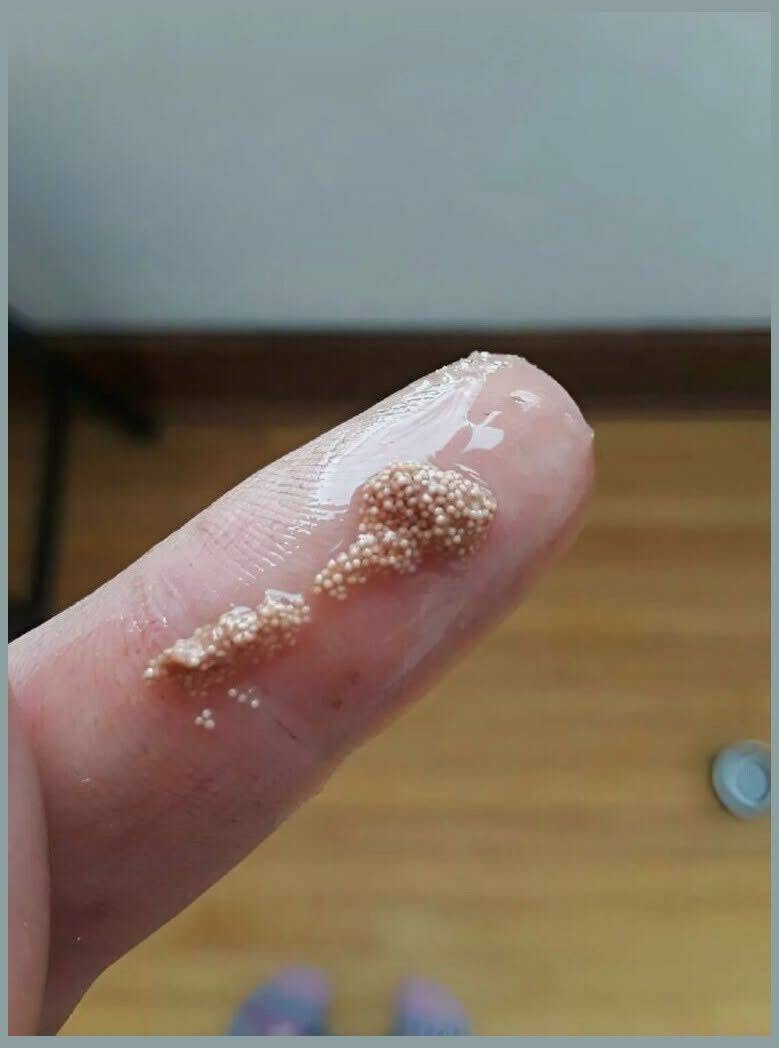
Recently, a viral Facebook photograph showed a fingertip covered with tiny, pale, grain-like particles.
The accompanying caption claimed that the slippery white flecks found inside a cracked egg were simply calcium deposits—completely harmless and easily dissolved during cooking.
The post suggested that there was nothing to worry about.
But is that explanation scientifically accurate?
Not necessarily.
While some white structures inside eggs are normal, the exact identity of unusual particles cannot be determined from a photograph alone.
And not every strange substance found in an egg should automatically be dismissed as harmless calcium.
Understanding the difference between normal egg structures, shell fragments, and possible signs of spoilage can help you make safer decisions in the kitchen.
What Are the Strange White Flecks Inside an Egg?
There are several possible explanations for white material found in or around a cracked egg.
Some are completely normal.
Others may be related to shell damage, storage conditions, or contamination.
The most common possibilities include:
- Chalazae, the natural white strands that help hold the yolk in place.
- Small fragments of eggshell.
- Bits of the shell membrane.
- Unusual deposits or irregularities associated with egg formation.
- Material introduced during cracking or handling.
- Changes associated with spoilage or contamination.
The appearance, texture, location, and condition of the egg all matter.
A photograph of tiny particles on a finger cannot establish exactly what they are.
The viral claim that they are definitely calcium deposits is therefore too confident.
Let’s examine the possibilities.
1. Chalazae: The Strange White Strings That Are Completely Normal
One of the most common things people notice inside a raw egg is a white, rope-like strand attached to the yolk.
It may look like a twisted piece of string.
Sometimes it resembles a tiny worm.
For people who have never noticed it before, the appearance can be surprising.
But this structure is a normal part of the egg.
It is called the chalaza.
What Is a Chalaza?
The chalazae are twisted strands of thick egg white that help stabilize the yolk.
They keep the yolk positioned within the egg.
These strands are made primarily of proteins.
They are not parasites.
They are not developing worms.
And they are not a sign that the egg has spoiled.
Are Chalazae Safe to Eat?
Yes.
Chalazae are normal edible parts of an egg.
They can be cooked along with the rest of the egg.
They usually become less noticeable during cooking.
Some people remove them when preparing delicate custards or other recipes where a perfectly smooth texture is desired.
But removing them is a matter of culinary preference, not food safety.
Do Chalazae Mean an Egg Is Fresh?
Prominent chalazae are often associated with relatively fresh eggs because the internal structures can become less distinct as eggs age.
However, their appearance alone is not a reliable test of freshness or safety.
An egg can contain visible chalazae and still require proper storage and cooking.
2. Tiny Pieces of Eggshell
Another possible explanation for white or pale particles in a cracked egg is broken eggshell.
Eggshells consist primarily of calcium carbonate.
When an egg is cracked, small shell fragments may fall into the egg white.
These pieces can be difficult to notice.
Some are large enough to remove easily.
Others are tiny and grain-like.
Why Do Shell Fragments Feel Gritty?
Eggshell is a hard mineralized structure.
Unlike the slippery proteins of egg white, shell fragments can feel rough or gritty.
If tiny particles are hard and grainy, shell fragments may be one possibility.
However, texture alone cannot confirm their identity.
Are Eggshell Fragments Safe to Eat?
Accidentally swallowing a very small fragment is not necessarily harmful, but shell fragments should be removed when possible.
They can be unpleasant to chew.
Larger or sharp pieces may create a physical hazard.
The shell surface may also carry microorganisms.
For this reason, eggshell fragments should not be deliberately added to food without appropriate processing and safety controls.
How to Remove Eggshell From a Raw Egg
If you notice a small fragment:
- Use a clean spoon to remove it.
- Avoid repeatedly touching the raw egg with your fingers.
- Wash your hands after handling raw eggs.
- Clean any utensils or surfaces that contact raw egg.
If the egg is heavily contaminated with shell debris or other foreign material, discarding it may be the safer choice.
3. Eggshell Membrane Fragments
Just beneath the hard eggshell are thin membranes.
These membranes help protect the contents of the egg.
When an egg is cracked, small pieces of membrane may detach.
They can appear whitish, translucent, or slightly rubbery.
Sometimes they cling to shell fragments.
Other times they fall into the egg.
These pieces are different from chalazae.
Chalazae are internal strands that help position the yolk.
Shell membranes form part of the egg’s protective structure.
Although small membrane fragments are not automatically evidence of spoilage, they should generally be removed from food when noticed.
4. Are White Flecks Really Calcium Deposits?
This is the central claim in the viral Facebook post.
Eggshells are rich in calcium carbonate.
Irregular mineral deposits can occur during shell formation.
Some eggs have rough, chalky, or bumpy areas on their outer shells.
These may be associated with variations in shell mineralization.
However, it is important to distinguish between deposits on the shell and unidentified material inside the egg.
There is no reliable basis for concluding that every collection of slippery white flecks found in a cracked egg is harmless calcium.
The exact material would need to be identified.
The photograph alone does not establish that the particles are calcium carbonate.
It also does not establish that cooking will make them disappear.
Does Calcium Dissolve When You Cook an Egg?
Not in the simple way the viral post suggests.
Calcium carbonate does not readily dissolve in ordinary cooking water.
It also does not simply vanish because an egg is heated.
Small shell fragments may become less noticeable when mixed into food, but they do not necessarily dissolve.
Therefore, the statement that calcium flecks disappear the moment an egg is cooked should not be treated as a reliable food science fact.
5. Could the White Flecks Be Parasites?
People sometimes worry that unusual structures inside eggs are worms or parasites.
This fear is understandable when a substance looks stringy or unfamiliar.
However, the common white strands attached to egg yolks are chalazae, not worms.
Commercially produced eggs do not normally contain visible parasites.
Still, unusual material cannot be identified with certainty simply by comparing it to online photographs.
If an egg contains a suspicious foreign object, unusual growth, or unexplained material that does not resemble normal egg structures, the safest approach is to discard it.
Do not taste an egg to determine whether it is safe.
6. Could the Egg Be Spoiled?
Yes, unusual appearance can sometimes accompany spoilage, although white flecks alone do not prove that an egg has gone bad.
Spoilage may produce changes in smell, color, and texture.
An egg that has a strong unpleasant odor when cracked should be discarded.
Unusual discoloration, visible mold, or abnormal growth are also reasons not to use it.
However, there is an important limitation.
An egg can contain harmful bacteria even when it looks and smells normal.
For example, Salmonella contamination cannot reliably be detected by appearance or odor.
That is why proper storage, handling, and cooking remain important even when an egg seems perfectly fresh.
7. Why Do Some Eggs Have White Spots on the Yolk?
A small white spot on the surface of an egg yolk is often a normal structure called the germinal disc.
In an unfertilized egg, it is typically called the blastodisc.
In a fertilized egg, early developmental changes may occur under appropriate incubation conditions.
The presence of a small white spot does not automatically mean that a chick is developing.
Most commercially sold eggs intended for consumption are unfertilized.
A normal germinal disc is not a sign of spoilage.
However, a white spot on the yolk is different from a collection of unidentified grainy particles.
8. What About Cloudy Egg Whites?
Some people become concerned when an egg white looks cloudy rather than perfectly transparent.
Cloudiness can be normal, particularly in relatively fresh eggs.
Fresh egg whites contain dissolved carbon dioxide.
As an egg ages, carbon dioxide gradually escapes through the shell, and the white may become clearer.
Therefore, cloudy egg white is not automatically a warning sign.
However, cloudiness alone cannot establish that an egg is safe.
Storage conditions and proper cooking still matter.
9. Why Are Some Egg Whites Watery?
Egg whites naturally change as eggs age.
Over time, the thick portion of the white may become thinner.
This can cause the white to spread more widely when the egg is cracked onto a flat surface.
A watery egg white may be associated with an older egg.
However, it does not automatically mean that the egg is spoiled.
Similarly, a thick egg white is not proof that an egg is free from harmful bacteria.
Freshness and microbiological safety are related but different concepts.
10. What Do Blood Spots Inside Eggs Mean?
Occasionally, a cracked egg contains a small red or brown spot.
This may be a blood spot.
Blood spots can occur when a small blood vessel breaks during egg formation.
They do not necessarily indicate that an egg has been fertilized.
A small blood spot is not automatically a sign of spoilage.
However, eggs with unusual discoloration, extensive abnormalities, or other concerning changes should be discarded.
If you are uncertain whether the material is a normal blood spot or something else, it is reasonable not to use the egg.
11. What Are Meat Spots in Eggs?
Some eggs contain tiny brownish or reddish particles known as meat spots.
These may originate from small pieces of tissue or blood-related material during egg formation.
They are not the same as parasites.
They are also different from the white strands known as chalazae.
Their presence is usually a quality issue rather than proof of bacterial contamination.
However, unidentified material should not automatically be assumed harmless.
If the egg looks significantly abnormal, discarding it is the safest practical decision.
12. Can Eggshell Color Tell You Whether an Egg Is Safe?
Eggshells come in different colors, including white, brown, and various tinted shades.
These differences are primarily related to the genetics of the hen.
Brown eggs are not inherently safer than white eggs.
White eggs are not necessarily less nutritious.
The nutritional composition of an egg is influenced by several factors, including the hen’s diet.
Shell color alone does not determine freshness, safety, or quality.
13. Are Farm-Fresh Eggs Safer Than Store-Bought Eggs?
Not necessarily.
Farm-fresh eggs may be appealing because they come directly from a local producer.
However, all eggs require appropriate handling.
Eggs from backyard hens can also carry harmful bacteria.
Commercial eggs are subject to different inspection and handling requirements depending on the country.
Neither farm-fresh nor store-bought eggs should be assumed completely free of contamination.
Safe storage and cooking practices are important regardless of where the eggs come from.
14. Can You Tell Whether an Egg Is Bad by Putting It in Water?
The egg float test is a popular kitchen trick.
It involves placing an egg in a bowl of water and observing whether it sinks or floats.
As an egg ages, the air cell inside it generally becomes larger.
This can make an older egg more likely to float.
However, the float test primarily provides information related to age and air-cell size.
It is not a reliable test for harmful bacteria.
An egg that sinks may still contain pathogens.
An egg that floats is generally older, but floating alone does not conclusively establish spoilage.
Do not use the float test as a substitute for proper storage, inspection, and cooking.
15. Why Cooking Matters More Than Viral Egg Tricks
Eggs are nutritious, but they can sometimes contain harmful bacteria.
Salmonella is one of the most important food safety concerns associated with eggs.
Proper cooking reduces the risk of foodborne illness.
For ordinary egg dishes, food safety guidance generally recommends cooking until the whites and yolks are firm.
Egg dishes such as casseroles and quiches should reach an internal temperature of 160°F (71°C).
For recipes that require raw or lightly cooked eggs, pasteurized eggs or egg products are a safer choice.
This is particularly important for people at higher risk of severe foodborne illness.
These groups include:
- Pregnant women.
- Young children.
- Older adults.
- People with weakened immune systems.
Cooking does not make every spoiled or contaminated food safe.
An egg with visible mold, severe spoilage, or suspicious foreign material should be discarded rather than cooked in an attempt to rescue it.
How to Tell if an Egg Is Safe to Use
There is no single household test that guarantees an egg is free of harmful microorganisms.
However, several precautions can reduce risk.
Check the Shell Before Cracking
Inspect eggs for cracks, leaks, or visible contamination.
Avoid using eggs with damaged shells when their safety is uncertain.
Store Eggs Correctly
Follow local food safety guidance and the storage instructions provided with the eggs.
In countries where eggs are sold refrigerated, they should generally remain refrigerated.
Avoid leaving refrigerated eggs at room temperature for extended periods.
Crack Eggs Into a Separate Bowl
When preparing recipes that require several eggs, crack each egg into a small separate bowl first.
This allows you to inspect it before adding it to the other ingredients.
If one egg appears abnormal, you can discard it without wasting the entire mixture.
Check for Unusual Odors
A strong rotten or sulfurous odor is a clear reason to discard an egg.
However, the absence of an odor does not guarantee safety.
Look for Unusual Changes
Discard eggs with visible mold, strange discoloration, or unexplained material that raises concern.
Cook Eggs Thoroughly
Follow established food safety recommendations, especially when preparing food for vulnerable individuals.
Prevent Cross-Contamination
Wash your hands after handling raw eggs.
Clean countertops, bowls, and utensils that have contacted raw egg.
Keep raw egg away from foods that will not be cooked.
What Should You Do if You Find White Grains in an Egg?
Imagine cracking an egg and discovering a collection of small white particles.
You are not sure whether they are shell fragments, a normal structure, or something else.
What should you do?
First, avoid touching the material repeatedly with bare fingers.
Examine the egg without tasting it.
If the material clearly consists of a few eggshell fragments, remove them with a clean utensil.
If it is a normal chalaza, it can remain in the egg.
However, if the particles are unusual, numerous, or difficult to identify, discarding the egg is a sensible precaution.
An inexpensive egg is not worth the risk of consuming something potentially contaminated.
If several eggs from the same carton show similar unexplained abnormalities, consider contacting the retailer or producer.
You may also report the issue to the appropriate local food safety authority.
Why Viral Food Safety Claims Can Be Misleading
The internet is full of photographs showing strange discoveries inside everyday foods.
These images often attract attention because they trigger surprise or disgust.
A person may find an unusual object in an egg, a piece of meat, or a packaged product.
Someone else offers an explanation.
Then the explanation spreads across social media as if it were a confirmed scientific fact.
But photographs can be misleading.
Without laboratory analysis, detailed context, or reliable identification, it may be impossible to know exactly what a substance is.
In the case of the viral egg photograph, the caption confidently describes the material as harmless calcium.
Yet the image does not provide enough information to verify that conclusion.
The best approach is to distinguish between established food science and speculation.
10 Common Egg Myths Explained
Myth 1: Every White String Inside an Egg Is a Worm
False.
The common white strands attached to the yolk are chalazae.
Myth 2: Every White Particle Is Calcium
False.
White material may have several different explanations.
Myth 3: Cooking Makes All Strange Substances Harmless
False.
Cooking reduces many microbial risks but does not make every contaminated or spoiled food safe.
Myth 4: Calcium Deposits Always Disappear During Cooking
False.
Calcium carbonate does not simply dissolve under ordinary egg-cooking conditions.
Myth 5: Brown Eggs Are Healthier Than White Eggs
Not necessarily.
Shell color does not determine overall nutritional quality.
Myth 6: A Floating Egg Is Always Rotten
False.
Floating is mainly associated with changes in the egg’s air cell as it ages.
Myth 7: An Egg That Smells Normal Cannot Contain Salmonella
False.
Harmful bacteria may be present without noticeable changes in smell.
Myth 8: Cloudy Egg Whites Mean an Egg Is Spoiled
False.
Cloudiness can be normal, particularly in fresh eggs.
Myth 9: Farm-Fresh Eggs Cannot Carry Harmful Bacteria
False.
Eggs from backyard and commercial flocks can both present food safety risks.
Myth 10: All Unusual Egg Structures Are Dangerous
False.
Some structures, such as chalazae and germinal discs, are normal.
The key is accurate identification.
Frequently Asked Questions
What Are the White Strings Inside a Raw Egg?
They are usually chalazae, natural strands of thick egg white that help stabilize the yolk.
Are White Strings in Eggs Safe to Eat?
Yes. Normal chalazae are edible and safe when the egg is handled and cooked appropriately.
Are Tiny White Flecks in Eggs Calcium?
They could have several explanations. A photograph alone cannot confirm that they are calcium deposits.
Do Calcium Deposits Disappear When Eggs Are Cooked?
Calcium carbonate does not simply dissolve during normal cooking. The viral claim is misleading.
Can Eggs Contain Parasites?
Unusual egg structures are often mistaken for parasites, but the common white strands inside eggs are not worms. Suspicious foreign material should be evaluated cautiously.
What If I Find Something Gritty in My Egg?
It may be a shell fragment or another substance. If you cannot identify it confidently, discard the egg.
Is a Cloudy Egg White Bad?
Not necessarily. Cloudiness can be normal.
Can You Eat an Egg With a Blood Spot?
A small blood spot is not automatically a sign of spoilage, but proper handling and cooking remain important.
How Do I Know if an Egg Has Salmonella?
You generally cannot tell by appearance, smell, or taste. Safe handling and proper cooking are essential.
Should I Wash Eggs Before Cooking?
Follow local food safety guidance. Washing eggs improperly can increase contamination risks in some circumstances, particularly when eggs have not been commercially processed.
Is It Safe to Eat Raw Eggs?
Raw eggs can carry foodborne illness risks. Pasteurized eggs are recommended for dishes that require raw or lightly cooked eggs.
What Should I Do if Several Eggs Contain Strange Material?
Stop using the affected eggs, document the issue, and contact the retailer, producer, or relevant food safety authority if appropriate.
Final Thoughts: Don’t Panic, but Don’t Believe Every Viral Explanation
Finding something unusual inside an egg can be surprising.
The viral photograph of tiny white particles on a fingertip has prompted questions about whether the material is harmless calcium.
But the truth is more complicated.
Some white structures inside eggs are completely normal.
Chalazae, for example, are natural protein strands that help keep the yolk in place.
Small shell fragments and membrane pieces may also appear when an egg is cracked.
However, unidentified grainy material should not automatically be labeled as calcium or declared safe based on a social media post.
And the claim that calcium deposits simply disappear during cooking is not a reliable explanation.
The safest approach is straightforward.
Inspect your eggs.
Store them properly.
Avoid cross-contamination.
Cook them according to food safety recommendations.
And when an egg contains suspicious material that you cannot identify, discard it.
Eggs are a nutritious and valuable food, but food safety should always come before viral kitchen myths.
Have you ever cracked an egg and found strange white strings, spots, or grainy particles inside? What did you think they were? Share your experience in the comments!